PRISTINA, Serbia (AP)--Kosovo's outgoing U.N. chief said Thursday that ethnic Albanians' dream of independence for the province must not become a nightmare for the Serb minority.
Soren Jessen-Petersen's plea came on his last day as the head of the U.N. mission in this province of 2 million, the status of which is being decided in U.N.-sponsored talks between the rival ethnic Albanian and Serbian communities.
"Your dream should not be a nightmare for others," Jessen-Petersen told Kosovo's mainly ethnic Albanian lawmakers during his farewell speech.
Kosovo, which officially remains part of Serbia, has been administered by the U.N. and patrolled by international peacekeepers since mid-1999, when a NATO air war halted a crackdown by former Serbian President Slobodan Milosevic's forces on separatist ethnic Albanians. The province's ethnic Albanian majority wants full independence, but Belgrade insists it retains control.
An estimated 10,000 ethnic Albanians were killed in Kosovo's war. After the end of the war, tens of thousands of Serbs fled the province in the face of reprisal attacks and threats from ethnic Albanians.
Those Serbs who remain live mainly in heavily guarded, isolated enclaves.
International officials have suggested some form of independence for the province - which Serbs consider the birthplace of their national identity - is the most likely outcome of the U.N.-mediated talks taking place in Vienna, Austria.
After serving for two years as the chief administrator in the U.N.-run province, Jessen-Petersen conceded that one of his greatest failures was the inability to bring its bitterly divided communities closer.
While acknowledging that the life of Serbs and other minorities remains hard, he blamed authorities in Serbia for discouraging the minority Serbs from participating in Kosovo's political life, which they have been boycotting since the worst anti-Serb violence rocked Kosovo in 2004.
Jessen-Petersen said that "major challenges" in the fields of rule of law, economy and in trying to ensure the multiethnic character of Kosovo will remain even after the status decision is reached, likely at the end of 2006.
Jessen-Petersen, a Danish refugee expert and former European Union representative to Macedonia, was appointed to the post in June 2004 and has been the longest-serving of five U.N. chiefs since the end of the war.
A lawyer, he has been assistant high commissioner for the U.N. High Commissioner for Refugees, as then chairman of a European Union initiative to manage population movements in the western Balkans. [ 29-06-06 1502GMT ]
Thursday, June 29, 2006


Wednesday, June 28, 2006
Milosevic's brother praises President Lukashenka on Belarus TV
Belarusian TV has broadcast an interview with Borislav Milosevic, former Yugoslav ambassador to Russia and brother of the late Yugoslav president, Slobodan Milosevic.
Speaking in the interview aired on 28 June, Milosevic said that the EU stood behind a recent referendum on Montenegro's independence. He forecast that the Albanian minority in the Balkans will press for a referendum on Kosovo's independence. Albanians in the Balkans will be pressing for the creation of "Great Albania", he said. He added that Albania will turn into an Islamic state and "this will do no good to Europe". He forecast that a possible referendum on Kosovo's independence may create a precedent for such referenda in Russian republics and did not rule out "a Yugoslav scenario" for Russia. Milosevic accused Albanians in Kosovo of trafficking drugs to Europe. This problem will only aggravate if Kosovo becomes independent, he predicted.
He slammed the West's "unbridled propaganda" against Belarus and attempts "to demonize" Belarusian President Alyaksandr Lukashenka. He also criticized NATO's plans to set up military bases in former Yugoslavia. Milosevic did not rule out the construction of a NATO naval base in Montenegro. He warned that NATO's expansion plans are aimed at securing the bloc's dominance in the world.
He said that NATO's operation against Yugoslavia demonstrated that "Europe was fighting against itself". He criticized Europe's participation in the US "adventures" in Iraq and Afghanistan. Milosevic also criticized the USA and its allies for exerting pressure on other countries under the pretext of combating international terrorism.
Commenting on the March presidential election in Belarus, Milosevic said the West is pressurizing Lukashenka for his independent policies. He added that Yugoslavia experienced similar pressure during a presidential election in his country. He praised Lukashenka for his visit to Belgrade during NATO's bombings and thanked Belarus for support.
Commenting on the death of his brother, he rebuked the Hague tribunal for not allowing Slobodan Milosevic to undergo treatment. Independence costs leaders dearly, he said.
The interview lasted for about 20 minutes. No further processing is planned.
Source: Belarusian television, Minsk, in Russian 1850 gmt 28 Jun 06
Speaking in the interview aired on 28 June, Milosevic said that the EU stood behind a recent referendum on Montenegro's independence. He forecast that the Albanian minority in the Balkans will press for a referendum on Kosovo's independence. Albanians in the Balkans will be pressing for the creation of "Great Albania", he said. He added that Albania will turn into an Islamic state and "this will do no good to Europe". He forecast that a possible referendum on Kosovo's independence may create a precedent for such referenda in Russian republics and did not rule out "a Yugoslav scenario" for Russia. Milosevic accused Albanians in Kosovo of trafficking drugs to Europe. This problem will only aggravate if Kosovo becomes independent, he predicted.
He slammed the West's "unbridled propaganda" against Belarus and attempts "to demonize" Belarusian President Alyaksandr Lukashenka. He also criticized NATO's plans to set up military bases in former Yugoslavia. Milosevic did not rule out the construction of a NATO naval base in Montenegro. He warned that NATO's expansion plans are aimed at securing the bloc's dominance in the world.
He said that NATO's operation against Yugoslavia demonstrated that "Europe was fighting against itself". He criticized Europe's participation in the US "adventures" in Iraq and Afghanistan. Milosevic also criticized the USA and its allies for exerting pressure on other countries under the pretext of combating international terrorism.
Commenting on the March presidential election in Belarus, Milosevic said the West is pressurizing Lukashenka for his independent policies. He added that Yugoslavia experienced similar pressure during a presidential election in his country. He praised Lukashenka for his visit to Belgrade during NATO's bombings and thanked Belarus for support.
Commenting on the death of his brother, he rebuked the Hague tribunal for not allowing Slobodan Milosevic to undergo treatment. Independence costs leaders dearly, he said.
The interview lasted for about 20 minutes. No further processing is planned.
Source: Belarusian television, Minsk, in Russian 1850 gmt 28 Jun 06
Serbia's PM Insists Serbs Will Never Give Up Kosovo
GRACANICA, Serbia (AP)--Serbs will never give up Kosovo, Serbian Prime Minister Vojislav Kostunica said Wednesday after arriving in Kosovo to mark the anniversary of an epic battle against Ottoman forces.
Security measures were high for the visit of Kostunica, who was attending ceremonies marking Vidovdan, or St. Vitus Day - the anniversary of the 1389 battle in which a Christian army led by Serbian Prince Lazar was defeated in Kosovo by invading Ottoman forces.
The battle came to symbolize Serbs' historic resolve not to give up Kosovo, the heartland of their statehood and religion.
"There is no better place...to repeat what every Serbian has to know: Kosovo has been and will always remain part of Serbia," said Kostunica, triggering applause and chanting from large crowds in the grounds of a 14th century monastery in Gracanica, a Serb enclave in Kosovo heavily protected by North Atlantic Treaty Organization peacekeepers.
Kostunica urged the dwindling Serb community to remain determined and unified at a time when Serbs and ethnic Albanians are conducting U.N.-sponsored talks on Kosovo's future.
Kosovo, which officially remains part of Serbia, has been administered by the U.N. and patrolled by international peacekeepers since mid-1999, when a NATO air war halted a crackdown by former Serbian President Slobodan Milosevic's forces on separatist ethnic Albanians.
The province's ethnic Albanian majority wants full independence, but Belgrade insists it retain control.
Tension and occasional violence persists between ethnic Albanians and the minority Serbs, who live in heavily guarded and isolated enclaves.
"We would not be able to pray today if it was not for the army's protection," he said.
Kosovo special police arrested 116 ethnic Albanian protesters who blocked roads linking Kosovo to the rest of Serbia in a bid to prevent the visit. Among those arrested was a member of Kosovo's parliament.
Many of the arrested protesters were members of an ethnic Albanian group calling itself "Self-determination," which described Kostunica's visit as "a provocation."
The group compared the trip to a 1989 visit by Milosevic, who used the St. Vitus Day anniversary to deliver a speech that whipped up Serb nationalist fervor. The event was seen as key in events that led to disintegration of Yugoslavia and a decade of Balkan wars.
An estimated 10,000 ethnic Albanians were killed in Kosovo's 1998-99 war. Afterward, tens of thousands of Serbs fled the province due to reprisal attacks and threats from ethnic Albanians.
Security measures were high for the visit of Kostunica, who was attending ceremonies marking Vidovdan, or St. Vitus Day - the anniversary of the 1389 battle in which a Christian army led by Serbian Prince Lazar was defeated in Kosovo by invading Ottoman forces.
The battle came to symbolize Serbs' historic resolve not to give up Kosovo, the heartland of their statehood and religion.
"There is no better place...to repeat what every Serbian has to know: Kosovo has been and will always remain part of Serbia," said Kostunica, triggering applause and chanting from large crowds in the grounds of a 14th century monastery in Gracanica, a Serb enclave in Kosovo heavily protected by North Atlantic Treaty Organization peacekeepers.
Kostunica urged the dwindling Serb community to remain determined and unified at a time when Serbs and ethnic Albanians are conducting U.N.-sponsored talks on Kosovo's future.
Kosovo, which officially remains part of Serbia, has been administered by the U.N. and patrolled by international peacekeepers since mid-1999, when a NATO air war halted a crackdown by former Serbian President Slobodan Milosevic's forces on separatist ethnic Albanians.
The province's ethnic Albanian majority wants full independence, but Belgrade insists it retain control.
Tension and occasional violence persists between ethnic Albanians and the minority Serbs, who live in heavily guarded and isolated enclaves.
"We would not be able to pray today if it was not for the army's protection," he said.
Kosovo special police arrested 116 ethnic Albanian protesters who blocked roads linking Kosovo to the rest of Serbia in a bid to prevent the visit. Among those arrested was a member of Kosovo's parliament.
Many of the arrested protesters were members of an ethnic Albanian group calling itself "Self-determination," which described Kostunica's visit as "a provocation."
The group compared the trip to a 1989 visit by Milosevic, who used the St. Vitus Day anniversary to deliver a speech that whipped up Serb nationalist fervor. The event was seen as key in events that led to disintegration of Yugoslavia and a decade of Balkan wars.
An estimated 10,000 ethnic Albanians were killed in Kosovo's 1998-99 war. Afterward, tens of thousands of Serbs fled the province due to reprisal attacks and threats from ethnic Albanians.
Serb leader lays claim to Kosovo
By Nicholas Wood International Herald Tribune
WEDNESDAY, JUNE 28, 2006
GRACANICA, Kosovo The prime minister of Serbia made a symbolic visit Wednesday to this town in the province of Kosovo, asserting Serbia's historic and religious claims to the region.
Vojislav Kostunica picked July 28, which Serbs regard as the most important date in their history. It commemorates the 14th-century defeat of the mainly Christian army in Kosovo by Ottoman Turks.
In Gracanica, "there is no better place to repeat what every Serb has to know," the prime minister told of hundreds of Serbs gathered on the grounds of the 14th-century monastery in the center of the village. "Kosovo has been and will always remain part of Serbia."
His foray into the United Nations-administered region was the latest attempt to head off what the government in Belgrade sees as the province's increasing momentum to becoming a separate state. That has long been the goal of Kosovo's ethnic Albanian majority.
Serbian and Albanian negotiators have made little progress on the topic in meetings in Vienna over the past six months. But Western diplomats here said independence would probably be granted by the UN Security Council by the end of the year, most probably in an imposed settlement.
The Serbian government has made no indication that it is ready to accept or even acknowledge such an agreement and senior UN officials in Kosovo appear worried about how the settlement will play out.
Kostunica met with Prime Minister Tony Blair of Britain in London on Tuesday and warned that Serbia might break its ties with the West unless the international community took a more conciliatory approach to its claims to Kosovo and to Serbia's failure to arrest the war crimes suspect Ratko Mladic, a former Serb general. The European Union cut off negotiations on Serbian membership in the bloc in May over the failure to detain Mladic.
Seventeen years ago, when he was president, Slobodan Milosevic used the same occasion to promote Serbian nationalism when he addressed a million Serbs gathered at the presumed site of the battlefield and gave a similar message, one that ultimately led to the break-up of Yugoslavia and the loss of tens of thousands of lives.
This time the anniversary was a low- key affair. With members of Serbia's Orthodox Church, Kostunica attended a ceremony in which Serbian mothers of four or more children were given gold and silver medals, an attempt to encourage the Serbian birth rate in the province, which lags behind that of the Albanians. The visit was his second since he came to office two-and-a-half years ago.
Sounding a conciliatory note, Kostunica told the crowd in Gracanica that Serbia wanted to reach a "compromise" over Kosovo's future, but made no mention of what that might entail.
Serbs, he said, want "justice, rights and peace, want to talk, want to make an arrangement, want to make a compromise and to make the right solution historically for Kosovo."
Although officially a part of Serbia, Kosovo has been controlled by the United Nations since June 1999, when Yugoslav troops accused of committing widespread atrocities were forced to withdraw after NATO-led bombing.
From 1998 to 1999 an estimated 10,000 people, mostly ethnic Albanian civilians, were killed as the Serb-dominated Yugoslav Army and the Serbian police cracked down on an insurgency led by ethnic Albanians.
While the day's visit passed without any significant reaction from ethnic Albanian leaders, international officials working here said they were alarmed that Serbian officials were toughening their stance over the province's future.
Senior UN officials say the government is trying to play up ethnic tensions to undermine the Albanian-led government's drive for independence.
In a recent interview, the departing head of the UN Mission in Kosovo, Soren Jessen-Petersen, warned that Belgrade's policies were compounding already hostile relations between Serbs and ethnic Albanians.
He said leading Serbian politicians were playing up safety worries, in ways that could prompt Serbs to leave the province.
"The Kosovo Serbs are constantly hearing statements from Belgrade that would give them every reason to fear for their future," said Jessen-Petersen, who is to leave his post Friday.
"We have had some statements by leading politicians saying it is clear that Serbs here have a choice between death or exodus," he said. "They are not the kinds of statements that you make if you want the Serbs to stay here."
Belgrade wants to administer the Serbian areas of Kosovo directly.
WEDNESDAY, JUNE 28, 2006
GRACANICA, Kosovo The prime minister of Serbia made a symbolic visit Wednesday to this town in the province of Kosovo, asserting Serbia's historic and religious claims to the region.
Vojislav Kostunica picked July 28, which Serbs regard as the most important date in their history. It commemorates the 14th-century defeat of the mainly Christian army in Kosovo by Ottoman Turks.
In Gracanica, "there is no better place to repeat what every Serb has to know," the prime minister told of hundreds of Serbs gathered on the grounds of the 14th-century monastery in the center of the village. "Kosovo has been and will always remain part of Serbia."
His foray into the United Nations-administered region was the latest attempt to head off what the government in Belgrade sees as the province's increasing momentum to becoming a separate state. That has long been the goal of Kosovo's ethnic Albanian majority.
Serbian and Albanian negotiators have made little progress on the topic in meetings in Vienna over the past six months. But Western diplomats here said independence would probably be granted by the UN Security Council by the end of the year, most probably in an imposed settlement.
The Serbian government has made no indication that it is ready to accept or even acknowledge such an agreement and senior UN officials in Kosovo appear worried about how the settlement will play out.
Kostunica met with Prime Minister Tony Blair of Britain in London on Tuesday and warned that Serbia might break its ties with the West unless the international community took a more conciliatory approach to its claims to Kosovo and to Serbia's failure to arrest the war crimes suspect Ratko Mladic, a former Serb general. The European Union cut off negotiations on Serbian membership in the bloc in May over the failure to detain Mladic.
Seventeen years ago, when he was president, Slobodan Milosevic used the same occasion to promote Serbian nationalism when he addressed a million Serbs gathered at the presumed site of the battlefield and gave a similar message, one that ultimately led to the break-up of Yugoslavia and the loss of tens of thousands of lives.
This time the anniversary was a low- key affair. With members of Serbia's Orthodox Church, Kostunica attended a ceremony in which Serbian mothers of four or more children were given gold and silver medals, an attempt to encourage the Serbian birth rate in the province, which lags behind that of the Albanians. The visit was his second since he came to office two-and-a-half years ago.
Sounding a conciliatory note, Kostunica told the crowd in Gracanica that Serbia wanted to reach a "compromise" over Kosovo's future, but made no mention of what that might entail.
Serbs, he said, want "justice, rights and peace, want to talk, want to make an arrangement, want to make a compromise and to make the right solution historically for Kosovo."
Although officially a part of Serbia, Kosovo has been controlled by the United Nations since June 1999, when Yugoslav troops accused of committing widespread atrocities were forced to withdraw after NATO-led bombing.
From 1998 to 1999 an estimated 10,000 people, mostly ethnic Albanian civilians, were killed as the Serb-dominated Yugoslav Army and the Serbian police cracked down on an insurgency led by ethnic Albanians.
While the day's visit passed without any significant reaction from ethnic Albanian leaders, international officials working here said they were alarmed that Serbian officials were toughening their stance over the province's future.
Senior UN officials say the government is trying to play up ethnic tensions to undermine the Albanian-led government's drive for independence.
In a recent interview, the departing head of the UN Mission in Kosovo, Soren Jessen-Petersen, warned that Belgrade's policies were compounding already hostile relations between Serbs and ethnic Albanians.
He said leading Serbian politicians were playing up safety worries, in ways that could prompt Serbs to leave the province.
"The Kosovo Serbs are constantly hearing statements from Belgrade that would give them every reason to fear for their future," said Jessen-Petersen, who is to leave his post Friday.
"We have had some statements by leading politicians saying it is clear that Serbs here have a choice between death or exodus," he said. "They are not the kinds of statements that you make if you want the Serbs to stay here."
Belgrade wants to administer the Serbian areas of Kosovo directly.
Tuesday, June 27, 2006
Kosovo Picks 2.7 Mln Euro Bid for Winery, 2.5 Mln Euro for Quarry
PRISTINA (Serbia), June 27 (SeeNews) - The privatisation authority of the U.N.-run Serbian province of Kosovo said it had picked provisional buyers for a winery, who offered to pay 2.7 million euro ($3.39 million), and for a quarry, who offered 2.5 million euro.
Kosovo Trust Agency (KTA), the body charged with the sale of hundreds of state-owned companies in the province, discloses the names of the buyers only after it signs privatisation contracts with them.
The Kosova Vera winery owns 19 hectares of land with 15,000 square metres of built-up area. It is fully equipped for wine production but relies on third parties for grape supply. The winery was put up for sale in the beginning of the year. KTA had extended the bidding deadline by nearly two months due to lack of bids, KTA said on its website.
The Cikatova quarry assets include some 10,000 square metres of built-up area, while the total land area under its ownership is nearly 64 hectares.
KTA also said it had picked buyers for the companies, offered for sale in the 15th wave of privatisation in Kosovo.
Details follow about prices received by KTA for the companies included in the 15th privatisation wave.
COMPANY.............................LINE OF BUSINESS...........HIGHEST BID (in euro)
1. IFS Progress Prizren..........polyester producer.................1,110,000
2. Kosovotrans ...........................transport............................505,000
3. IFS Progres Istog.............polyester producer....................776,527
4. Agri-Station Gjakove......administrative building ................717,000
5. Restaurant Tirana..................restaurant.............................222,222
6. Magjistrala..........................agricultural land.......................166,000
7. Agri-Land Qesta................agricultural land.........................314,500
8. Malishgan........................agricultural land..........................355,555
9. Motel Nora .......................motel and restaurant.................443,194
10. Gusar ...............................cattle farm...............................131,000
11. Gusar...........................agricultural land...........................240,000
12. Leshan..................................warehouse...........................101,000
13. Koretin...........................agricultural land..........................45,555
14. Kamenica.........................veterinary..................................15,000
15. Viti........................................veterinary.............................91,265
16. Tregtia Shtime ...................shopping mall.........................942,000
17. Tregtia Prishtine & Lipjan......shopping mall.......................384,750
18. Runiku..................................office premises.......................61,235
19. Hotel Palas..............................hotel....................................305,550
KTA, which seeks to sell 90% of the assets of 500 state-owned companies in Kosovo by mid-2006, has sold around 320 of them so far, earning around 250 million euro.
Legally still a province of Serbia, Kosovo has been under U.N. administration since 1999 following NATO bombings that expelled Serb forces to end what Western powers said was repression of civilians in fighting an ethnic Albanian rebel insurgency. U.N.-brokered talks are underway to determine the future status of Kosovo.
Kosovo Trust Agency (KTA), the body charged with the sale of hundreds of state-owned companies in the province, discloses the names of the buyers only after it signs privatisation contracts with them.
The Kosova Vera winery owns 19 hectares of land with 15,000 square metres of built-up area. It is fully equipped for wine production but relies on third parties for grape supply. The winery was put up for sale in the beginning of the year. KTA had extended the bidding deadline by nearly two months due to lack of bids, KTA said on its website.
The Cikatova quarry assets include some 10,000 square metres of built-up area, while the total land area under its ownership is nearly 64 hectares.
KTA also said it had picked buyers for the companies, offered for sale in the 15th wave of privatisation in Kosovo.
Details follow about prices received by KTA for the companies included in the 15th privatisation wave.
COMPANY.............................LINE OF BUSINESS...........HIGHEST BID (in euro)
1. IFS Progress Prizren..........polyester producer.................1,110,000
2. Kosovotrans ...........................transport............................505,000
3. IFS Progres Istog.............polyester producer....................776,527
4. Agri-Station Gjakove......administrative building ................717,000
5. Restaurant Tirana..................restaurant.............................222,222
6. Magjistrala..........................agricultural land.......................166,000
7. Agri-Land Qesta................agricultural land.........................314,500
8. Malishgan........................agricultural land..........................355,555
9. Motel Nora .......................motel and restaurant.................443,194
10. Gusar ...............................cattle farm...............................131,000
11. Gusar...........................agricultural land...........................240,000
12. Leshan..................................warehouse...........................101,000
13. Koretin...........................agricultural land..........................45,555
14. Kamenica.........................veterinary..................................15,000
15. Viti........................................veterinary.............................91,265
16. Tregtia Shtime ...................shopping mall.........................942,000
17. Tregtia Prishtine & Lipjan......shopping mall.......................384,750
18. Runiku..................................office premises.......................61,235
19. Hotel Palas..............................hotel....................................305,550
KTA, which seeks to sell 90% of the assets of 500 state-owned companies in Kosovo by mid-2006, has sold around 320 of them so far, earning around 250 million euro.
Legally still a province of Serbia, Kosovo has been under U.N. administration since 1999 following NATO bombings that expelled Serb forces to end what Western powers said was repression of civilians in fighting an ethnic Albanian rebel insurgency. U.N.-brokered talks are underway to determine the future status of Kosovo.
Blair to convince Serbia of Kosovo’s inevitable independence.
LONDON, June 27 (Itar-Tass) — British Premier Tony Blair is determined to convince Serbian Prime Minister Vojislav Kostunisa during their Tuesday meeting here that he should recognise the inevitability of Kosovo’s independence, which the territory is expected to get by the end of 2006, the “Financial Times” reports.
The British side will also call on the Balkan partners once more to ensure Belgrade’s abidance by its international commitments to arrest the persons, who are charged of war crimes. In case of a refusal to implement them and of unwillingness to comply with the new vision of the configuration of the state formations in the south-eastern part of Europe, Belgrade may be confronted with tougher isolation and waning possibility of having closer relations with the European Union, the newspaper predicts.
At the same time, it notes that the Serbian public at large is exerting pressure on Kostunisa to prevent Belgrade from renouncing its “historical claims” to Kosovo. This is why the Serbian authorities are continuing to insist on “maximum possible autonomy” to the territory without granting it independence.
The newspaper also points out that the 100,000 Serbs, still remaining on the territory of Kosovo, are sounding the alarm in view of the resumption ethnic violence, intended to oust them out of Kosovo. Two hundred thousand people have reportedly fled from the territory after the 1999 hostilities, which is at least fifty per cent of the Serbian minority there. Only five per cent of them have returned to their homes in Kosovo in spite of the entry into force of the protocol on the repatriation of refugees, which was adopted with the mediation of the United Nations.
The British side will also call on the Balkan partners once more to ensure Belgrade’s abidance by its international commitments to arrest the persons, who are charged of war crimes. In case of a refusal to implement them and of unwillingness to comply with the new vision of the configuration of the state formations in the south-eastern part of Europe, Belgrade may be confronted with tougher isolation and waning possibility of having closer relations with the European Union, the newspaper predicts.
At the same time, it notes that the Serbian public at large is exerting pressure on Kostunisa to prevent Belgrade from renouncing its “historical claims” to Kosovo. This is why the Serbian authorities are continuing to insist on “maximum possible autonomy” to the territory without granting it independence.
The newspaper also points out that the 100,000 Serbs, still remaining on the territory of Kosovo, are sounding the alarm in view of the resumption ethnic violence, intended to oust them out of Kosovo. Two hundred thousand people have reportedly fled from the territory after the 1999 hostilities, which is at least fifty per cent of the Serbian minority there. Only five per cent of them have returned to their homes in Kosovo in spite of the entry into force of the protocol on the repatriation of refugees, which was adopted with the mediation of the United Nations.
Kosovo prime minister urges Albanians in Macedonia to refrain from violence
PRISTINA, Serbia (AP) - Kosovo's prime minister appealed Tuesday to ethnic Albanian political parties in neighboring Macedonia to refrain from violence that has marred the campaigning ahead of elections in the Balkan country.
Agim Ceku said violence in the past week threatened to "deeply damage not only the good image that Macedonia has built, but also the legitimacy of the (ethnic) Albanian political class in the country."
"They become an obstacle in the country's path to integration" into European Union and NATO, Ceku said in a statement.
He also called upon Kosovo's citizens to stay away from Macedonia's internal affairs a day after Macedonia's Prime Minister Vlado Buckovski discussed the violence by telephone with him and opposition leader Hashim Thaci, asking them to condemn the recent incidents and urge Macedonia's ethnic Albanian leaders to rein in their supporters.
Thaci issued a similar appeal Monday.
In his statement, Ceku said that by behaving responsibly, ethnic Albanian leaders in Macedonia would contribute toward resolving Kosovo's disputed status, which is the subject of U.N.-brokered negotiations, which aim to conclude by the year-end.
More than two dozen violent incidents have been reported since the election campaign began in mid-June in Macedonia, mostly between supporters of rival ethnic Albanian parties.
The July 5 elections in Macedonia are seen as a test for the country of 2 million, held five years after ethnic conflict threatened to develop into civil war between Macedonians and ethnic Albanians, who make up nearly the third of the population.
NATO and European Union officials have warned that fair elections are crucial to Macedonian hopes of joining the military alliance and the 25-member bloc.
The alliance warned Macedonia's political parties Tuesday to contain the pre-election violence or risk delays in the Balkan country's ambitions to join the military alliance.
Agim Ceku said violence in the past week threatened to "deeply damage not only the good image that Macedonia has built, but also the legitimacy of the (ethnic) Albanian political class in the country."
"They become an obstacle in the country's path to integration" into European Union and NATO, Ceku said in a statement.
He also called upon Kosovo's citizens to stay away from Macedonia's internal affairs a day after Macedonia's Prime Minister Vlado Buckovski discussed the violence by telephone with him and opposition leader Hashim Thaci, asking them to condemn the recent incidents and urge Macedonia's ethnic Albanian leaders to rein in their supporters.
Thaci issued a similar appeal Monday.
In his statement, Ceku said that by behaving responsibly, ethnic Albanian leaders in Macedonia would contribute toward resolving Kosovo's disputed status, which is the subject of U.N.-brokered negotiations, which aim to conclude by the year-end.
More than two dozen violent incidents have been reported since the election campaign began in mid-June in Macedonia, mostly between supporters of rival ethnic Albanian parties.
The July 5 elections in Macedonia are seen as a test for the country of 2 million, held five years after ethnic conflict threatened to develop into civil war between Macedonians and ethnic Albanians, who make up nearly the third of the population.
NATO and European Union officials have warned that fair elections are crucial to Macedonian hopes of joining the military alliance and the 25-member bloc.
The alliance warned Macedonia's political parties Tuesday to contain the pre-election violence or risk delays in the Balkan country's ambitions to join the military alliance.
UNMIK: Kostunica visit allowed in consultation with Kosovo government
Text of report by Fatmir Aliu and Sami Kastrati: "Kostunica allowed; Ceku and Haziri also in favour" published by the Kosovo Albanian newspaper Koha Ditore on 27 June
Prishtina [Pristina], 26 June: The UN Mission in Kosova [Kosovo] decided on Monday [26 June] to allow Serbian Prime Minister Vojislav Kostunica to visit a town in Kosova on St Vitus day, Wednesday 28 June.
A few days ago, Serbian Prime Minister Kostunica asked the authorities of the international administration in Kosova to allow this visit for, as he wrote in his letter, "private and religious" reasons.
UNMIK [UN Interim Administrative Mission in Kosovo] Information Department Chief Alexander Ivanko confirmed to Koha Ditore, and also officially, that the decision whether or not to allow Kostunica has been made and it is in Kostunica's favour.
"We made the decision at 1800 [1600 gmt] and we have already requested the security forces in Kosova to make all the preparations for the visit that we have granted Prime Minister Kostunica. He has asked to visit Gracanice [Gracanica] on St Vitus day and we have allowed this because the request has no political motives behind it, only religious and private ones," Ivankov told Koha Ditore.
He asserted that the Kosova government has been asked and consulted on all these questions. According to Ivankov, the Kosova government did not oppose it. However, on Monday Kosova government officials came out against this visit, and some even tried to pass the responsibility onto the international authorities.
But, according to Ivankov, the most senior officials of the country were asked about Vojislav Kostunica's visit to Kosova. "We consulted Kosova Prime Minister Agim Ceku and his deputy Lutfi Haziri," Ivankov told Koha Ditore.
Meanwhile, other officials of the institutions of Kosova have spoken against Serbian Prime Minister Vojislav Kostunica's visit to Kosova on St Vitus day.
Kosova Assembly Speaker Kole Berisha said that such visits could occur only when Kosova and Serbia are completely separated. He added that if he were to be asked, Kostunica would not be allowed to visit any place or town in Kosova.
"My position would be no, because it is too early to pay a visit to Kosova. We can visit Serbia, and Belgrade can visit Kosova once we are completely separated. If I were to be asked about Kostunica's visit, I would say no. It is UNMIK, however, that is responsible for this issue," Berisha said.
Kosova government spokeswoman Ulpiana Lama repeated the same words for all the local and international media throughout her working day and she conveyed the message that it is not up to the local authorities to decide whether or not to allow Kostunica to pay a visit to Kosova, because the request was addressed to UNMIK.
"The request was not made to us, the Kosova government, but to the UNMIK authorities; therefore, it is up to them to give an answer," Lama said.
She added that there are two elements to be considered in this visit: the visit of Kostunica as a citizen, and that of Kostunica the politician. "As a citizen, anyone can come to Kosova, celebrate religious holidays, and exercise religious freedom, for as long as the Kosova government and the Kosovar society promotes and protects the principle of the freedom of movement. As a politician, Kostunica should be careful not to manipulate the passions of the audience that he addresses and he should not misuse the opportunity that is being offered to him. Moving forward a political agenda that favours separation and outlines divergences only discredits the personality of Kostunica as a politician before the eyes of the international community," Lama said, outlining her advice for Kostunica.
According to Serbian news agencies, Belgrade officials said that "Kosova and Metohija and the Gracanice Monastery are the places that the Serbian prime minister should visit and where he should be with the Serb people on St Vitus day."
Serbian Prime Minister Vojislav Kostunica made his request to visit Kosova on 28 June, on the day of St Vitus, which, in the collective memory of Serbs, is the 617th anniversary of the Battle of Kosova in 1389, when the army of the Balkan peoples and that of the Ottoman Empire confronted each other. Seventeen years ago, in 1989, Slobodan Milosevic held a nationalistic speech in Gazimestan [Kosovo Polje], heralding the beginning of bloody wars in the former Yugoslavia.
However, the visit by the Serbian prime minister is not the first by a Serbian official. Serbian Foreign Minister Vuk Draskovic visited Kosova last year on this holiday. This visit was also marked by protest.
At the time when the decision was made by the international administration, the town of Gracanice, which is located 6km east of Prishtina, was at the stage of making security preparations. Two police patrols were placed at its entry and exit, while police forces and Kfor [Kosovo Force] military troops were located in the town itself and around the Gracanice Monastery.
Sources from the Kosovar police said that if the movements inside and outside Gracanice are not completely limited on Tuesday and Wednesday, then measures will be stepped up to include a search of all vehicles that come in and out of the town.
Source: Koha Ditore, Pristina, in Albanian 27 Jun 06
Prishtina [Pristina], 26 June: The UN Mission in Kosova [Kosovo] decided on Monday [26 June] to allow Serbian Prime Minister Vojislav Kostunica to visit a town in Kosova on St Vitus day, Wednesday 28 June.
A few days ago, Serbian Prime Minister Kostunica asked the authorities of the international administration in Kosova to allow this visit for, as he wrote in his letter, "private and religious" reasons.
UNMIK [UN Interim Administrative Mission in Kosovo] Information Department Chief Alexander Ivanko confirmed to Koha Ditore, and also officially, that the decision whether or not to allow Kostunica has been made and it is in Kostunica's favour.
"We made the decision at 1800 [1600 gmt] and we have already requested the security forces in Kosova to make all the preparations for the visit that we have granted Prime Minister Kostunica. He has asked to visit Gracanice [Gracanica] on St Vitus day and we have allowed this because the request has no political motives behind it, only religious and private ones," Ivankov told Koha Ditore.
He asserted that the Kosova government has been asked and consulted on all these questions. According to Ivankov, the Kosova government did not oppose it. However, on Monday Kosova government officials came out against this visit, and some even tried to pass the responsibility onto the international authorities.
But, according to Ivankov, the most senior officials of the country were asked about Vojislav Kostunica's visit to Kosova. "We consulted Kosova Prime Minister Agim Ceku and his deputy Lutfi Haziri," Ivankov told Koha Ditore.
Meanwhile, other officials of the institutions of Kosova have spoken against Serbian Prime Minister Vojislav Kostunica's visit to Kosova on St Vitus day.
Kosova Assembly Speaker Kole Berisha said that such visits could occur only when Kosova and Serbia are completely separated. He added that if he were to be asked, Kostunica would not be allowed to visit any place or town in Kosova.
"My position would be no, because it is too early to pay a visit to Kosova. We can visit Serbia, and Belgrade can visit Kosova once we are completely separated. If I were to be asked about Kostunica's visit, I would say no. It is UNMIK, however, that is responsible for this issue," Berisha said.
Kosova government spokeswoman Ulpiana Lama repeated the same words for all the local and international media throughout her working day and she conveyed the message that it is not up to the local authorities to decide whether or not to allow Kostunica to pay a visit to Kosova, because the request was addressed to UNMIK.
"The request was not made to us, the Kosova government, but to the UNMIK authorities; therefore, it is up to them to give an answer," Lama said.
She added that there are two elements to be considered in this visit: the visit of Kostunica as a citizen, and that of Kostunica the politician. "As a citizen, anyone can come to Kosova, celebrate religious holidays, and exercise religious freedom, for as long as the Kosova government and the Kosovar society promotes and protects the principle of the freedom of movement. As a politician, Kostunica should be careful not to manipulate the passions of the audience that he addresses and he should not misuse the opportunity that is being offered to him. Moving forward a political agenda that favours separation and outlines divergences only discredits the personality of Kostunica as a politician before the eyes of the international community," Lama said, outlining her advice for Kostunica.
According to Serbian news agencies, Belgrade officials said that "Kosova and Metohija and the Gracanice Monastery are the places that the Serbian prime minister should visit and where he should be with the Serb people on St Vitus day."
Serbian Prime Minister Vojislav Kostunica made his request to visit Kosova on 28 June, on the day of St Vitus, which, in the collective memory of Serbs, is the 617th anniversary of the Battle of Kosova in 1389, when the army of the Balkan peoples and that of the Ottoman Empire confronted each other. Seventeen years ago, in 1989, Slobodan Milosevic held a nationalistic speech in Gazimestan [Kosovo Polje], heralding the beginning of bloody wars in the former Yugoslavia.
However, the visit by the Serbian prime minister is not the first by a Serbian official. Serbian Foreign Minister Vuk Draskovic visited Kosova last year on this holiday. This visit was also marked by protest.
At the time when the decision was made by the international administration, the town of Gracanice, which is located 6km east of Prishtina, was at the stage of making security preparations. Two police patrols were placed at its entry and exit, while police forces and Kfor [Kosovo Force] military troops were located in the town itself and around the Gracanice Monastery.
Sources from the Kosovar police said that if the movements inside and outside Gracanice are not completely limited on Tuesday and Wednesday, then measures will be stepped up to include a search of all vehicles that come in and out of the town.
Source: Koha Ditore, Pristina, in Albanian 27 Jun 06
Serbian premier tells Blair independent Kosovo would destabilize region
[Presenter] Serbian Premier Vojislav Kostunica has held talks in London with British Premier Tony Blair and Minister for Europe Geoff Hoon on resolving the issues of Kosovo-Metohija and cooperation with the Hague tribunal. Kostunica informed his British counterpart on Belgrade's stance that the solution to the province's status must be sought within the framework of international law and that Serbia is ready to give Kosovo more autonomy than any other region in Europe. [Reporting] From London Bojan Brkic:
[Reporter Bojan Brkic] Even though the British media had said that Tony Blair would openly tell the Serbian premier that his government was dissatisfied because Serbia was not preparing for the fact that Kosovo would be independent, Premier Kostunica said after the meeting that no such thing occurred and that Tony Blair was more interested in Belgrade's stance and plans. Kostunica informed him that the independence of Kosovo would destabilize the region and Serbia was prepared to negotiate on the widest possible autonomy, one which does not exist in any other European country.
The second topic of the talks was the suspension of negotiations on Serbia joining the European Union because of incomplete cooperation with the Hague tribunal. Premier Kostunica said that in Serbia, not only was there the political will to arrest Ratko Mladic, but this was being done thoroughly and it was unproductive to have the whole country in a stalemate because of one fugitive. The most significant outcome of this part of the talks was that Tony Blair, according to Kostunica, endorsed the idea of Serbia continuing negotiations with Brussels and receiving assistance in cooperation with the Hague [tribunal].
Source: RTS 1 TV, Belgrade, in Serbian 1300 gmt 27 Jun 06
[Reporter Bojan Brkic] Even though the British media had said that Tony Blair would openly tell the Serbian premier that his government was dissatisfied because Serbia was not preparing for the fact that Kosovo would be independent, Premier Kostunica said after the meeting that no such thing occurred and that Tony Blair was more interested in Belgrade's stance and plans. Kostunica informed him that the independence of Kosovo would destabilize the region and Serbia was prepared to negotiate on the widest possible autonomy, one which does not exist in any other European country.
The second topic of the talks was the suspension of negotiations on Serbia joining the European Union because of incomplete cooperation with the Hague tribunal. Premier Kostunica said that in Serbia, not only was there the political will to arrest Ratko Mladic, but this was being done thoroughly and it was unproductive to have the whole country in a stalemate because of one fugitive. The most significant outcome of this part of the talks was that Tony Blair, according to Kostunica, endorsed the idea of Serbia continuing negotiations with Brussels and receiving assistance in cooperation with the Hague [tribunal].
Source: RTS 1 TV, Belgrade, in Serbian 1300 gmt 27 Jun 06
Kosovo president says ethnic Albanians must live alongside Serbs
TIRANA, Albania (AP) - Kosovo's President Fatmir Sejdiu on Tuesday said the ethnic Albanian population in the province must acknowledge and live alongside the Serb minority.
"It is an important objective at this time of development -- Kosovo wants to testify to an internal stability ... and to have a special commitment to the minorities in Kosovo," said Sejdiu at a news conference after meeting with Albanian President Alfred Moisiu on the first day of a two-day visit to Albania.
"That is part of our obligation to prove ourselves" he said, adding ethnic Albanians should "become an example of good neighborhood, a powerful guarantee for further integration processes."
Moisiu hailed Sejdiu for "the personal steps undertaken together with premier (Agim Ceku) to get close to the Serb minority in Kosovo, something which speaks of the determination of Kosovo politics, which considers (the Serbs) equal among equals in a future Kosovo."
Both presidents said Albania and Kosovo had to intensify political, economic, cultural and other relations.
Sejdiu was due to address the parliament during his visit, and meet with Albanian Prime Minister Sali Berisha, Parliament Speaker Jozefina Topalli and opposition leaders. He will also receive a Tirana University medal.
His visit comes amid U.N.-mediated talks between predominantly ethnic Albanian Kosovo and Serbia over the future status of the province. Ethnic Albanians want Kosovo to become independent; Serbs want it to remain part of Serbia.
Albania has been the biggest supporter of separatist ethnic Albanians in neighboring Kosovo, leading to frosty relations with Serbia. Tirana has, however, always said it has no territorial claims and does not intend border changes, adding that international institutions and military troops should stay in Kosovo even after its independence.
Earlier this month, during a visit to Pristina, Berisha said that an improvement in the way the ethnic Albanians in Kosovo treat the province's Serb minority would lead to an improvement in relations between Serbs and Albanians after years of enmity and distrust. He also said that peace and stability in the Balkans depend on Kosovo's eventually gaining independence.
"Our stand has been, is and remains: an independent Kosovo would favor stability in the Balkans and all together we would prepare for integration into the European Union," said Moisiu.
Although still formally a part of Serbia, Kosovo has been run by a United Nations administration and patrolled by international peacekeepers since NATO bombed Serbia to stop a crackdown by Belgrade on separatist ethnic Albanians.
Both presidents appealed to the ethnic Albanian political leaders in neighboring Macedonia to play by the rules of democracy and let the voters decide on the future government, and called recent cases of violence "improper and unacceptable" and "not normal."
"I believe (Albanian political forces) have enough energy to show that the fight for the vote is part of reflecting the political culture, and the electoral process is a good opportunity to testify to that," said Sejdiu.
"It is an important objective at this time of development -- Kosovo wants to testify to an internal stability ... and to have a special commitment to the minorities in Kosovo," said Sejdiu at a news conference after meeting with Albanian President Alfred Moisiu on the first day of a two-day visit to Albania.
"That is part of our obligation to prove ourselves" he said, adding ethnic Albanians should "become an example of good neighborhood, a powerful guarantee for further integration processes."
Moisiu hailed Sejdiu for "the personal steps undertaken together with premier (Agim Ceku) to get close to the Serb minority in Kosovo, something which speaks of the determination of Kosovo politics, which considers (the Serbs) equal among equals in a future Kosovo."
Both presidents said Albania and Kosovo had to intensify political, economic, cultural and other relations.
Sejdiu was due to address the parliament during his visit, and meet with Albanian Prime Minister Sali Berisha, Parliament Speaker Jozefina Topalli and opposition leaders. He will also receive a Tirana University medal.
His visit comes amid U.N.-mediated talks between predominantly ethnic Albanian Kosovo and Serbia over the future status of the province. Ethnic Albanians want Kosovo to become independent; Serbs want it to remain part of Serbia.
Albania has been the biggest supporter of separatist ethnic Albanians in neighboring Kosovo, leading to frosty relations with Serbia. Tirana has, however, always said it has no territorial claims and does not intend border changes, adding that international institutions and military troops should stay in Kosovo even after its independence.
Earlier this month, during a visit to Pristina, Berisha said that an improvement in the way the ethnic Albanians in Kosovo treat the province's Serb minority would lead to an improvement in relations between Serbs and Albanians after years of enmity and distrust. He also said that peace and stability in the Balkans depend on Kosovo's eventually gaining independence.
"Our stand has been, is and remains: an independent Kosovo would favor stability in the Balkans and all together we would prepare for integration into the European Union," said Moisiu.
Although still formally a part of Serbia, Kosovo has been run by a United Nations administration and patrolled by international peacekeepers since NATO bombed Serbia to stop a crackdown by Belgrade on separatist ethnic Albanians.
Both presidents appealed to the ethnic Albanian political leaders in neighboring Macedonia to play by the rules of democracy and let the voters decide on the future government, and called recent cases of violence "improper and unacceptable" and "not normal."
"I believe (Albanian political forces) have enough energy to show that the fight for the vote is part of reflecting the political culture, and the electoral process is a good opportunity to testify to that," said Sejdiu.
Monday, June 26, 2006
Blair warns Serbs to accept different vision for Kosovo
Financial Times
By Neil MacDonald in Belgrade and Mark Turner at the United,Nations
Published: June 26 2006 03:00 | Last updated: June 26 2006 03:00
Serbia must accept a "different vision" for the future make-up of south-east Europe or face increasing isolation and diminishing prospects of closer relations with the European Union, Tony Blair, the UK prime minister, will tell Vojislav Kostunica, his Serbian counterpart, tomorrow
At a London meeting at which Belgrade is likely to be pressed to meet its international obligations, such as catching indicted war criminals, Mr Kostunica would also be urged to accept the inevitability of independence for Kosovo, the breakaway Serbian province under United Nations administration, by the end of this year, British officials said.
The warning comes amid increased diplomatic activity as UN-mediated negotiations in Vienna over the status of Kosovo approach their decisive political phase. Six rounds of technical meetings have failed to produce any breakthrough on the basic status question.
Belgrade is under pressure from the UK, US and the UN administration in Kosovo to accept independence as the "least problematic solution".
However, Mr Kostunica faces formidable domestic pressure not to abandon Serbia's historical claims to the province, now dominated by ethnic Albanians. Belgrade continues to offer "the widest possible autonomy" without conceding sovereignty.
The 100,000 remaining Kosovo Serbs have sounded alarm bells about renewed ethnic violence aimed at driving them out. Serbs who have returned to northern Kosovo say they will pack up and go to central Serbia again unless the UN interim administration tracks down the murderer of Dragan Popovic, a 68-year-old Serbkilled last week on the doorstep of his home, to which he returned last year after abandoning it in 1999.
While an autopsy showed a gunshot wound to the back of his head, the UN administration refused to confirm an ethnic motive for the killing. UN officials warned Serbs against "any unilateral security measures not within the bounds of law", such as forming local militias.
Guaranteeing the rights and safety of the ethnic minorities who make up 10 per cent of Kosovo's population is the main test for the ethnic Albanian leadership negotiating independence.
Roughly 200,000 people - including at least half of the province's Serb population - from ethnic minority groups fled Kosovo in the wake of the 1999 war.
Only around 5 per cent of those Serbs have returned, despite a UN-brokered protocol on returns.
Soren Jessen-Petersen, chief UN administrator in Kosovo, told the UN Security Council last week that many Kosovo Serbs "feel confused, exposed and isolated, and they do not know what to think about the future".
But he also accused Belgrade of keeping them from engaging in local democratic politics.
Serbian state-run newspapers recently exposed internal UN plans for dealing with a "new Serb exodus" of 70,000 people from Kosovo in the event of independence.
UN officials in Belgrade confirmed the existence of emergency evacuation plans, but cautioned against citing these as a "scare tactic".
Copyright The Financial Times Limited 2006
By Neil MacDonald in Belgrade and Mark Turner at the United,Nations
Published: June 26 2006 03:00 | Last updated: June 26 2006 03:00
Serbia must accept a "different vision" for the future make-up of south-east Europe or face increasing isolation and diminishing prospects of closer relations with the European Union, Tony Blair, the UK prime minister, will tell Vojislav Kostunica, his Serbian counterpart, tomorrow
At a London meeting at which Belgrade is likely to be pressed to meet its international obligations, such as catching indicted war criminals, Mr Kostunica would also be urged to accept the inevitability of independence for Kosovo, the breakaway Serbian province under United Nations administration, by the end of this year, British officials said.
The warning comes amid increased diplomatic activity as UN-mediated negotiations in Vienna over the status of Kosovo approach their decisive political phase. Six rounds of technical meetings have failed to produce any breakthrough on the basic status question.
Belgrade is under pressure from the UK, US and the UN administration in Kosovo to accept independence as the "least problematic solution".
However, Mr Kostunica faces formidable domestic pressure not to abandon Serbia's historical claims to the province, now dominated by ethnic Albanians. Belgrade continues to offer "the widest possible autonomy" without conceding sovereignty.
The 100,000 remaining Kosovo Serbs have sounded alarm bells about renewed ethnic violence aimed at driving them out. Serbs who have returned to northern Kosovo say they will pack up and go to central Serbia again unless the UN interim administration tracks down the murderer of Dragan Popovic, a 68-year-old Serbkilled last week on the doorstep of his home, to which he returned last year after abandoning it in 1999.
While an autopsy showed a gunshot wound to the back of his head, the UN administration refused to confirm an ethnic motive for the killing. UN officials warned Serbs against "any unilateral security measures not within the bounds of law", such as forming local militias.
Guaranteeing the rights and safety of the ethnic minorities who make up 10 per cent of Kosovo's population is the main test for the ethnic Albanian leadership negotiating independence.
Roughly 200,000 people - including at least half of the province's Serb population - from ethnic minority groups fled Kosovo in the wake of the 1999 war.
Only around 5 per cent of those Serbs have returned, despite a UN-brokered protocol on returns.
Soren Jessen-Petersen, chief UN administrator in Kosovo, told the UN Security Council last week that many Kosovo Serbs "feel confused, exposed and isolated, and they do not know what to think about the future".
But he also accused Belgrade of keeping them from engaging in local democratic politics.
Serbian state-run newspapers recently exposed internal UN plans for dealing with a "new Serb exodus" of 70,000 people from Kosovo in the event of independence.
UN officials in Belgrade confirmed the existence of emergency evacuation plans, but cautioned against citing these as a "scare tactic".
Copyright The Financial Times Limited 2006
U.N. to allow Serbia's prime minister to visit Kosovo
PRISTINA, Serbia (AP) - The U.N. mission in Kosovo will allow Serbia's Prime Minister Vojislav Kostunica to visit the disputed province, a U.N. official said Monday.
Kostunica will participate Wednesday in ceremonies marking Vidovdan, or St. Vitus Day, which marks the day that Ottoman forces defeated a Christian army led by Serbian Prince Lazar in 1389, a U.N. official said on condition of anonymity because he was not authorized to speak to the press.
Kosovo has been administered by the U.N. since mid-1999, when a NATO air war halted a crackdown by Serb forces on ethnic Albanians seeking independence.
Kostunica had asked U.N. authorities in Kosovo -- who will also be in charge of arranging for his protection during his stay -- for permission to visit. The province's U.N. administration can deny entry to anyone they believe could be under threat, or if their presence could pose a threat to others.
In 2000, they denied permission for a visit by Albanian President Sali Berisha on security grounds.
Ethnic Albanians, who comprise about 90 percent of the province's population of 2 million, want independence. Serbia insists on retaining some control over the province, which it considers the birthplace of its national identity centuries ago.
An estimated 10,000 ethnic Albanians were killed in Kosovo's war. After the end of the war, tens of thousands of Serbs fled the province in the face of reprisal attacks and threats from ethnic Albanian extremists.
The Serbs who remain live mainly in isolated enclaves scattered around the province, and the two communities remain as divided as ever.
Kostunica's visit will come amid U.N.-mediated talks aimed at determining whether Kosovo becomes fully independent or remains part of Serbia and following his planned meetings in London with British Prime Minister Tony Blair.
Kostunica will participate Wednesday in ceremonies marking Vidovdan, or St. Vitus Day, which marks the day that Ottoman forces defeated a Christian army led by Serbian Prince Lazar in 1389, a U.N. official said on condition of anonymity because he was not authorized to speak to the press.
Kosovo has been administered by the U.N. since mid-1999, when a NATO air war halted a crackdown by Serb forces on ethnic Albanians seeking independence.
Kostunica had asked U.N. authorities in Kosovo -- who will also be in charge of arranging for his protection during his stay -- for permission to visit. The province's U.N. administration can deny entry to anyone they believe could be under threat, or if their presence could pose a threat to others.
In 2000, they denied permission for a visit by Albanian President Sali Berisha on security grounds.
Ethnic Albanians, who comprise about 90 percent of the province's population of 2 million, want independence. Serbia insists on retaining some control over the province, which it considers the birthplace of its national identity centuries ago.
An estimated 10,000 ethnic Albanians were killed in Kosovo's war. After the end of the war, tens of thousands of Serbs fled the province in the face of reprisal attacks and threats from ethnic Albanian extremists.
The Serbs who remain live mainly in isolated enclaves scattered around the province, and the two communities remain as divided as ever.
Kostunica's visit will come amid U.N.-mediated talks aimed at determining whether Kosovo becomes fully independent or remains part of Serbia and following his planned meetings in London with British Prime Minister Tony Blair.
Sunday, June 25, 2006
Balkan Gains in Peril
By Gordon N. Bardos
Sunday, June 25, 2006; B07
The Bush administration is facing a moment of truth in the Balkans. Montenegro's newly declared independence, the decision on Kosovo's future status expected later this year and ongoing efforts to promote constitutional reform in Bosnia-Herzegovina all bring sharply into focus the irreconcilability of two administration goals: disengagement from the Balkans (so full attention can be given to Afghanistan and the Middle East) and the obligation to manage the political and security changes facing southeastern Europe in the near future.
Given the European Union's problems -- an economic downturn in much of the eurozone, weak leadership in Italy and Germany, lame-duck leaders in Britain and France, and enlargement fatigue -- expecting the alliance to provide serious leadership in the region over the next few years is unrealistic.
The disintegration of Serbia-Montenegro is only the first of many important changes the region confronts. Montenegro's declaration of independence on June 3 from its union with Serbia was a considerable success for its top politician, Prime Minister Milo Djukanovic. But the independence referendum campaign and its outcome revealed the deep divisions within Montenegrin society. While the referendum passed by a 55 to 45 percent margin, in real terms the difference between the pro-independence and anti-independence blocs (roughly 45,000 votes) was less than the number of people in Yankee Stadium on a Sunday afternoon. Voters identifying themselves as Montenegrins, Albanians, or Muslims voted overwhelmingly in favor of independence, while Montenegrin citizens identifying themselves as Serbs -- more than 30 percent of the population -- voted just as strongly for maintaining the union. These divisions, coupled with an economy in which less than 20 percent of the population is officially employed, suggest future Montenegrin politics could be bitter and divisive.
Independent Montenegro faces two important challenges. The first is healing the wounds of the independence campaign and fostering an atmosphere in which the Serb population will be able to play a constructive role in political life. The second is satisfying the demands of Montenegro's ethnic minorities now that the terms of the political game in the country are changed. For several years Djukanovic has enjoyed the support of Albanian and Muslim minorities because they supported his campaign to break the tie with Serbia. Now that this has been achieved, ethnic minorities are likely to up the ante and begin seeking increased cultural and territorial autonomy within the new state. Montenegrin politics could begin to resemble the difficult, ethnically based politics of Bosnia-Herzegovina or Macedonia, which would hamper the country's Euro-Atlantic integration efforts down the road.
The spillover effects of Montenegro's independence referendum are already evident. Serb leaders in Bosnia have aired the possibility of holding their own independence referendum, while some Bosnian Muslim politicians have started calling for the Bosnian Serb republic to be eliminated altogether. Either action would mean, in effect, scrapping the Dayton Accords, which have kept the peace in Bosnia since 1995. In Serbia, support for extreme nationalist parties is rising and likely to increase still more if, as is widely expected, Kosovo is granted some form of independence later in the year. In Kosovo, recent reports by the United Nations and Human Rights Watch on corruption in political life and the absence of the rule of law show that place is a long way from becoming a stable democratic polity.
All of this suggests how easy it would be, absent strong U.S. leadership, for events to spin out of control and erase 10 years of efforts to stabilize the region. In such an unstable political climate, statements by U.S. policymakers about their eagerness to pull U.S. troops out of the Balkans and turn the job over to the Europeans only embolden extremists. Bosnia-Herzegovina, Macedonia and Serbia are all gearing up for elections, and moderate political forces in these countries need U.S. support now to convince their electorates that the difficult choices being made to adopt economic and political reforms will pay off in the near future, not two or three electoral cycles down the line. The assassination of former Serbian prime minister Zoran Djindjic in March 2003 is a tragic reminder of the great personal risks reformers throughout southeastern Europe are taking. They need and deserve U.S. understanding and support.
By visiting Baghdad this month, President Bush sent a strong personal message to Iraqis that the United States intends to support their country until its transition to democracy is completed. The administration should send a similar message to both extremists and moderates in the Balkans that the United States will actively lead the effort to integrate all the countries of southeastern Europe into both NATO and the European Union -- and that it won't pull out until the job is done.
The writer is assistant director of the Harriman Institute at Columbia University's School of International and Public Affairs. He also serves as a Balkans analyst for Freedom House.
Sunday, June 25, 2006; B07
The Bush administration is facing a moment of truth in the Balkans. Montenegro's newly declared independence, the decision on Kosovo's future status expected later this year and ongoing efforts to promote constitutional reform in Bosnia-Herzegovina all bring sharply into focus the irreconcilability of two administration goals: disengagement from the Balkans (so full attention can be given to Afghanistan and the Middle East) and the obligation to manage the political and security changes facing southeastern Europe in the near future.
Given the European Union's problems -- an economic downturn in much of the eurozone, weak leadership in Italy and Germany, lame-duck leaders in Britain and France, and enlargement fatigue -- expecting the alliance to provide serious leadership in the region over the next few years is unrealistic.
The disintegration of Serbia-Montenegro is only the first of many important changes the region confronts. Montenegro's declaration of independence on June 3 from its union with Serbia was a considerable success for its top politician, Prime Minister Milo Djukanovic. But the independence referendum campaign and its outcome revealed the deep divisions within Montenegrin society. While the referendum passed by a 55 to 45 percent margin, in real terms the difference between the pro-independence and anti-independence blocs (roughly 45,000 votes) was less than the number of people in Yankee Stadium on a Sunday afternoon. Voters identifying themselves as Montenegrins, Albanians, or Muslims voted overwhelmingly in favor of independence, while Montenegrin citizens identifying themselves as Serbs -- more than 30 percent of the population -- voted just as strongly for maintaining the union. These divisions, coupled with an economy in which less than 20 percent of the population is officially employed, suggest future Montenegrin politics could be bitter and divisive.
Independent Montenegro faces two important challenges. The first is healing the wounds of the independence campaign and fostering an atmosphere in which the Serb population will be able to play a constructive role in political life. The second is satisfying the demands of Montenegro's ethnic minorities now that the terms of the political game in the country are changed. For several years Djukanovic has enjoyed the support of Albanian and Muslim minorities because they supported his campaign to break the tie with Serbia. Now that this has been achieved, ethnic minorities are likely to up the ante and begin seeking increased cultural and territorial autonomy within the new state. Montenegrin politics could begin to resemble the difficult, ethnically based politics of Bosnia-Herzegovina or Macedonia, which would hamper the country's Euro-Atlantic integration efforts down the road.
The spillover effects of Montenegro's independence referendum are already evident. Serb leaders in Bosnia have aired the possibility of holding their own independence referendum, while some Bosnian Muslim politicians have started calling for the Bosnian Serb republic to be eliminated altogether. Either action would mean, in effect, scrapping the Dayton Accords, which have kept the peace in Bosnia since 1995. In Serbia, support for extreme nationalist parties is rising and likely to increase still more if, as is widely expected, Kosovo is granted some form of independence later in the year. In Kosovo, recent reports by the United Nations and Human Rights Watch on corruption in political life and the absence of the rule of law show that place is a long way from becoming a stable democratic polity.
All of this suggests how easy it would be, absent strong U.S. leadership, for events to spin out of control and erase 10 years of efforts to stabilize the region. In such an unstable political climate, statements by U.S. policymakers about their eagerness to pull U.S. troops out of the Balkans and turn the job over to the Europeans only embolden extremists. Bosnia-Herzegovina, Macedonia and Serbia are all gearing up for elections, and moderate political forces in these countries need U.S. support now to convince their electorates that the difficult choices being made to adopt economic and political reforms will pay off in the near future, not two or three electoral cycles down the line. The assassination of former Serbian prime minister Zoran Djindjic in March 2003 is a tragic reminder of the great personal risks reformers throughout southeastern Europe are taking. They need and deserve U.S. understanding and support.
By visiting Baghdad this month, President Bush sent a strong personal message to Iraqis that the United States intends to support their country until its transition to democracy is completed. The administration should send a similar message to both extremists and moderates in the Balkans that the United States will actively lead the effort to integrate all the countries of southeastern Europe into both NATO and the European Union -- and that it won't pull out until the job is done.
The writer is assistant director of the Harriman Institute at Columbia University's School of International and Public Affairs. He also serves as a Balkans analyst for Freedom House.
Friday, June 23, 2006
American Analyst Says Belgrade May be Working to Divide
By Barry Wood
Washington
23 June 2006
The head of the International Crisis Group research agency in Serbia, James Lyon, says the Belgrade government appears to be intent on dividing the mostly Albanian province of Kosovo. Lyon spoke Friday at a Radio Free Europe forum in Washington.
Speaking in Washington, Lyon said the Serbian government has decided that it wants the separation of Serbian and ethnic Albanian areas of Kosovo. Evidence of the decision, he said, comes from the increasing number of propaganda pieces in state-controlled media and the rehabilitation of several Milosevic era ideologues. "All the preparations have been completed. And the Serbian government literally can flip a switch and partition Kosovo," he said.
The area in question is largely populated by Serbs, comprises less than a quarter of Kosovo's territory, and is adjacent to Serbia proper. In a real sense, said Lyon, the partition has already occurred. "All of the telephone infrastructure has been rerouted both from the enclaves and from the north, northern Mitrovica, Zvecan, Zubin Potok, and those areas. The electricity infrastructure has been completely rerouted. As we're all aware the administrative, educational, judicial, police infrastructure is all dependent on Belgrade," he said.
While still technically a province of Serbia, the United Nations is likely later this year to put Kosovo on a road to independence. Ninety percent of Kosovo's population is ethnic Albanian.
Agim Ceku, Kosovo's prime minister, rejects the assertion that Kosovo is already divided. "That's not true. Kosovo is one unit. Yes, in the north the majority are Serbs who live there. (But) Unmik (the United Nations administration) has authority over all Kosovo. Kfor (the NATO led force) is there," he said.
Speaking to VOA in Washington, Ceku said he does not believe there will be a partition. "There is a temptation for a soft partition, if we recognize this. But it's just a temptation. It will not be allowed by the international community, which has decided there will be no partition in Kosovo," he said.
United Nations led talks in Vienna on Kosovo's future are deadlocked with the Serbs refusing to consider the independence that the ethnic Albanian majority insist upon. Altogether, there are less than 100 thousand Serbs in Kosovo and only half of them live in the area adjacent to Serbia proper.
Washington
23 June 2006
The head of the International Crisis Group research agency in Serbia, James Lyon, says the Belgrade government appears to be intent on dividing the mostly Albanian province of Kosovo. Lyon spoke Friday at a Radio Free Europe forum in Washington.
Speaking in Washington, Lyon said the Serbian government has decided that it wants the separation of Serbian and ethnic Albanian areas of Kosovo. Evidence of the decision, he said, comes from the increasing number of propaganda pieces in state-controlled media and the rehabilitation of several Milosevic era ideologues. "All the preparations have been completed. And the Serbian government literally can flip a switch and partition Kosovo," he said.
The area in question is largely populated by Serbs, comprises less than a quarter of Kosovo's territory, and is adjacent to Serbia proper. In a real sense, said Lyon, the partition has already occurred. "All of the telephone infrastructure has been rerouted both from the enclaves and from the north, northern Mitrovica, Zvecan, Zubin Potok, and those areas. The electricity infrastructure has been completely rerouted. As we're all aware the administrative, educational, judicial, police infrastructure is all dependent on Belgrade," he said.
While still technically a province of Serbia, the United Nations is likely later this year to put Kosovo on a road to independence. Ninety percent of Kosovo's population is ethnic Albanian.
Agim Ceku, Kosovo's prime minister, rejects the assertion that Kosovo is already divided. "That's not true. Kosovo is one unit. Yes, in the north the majority are Serbs who live there. (But) Unmik (the United Nations administration) has authority over all Kosovo. Kfor (the NATO led force) is there," he said.
Speaking to VOA in Washington, Ceku said he does not believe there will be a partition. "There is a temptation for a soft partition, if we recognize this. But it's just a temptation. It will not be allowed by the international community, which has decided there will be no partition in Kosovo," he said.
United Nations led talks in Vienna on Kosovo's future are deadlocked with the Serbs refusing to consider the independence that the ethnic Albanian majority insist upon. Altogether, there are less than 100 thousand Serbs in Kosovo and only half of them live in the area adjacent to Serbia proper.
Wednesday, June 21, 2006
Kosovo To Select Bidder For New Power Plant In Early 2007
PRISTINA, Serbia (AP)--Kosovo's authorities will select a bidder to build a new power plant in early 2007 in the impoverished province, which frequently battles energy problems, the energy minister said Wednesday.
Ethem Ceku, who runs Kosovo's Ministry for Energy and Minerals, said the project to build Kosovo C, with a capacity of producing 1800 to 2100 megawatts of electricity, will be the largest investment that the province has seen since it came under U.N. rule in mid-1999.
Kosovo, a province of 2 million with an unemployment rate estimated at 50%, has been gripped by frequent power shortages, which have made it dependent on expensive imports for years, an anomaly for a territory with billions of tons of coal reserves.
The province has two thermal power plants -Kosovo A and B -both old and dilapidated, just outside the capital Pristina, prone to breakdowns that cause regular power cuts, despite large investments. It also sits at the center of a region with a growing energy demand in Europe.
The authorities will call on potential investors in mid-July to make proposals on how they think that Kosovo's short and mid term energy problems can be solved, said Joachim Ruecker, the U.N. official in charge of the economy sector.
That will be followed by opening a bid procedure later in the year, which will be completed with choosing a partner, Ruecker said.
The building of the new plant, as well as the rehabilitation of an old plant and the opening of a new lignite mine, should be completed by 2012, and will cost about EUR3 billion, Ceku said.
"We will be able to turn Kosovo from a place where its citizens, schools and hospitals face energy restrictions, in a place of stability," Ceku said.
He said companies from U.S., Germany, Italy, France, Russia and Turkey have shown interest in the province's energy sector.
Kosovo, formally a province of Serbia, has been administered by the U.N. since mid-1999. Talks to determine whether the province will become independent or remain with Serbia are underway.
Ethem Ceku, who runs Kosovo's Ministry for Energy and Minerals, said the project to build Kosovo C, with a capacity of producing 1800 to 2100 megawatts of electricity, will be the largest investment that the province has seen since it came under U.N. rule in mid-1999.
Kosovo, a province of 2 million with an unemployment rate estimated at 50%, has been gripped by frequent power shortages, which have made it dependent on expensive imports for years, an anomaly for a territory with billions of tons of coal reserves.
The province has two thermal power plants -Kosovo A and B -both old and dilapidated, just outside the capital Pristina, prone to breakdowns that cause regular power cuts, despite large investments. It also sits at the center of a region with a growing energy demand in Europe.
The authorities will call on potential investors in mid-July to make proposals on how they think that Kosovo's short and mid term energy problems can be solved, said Joachim Ruecker, the U.N. official in charge of the economy sector.
That will be followed by opening a bid procedure later in the year, which will be completed with choosing a partner, Ruecker said.
The building of the new plant, as well as the rehabilitation of an old plant and the opening of a new lignite mine, should be completed by 2012, and will cost about EUR3 billion, Ceku said.
"We will be able to turn Kosovo from a place where its citizens, schools and hospitals face energy restrictions, in a place of stability," Ceku said.
He said companies from U.S., Germany, Italy, France, Russia and Turkey have shown interest in the province's energy sector.
Kosovo, formally a province of Serbia, has been administered by the U.N. since mid-1999. Talks to determine whether the province will become independent or remain with Serbia are underway.
Bushes See Sites, Answer Public Questions in Austria
Tears rolled down the cheeks of some White House aides as that same questioner, a woman named Rezarta Gashi, expressed gratitude for the U.S.-NATO intervention in Kosovo in 1999.
She gave Bush her thanks, although he wasn't involved. Bill Clinton was president at the time; Bush was governor of Texas.
"The intervention of 1999, of the American troops along with NATO partners, has enabled me to be a participant today at this round-table," Gashi said. "Otherwise, most of all, I would have had the tragic fate of my father, a prominent university professor and minister of agriculture, as well, who was murdered in the war."
Tears flowed from Bush communications director Nicole Wallace and Anita McBride, the first lady's chief of staff, while the president and Laura Bush listened intently.
Bush clenched his jaw. The first lady had a stern look on her face.
She gave Bush her thanks, although he wasn't involved. Bill Clinton was president at the time; Bush was governor of Texas.
"The intervention of 1999, of the American troops along with NATO partners, has enabled me to be a participant today at this round-table," Gashi said. "Otherwise, most of all, I would have had the tragic fate of my father, a prominent university professor and minister of agriculture, as well, who was murdered in the war."
Tears flowed from Bush communications director Nicole Wallace and Anita McBride, the first lady's chief of staff, while the president and Laura Bush listened intently.
Bush clenched his jaw. The first lady had a stern look on her face.
Tuesday, June 20, 2006
Belgrade's "isolationist" attitude toward Kosovo Serbs unhelpful, envoy says
.
UNITED NATIONS (AP) - The Serbian government has left minority Serbs in Kosovo isolated and unable to make informed choices, a tactic that can only complicate negotiations on the tiny province's future, a U.N. official said Tuesday.
Belgrade bars the 100,000 ethnic Serbs in Kosovo from joining the province's government and sometimes forces them to choose between taking a salary from Serbia or from Kosovo, top U.N. envoy Soren Jessen-Petersen told the U.N. Security Council.
"I do not see any merit to Belgrade's isolationist policy from the point of view of Kosovo's Serbs," Jessen-Petersen told the Security Council.
The briefing was Jessen-Petersen's last before he steps down June 30 as U.N. Secretary-General Kofi Annan's special representative for Kosovo, which has been under U.N. stewardship since 1999.
Talks are under way to determine whether Kosovo becomes an independent state or remains attached to Serbia. They have stumbled because Kosovo insists on full independence, while Serbia says it will only allow the province greater autonomy.
A key stumbling block has been the fate of the ethnic Serbs who make up less than 10 percent of the population.
Jessen-Petersen was briefing the council on a report in which Annan said neither the ethnic Albanians or Serbs will benefit unless they show more willingness to make concessions in the talks on Kosovo's future.
Yet Jessen-Petersen said Kosovo is making progress and its leaders showed a "far greater willingness" to reach out to minorities, particularly the Kosovo Serbs.
The problem, he said, is that Serbs are left "confused, exposed and isolated" because of the messages sent by the Serbian government. Many of them want to take part in Kosovo's administration but are barred from doing so.
He suggested that Belgrade makes Kosovo Serbs feel that crimes against them are always motivated by ethnicity, an unfair characterization that "perpetuates a climate of insecurity."
Serbia's representative at the meeting, Sanda Raskovic-Ivic, rejected Jessen-Petersen's remarks, saying that Kosovo Serbs should only participate if they can do so in a meaningful way.
Raskovic-Ivic stressed that Belgrade believes Kosovo Serbs face grave danger from the ethnic Albanians there.
"The very right to survival of Serbs and non-Albanians, a definite minority in the province, has been threatened," she said.
The current talks on Kosovo's future are being held under the auspices of the United Nations, the United States, Britain, Germany, France, Russia and Italy. That group has said it wants a solution by the end of the year.
Kosovo's ethnic Albanians took up arms in 1998 to secede from Serbia, triggering a brutal government crackdown which led to NATO military intervention in 1999 that eventually forced Serbia to hand over authority of Kosovo to a temporary U.N. administration and NATO peacekeepers.
UNITED NATIONS (AP) - The Serbian government has left minority Serbs in Kosovo isolated and unable to make informed choices, a tactic that can only complicate negotiations on the tiny province's future, a U.N. official said Tuesday.
Belgrade bars the 100,000 ethnic Serbs in Kosovo from joining the province's government and sometimes forces them to choose between taking a salary from Serbia or from Kosovo, top U.N. envoy Soren Jessen-Petersen told the U.N. Security Council.
"I do not see any merit to Belgrade's isolationist policy from the point of view of Kosovo's Serbs," Jessen-Petersen told the Security Council.
The briefing was Jessen-Petersen's last before he steps down June 30 as U.N. Secretary-General Kofi Annan's special representative for Kosovo, which has been under U.N. stewardship since 1999.
Talks are under way to determine whether Kosovo becomes an independent state or remains attached to Serbia. They have stumbled because Kosovo insists on full independence, while Serbia says it will only allow the province greater autonomy.
A key stumbling block has been the fate of the ethnic Serbs who make up less than 10 percent of the population.
Jessen-Petersen was briefing the council on a report in which Annan said neither the ethnic Albanians or Serbs will benefit unless they show more willingness to make concessions in the talks on Kosovo's future.
Yet Jessen-Petersen said Kosovo is making progress and its leaders showed a "far greater willingness" to reach out to minorities, particularly the Kosovo Serbs.
The problem, he said, is that Serbs are left "confused, exposed and isolated" because of the messages sent by the Serbian government. Many of them want to take part in Kosovo's administration but are barred from doing so.
He suggested that Belgrade makes Kosovo Serbs feel that crimes against them are always motivated by ethnicity, an unfair characterization that "perpetuates a climate of insecurity."
Serbia's representative at the meeting, Sanda Raskovic-Ivic, rejected Jessen-Petersen's remarks, saying that Kosovo Serbs should only participate if they can do so in a meaningful way.
Raskovic-Ivic stressed that Belgrade believes Kosovo Serbs face grave danger from the ethnic Albanians there.
"The very right to survival of Serbs and non-Albanians, a definite minority in the province, has been threatened," she said.
The current talks on Kosovo's future are being held under the auspices of the United Nations, the United States, Britain, Germany, France, Russia and Italy. That group has said it wants a solution by the end of the year.
Kosovo's ethnic Albanians took up arms in 1998 to secede from Serbia, triggering a brutal government crackdown which led to NATO military intervention in 1999 that eventually forced Serbia to hand over authority of Kosovo to a temporary U.N. administration and NATO peacekeepers.
UN official warns Belgrade of damaging Kosovo
UNITED NATIONS, June 20 (Reuters) - The U.N. governor of Kosovo on Tuesday warned Belgrade that its policies in the province were damaging and divisive and were complicating negotiations on the future status of Kosovo.
Soren Jessen-Petersen criticized Belgrade, which finances many services in enclaves in the province, for ordering all Serb government employees in Kosovo to resign from jobs with the United Nations or lose their Serbian paychecks.
"I take the opportunity to call on Belgrade ... to withdraw this damaging directive," he told the U.N. Security Council. He called Serbia's action a "divisive move" that prevented Kosovo Serbs from participating in their future.
Jessen-Petersen, in his last address to the council after two years in the post, said Kosovo was suffering economic hardship and that unemployment was spectacularly high with no prospect of foreign investment until its future was resolved.
"The risk is very clear. Kosovo is a place with some extremely difficult social hardship cases," Jessen-Petersen told a news conference after his council address. "It is my biggest hope that we clarify the status."
The status talks are conducted by Martti Ahtisaari, a Finish statesman. An outcome is expected be presented to the Security Council for approval by the end of the year.
At Jessen-Petersen's side was Kosovo's prime minister, Agim Ceku, who took office in March and is considered to have taken some steps to promote reconciliation with Kosovo Serbs.
Kosovo's 90 percent Albanian majority demands independence -- an outcome favored by the West as the only viable solution, providing rights for Serbs are closely monitored. But Serbia, which has claims on the province rejects this.
The Serbian official in charge of Kosovo policy, Sanda Raskovic-Ivic. told the council that the best solution was "substantial autonomy" within Serbia.
She emphasized little progress had been made to resolve Serb property rights and human rights. "There is no rule of law, corruption is rife, pervasive organized crime hampers economic recovery and ...undermines people's faith in institutions."
Russia's U.N. ambassador, Vitaly Churkin, urged a compromise but stopped short of rejecting independence. But he said a timetable to end status talks by the end of the year was arbitrary and wrong.
"This can be assured only over a lengthy period of time," Churkin said, adding that a "one-sided unilaterally-imposed solution" was not acceptable to the Security Council.
Kosovo has been under U.N. rule since 1999, when NATO bombs drove out Serb forces, accused of ethnic cleansing while fighting an ethnic Albanian insurgency.
Soren Jessen-Petersen criticized Belgrade, which finances many services in enclaves in the province, for ordering all Serb government employees in Kosovo to resign from jobs with the United Nations or lose their Serbian paychecks.
"I take the opportunity to call on Belgrade ... to withdraw this damaging directive," he told the U.N. Security Council. He called Serbia's action a "divisive move" that prevented Kosovo Serbs from participating in their future.
Jessen-Petersen, in his last address to the council after two years in the post, said Kosovo was suffering economic hardship and that unemployment was spectacularly high with no prospect of foreign investment until its future was resolved.
"The risk is very clear. Kosovo is a place with some extremely difficult social hardship cases," Jessen-Petersen told a news conference after his council address. "It is my biggest hope that we clarify the status."
The status talks are conducted by Martti Ahtisaari, a Finish statesman. An outcome is expected be presented to the Security Council for approval by the end of the year.
At Jessen-Petersen's side was Kosovo's prime minister, Agim Ceku, who took office in March and is considered to have taken some steps to promote reconciliation with Kosovo Serbs.
Kosovo's 90 percent Albanian majority demands independence -- an outcome favored by the West as the only viable solution, providing rights for Serbs are closely monitored. But Serbia, which has claims on the province rejects this.
The Serbian official in charge of Kosovo policy, Sanda Raskovic-Ivic. told the council that the best solution was "substantial autonomy" within Serbia.
She emphasized little progress had been made to resolve Serb property rights and human rights. "There is no rule of law, corruption is rife, pervasive organized crime hampers economic recovery and ...undermines people's faith in institutions."
Russia's U.N. ambassador, Vitaly Churkin, urged a compromise but stopped short of rejecting independence. But he said a timetable to end status talks by the end of the year was arbitrary and wrong.
"This can be assured only over a lengthy period of time," Churkin said, adding that a "one-sided unilaterally-imposed solution" was not acceptable to the Security Council.
Kosovo has been under U.N. rule since 1999, when NATO bombs drove out Serb forces, accused of ethnic cleansing while fighting an ethnic Albanian insurgency.
Kosovo Serbs recruit ex-soldiers for defence
MITROVICA, Serbia, June 20 (Reuters) - Serbs in northern Kosovo have recruited hundreds of former Yugoslav army soldiers to defend them from attacks by ethnic Albanians pushing for independence for the province, Serb officials said on Tuesday.
It is the latest sign of resistance among the Serb minority in the United Nations-run province to the drive for independence by the 2 million-strong Albanian majority. U.N.-led talks look likely to give Kosovo some form of independence before year-end.
Officials in the north, home to 50,000 Serbs, said 385 former Yugoslav reservists had been employed by municipalities to "organise defence in the event of extremist violence".
"We have been forced into such a move because of police ineffectiveness, and the cover-up of crimes and their perpetrators," Zvecan mayor Dragisa Milovic told Reuters. Officially, the "Civil Defence Service" will not be armed.
The north, adjacent to central Serbia, cut ties last month with Albanian authorities in the capital -- a move some analysts said was a precursor to a Serb bid to partition the province.
Underlining Serb fears, police said a 68-year-old Serb refugee who returned to Kosovo having fled after the war had been found dead in his home in the western town of Klina. A police source said he had been shot. The motive was unclear.
Serb troops were forced from Kosovo in 1999 when NATO bombed to halt their killing and ethnic cleansing of ethnic Albanian civilians in a two-year war with separatist guerrillas.
Around half the Serb population fled a wave of revenge attacks. The 100,000 who stayed live in enclaves isolated from the ethnic Albanian majority.
Kosovo's outgoing U.N. governor, Soren Jessen-Petersen, told the U.N. Security Council on Tuesday that Kosovo Albanian leaders had made strides in improving the rights and security of the remaining Serbs -- something U.N. and Western diplomats say is vital to clinching independence.
The Serbs say this is a lie and blame a recent spate of violence on Albanians bent on driving them out.
Direct talks on Kosovo's fate began in February in Vienna under U.N. mediation. The crunch issue of status should be on the table in late July, with Western powers determined to end seven years of limbo in Kosovo by the end of the year.
Diplomats say the West favours independence, but fear a bid by Serbs in the north to partition Kosovo, a move seen certain to bring Albanian retaliation likely to force thousands to flee.
The U.N. has contingency plans for the exodus of 50,000 Serbs if Kosovo splits from Serbia. The 17,000-strong NATO peace force said this month it would bolster mobile units in the north by reopening a military base there.
(Additional reporting by Shaban Buza)
It is the latest sign of resistance among the Serb minority in the United Nations-run province to the drive for independence by the 2 million-strong Albanian majority. U.N.-led talks look likely to give Kosovo some form of independence before year-end.
Officials in the north, home to 50,000 Serbs, said 385 former Yugoslav reservists had been employed by municipalities to "organise defence in the event of extremist violence".
"We have been forced into such a move because of police ineffectiveness, and the cover-up of crimes and their perpetrators," Zvecan mayor Dragisa Milovic told Reuters. Officially, the "Civil Defence Service" will not be armed.
The north, adjacent to central Serbia, cut ties last month with Albanian authorities in the capital -- a move some analysts said was a precursor to a Serb bid to partition the province.
Underlining Serb fears, police said a 68-year-old Serb refugee who returned to Kosovo having fled after the war had been found dead in his home in the western town of Klina. A police source said he had been shot. The motive was unclear.
Serb troops were forced from Kosovo in 1999 when NATO bombed to halt their killing and ethnic cleansing of ethnic Albanian civilians in a two-year war with separatist guerrillas.
Around half the Serb population fled a wave of revenge attacks. The 100,000 who stayed live in enclaves isolated from the ethnic Albanian majority.
Kosovo's outgoing U.N. governor, Soren Jessen-Petersen, told the U.N. Security Council on Tuesday that Kosovo Albanian leaders had made strides in improving the rights and security of the remaining Serbs -- something U.N. and Western diplomats say is vital to clinching independence.
The Serbs say this is a lie and blame a recent spate of violence on Albanians bent on driving them out.
Direct talks on Kosovo's fate began in February in Vienna under U.N. mediation. The crunch issue of status should be on the table in late July, with Western powers determined to end seven years of limbo in Kosovo by the end of the year.
Diplomats say the West favours independence, but fear a bid by Serbs in the north to partition Kosovo, a move seen certain to bring Albanian retaliation likely to force thousands to flee.
The U.N. has contingency plans for the exodus of 50,000 Serbs if Kosovo splits from Serbia. The 17,000-strong NATO peace force said this month it would bolster mobile units in the north by reopening a military base there.
(Additional reporting by Shaban Buza)
PM tells US officials Kosovo independence to bring stability in region
Text of report by Kosovo Albanian Kosovapress news agency website
Washington, 19 June: At a meeting today with the members of the US National Security Council, Prime Minister Agim Ceku said that the international recognition of the independence of Kosova [Kosovo] would generate political stability, economic progress, and a new dynamics for the entire region.
The head of the Kosova government said that an independent and democratic Kosova would be a strategic partner of the United States in the areas of energy and security. Focusing on the latter, the prime minister mentioned the role that the Kosova Protection Corps [TMK] would be able to play in tackling security challenges.
Ceku focused on the work of the Kosova government in dealing with priorities, such as the Standards, and in producing a positive vision of democracy in Kosova, which would be functional and designed to create favourable and safe environment for all Kosova citizens.
Jack D. Crouch, an assistant to the president and deputy national security adviser, said that the United States remained committed to helping Kosova and expected it to develop democratic standards, such as multi-ethnicity and respect and tolerance for minorities.
At the meeting, Kosova President Fatmir Sejdiu focused on the status of Kosova and the work of the negotiating team.
Sometime today, the Kosova delegation is expected to meet with Secretary of State Condoleezza Rice, Daniel Fried, assistant secretary for European and Eurasian affairs, and Rosemary di Carlo, deputy assistant secretary of state, the Kosova Government Information Office has announced.
Source: Kosovapress news agency website, Pristina, in Albanian 19 Jun 06
Washington, 19 June: At a meeting today with the members of the US National Security Council, Prime Minister Agim Ceku said that the international recognition of the independence of Kosova [Kosovo] would generate political stability, economic progress, and a new dynamics for the entire region.
The head of the Kosova government said that an independent and democratic Kosova would be a strategic partner of the United States in the areas of energy and security. Focusing on the latter, the prime minister mentioned the role that the Kosova Protection Corps [TMK] would be able to play in tackling security challenges.
Ceku focused on the work of the Kosova government in dealing with priorities, such as the Standards, and in producing a positive vision of democracy in Kosova, which would be functional and designed to create favourable and safe environment for all Kosova citizens.
Jack D. Crouch, an assistant to the president and deputy national security adviser, said that the United States remained committed to helping Kosova and expected it to develop democratic standards, such as multi-ethnicity and respect and tolerance for minorities.
At the meeting, Kosova President Fatmir Sejdiu focused on the status of Kosova and the work of the negotiating team.
Sometime today, the Kosova delegation is expected to meet with Secretary of State Condoleezza Rice, Daniel Fried, assistant secretary for European and Eurasian affairs, and Rosemary di Carlo, deputy assistant secretary of state, the Kosova Government Information Office has announced.
Source: Kosovapress news agency website, Pristina, in Albanian 19 Jun 06
Kosovo government reiterates commitment to help return of all refugees
Text of report in English by independent internet news agency KosovaLive
Prishtina [Pristina], 20 June: On World Refugees Day the government said that despite the limited budget, it has managed to provide conditions for return, and pledged that it will work even harder for returning of all of refugees home.
The government said that it is committed to create conditions for return of all to return to their properties.
"We share the pain and sufferings with all those who are refugees and displaced persons with the hope and wish that they will find strength to keep alive their hopes until the day when their status as a refugee ends and when they return to their homes to begin a new life," the government stated in a press release.
The Head of the OSCE Mission in Kosova [Kosovo], ambassador Werner Wnendt, today urged refugees and the internally displaced persons [IDPs] to hold on to their dreams of returning home.
"We at the OSCE honour the strength, the patience, and the hopes held by all refugees and IDPs from and within Kosovo, and on this day encourage you to persevere. We are helping to prepare the ground for your return, so that your dreams can be realized in the near future," he said.
Prime Minister Ceku has launched a "Confidence-Building Task Force" and a "Communities Security Council" to assess and address the needs of minorities, who remain the most at-risk populations for human rights violations in Kosovo. The PISG [Provisional Institutions of Self-Government] also recently endorsed a Protocol on Voluntary and Sustainable Returns.
Ambassador Wnendt added: "We applaud all the recent efforts by the authorities to take remedial action towards improving the conditions in Kosovo for voluntary and sustainable returns of refugees and IDPs. We stand beside this government and all its institutions, as an ally and supporter in the quest to secure better living conditions for refugees, IDPs and all Kosovo residents."
The UN General Assembly designated 20 June every year as World Refugee Day in a resolution that was unanimously adopted in 2000.
Source: KosovaLive website, Pristina, in English 20 Jun 06
Prishtina [Pristina], 20 June: On World Refugees Day the government said that despite the limited budget, it has managed to provide conditions for return, and pledged that it will work even harder for returning of all of refugees home.
The government said that it is committed to create conditions for return of all to return to their properties.
"We share the pain and sufferings with all those who are refugees and displaced persons with the hope and wish that they will find strength to keep alive their hopes until the day when their status as a refugee ends and when they return to their homes to begin a new life," the government stated in a press release.
The Head of the OSCE Mission in Kosova [Kosovo], ambassador Werner Wnendt, today urged refugees and the internally displaced persons [IDPs] to hold on to their dreams of returning home.
"We at the OSCE honour the strength, the patience, and the hopes held by all refugees and IDPs from and within Kosovo, and on this day encourage you to persevere. We are helping to prepare the ground for your return, so that your dreams can be realized in the near future," he said.
Prime Minister Ceku has launched a "Confidence-Building Task Force" and a "Communities Security Council" to assess and address the needs of minorities, who remain the most at-risk populations for human rights violations in Kosovo. The PISG [Provisional Institutions of Self-Government] also recently endorsed a Protocol on Voluntary and Sustainable Returns.
Ambassador Wnendt added: "We applaud all the recent efforts by the authorities to take remedial action towards improving the conditions in Kosovo for voluntary and sustainable returns of refugees and IDPs. We stand beside this government and all its institutions, as an ally and supporter in the quest to secure better living conditions for refugees, IDPs and all Kosovo residents."
The UN General Assembly designated 20 June every year as World Refugee Day in a resolution that was unanimously adopted in 2000.
Source: KosovaLive website, Pristina, in English 20 Jun 06
Serb cemetery desecrated in Kosovo
PRISTINA, Serbia (AP) - Vandals have damaged tombstones in a Serb cemetery in central Kosovo, police and a Serb government center said Tuesday.
Sixteen graveside monuments were damaged in the Serb village of Staro Gracko, 20 kilometers (12 miles) south of the province's capital, Pristina, said police spokesman Veton Elshani.
Police were at the scene investigating. Elshani said it was not clear when the damage was done.
But a Serb government-run center in Kosovo, quoting local Serb representatives, said a group got into the cemetery early Tuesday and vandalized the monuments, leaving behind broken crosses, benches and pots for flowers and candles.
Kosovo has been run by a United Nations mission since 1999, when a NATO air war halted Serb forces' crackdown on independence-seeking ethnic Albanians.
U.N.-brokered talks will determine whether Kosovo will become an independent state, as the ethnic Albanians demand, or remain attached to Serbia, as the province's minority Serbs insist.
Sixteen graveside monuments were damaged in the Serb village of Staro Gracko, 20 kilometers (12 miles) south of the province's capital, Pristina, said police spokesman Veton Elshani.
Police were at the scene investigating. Elshani said it was not clear when the damage was done.
But a Serb government-run center in Kosovo, quoting local Serb representatives, said a group got into the cemetery early Tuesday and vandalized the monuments, leaving behind broken crosses, benches and pots for flowers and candles.
Kosovo has been run by a United Nations mission since 1999, when a NATO air war halted Serb forces' crackdown on independence-seeking ethnic Albanians.
U.N.-brokered talks will determine whether Kosovo will become an independent state, as the ethnic Albanians demand, or remain attached to Serbia, as the province's minority Serbs insist.
Monday, June 19, 2006
Exclusive Picture of the Day: U.S. Sec. of State Rice Meeting Kosovo Leaders
U.S. Secretary of State Condoleezza Rice (C) shakes hands with Kosovo's President Fatmir Sejdiu (L), as Kosovo's Prime Minister Agim Ceku (R) smiles, before their meeting in the Secretary's Outer Office at the State Department in Washington June 19, 2006. REUTERS/Yuri Gripas (UNITED STATES)
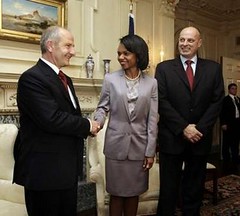
Kosovo Working Toward Stability, Top Leaders Tell US Rice
WASHINGTON (AP)--Kosovo's top leaders said they told the U.S. secretary of state in a meeting Monday that they are working to build a modern, multiethnic country.
"We are looking for Kosovo to become a normal country," Prime Minister Agim Ceku told reporters after he and President Fatmir Sejdiu met with U.S. Secretary of State Condoleezza Rice.
Ceku said he and Sejdiu assured Rice that they were capable of running a stable, democratic country, but that Kosovo needed resources from the U.S. to help transform itself.
Kosovo, formally a province of Serbia, has been administered by the United Nations since NATO's 1999 air war forced Serb forces to end a crackdown on separatist ethnic Albanians and relinquish control over the region.
Talks are under way to determine whether Kosovo becomes an independent state or remains attached to Serbia.
Ethnic Albanians in Kosovo insist on full independence, while the minority Serbs and Belgrade want the province to remain within Serbia.
Before Monday's meeting, the U.S. State Department was stressing the need for Kosovo's leaders to build confidence with minority communities, State Department spokeswoman Nancy Beck said.
Ceku said the majority of people in Kosovo understand that it is "in their best interest to accommodate minorities."
"We are looking for Kosovo to become a normal country," Prime Minister Agim Ceku told reporters after he and President Fatmir Sejdiu met with U.S. Secretary of State Condoleezza Rice.
Ceku said he and Sejdiu assured Rice that they were capable of running a stable, democratic country, but that Kosovo needed resources from the U.S. to help transform itself.
Kosovo, formally a province of Serbia, has been administered by the United Nations since NATO's 1999 air war forced Serb forces to end a crackdown on separatist ethnic Albanians and relinquish control over the region.
Talks are under way to determine whether Kosovo becomes an independent state or remains attached to Serbia.
Ethnic Albanians in Kosovo insist on full independence, while the minority Serbs and Belgrade want the province to remain within Serbia.
Before Monday's meeting, the U.S. State Department was stressing the need for Kosovo's leaders to build confidence with minority communities, State Department spokeswoman Nancy Beck said.
Ceku said the majority of people in Kosovo understand that it is "in their best interest to accommodate minorities."
Bush to Visit Europe This Week - Pro-US Sentiment Peaks in Kosovo
VIENNA, Austria — Abu Ghraib. Guantanamo. Haditha. America's problems with Iraq are casting a long shadow over President Bush's meeting with European Union leaders this week.
The gathering is restricted to U.S. officials and the European Union leadership, and the agenda focuses on Iran's nuclear ambitions, agricultural subsidies and the West's dependence on imported oil and gas.
But the United States' precarious world standing will be the unspoken theme of Wednesday's session in Vienna.
Ahead of the visit, National Security Adviser Stephen Hadley said he doubted Bush would have much to say about the U.S. prison for terror suspects at Guantanamo Bay, allegations of prisoner abuse in Iraq and alleged killings of Iraqi civilians by Marines in Haditha.
For millions of Europeans, however, these are the issues that matter — and their concerns are shared by politicians.
Austrian Chancellor Wolfgang Schuessel, whose country holds the rotating EU presidency, plans to urge Bush to close Guantanamo. Peter Pilz, a senior member of Austria's Green party, says Schuessel should tell Bush "that the criminal actions of his government will not be tolerated in Europe."
Pilz is one of Austria's more outspoken public figures. Still, his sentiments — that the U.S. is breaking the law in Iraq and in its larger fight against terror — are shared by many Europeans angry over the Iraq invasion, recent suicides at Guantanamo and the reported existence of secret CIA prisons worldwide.
Newspaper editorials reflect Europe's dismay with a partnership most here see as has having gone wrong.
"Those who came as liberators, those who wanted to bring the rule of justice ... lost their moral credibility in Iraq," wrote the German weekly Die Zeit. "Not just a few soldiers have 'lost their control' as they like to say. America's entire Iraq policy is out of control."
In France, the newspaper Le Monde wrote of the Guantanamo suicides: "We continue to ask by what heavenly decree America holds itself above the rule of law."
Young people, like Andrej Mantei of Berlin, are even more scathing. "I don't think it's possible that anybody could make worse foreign policy than Bush," he says.
And even many older people are critical, unlike a few decades ago, when they equated America with the war against Nazi Germany, postwar reconstruction and the shield against the Soviet Union.
"I think Bush was wrong, and he should have remorse," said Rosa Sarrocco, 80, of Rome. "The recent events ... have had a further negative impact on my opinion of America."
America's image problems in Europe are reflected by a survey done by the Pew Research Center for the People & the Press and released last week. Favorable opinions of the United States ranged from a high of 56 percent in Britain to a low of 23 percent in Spain.
Even in Britain, support for Bush was only 30 percent, and 60 percent of British respondents said the Iraq war has made the world less safe.
Pro-U.S. sentiment is stronger in much of formerly communist eastern Europe, where Washington's contribution to toppling Soviet dominance lingers in many minds. It peaks in Kosovo, whose ethnic Albanian majority gratefully remembers the U.S.-led bombing in 1999 that forced Serb troops from the province.
"Till I die, I will support whatever America does, be it in Iraq, Afghanistan or elsewhere," says Arben Shaqiri, a 25-year-old bartender in Pristina, Kosovo's main city.
But "Old Europe" is more critical. There have always been trans-Atlantic rivalries, but the divide has grown: The end of the Cold War removed the threat that had united America and Europe since World War II.
It's partly a reflection of two societies drifting apart as the continent seeks to preserve its model of free college education, universal health care, seven-week holidays and other social programs that reflect a different emphasis from the American work ethic.
In his book, "The European Dream," author Jeremy Rifkin outlines characteristics that push the two peoples apart. "The American Dream puts an emphasis on economic growth, personal wealth and independence," he writes. "The new European Dream focuses more on sustainable development, quality of life, and interdependence."
A recent addition to the differences is widespread European dislike not just of the Iraq war but Bush's blunt style. Editorials often talk of the Texan as the "cowboy president."
Washington's decision to work in concert with other world powers as it tries to engage Iran over its nuclear program shows America may have learned some lessons about the benefits of diplomacy.
Still, the damage seems done.
"Whatever the Bush administration does, it is automatically viewed with suspicion by the European population," says Steven Casey of the London School of Economics, an expert on American public opinion.
The gathering is restricted to U.S. officials and the European Union leadership, and the agenda focuses on Iran's nuclear ambitions, agricultural subsidies and the West's dependence on imported oil and gas.
But the United States' precarious world standing will be the unspoken theme of Wednesday's session in Vienna.
Ahead of the visit, National Security Adviser Stephen Hadley said he doubted Bush would have much to say about the U.S. prison for terror suspects at Guantanamo Bay, allegations of prisoner abuse in Iraq and alleged killings of Iraqi civilians by Marines in Haditha.
For millions of Europeans, however, these are the issues that matter — and their concerns are shared by politicians.
Austrian Chancellor Wolfgang Schuessel, whose country holds the rotating EU presidency, plans to urge Bush to close Guantanamo. Peter Pilz, a senior member of Austria's Green party, says Schuessel should tell Bush "that the criminal actions of his government will not be tolerated in Europe."
Pilz is one of Austria's more outspoken public figures. Still, his sentiments — that the U.S. is breaking the law in Iraq and in its larger fight against terror — are shared by many Europeans angry over the Iraq invasion, recent suicides at Guantanamo and the reported existence of secret CIA prisons worldwide.
Newspaper editorials reflect Europe's dismay with a partnership most here see as has having gone wrong.
"Those who came as liberators, those who wanted to bring the rule of justice ... lost their moral credibility in Iraq," wrote the German weekly Die Zeit. "Not just a few soldiers have 'lost their control' as they like to say. America's entire Iraq policy is out of control."
In France, the newspaper Le Monde wrote of the Guantanamo suicides: "We continue to ask by what heavenly decree America holds itself above the rule of law."
Young people, like Andrej Mantei of Berlin, are even more scathing. "I don't think it's possible that anybody could make worse foreign policy than Bush," he says.
And even many older people are critical, unlike a few decades ago, when they equated America with the war against Nazi Germany, postwar reconstruction and the shield against the Soviet Union.
"I think Bush was wrong, and he should have remorse," said Rosa Sarrocco, 80, of Rome. "The recent events ... have had a further negative impact on my opinion of America."
America's image problems in Europe are reflected by a survey done by the Pew Research Center for the People & the Press and released last week. Favorable opinions of the United States ranged from a high of 56 percent in Britain to a low of 23 percent in Spain.
Even in Britain, support for Bush was only 30 percent, and 60 percent of British respondents said the Iraq war has made the world less safe.
Pro-U.S. sentiment is stronger in much of formerly communist eastern Europe, where Washington's contribution to toppling Soviet dominance lingers in many minds. It peaks in Kosovo, whose ethnic Albanian majority gratefully remembers the U.S.-led bombing in 1999 that forced Serb troops from the province.
"Till I die, I will support whatever America does, be it in Iraq, Afghanistan or elsewhere," says Arben Shaqiri, a 25-year-old bartender in Pristina, Kosovo's main city.
But "Old Europe" is more critical. There have always been trans-Atlantic rivalries, but the divide has grown: The end of the Cold War removed the threat that had united America and Europe since World War II.
It's partly a reflection of two societies drifting apart as the continent seeks to preserve its model of free college education, universal health care, seven-week holidays and other social programs that reflect a different emphasis from the American work ethic.
In his book, "The European Dream," author Jeremy Rifkin outlines characteristics that push the two peoples apart. "The American Dream puts an emphasis on economic growth, personal wealth and independence," he writes. "The new European Dream focuses more on sustainable development, quality of life, and interdependence."
A recent addition to the differences is widespread European dislike not just of the Iraq war but Bush's blunt style. Editorials often talk of the Texan as the "cowboy president."
Washington's decision to work in concert with other world powers as it tries to engage Iran over its nuclear program shows America may have learned some lessons about the benefits of diplomacy.
Still, the damage seems done.
"Whatever the Bush administration does, it is automatically viewed with suspicion by the European population," says Steven Casey of the London School of Economics, an expert on American public opinion.
Sunday, June 18, 2006
Tensions with Serbs raise fears over links with EU
Tensions with Serbs raise fears over links with EU
Concerns are mounting that Serbia could break with the west because of tensions over unfulfilled obligations to the international community.
The country's lack of progress in arresting and transferring Gen Ratlo Mladic, an indicted war criminal, is a key stumbling block, but European Union diplomats also fear Russian backing for hardliners in Serbia who question the need – or the inevitability – of a "European future" for south-eastern Europe.
There was a "sense of urgency concerning Serbia" at an EU summit in Brussels last week that discussed ways of bolstering ties with Belgrade, according to one person who was present.
Foreign ministers in attendance warned that the EU needed to prevent Serbia from "falling into nationalism" and had to ensure that the country was not "lost."
"An important consideration is keeping Serbia in the right direction as a country, not driving away from the EU and towards extreme behaviour," said a UK official. But he emphasised that Belgrade also had to live up to its commitments.
Last month the EU stopped negotiations on a stabilisation and association agreement with Belgrade – widely seen as a step towards EU membership – over Serbia's failure to apprehend Mr Mladic.
Since then, Belgrade has seen Montenegro, formerly the junior partner in a federation with Serbia, win recognition as a sovereign state.
Serbia also faces losing its province of Kosovo this year, since the world's big powers intend to resolve the territory's "final status" and largely favour independence for the ethnic Albanian majority.
Against such a backdrop, Serbia's ultranationalist Radical party has gained strength, registering 40 per cent in a recent poll, amid disillusionment with the governing coalition of largely pro-EU "democratic forces".
But prime minister Vojislav Kostunica, a moderate nationalist, also received a shot in the arm last week in Moscow, where he met Vladimir Putin, Russia's president. Mr Kostunica came out of the meeting "extremely satisfied", said officials in his government.
At the EU foreign ministers' meeting at the summit, Olli Rehn, EU enlargement commissioner, urged deeper economic and trade links with Serbia while the association talks are in limbo.
The Commission also favours relaxing visa rules for Serbian nationals, although this may be scaled down to a scheme reducing red tape for Serbian students following opposition from countries such as France.
Mr Rehn has also proposed a plan to help Serbia co-operate with the United Nations tribunal on the former Yugoslavia, which has demanded Mr Mladic's transfer over crimes connected with the 1995 Srebrenica massacre.
Copyright 2006 Financial Times
Concerns are mounting that Serbia could break with the west because of tensions over unfulfilled obligations to the international community.
The country's lack of progress in arresting and transferring Gen Ratlo Mladic, an indicted war criminal, is a key stumbling block, but European Union diplomats also fear Russian backing for hardliners in Serbia who question the need – or the inevitability – of a "European future" for south-eastern Europe.
There was a "sense of urgency concerning Serbia" at an EU summit in Brussels last week that discussed ways of bolstering ties with Belgrade, according to one person who was present.
Foreign ministers in attendance warned that the EU needed to prevent Serbia from "falling into nationalism" and had to ensure that the country was not "lost."
"An important consideration is keeping Serbia in the right direction as a country, not driving away from the EU and towards extreme behaviour," said a UK official. But he emphasised that Belgrade also had to live up to its commitments.
Last month the EU stopped negotiations on a stabilisation and association agreement with Belgrade – widely seen as a step towards EU membership – over Serbia's failure to apprehend Mr Mladic.
Since then, Belgrade has seen Montenegro, formerly the junior partner in a federation with Serbia, win recognition as a sovereign state.
Serbia also faces losing its province of Kosovo this year, since the world's big powers intend to resolve the territory's "final status" and largely favour independence for the ethnic Albanian majority.
Against such a backdrop, Serbia's ultranationalist Radical party has gained strength, registering 40 per cent in a recent poll, amid disillusionment with the governing coalition of largely pro-EU "democratic forces".
But prime minister Vojislav Kostunica, a moderate nationalist, also received a shot in the arm last week in Moscow, where he met Vladimir Putin, Russia's president. Mr Kostunica came out of the meeting "extremely satisfied", said officials in his government.
At the EU foreign ministers' meeting at the summit, Olli Rehn, EU enlargement commissioner, urged deeper economic and trade links with Serbia while the association talks are in limbo.
The Commission also favours relaxing visa rules for Serbian nationals, although this may be scaled down to a scheme reducing red tape for Serbian students following opposition from countries such as France.
Mr Rehn has also proposed a plan to help Serbia co-operate with the United Nations tribunal on the former Yugoslavia, which has demanded Mr Mladic's transfer over crimes connected with the 1995 Srebrenica massacre.
Copyright 2006 Financial Times
Friday, June 16, 2006
BREAKING NEWS: Kosovo's President, PM to meet US Secretary of State Rice during visit to US next week
PRISTINA, Serbia (AP) - Kosovo's top leaders travel to Washington next week to hold talks with U.S. Secretary of State Condoleezza Rice, the president's office said Friday.
President Fatmir Sejdiu and Prime Minister Agim Ceku are to meet Rice on Monday, said Muhamet Hamiti, the president's adviser.
Sejdiu will visit the United States for the first time since he was elected in February, succeeding Kosovo's late President Ibrahim Rugova, who died of lung cancer earlier this year.
During his trip, Sejdiu will meet other officials in the State Department and the White House, the statement said. Ceku is also scheduled to attend a regular U.N. Security Council meeting on the province on June 20.
Kosovo, formally a province of Serbia, has been administered by the United Nations since NATO's 1999 air war forced Serb forces to end a crackdown on separatist ethnic Albanians and relinquish control over the region.
Talks to determine Kosovo's future -- whether it becomes an independent state or remains attached to Serbia -- are under way and are aimed at steering the two sides toward settling the province's status by the end of the year.
Ethnic Albanians in Kosovo insist on full independence, while the minority Serbs and Belgrade want the province to remain within Serbia.
The negotiation process is led by former Finnish President Martti Ahtisaari and the United States have appointed an envoy in the process.
President Fatmir Sejdiu and Prime Minister Agim Ceku are to meet Rice on Monday, said Muhamet Hamiti, the president's adviser.
Sejdiu will visit the United States for the first time since he was elected in February, succeeding Kosovo's late President Ibrahim Rugova, who died of lung cancer earlier this year.
During his trip, Sejdiu will meet other officials in the State Department and the White House, the statement said. Ceku is also scheduled to attend a regular U.N. Security Council meeting on the province on June 20.
Kosovo, formally a province of Serbia, has been administered by the United Nations since NATO's 1999 air war forced Serb forces to end a crackdown on separatist ethnic Albanians and relinquish control over the region.
Talks to determine Kosovo's future -- whether it becomes an independent state or remains attached to Serbia -- are under way and are aimed at steering the two sides toward settling the province's status by the end of the year.
Ethnic Albanians in Kosovo insist on full independence, while the minority Serbs and Belgrade want the province to remain within Serbia.
The negotiation process is led by former Finnish President Martti Ahtisaari and the United States have appointed an envoy in the process.
Albania PM says Kosovo independence brings stability to region
Text of report in English by independent internet news agency KosovaLive
Prishtina [Pristina], 16 June: Albanian Prime Minister Sali Berisha said during his address to Kosova [Kosovo] Assembly that the Albanian nation is moving safely towards the European future.
He said that Kosova will become independent and a sovereign state with guarantees of human rights for all citizens.
'This is a solution that guarantees stability not only to Kosova but also to Albania, Macedonia and Montenegro."
Source: KosovaLive website, Pristina, in English 16 Jun 06
Prishtina [Pristina], 16 June: Albanian Prime Minister Sali Berisha said during his address to Kosova [Kosovo] Assembly that the Albanian nation is moving safely towards the European future.
He said that Kosova will become independent and a sovereign state with guarantees of human rights for all citizens.
'This is a solution that guarantees stability not only to Kosova but also to Albania, Macedonia and Montenegro."
Source: KosovaLive website, Pristina, in English 16 Jun 06
EU SEE Coordinator Expects an Independent Kosovo Soon
The European Union’s special coordinator for Southeastern Europe, Erhard Busek, says that he expects Kosovo to follow Montenegro in pushing for full independence from Serbia.
A former Austrian vice-chancellor, Busek has said that Serbian offers of broad autonomy for the province have come far too late to appease Kosovo’s ethnic Albanian majority. Busek said Belgrade had to realise that the decision by Montenegro to declare its independence and Kosovo’s push to do the same are a direct result of the nationalist agenda pursued by Slobodan Milosevic. That agenda led to the breakup of the Yugoslav federation and the Balkan wars of the 1990s.
Kosovo is still technically a province of Serbia, although it has been under UN administration since the end of the 1999 NATO military campaign against Belgrade.
Vienna has been hosting talks between Belgrade and Pristina on the future status of Kosovo. Austria has also made stability in the Balkans a top priority as the current president of the EU. The Kosovars have ruled out autonomy, saying they will settle for nothing less than becoming a fully independent country.
Some officials in Belgrade say independence would lead to violence against Kosovo’s Serbs and would inflame ultranationalists in Serbia.
A former Austrian vice-chancellor, Busek has said that Serbian offers of broad autonomy for the province have come far too late to appease Kosovo’s ethnic Albanian majority. Busek said Belgrade had to realise that the decision by Montenegro to declare its independence and Kosovo’s push to do the same are a direct result of the nationalist agenda pursued by Slobodan Milosevic. That agenda led to the breakup of the Yugoslav federation and the Balkan wars of the 1990s.
Kosovo is still technically a province of Serbia, although it has been under UN administration since the end of the 1999 NATO military campaign against Belgrade.
Vienna has been hosting talks between Belgrade and Pristina on the future status of Kosovo. Austria has also made stability in the Balkans a top priority as the current president of the EU. The Kosovars have ruled out autonomy, saying they will settle for nothing less than becoming a fully independent country.
Some officials in Belgrade say independence would lead to violence against Kosovo’s Serbs and would inflame ultranationalists in Serbia.
EU Launches Project To Train Kosovo's Border Police
PRISTINA, Kosovo (AP)--The European Union Friday launched a project to train Kosovo's border police, officials said, as U.N. peacekeepers administering the province hope to transfer more control to local authorities.
The EUR1 million program will bring in experts to train border police officers in using surveillance equipment and examining documents in order to combat transnational crime, the E.U. said in a statement.
Kosovo, formally part of Serbia, has been under U.N. administrative rule since mid-1999, when NATO waged an air war to halt Serb forces' crackdown on independence-seeking ethnic Albanians.
The U.N. mission is in the process of transferring authority over judiciary and police to the local authorities as it reduces its presence with the aim of turning over some other responsibilities to a possible E.U.-led mission once a decision on the province's future is reached.
There are more than 2,000 U.N. police officers in Kosovo and the province has a 7,000-strong local police force. [ 16-06-06 1151GMT ]
The EUR1 million program will bring in experts to train border police officers in using surveillance equipment and examining documents in order to combat transnational crime, the E.U. said in a statement.
Kosovo, formally part of Serbia, has been under U.N. administrative rule since mid-1999, when NATO waged an air war to halt Serb forces' crackdown on independence-seeking ethnic Albanians.
The U.N. mission is in the process of transferring authority over judiciary and police to the local authorities as it reduces its presence with the aim of turning over some other responsibilities to a possible E.U.-led mission once a decision on the province's future is reached.
There are more than 2,000 U.N. police officers in Kosovo and the province has a 7,000-strong local police force. [ 16-06-06 1151GMT ]
Balkans moving toward European integration, progress needed: commission
WASHINGTON, June 16, 2006 (AFP) -
Balkan countries need to do more to protect the Roma community and must hand over indicted war criminals if they are to continue on the path to joining the European Union and NATO, US officials and experts said.
At a hearing before the US Commission on Security and Cooperation in Europe, also known as the Helsinki Commission, several witnesses on Thursday noted that countries such as Albania, Bosnia-Hercegovina, Croatia and Macedonia have made some progress in implementing democratic reforms and improving human rights.
But they underlined that ethnic minorities, especially the Roma community, remain vulnerable to discrimination and violence and denounced the fact that top war crimes suspects Radovan Karadzic and Ratko Mladic remain at large.
"Whether it be physical harassment from police, lack of access to basic services such as education, health care and housing, or societal discrimination, the Roma are among the most marginalized of minorities," Rosemary DiCarlo, Deputy Assistant Secretary of State for European and Eurasian Affairs, told the hearing.
Estimated at eight to 12 million, Roma are Europe's largest ethnic minority and also one of its most marginalized.
Nicolae Gheorghe, adviser for Roma and Sinti (Gypsies) issues with the Organization for Security and Cooperation in Europe, said the major challenge facing institutions and governments in the Balkans was the implementation of policies aimed at integrating the Roma in society.
"For any lasting changes to take place, there must be a thorough examination of the underlying root causes of human rights abuses towards Roma communities -- namely issues of racism and discrimination -- and these must be addressed through legislation and with the full support of international institutions," Gheorghe told the Helsinki Commission.
The commission is a bi-partisan US rights watchdog set up by Congress. It consists of nine members from the US Senate, nine from the House of Representatives, and one member each from the Departments of State, Defense and Commerce.
Its chairman, Senator Sam Brownback, said while some countries in the Balkans have made remarkable strides to recover from a decade of regional conflict there is still concern that Europe will leave them behind.
He and others stressed that unless Karadzic and Mladic, who have been charged with genocide and crimes against humanity for their role in the 1992-95 Bosnian war, are brought to justice, there was little chance of Serbia joining Euro-Atlantic institutions.
"This is a year of decision in the Balkans," said Daniel Serwer, of the United States Institute of Peace. "The question is whether the decisions will bring peace or instability."
He said that while Bosnia, Serbia and the Serb province of Kosovo are not likely to go back to war, none has established peace on a firm foundation.
Serbia, Montenegro, Croatia, Bosnia and Macedonia are all hoping to join the European Union (EU) as well as the North Atlantic Treaty Organization (NATO).
But in a significant setback last month, the EU suspended talks on closer ties with Serbia because of its failure to fulfill a promise to "locate, arrest and transfer" Mladic to The Hague by April 30.
Balkan countries need to do more to protect the Roma community and must hand over indicted war criminals if they are to continue on the path to joining the European Union and NATO, US officials and experts said.
At a hearing before the US Commission on Security and Cooperation in Europe, also known as the Helsinki Commission, several witnesses on Thursday noted that countries such as Albania, Bosnia-Hercegovina, Croatia and Macedonia have made some progress in implementing democratic reforms and improving human rights.
But they underlined that ethnic minorities, especially the Roma community, remain vulnerable to discrimination and violence and denounced the fact that top war crimes suspects Radovan Karadzic and Ratko Mladic remain at large.
"Whether it be physical harassment from police, lack of access to basic services such as education, health care and housing, or societal discrimination, the Roma are among the most marginalized of minorities," Rosemary DiCarlo, Deputy Assistant Secretary of State for European and Eurasian Affairs, told the hearing.
Estimated at eight to 12 million, Roma are Europe's largest ethnic minority and also one of its most marginalized.
Nicolae Gheorghe, adviser for Roma and Sinti (Gypsies) issues with the Organization for Security and Cooperation in Europe, said the major challenge facing institutions and governments in the Balkans was the implementation of policies aimed at integrating the Roma in society.
"For any lasting changes to take place, there must be a thorough examination of the underlying root causes of human rights abuses towards Roma communities -- namely issues of racism and discrimination -- and these must be addressed through legislation and with the full support of international institutions," Gheorghe told the Helsinki Commission.
The commission is a bi-partisan US rights watchdog set up by Congress. It consists of nine members from the US Senate, nine from the House of Representatives, and one member each from the Departments of State, Defense and Commerce.
Its chairman, Senator Sam Brownback, said while some countries in the Balkans have made remarkable strides to recover from a decade of regional conflict there is still concern that Europe will leave them behind.
He and others stressed that unless Karadzic and Mladic, who have been charged with genocide and crimes against humanity for their role in the 1992-95 Bosnian war, are brought to justice, there was little chance of Serbia joining Euro-Atlantic institutions.
"This is a year of decision in the Balkans," said Daniel Serwer, of the United States Institute of Peace. "The question is whether the decisions will bring peace or instability."
He said that while Bosnia, Serbia and the Serb province of Kosovo are not likely to go back to war, none has established peace on a firm foundation.
Serbia, Montenegro, Croatia, Bosnia and Macedonia are all hoping to join the European Union (EU) as well as the North Atlantic Treaty Organization (NATO).
But in a significant setback last month, the EU suspended talks on closer ties with Serbia because of its failure to fulfill a promise to "locate, arrest and transfer" Mladic to The Hague by April 30.
Talks on Kosovo status ended in 1999, Democratic Party chairman says
Text of report by Radio-Television Kosovo TV website on 15 June
PDK [Democratic Party of Kosovo] chairman and member of the Negotiation Team Hashim Thaci said today that talks on Kosova's [Kosovo] status ended in Rambouillet in 1999, while now talks are being held for the forming of a new state of Kosova and minority rights. He is optimistic that things are going in the right direction so Kosova can become a state this year. There are some claims to divide Kosova, however, Kosova will be unified with a unified Mitrovica said Thaci commenting the latest developments in northern Kosova. On the issue of replacing UNMIK with EUMIK he added that there will be an international presence in Kosova in accordance to the new reality of the new state of Kosova.
Source: RTK TV website, Pristina, in Albanian 15 Jun 06
PDK [Democratic Party of Kosovo] chairman and member of the Negotiation Team Hashim Thaci said today that talks on Kosova's [Kosovo] status ended in Rambouillet in 1999, while now talks are being held for the forming of a new state of Kosova and minority rights. He is optimistic that things are going in the right direction so Kosova can become a state this year. There are some claims to divide Kosova, however, Kosova will be unified with a unified Mitrovica said Thaci commenting the latest developments in northern Kosova. On the issue of replacing UNMIK with EUMIK he added that there will be an international presence in Kosova in accordance to the new reality of the new state of Kosova.
Source: RTK TV website, Pristina, in Albanian 15 Jun 06
Thursday, June 15, 2006
Serbia: Hundreds of ethnic Albanians demand regional self-rule at rally
BELGRADE, Serbia (AP) - Hundreds of ethnic Albanians demonstrated in tense southern Serbia Thursday, demanding regional self-rule in the municipalities where they form a majority.
At the gathering in the town of Presevo, near the boundary with U.N.-run province of Kosovo, the ethnic Albanians accused the Serbian government of an "inadequate" approach to problems in the area.
The Presevo Valley was the scene of an ethnic Albanian rebellion in 2000-2001, which ended in a western-brokered deal granting more rights to the local communities.
The ethnic Albanians in the area have said they want to split the region from Serbia and unite it with neighboring Kosovo, also populated predominantly by ethnic Albanians.
Speaking at the rally, local ethnic Albanian leader and former Presevo mayor Riza Halimi said the Presevo Valley should gain "regional self-rule." He did not elaborate.
At the gathering in the town of Presevo, near the boundary with U.N.-run province of Kosovo, the ethnic Albanians accused the Serbian government of an "inadequate" approach to problems in the area.
The Presevo Valley was the scene of an ethnic Albanian rebellion in 2000-2001, which ended in a western-brokered deal granting more rights to the local communities.
The ethnic Albanians in the area have said they want to split the region from Serbia and unite it with neighboring Kosovo, also populated predominantly by ethnic Albanians.
Speaking at the rally, local ethnic Albanian leader and former Presevo mayor Riza Halimi said the Presevo Valley should gain "regional self-rule." He did not elaborate.
ANALYSIS-Serbia on the ropes has the West a little worried
BELGRADE, June 15 (Reuters) - Shattered buildings on the boulevard tell the story: Belgrade is the only European capital bombed by NATO and Serbia does not forget it.
The cruise-missile ruins on "Tomahawk Alley" are totems of resentment of a people who feel misunderstood and abused by the powerful Westerners who ought to be their friends.
Seven years after NATO dropped its last bomb to drive Serb forces out of Kosovo, the Serbs still feel battered -- by rebukes, ultimatums and penalties from Brussels and Washington, by humiliating visa restrictions, by the sting of exclusion.
This feeling of "more stick than carrot" benefits hardline nationalists who tell Serbia the West never did love it and never will, says analyst Dejan Vuk Stankovic.
Setbacks and dashed hopes are part of the daily news diet here but the past six weeks were exceptional even by Serbian standards, and the latest party poll ratings reflect that.
On May 3, the European Union froze pre-membership talks with Serbia because it failed to hand over top war crimes fugitive Ratko Mladic, a Bosnian Serb, to the U.N. tribunal in The Hague.
On May 21, Serbia's partner Montenegro chose independence, saying the EU freeze proved it would be better off without Serbia and its odious legacy as instigator of the Yugoslav wars.
On June 9, a poll gave the opposition Radical Party over 40 percent voter support. Radicals worship Mladic, back revanchist aims, hate Western interference and despise liberals.
WRONG TIMING
"The Montenegro referendum ... has increased Serbia's anger at the international community and its feeling of isolation," former U.S. ambassador William Montgomery wrote this week.
It made Serbs "less cooperative, more negative and more aggressive" at the very time the West needs their cooperation on Kosovo, whose 90 percent ethnic Albanian majority is expected to get independence this year with or without Serb approval.
A Western-inspired U.N. vote to amputate Serbia's cherished southern province could be exploited by anti-Western parties to whip up national outrage, with unpredictable consequences.
The U.S. and EU do not want Serbia reverting to chauvinism. They want it embedded in the West, not on the ropes, or at bay, or off the reservation in a region known for radical solutions.
Europe's worst wars since 1945 started here, just 15 years ago. Fighting in Bosnia and Croatia went on until 1995. In 1998-99 it raged again in Kosovo. Then it flared next door in Macedonia in 2000. The overall toll was 200,000 dead.
Serb analysts say Kosovo independence would further crank up support for the Radicals, raising the possibility of a hardline government in Belgrade if, as some predict, a snap election later this year unseats Serbia's fractious minority coalition.
The U.N. and NATO are braced for the possible exodus of 50,000 Serbs from Kosovo if the Albanians get independence, and for unrest in the Serb-dominated north which favours partition. But there is no known plan for a lurch back to defiance in Belgrade -- an issue to be discussed at this week's EU summit.
To complicate the picture in the wake of Montenegro's independence, Serbs in Bosnia sounded an alarm in the West this month by insisting they too have a right to vote for secession.
A breakaway movement in either place, egged on by a hardline Serbia, could scupper hopes of a peaceful solution in Kosovo.
WEAKENING RESTRAINT, RISING RESENTMENT
No one expects all-out war to return to the Balkans, because people are in no mood for it, and war does not mix with hopes of a more prosperous future via EU and NATO membership.
But if hopes are scotched by a new isolationism, restraint could weaken as resentment of the West rises. Without official restraint the Balkans is known to breed violence.
Many Serbs firmly believe they are being bullied into betraying national interests and should tell the West where to go. The question is whether this sentiment will predominate.
NATO bombed for 78 days in 1999 to make Slobodan Milosevic pull his troops out of Kosovo. Seven years ago this week the army withdrew, bristling with brassy bandoliers and defiance.
Despite reconciliation, the defiance still smoulders, sustained by a lingering Serb sense of exceptionalism.
Serbia had to be threatened with sanctions before seeing the West was serious about surrendering suspects to The Hague to stand trial for the worst atrocities of the late 20th century.
It still refuses to admit the reality that Kosovo Albanians will never again entrust their fate to the state that killed 10,000 of them in two years, and drove out nearly a million.
Most Serbs have not seen Kosovo, yet insist it is their inalienable cultural and religious "Jerusalem". In the words of one analyst Serbia "wants the land but not the people on it".
The cruise-missile ruins on "Tomahawk Alley" are totems of resentment of a people who feel misunderstood and abused by the powerful Westerners who ought to be their friends.
Seven years after NATO dropped its last bomb to drive Serb forces out of Kosovo, the Serbs still feel battered -- by rebukes, ultimatums and penalties from Brussels and Washington, by humiliating visa restrictions, by the sting of exclusion.
This feeling of "more stick than carrot" benefits hardline nationalists who tell Serbia the West never did love it and never will, says analyst Dejan Vuk Stankovic.
Setbacks and dashed hopes are part of the daily news diet here but the past six weeks were exceptional even by Serbian standards, and the latest party poll ratings reflect that.
On May 3, the European Union froze pre-membership talks with Serbia because it failed to hand over top war crimes fugitive Ratko Mladic, a Bosnian Serb, to the U.N. tribunal in The Hague.
On May 21, Serbia's partner Montenegro chose independence, saying the EU freeze proved it would be better off without Serbia and its odious legacy as instigator of the Yugoslav wars.
On June 9, a poll gave the opposition Radical Party over 40 percent voter support. Radicals worship Mladic, back revanchist aims, hate Western interference and despise liberals.
WRONG TIMING
"The Montenegro referendum ... has increased Serbia's anger at the international community and its feeling of isolation," former U.S. ambassador William Montgomery wrote this week.
It made Serbs "less cooperative, more negative and more aggressive" at the very time the West needs their cooperation on Kosovo, whose 90 percent ethnic Albanian majority is expected to get independence this year with or without Serb approval.
A Western-inspired U.N. vote to amputate Serbia's cherished southern province could be exploited by anti-Western parties to whip up national outrage, with unpredictable consequences.
The U.S. and EU do not want Serbia reverting to chauvinism. They want it embedded in the West, not on the ropes, or at bay, or off the reservation in a region known for radical solutions.
Europe's worst wars since 1945 started here, just 15 years ago. Fighting in Bosnia and Croatia went on until 1995. In 1998-99 it raged again in Kosovo. Then it flared next door in Macedonia in 2000. The overall toll was 200,000 dead.
Serb analysts say Kosovo independence would further crank up support for the Radicals, raising the possibility of a hardline government in Belgrade if, as some predict, a snap election later this year unseats Serbia's fractious minority coalition.
The U.N. and NATO are braced for the possible exodus of 50,000 Serbs from Kosovo if the Albanians get independence, and for unrest in the Serb-dominated north which favours partition. But there is no known plan for a lurch back to defiance in Belgrade -- an issue to be discussed at this week's EU summit.
To complicate the picture in the wake of Montenegro's independence, Serbs in Bosnia sounded an alarm in the West this month by insisting they too have a right to vote for secession.
A breakaway movement in either place, egged on by a hardline Serbia, could scupper hopes of a peaceful solution in Kosovo.
WEAKENING RESTRAINT, RISING RESENTMENT
No one expects all-out war to return to the Balkans, because people are in no mood for it, and war does not mix with hopes of a more prosperous future via EU and NATO membership.
But if hopes are scotched by a new isolationism, restraint could weaken as resentment of the West rises. Without official restraint the Balkans is known to breed violence.
Many Serbs firmly believe they are being bullied into betraying national interests and should tell the West where to go. The question is whether this sentiment will predominate.
NATO bombed for 78 days in 1999 to make Slobodan Milosevic pull his troops out of Kosovo. Seven years ago this week the army withdrew, bristling with brassy bandoliers and defiance.
Despite reconciliation, the defiance still smoulders, sustained by a lingering Serb sense of exceptionalism.
Serbia had to be threatened with sanctions before seeing the West was serious about surrendering suspects to The Hague to stand trial for the worst atrocities of the late 20th century.
It still refuses to admit the reality that Kosovo Albanians will never again entrust their fate to the state that killed 10,000 of them in two years, and drove out nearly a million.
Most Serbs have not seen Kosovo, yet insist it is their inalienable cultural and religious "Jerusalem". In the words of one analyst Serbia "wants the land but not the people on it".
Albanian premier calls for Kosovo's independence
Text of report in English by Albanian news agency ATA
Pristina, 15 June: Prime Minister Sali Berisha said on Thursday [15 June] that "the Albanian nation moves free and safe towards the future." "Kosova [Kosovo] and Albania move like two sisters towards EU and Euro-Atlantic integration," he said.
In a greeting message delivered to the Assembly of Kosova, Berisha stressed: "The date of 12 June 1999 marks a great event in the history of freedom and peace not just for Kosova but for the whole Balkans, Europe, NATO and its member countries. On this anniversary, I would like to express my deepest gratitude to those who turned into a reality the dream of freedom of the citizens of Kosova, my great expectation".
Albanian Prime Minister Sali Berisha was received with standing applause by deputies in the special session of the Assembly of Kosova as he entered the hall and his speech was applauded several times. "Please, allow me, first of all, to convey to you, the representatives of the people of Kosova, on behalf of the government and the citizens of Albania the most cordial greetings, the deepest gratitude and absolute and all-round support for your forward advance in the efforts for the realization of your legitimate aspirations", Prime Minister Berisha said in his address to the deputies of the Assembly of Kosova.
Further on, in his speech Mr.Berisha said: "I come to Kosova only three days after the seventh anniversary of the liberation of Kosova and just three days after Albania signed with the European Union the Stabilization and Association Agreement [SAA], leaving behind the transition and consolidating, in an irreversible way, its road towards joining the family of the peoples and European states".
"I bow before the resistance of the citizens of Kosova, their sublime sacrifice for freedom, dignity, honour and national and European identity. I also express admiration to you for transforming this Assembly into a real temple, sponsor of freedom values, for the approval of laws for building democracy, rule of law in the European Kosova, in Kosova of equal citizens that moves towards Euro-Atlantic integration," said Berisha.
The prime minister said: "I notice with satisfaction that in Kosova notable progress has been achieved in regard to keeping of stability and tranquillity, in the progressive realization of the required standards. These achievements have been a result of your willingness to build all-embracing democratic institutions based on Western values that guarantee respect of the rights and freedoms of the individual and of the minorities in a free country", said the prime minister.
Speaking about Albania's stand in regard to Kosova status, Berisha said: "Albania has been and will continue to be an important factor, active and constructive for the solution of Kosova issue". "Albania's stand for Kosova is crystal clear: we strongly support the efforts of the international community, the Security Council, the Contact Group and the Mission of the envoy of the UN secretary-general, Marti Ahtisaari, along with the representatives of Kosova, for finding a solution, which takes into account the real will of the people of Kosova", said Berisha.
According to the prime minister, "Albania also supports the basic principles drafted by the international bodies on which such a solution will be build: no return to situation prior 1999, no division of Kosova and no union with any other country".
Berisha said: "We consider the international presence as indispensable for Kosova even in the period after the status." The prime minister also expressed his appreciation about the work of UNMIK [UN Interim Administration Mission in Kosovo ] chief, Soeren Jessen-Petersen, saying that "we believe that the brilliant job of Mr Petersen will be proceeded further up to the completion of negotiations and determination of the final status of Kosova", said Berisha.
According to him, Albania considers Kosova's independence as the only solution which guarantees peace and stability in Kosova, but even in the other surrounding countries. "Peace, stability and their consolidation in Kosova have a great importance for Albania, Macedonia, Montenegro and Balkans as a whole. But, their consolidation makes a hard and vital process," said Berisha.
Speaking about the cooperation between Albania and Kosova, Berisha said: "Albania and Kosova have common interests in all the fields, but more is needed in the future. Kosova, through the ports of Albania (Shengjin) approaches with Europe. To this goal serves even the acceleration of the work on the realization of the project on Durres-Morine road. More intensity and interest is needed even for the increase of trade, tourist relations and the creation of a unique energy network, development of educational, scientific and cultural links," said Berisha. The prime minister stressed that "Albania considers Kosova part of the democratic and integration processes in the region and over a wider area".
Source: ATA news agency, Tirana, in English 1842 gmt 15 Jun 06
Pristina, 15 June: Prime Minister Sali Berisha said on Thursday [15 June] that "the Albanian nation moves free and safe towards the future." "Kosova [Kosovo] and Albania move like two sisters towards EU and Euro-Atlantic integration," he said.
In a greeting message delivered to the Assembly of Kosova, Berisha stressed: "The date of 12 June 1999 marks a great event in the history of freedom and peace not just for Kosova but for the whole Balkans, Europe, NATO and its member countries. On this anniversary, I would like to express my deepest gratitude to those who turned into a reality the dream of freedom of the citizens of Kosova, my great expectation".
Albanian Prime Minister Sali Berisha was received with standing applause by deputies in the special session of the Assembly of Kosova as he entered the hall and his speech was applauded several times. "Please, allow me, first of all, to convey to you, the representatives of the people of Kosova, on behalf of the government and the citizens of Albania the most cordial greetings, the deepest gratitude and absolute and all-round support for your forward advance in the efforts for the realization of your legitimate aspirations", Prime Minister Berisha said in his address to the deputies of the Assembly of Kosova.
Further on, in his speech Mr.Berisha said: "I come to Kosova only three days after the seventh anniversary of the liberation of Kosova and just three days after Albania signed with the European Union the Stabilization and Association Agreement [SAA], leaving behind the transition and consolidating, in an irreversible way, its road towards joining the family of the peoples and European states".
"I bow before the resistance of the citizens of Kosova, their sublime sacrifice for freedom, dignity, honour and national and European identity. I also express admiration to you for transforming this Assembly into a real temple, sponsor of freedom values, for the approval of laws for building democracy, rule of law in the European Kosova, in Kosova of equal citizens that moves towards Euro-Atlantic integration," said Berisha.
The prime minister said: "I notice with satisfaction that in Kosova notable progress has been achieved in regard to keeping of stability and tranquillity, in the progressive realization of the required standards. These achievements have been a result of your willingness to build all-embracing democratic institutions based on Western values that guarantee respect of the rights and freedoms of the individual and of the minorities in a free country", said the prime minister.
Speaking about Albania's stand in regard to Kosova status, Berisha said: "Albania has been and will continue to be an important factor, active and constructive for the solution of Kosova issue". "Albania's stand for Kosova is crystal clear: we strongly support the efforts of the international community, the Security Council, the Contact Group and the Mission of the envoy of the UN secretary-general, Marti Ahtisaari, along with the representatives of Kosova, for finding a solution, which takes into account the real will of the people of Kosova", said Berisha.
According to the prime minister, "Albania also supports the basic principles drafted by the international bodies on which such a solution will be build: no return to situation prior 1999, no division of Kosova and no union with any other country".
Berisha said: "We consider the international presence as indispensable for Kosova even in the period after the status." The prime minister also expressed his appreciation about the work of UNMIK [UN Interim Administration Mission in Kosovo ] chief, Soeren Jessen-Petersen, saying that "we believe that the brilliant job of Mr Petersen will be proceeded further up to the completion of negotiations and determination of the final status of Kosova", said Berisha.
According to him, Albania considers Kosova's independence as the only solution which guarantees peace and stability in Kosova, but even in the other surrounding countries. "Peace, stability and their consolidation in Kosova have a great importance for Albania, Macedonia, Montenegro and Balkans as a whole. But, their consolidation makes a hard and vital process," said Berisha.
Speaking about the cooperation between Albania and Kosova, Berisha said: "Albania and Kosova have common interests in all the fields, but more is needed in the future. Kosova, through the ports of Albania (Shengjin) approaches with Europe. To this goal serves even the acceleration of the work on the realization of the project on Durres-Morine road. More intensity and interest is needed even for the increase of trade, tourist relations and the creation of a unique energy network, development of educational, scientific and cultural links," said Berisha. The prime minister stressed that "Albania considers Kosova part of the democratic and integration processes in the region and over a wider area".
Source: ATA news agency, Tirana, in English 1842 gmt 15 Jun 06
EU to work on incentives for Serbia
BRUSSELS, June 15 (Reuters) - The EU said on Thursday it would work on incentives, including easier bloc entry for young Serbians, to encourage Serbia to opt for integration into Europe and reject nationalist isolation.
At a summit in Brussels, EU foreign ministers discussed ways of reaching out to Serbia, even though negotiations on closer ties were suspended last month after Belgrade failed to hand over fugitive war crimes indictee Ratko Mladic.
The European Union has said talks about a closer association with the bloc -- a prelude to actual candidate status -- would remain on ice as long as Mladic was at large. Mladic led Bosnian Serb forces in Balkan conflicts in the 1990s. "There is high awareness the visa question is one that is important in particular for the young generation," said Austrian Foreign Minister Ursula Plassnik, whose country holds the rotating EU presidency.
"We will be working on developing a number of positive measures at the same time, expecting very clearly Serbia to engage on a path of reforms and provide full cooperation with the (international war crimes tribunal)," she said.
Ministers at the summit expressed concern about the risk of an upsurge in nationalism should Serbia be left out in the cold.
"It is clear that one of the things we are discussing here is how we prevent Serbia falling into nationalism which will create disturbances in the Balkans," said Danish Foreign Minister Per Stig Moeller.
"We believe that we can only prevent that by telling the Serbs there are possibilities, but this also means that certain conditions are fulfilled."
EU Enlargement Commissioner Olli Rehn told Reuters an action plan would be worked out with Serbia to encourage it to comply.
"We need to support Serbia to join the European mainstream and there is a sense of urgency, a sense of seriousness ... especially about the need to help Serbia to help itself, by encouraging it to achieve full cooperation with the (tribunal)."
Rehn said he had proposed intensified cooperation between the EU presidency, foreign policy chief Javier Solana and the EU's executive Commission on support measures, including visa facilitation and economic and trade relations.
He said it was a political signal of the bloc's support for Serbia's future with the EU, although there had been "no dramatic change" in its cooperation with the tribunal.
Serbia has suffered a series of setbacks this year, fuelling a growing feeling of abandonment in Belgrade that has raised widespread fears of increased nationalism.
Apart from the freezing of talks on closer EU ties, Montenegro has seceded from its union with Serbia and the province of Kosovo, which has an ethnic Albanian majority, is poised to follow suit.
At a summit in Brussels, EU foreign ministers discussed ways of reaching out to Serbia, even though negotiations on closer ties were suspended last month after Belgrade failed to hand over fugitive war crimes indictee Ratko Mladic.
The European Union has said talks about a closer association with the bloc -- a prelude to actual candidate status -- would remain on ice as long as Mladic was at large. Mladic led Bosnian Serb forces in Balkan conflicts in the 1990s. "There is high awareness the visa question is one that is important in particular for the young generation," said Austrian Foreign Minister Ursula Plassnik, whose country holds the rotating EU presidency.
"We will be working on developing a number of positive measures at the same time, expecting very clearly Serbia to engage on a path of reforms and provide full cooperation with the (international war crimes tribunal)," she said.
Ministers at the summit expressed concern about the risk of an upsurge in nationalism should Serbia be left out in the cold.
"It is clear that one of the things we are discussing here is how we prevent Serbia falling into nationalism which will create disturbances in the Balkans," said Danish Foreign Minister Per Stig Moeller.
"We believe that we can only prevent that by telling the Serbs there are possibilities, but this also means that certain conditions are fulfilled."
EU Enlargement Commissioner Olli Rehn told Reuters an action plan would be worked out with Serbia to encourage it to comply.
"We need to support Serbia to join the European mainstream and there is a sense of urgency, a sense of seriousness ... especially about the need to help Serbia to help itself, by encouraging it to achieve full cooperation with the (tribunal)."
Rehn said he had proposed intensified cooperation between the EU presidency, foreign policy chief Javier Solana and the EU's executive Commission on support measures, including visa facilitation and economic and trade relations.
He said it was a political signal of the bloc's support for Serbia's future with the EU, although there had been "no dramatic change" in its cooperation with the tribunal.
Serbia has suffered a series of setbacks this year, fuelling a growing feeling of abandonment in Belgrade that has raised widespread fears of increased nationalism.
Apart from the freezing of talks on closer EU ties, Montenegro has seceded from its union with Serbia and the province of Kosovo, which has an ethnic Albanian majority, is poised to follow suit.
Wednesday, June 14, 2006
Kosovo Reformist Party chairman meets Serb leader
Text of report by Radio-Television Kosovo TV on 13 June
[Announcer] ORA [Kosovo Reformist Party] Chairman Veton Surroi met today in northern Mitrovica Kosova Serb leader Oliver Ivanovic they discussed decentralization process. During the meeting Ivanovic presented to Surroi the newest Serb plan compiled by the Serb List for Kosova on decentralization. This plan foresees the forming of around 10 municipalities and as such it has been opposed by Minister of Local Government Lutfi Haziri.
[Kosova Serb leader Oliver Ivanovic in Serbian with Albanian voice-over] The next step is to have talks with the Contact Group on Friday where we are going to present our plan. Afterwards, it would be the right thing to meet with Kosova [Kosovo] Negotiation Team and discuss this issue. We want functional local government that meets the needs of citizens.
[Reporter] Kosova Serb leader Oliver Ivanovic believes that his plan on decentralization is more functional and it would be a compromise solution between Prishtina and Belgrade delegations on decentralization process.
Source: RTK TV, Pristina, in Albanian 1730 gmt 13 Jun 06
[Announcer] ORA [Kosovo Reformist Party] Chairman Veton Surroi met today in northern Mitrovica Kosova Serb leader Oliver Ivanovic they discussed decentralization process. During the meeting Ivanovic presented to Surroi the newest Serb plan compiled by the Serb List for Kosova on decentralization. This plan foresees the forming of around 10 municipalities and as such it has been opposed by Minister of Local Government Lutfi Haziri.
[Kosova Serb leader Oliver Ivanovic in Serbian with Albanian voice-over] The next step is to have talks with the Contact Group on Friday where we are going to present our plan. Afterwards, it would be the right thing to meet with Kosova [Kosovo] Negotiation Team and discuss this issue. We want functional local government that meets the needs of citizens.
[Reporter] Kosova Serb leader Oliver Ivanovic believes that his plan on decentralization is more functional and it would be a compromise solution between Prishtina and Belgrade delegations on decentralization process.
Source: RTK TV, Pristina, in Albanian 1730 gmt 13 Jun 06
Austria seeks to stop Serbia feeling abandoned
(c) 2006 Reuters Limited
VIENNA, June 14 (Reuters) - Austria has put Serbia on the agenda of European Union foreign ministers at the EU summit starting on Thursday, seeking to keep the former Yugoslav state from drifting into isolation.
Serbia has endured a series of setbacks this year with more coming down the road, fuelling a growing feeling of abandonment in Belgrade which Austria fears could foster radical movements.
The EU froze talks for closer ties with the Balkan state in May when Serbia failed to deliver war criminal Ratko Mladic. Montenegro seceded from its union with Serbia in the same month. Its breakaway province, Kosovo, is knocking on the door.
"We knew this year would be difficult (for Serbia)," said Austrian foreign minister Ursula Plassnik at a news conference in Vienna ahead of the Brussels summit.
"Decisions about a nation's status are among the most delicate issues the international community has to discuss and resolve, and there are several such issues still outstanding in the region," she added in an allusion to Kosovo.
Plassnik said she put Serbia on the agenda for the foreign ministers' dinner -- a standard feature on the sidelines of EU summits -- and Austrian diplomats said it was mainly meant as a signal to Serbians that the world still cares about them.
"They are feeling cornered at the moment," said one diplomat. "We can't allow that they think they are just bulldozed over and turn to the wrong, nationalist people," the diplomat said.
Talks about a closer association with the EU -- a prelude to actual candidate status -- will remain on ice for Serbia as long as Mladic is at large. The main carrot for Serbia is the possibility of visa facilitations for Serbian citizens.
"Of course in theory it would be the best if we could just resume the (association talks) tomorrow," the diplomat said. "But we can't if Mladic doesn't turn up, we owe that to ourselves."
Austria will ask EU leaders at the summit to reiterate a declaration by EU foreign ministers in March saying that the future of the entire region of former Yugoslavia and Albania -- the "western Balkans" in EU lingo -- was in the EU.
VIENNA, June 14 (Reuters) - Austria has put Serbia on the agenda of European Union foreign ministers at the EU summit starting on Thursday, seeking to keep the former Yugoslav state from drifting into isolation.
Serbia has endured a series of setbacks this year with more coming down the road, fuelling a growing feeling of abandonment in Belgrade which Austria fears could foster radical movements.
The EU froze talks for closer ties with the Balkan state in May when Serbia failed to deliver war criminal Ratko Mladic. Montenegro seceded from its union with Serbia in the same month. Its breakaway province, Kosovo, is knocking on the door.
"We knew this year would be difficult (for Serbia)," said Austrian foreign minister Ursula Plassnik at a news conference in Vienna ahead of the Brussels summit.
"Decisions about a nation's status are among the most delicate issues the international community has to discuss and resolve, and there are several such issues still outstanding in the region," she added in an allusion to Kosovo.
Plassnik said she put Serbia on the agenda for the foreign ministers' dinner -- a standard feature on the sidelines of EU summits -- and Austrian diplomats said it was mainly meant as a signal to Serbians that the world still cares about them.
"They are feeling cornered at the moment," said one diplomat. "We can't allow that they think they are just bulldozed over and turn to the wrong, nationalist people," the diplomat said.
Talks about a closer association with the EU -- a prelude to actual candidate status -- will remain on ice for Serbia as long as Mladic is at large. The main carrot for Serbia is the possibility of visa facilitations for Serbian citizens.
"Of course in theory it would be the best if we could just resume the (association talks) tomorrow," the diplomat said. "But we can't if Mladic doesn't turn up, we owe that to ourselves."
Austria will ask EU leaders at the summit to reiterate a declaration by EU foreign ministers in March saying that the future of the entire region of former Yugoslavia and Albania -- the "western Balkans" in EU lingo -- was in the EU.
Serbian NGO says emergency measures in northern Kosovo dangerous for Serbs
Text of report by Serbian news agency Beta
Belgrade, 13 June: The Forum for Security and Democracy (FBD) today warned the authorities in Serb municipalities in northern Kosovo and Belgrade that unilateral decisions on introducing emergency measures could have unforeseeable consequences on Serbs in the province and on Serbia as a state.
The FBD advised the municipal authorities in Zubin Potok and other municipalities to re-examine whether they had overstepped their authority when they introduced emergency measures, specifically whether they had violated UN Security Council Resolution 1244 on Kosovo-Metohija.
The FBD argues that the municipality of Zubin Potok is not authorized to ban the presence of regional Kosovo police forces from its territory, or investigating units, which is precisely what the adopted measure says.
The FBD considers controversial and dangerous plans by the municipality to post an advertisement for the admission of 999 Serb policemen, invoking Resolution 1244.
"We particularly consider dangerous requests to the local population to cooperate with the municipality in the implementation of these measures, including 'self-organization,' that is Serb guards, as was decided yesterday," said the FBD.
The FBD recommended that they consider in particular the impact of the above measures on the security of Serbs south of northern Kosovo. The body called on Serbs, Serb parties and political representatives to assume a critical stance on Serb organized crime in northern Kosovo, which often masks its operations and declares them attacks by Albanian extremists.
Source: Beta news agency, Belgrade, in Serbian 1221 gmt 13 Jun 06
Belgrade, 13 June: The Forum for Security and Democracy (FBD) today warned the authorities in Serb municipalities in northern Kosovo and Belgrade that unilateral decisions on introducing emergency measures could have unforeseeable consequences on Serbs in the province and on Serbia as a state.
The FBD advised the municipal authorities in Zubin Potok and other municipalities to re-examine whether they had overstepped their authority when they introduced emergency measures, specifically whether they had violated UN Security Council Resolution 1244 on Kosovo-Metohija.
The FBD argues that the municipality of Zubin Potok is not authorized to ban the presence of regional Kosovo police forces from its territory, or investigating units, which is precisely what the adopted measure says.
The FBD considers controversial and dangerous plans by the municipality to post an advertisement for the admission of 999 Serb policemen, invoking Resolution 1244.
"We particularly consider dangerous requests to the local population to cooperate with the municipality in the implementation of these measures, including 'self-organization,' that is Serb guards, as was decided yesterday," said the FBD.
The FBD recommended that they consider in particular the impact of the above measures on the security of Serbs south of northern Kosovo. The body called on Serbs, Serb parties and political representatives to assume a critical stance on Serb organized crime in northern Kosovo, which often masks its operations and declares them attacks by Albanian extremists.
Source: Beta news agency, Belgrade, in Serbian 1221 gmt 13 Jun 06
Another Serb municipality in northern Kosovo introduces emergency measures
Text of report by Serbia-Montenegrin radio Kontakt Plus on 13 June
[Announcer] Leposavic municipal deputies decided today [13 June] to introduce emergency measures in this northern Kosovo municipality and to cut all ties with Kosovo interim institutions. Zeljko Tvrdisic reports.
[Tvrdisic] This is the third municipality in northern Kosovo, following Zvecan and Zubin Potok, which decided to cut ties with the Kosovo government due to, as it was stated, alarmingly-worsened security situation in this part of Kosovo. Besides the decision that Serbs refuse to receive salaries and all other dues from Kosovo institutions, the deputies also supported a general petition from last week's rally in Zvecan, that they get self-organized for security reasons. It was also mentioned that the Leposavic municipality was prepared, if the previous petition is not met, to take part in employing and financing 999 Serb policemen. The measure passed by the Leposavic deputies stepped took immediate effect and shall be implemented until perpetrators of numerous crimes have been found, i.e. until the security situation in northern Kosovo has stabilized.
Source: Kontakt Plus, Kosovska Mitrovica, in Serbian 1500 gmt 13 Jun 06
[Announcer] Leposavic municipal deputies decided today [13 June] to introduce emergency measures in this northern Kosovo municipality and to cut all ties with Kosovo interim institutions. Zeljko Tvrdisic reports.
[Tvrdisic] This is the third municipality in northern Kosovo, following Zvecan and Zubin Potok, which decided to cut ties with the Kosovo government due to, as it was stated, alarmingly-worsened security situation in this part of Kosovo. Besides the decision that Serbs refuse to receive salaries and all other dues from Kosovo institutions, the deputies also supported a general petition from last week's rally in Zvecan, that they get self-organized for security reasons. It was also mentioned that the Leposavic municipality was prepared, if the previous petition is not met, to take part in employing and financing 999 Serb policemen. The measure passed by the Leposavic deputies stepped took immediate effect and shall be implemented until perpetrators of numerous crimes have been found, i.e. until the security situation in northern Kosovo has stabilized.
Source: Kontakt Plus, Kosovska Mitrovica, in Serbian 1500 gmt 13 Jun 06
Tuesday, June 13, 2006
For Albanians in Kosovo, Hope for Independence From Serbia
By NICHOLAS WOOD
BELGRADE, Serbia, June 8 — Seven years after Kosovo was placed under United Nations control, it appears increasingly likely that the province will be allowed to break away from Serbia formally and become an independent nation.
Members of the United Nations Security Council appear to be leaning toward permitting Kosovo to go its own way. The Council is expected to vote on Kosovo's fate by the end of the year, unless the Serbs and Kosovo Albanians, who have been negotiating unsuccessfully for months, reach a resolution.
But some of the world's most powerful countries are fearful the move will encourage separatist movements elsewhere to intensify their often bloody struggles and give hope to nascent independence groups that have not yet begun to fight.
On the other hand Russia, which had been adamantly opposed to Kosovo's independence, has indicated that it may set a welcome precedent for pro-Russian movements in Georgia and Moldova.
The six nations working on a plan for Kosovo's future — Britain, France, Italy, the United States, Germany and Russia — have coordinated international policy there since the province came under the control of the United Nations.
Their representatives say they will try to draft a resolution for the Security Council that will be so specific to the province that it will avoid setting a precedent for other separatists.
The United Nations has controlled Kosovo, which is still officially a part of Serbia, since June 1999, when Yugoslav troops accused of committing widespread atrocities were forced to withdraw after months of NATO-led bombing. In 1998 and 1999, an estimated 10,000 people, mostly ethnic Albanian civilians, were killed as the Serb-dominated Yugoslav Army and the Serbian police cracked down on an ethnic Albanian insurgency.
Diplomats who represent the United States and Britain in the talks say they believe that the only solution Kosovo's ethnic Albanians will accept is independence, but the diplomats insist that such a new state must provide guarantees for the minority Serbs. Other Western governments also want to find a speedy solution because they are growing weary of financing the peacekeeping troops and the international officials who now administer the province.
But Serbian leaders, wounded by Montenegro's recent break from Serbia and bitterly opposed to yet another split, say Kosovo independence could encourage the breakup of Bosnia and Herzegovina, another former Yugoslav republic.
Milorad Dodik, the prime minister of the Bosnian Serb republic — the area seized by Bosnian Serb forces during the 1992-1995 war — said the region should "affirm the right to self-determination" by holding a referendum. The republic has remained part of Bosnia since the end of the conflict, but many Bosnian Serb politicians have long hoped to unite with neighboring Serbia. A referendum could split Bosnia and provoke renewed violence.
While Mr. Dodik later toned down his remarks, saying the suggestion was "theoretical," ethnic Serbian politicians throughout the region say that if Kosovo becomes independent, pressure will inevitably increase for the breakup of Bosnia.
Some leaders in Serbia have suggested that Kosovo itself should be split, with the Serb-dominated north allowed to remain a part of Serbia, while the Albanian-dominated south forms its own government.
"If the Albanians want independence, maybe they should give something in return," Cedomir Antic, a member of the G17 Plus, a political party in Serbia's coalition government, said in a recent interview.
The United Nations Mission in Kosovo recently announced the deployment of an additional 500 police officers in the north, after threats by local leaders to form vigilante groups to provide security for Serbs against Albanians. Ethnic Albanian leaders have said the threats signal a separatist intent. The NATO-led peacekeeping force also said it would re-open a military base in the area.
In the Caucasus, two pro-Russian breakaway areas of Georgia, South Ossetia and Abkhazia, might seek statehood on their own. Both have been outside the control of Georgia's government since the early 1990's. In addition, Transnistria, a Communist-run separatist region on the eastern edge of Moldova, may seek independence.
In January, President Vladimir V. Putin made it clear that he regarded Kosovo as a precedent for the Caucasus, saying, "If someone believes that Kosovo should be granted full independence as a state, then why should we deny it to the Abkhaz and the South Ossetians?"
Abkhaz politicians have asserted recently that their claims for international recognition are stronger than Kosovo's, because they are not under international protection and because, in their view, they have had a democratic government for almost 12 years.
U.N. Leader in Kosovo to Leave
By The New York Times
LJUBLJANA, Slovenia, June 12 — Soren Jessen-Petersen, the chief of the United Nations mission in Kosovo, announced Monday that he would step down from his post at the end of this month.
Mr. Jessen-Petersen, a Dane, has been in Kosovo since June 2004, and is the United Nations' longest serving head of mission since it took over the administration of the province from Serbia in 1999. He said he was stepping down for "family reasons."
BELGRADE, Serbia, June 8 — Seven years after Kosovo was placed under United Nations control, it appears increasingly likely that the province will be allowed to break away from Serbia formally and become an independent nation.
Members of the United Nations Security Council appear to be leaning toward permitting Kosovo to go its own way. The Council is expected to vote on Kosovo's fate by the end of the year, unless the Serbs and Kosovo Albanians, who have been negotiating unsuccessfully for months, reach a resolution.
But some of the world's most powerful countries are fearful the move will encourage separatist movements elsewhere to intensify their often bloody struggles and give hope to nascent independence groups that have not yet begun to fight.
On the other hand Russia, which had been adamantly opposed to Kosovo's independence, has indicated that it may set a welcome precedent for pro-Russian movements in Georgia and Moldova.
The six nations working on a plan for Kosovo's future — Britain, France, Italy, the United States, Germany and Russia — have coordinated international policy there since the province came under the control of the United Nations.
Their representatives say they will try to draft a resolution for the Security Council that will be so specific to the province that it will avoid setting a precedent for other separatists.
The United Nations has controlled Kosovo, which is still officially a part of Serbia, since June 1999, when Yugoslav troops accused of committing widespread atrocities were forced to withdraw after months of NATO-led bombing. In 1998 and 1999, an estimated 10,000 people, mostly ethnic Albanian civilians, were killed as the Serb-dominated Yugoslav Army and the Serbian police cracked down on an ethnic Albanian insurgency.
Diplomats who represent the United States and Britain in the talks say they believe that the only solution Kosovo's ethnic Albanians will accept is independence, but the diplomats insist that such a new state must provide guarantees for the minority Serbs. Other Western governments also want to find a speedy solution because they are growing weary of financing the peacekeeping troops and the international officials who now administer the province.
But Serbian leaders, wounded by Montenegro's recent break from Serbia and bitterly opposed to yet another split, say Kosovo independence could encourage the breakup of Bosnia and Herzegovina, another former Yugoslav republic.
Milorad Dodik, the prime minister of the Bosnian Serb republic — the area seized by Bosnian Serb forces during the 1992-1995 war — said the region should "affirm the right to self-determination" by holding a referendum. The republic has remained part of Bosnia since the end of the conflict, but many Bosnian Serb politicians have long hoped to unite with neighboring Serbia. A referendum could split Bosnia and provoke renewed violence.
While Mr. Dodik later toned down his remarks, saying the suggestion was "theoretical," ethnic Serbian politicians throughout the region say that if Kosovo becomes independent, pressure will inevitably increase for the breakup of Bosnia.
Some leaders in Serbia have suggested that Kosovo itself should be split, with the Serb-dominated north allowed to remain a part of Serbia, while the Albanian-dominated south forms its own government.
"If the Albanians want independence, maybe they should give something in return," Cedomir Antic, a member of the G17 Plus, a political party in Serbia's coalition government, said in a recent interview.
The United Nations Mission in Kosovo recently announced the deployment of an additional 500 police officers in the north, after threats by local leaders to form vigilante groups to provide security for Serbs against Albanians. Ethnic Albanian leaders have said the threats signal a separatist intent. The NATO-led peacekeeping force also said it would re-open a military base in the area.
In the Caucasus, two pro-Russian breakaway areas of Georgia, South Ossetia and Abkhazia, might seek statehood on their own. Both have been outside the control of Georgia's government since the early 1990's. In addition, Transnistria, a Communist-run separatist region on the eastern edge of Moldova, may seek independence.
In January, President Vladimir V. Putin made it clear that he regarded Kosovo as a precedent for the Caucasus, saying, "If someone believes that Kosovo should be granted full independence as a state, then why should we deny it to the Abkhaz and the South Ossetians?"
Abkhaz politicians have asserted recently that their claims for international recognition are stronger than Kosovo's, because they are not under international protection and because, in their view, they have had a democratic government for almost 12 years.
U.N. Leader in Kosovo to Leave
By The New York Times
LJUBLJANA, Slovenia, June 12 — Soren Jessen-Petersen, the chief of the United Nations mission in Kosovo, announced Monday that he would step down from his post at the end of this month.
Mr. Jessen-Petersen, a Dane, has been in Kosovo since June 2004, and is the United Nations' longest serving head of mission since it took over the administration of the province from Serbia in 1999. He said he was stepping down for "family reasons."
Subscribe to:
Posts (Atom)