The paper writes that Natasa Kandic from the Humanitarian Law Fund accuses senior Serbian government officials of being involved in war crimes committed in Kosovo. Among them are Tomislav Nikolic – also known as Toma Grobar [Grobar being the Serbian word for gravedigger] - and Vojislav Seselj from the Radical Party.
‘I have recently been threatened by Tomislav Nikolic [also known as Toma Brobar] for investigating a case and I have obtained facts showing that both of them [Seselj and Nikolic] were involved in the war crimes in Croatia and Kosovo’, Kandic told Lajm.
Kandic says she has publicly stated the names of those who committed crimes in Kosovo some of whom still hold key positions within the Serbian Government. ‘Some of them even own factories where bodies were burnt, like in the factory of Bor and Mackatica’.
Wednesday, June 29, 2005


Kosovo and FYROM finalize Free Trade Agreement
Daily newspapers report that Kosovan officials, UNMIK and the Macedonian Government have harmonized all positions on reaching a free trade agreement between Kosovo and FYR Macedonia.
‘This is a good step toward building a good climate between Kosovo and countries in the region. Such agreements are part of Standards and we hope that this will turn into a liberalization agreement,’ Trade and Industry Minister Bujar Dugolli was quoted as saying.
Zëri reports that the free trade agreement has been finalized and that technical issues must be signed by the respective representatives, and this should happen after the return of UNMIK chief Søren Jessen-Petersen to Kosovo, who is one of the two signatories from the Kosovan side.
The paper quotes PDSRSG Larry Rossin as saying, ‘We have reached agreement on all elements of the free trade agreement.’
‘This is a good step toward building a good climate between Kosovo and countries in the region. Such agreements are part of Standards and we hope that this will turn into a liberalization agreement,’ Trade and Industry Minister Bujar Dugolli was quoted as saying.
Zëri reports that the free trade agreement has been finalized and that technical issues must be signed by the respective representatives, and this should happen after the return of UNMIK chief Søren Jessen-Petersen to Kosovo, who is one of the two signatories from the Kosovan side.
The paper quotes PDSRSG Larry Rossin as saying, ‘We have reached agreement on all elements of the free trade agreement.’
Tuesday, June 28, 2005
A test for 'Europe whole and free' ; From Albania, of all places
There's an important election next Sunday, one that may make a significant difference not only to the prospects for consolidating a democratic transition, but also to regional peace, security and stability, and to the question of whether "Europe whole and free" still has meaning after the failure of the EU Constitutional Treaty in France and the Netherlands. It's in Albania. That's right, Albania.
During the Cold War, Albania was the ne plus ultra communist country of Eastern Europe, a place where strange little apparatchiks in ill-fitting black suits and plastic shoes had grown deeply suspicious about the fidelity of Leonid Brezhnev's Soviet Union and Mao's China to the principles of Marxism-Leninism and severed their ties accordingly. Albania was the North Korea of the Balkans, tucked at a far distant end of the earth past the point where the rail lines stop running. Even if you could get there, you couldn't. Albania was closed to the outside world, hermetically sealed by its deranged political class to prevent the intrusion of corrupting influences. Albania was the place people living under the thumb of the Soviet Union in its heyday could point to as consolation that things could be worse.
The post-communist transition was difficult. Albania's communist rulers held on a couple years longer than their brethren in Eastern and Central Europe, and it looked for a while like the poor Albanians - and by poor, I mean about as poor as possible in Europe, even in the Balkans - would long be fated to a choice of communist- era goons repackaged as "democrats" but more interested in seizing political control to enrich themselves and their cronies than in improving the lives of Albanians. On a good day, there's not much to steal in Albania; nevertheless, it beats working - at least for a certain sort of opportunistic political entrepreneur.
Sali Berisha was the first post-communist president of Albania. Elected in 1992 following his party's sweep of parliamentary elections, he had a golden opportunity to steer Albania into the modern world. He didn't. Instead, he cracked down on press freedoms and political rights in a fashion that earned the condemnation of Western human-rights groups; attempted to politicize the judiciary by firing and demoting judges who ruled against him; tried (and failed) to ram through a constitution in 1994 that would have consolidated his own power; and rigged the 1996 elections in favor of his party, prompting calls from European monitors for new elections.
Meanwhile, the Albanian economy had essentially been turned into a giant ponzi scheme. Albanians, though new to capitalism, took to it well enough to generate substantial savings (including remittances from the 400,000 or so Albanians then living abroad out of a total population of 3.5 million, according to a World Bank report). They weren't quite sophisticated enough to refrain from depositing their savings in accounts seductively offering sky-high interest rates. Fund managers made payments straight from the deposits of new investors, minus what the managers stole, until the whole scheme collapsed in 1997. People lost everything, the country dissolved into riots and chaos, and the Berisha government fell.
Now, Mr. Berisha wants back in. He is hoping to unseat the incumbent prime minister, Fatos Nano, who helped steer the country out of chaos as prime minister in 1997 and was named prime minister again in 2002. Mr. Nano's past is somewhat checkered in the manner of most of the country's politicians - the exception being his party- mate Edi Rama, the extraordinary mayor of Tirana. But what Mr. Nano has that Mr. Berisha lacks is a genuine record of performance: The economy has grown by nearly 7 percent per year since 1998, per capita GDP has increased from $800 to a little over $1,700 and unemployment has been falling.
Perhaps even more important, Mr. Nano has been energetic in seeking Albania's permanent integration into Western institutions. Albania, Croatia and Macedonia jointly created the Adriatic Charter for regional cooperation, a novelty in the war-ravaged Balkans. Mr. Nano's Albania has aspirations to join NATO and contributed a small contingent of troops to Iraq. Albania has also been working to strengthen ties with the European Union.
In truth, I don't know what Mr. Berisha would do in office. Perhaps he is a very different man from the one who was in charge a decade ago. But with Mr. Nano, we know that Albania will get someone who can keep pushing for his country's further integration into the West. This comes at an important time, with the European Union looking inward as a result of the crisis over the constitutional treaty and with crucial negotiations over the future of Kosovo looming. The danger posed by backsliding in the Balkans would be acute.
One test of the maturity of a democracy is that the United States need be no more concerned about which party wins the election than in the case of Britain, France or Germany. Albania may be getting closer, but it's not there yet. For Albanians, Europeans and Americans, Mr. Nano would be the better choice.
* Tod Lindberg is the editor of Policy Review magazine and a research fellow at the Hoover Institution. His column appears on Tuesdays. E-mail: lindberg@hoover.stanford.edu.
During the Cold War, Albania was the ne plus ultra communist country of Eastern Europe, a place where strange little apparatchiks in ill-fitting black suits and plastic shoes had grown deeply suspicious about the fidelity of Leonid Brezhnev's Soviet Union and Mao's China to the principles of Marxism-Leninism and severed their ties accordingly. Albania was the North Korea of the Balkans, tucked at a far distant end of the earth past the point where the rail lines stop running. Even if you could get there, you couldn't. Albania was closed to the outside world, hermetically sealed by its deranged political class to prevent the intrusion of corrupting influences. Albania was the place people living under the thumb of the Soviet Union in its heyday could point to as consolation that things could be worse.
The post-communist transition was difficult. Albania's communist rulers held on a couple years longer than their brethren in Eastern and Central Europe, and it looked for a while like the poor Albanians - and by poor, I mean about as poor as possible in Europe, even in the Balkans - would long be fated to a choice of communist- era goons repackaged as "democrats" but more interested in seizing political control to enrich themselves and their cronies than in improving the lives of Albanians. On a good day, there's not much to steal in Albania; nevertheless, it beats working - at least for a certain sort of opportunistic political entrepreneur.
Sali Berisha was the first post-communist president of Albania. Elected in 1992 following his party's sweep of parliamentary elections, he had a golden opportunity to steer Albania into the modern world. He didn't. Instead, he cracked down on press freedoms and political rights in a fashion that earned the condemnation of Western human-rights groups; attempted to politicize the judiciary by firing and demoting judges who ruled against him; tried (and failed) to ram through a constitution in 1994 that would have consolidated his own power; and rigged the 1996 elections in favor of his party, prompting calls from European monitors for new elections.
Meanwhile, the Albanian economy had essentially been turned into a giant ponzi scheme. Albanians, though new to capitalism, took to it well enough to generate substantial savings (including remittances from the 400,000 or so Albanians then living abroad out of a total population of 3.5 million, according to a World Bank report). They weren't quite sophisticated enough to refrain from depositing their savings in accounts seductively offering sky-high interest rates. Fund managers made payments straight from the deposits of new investors, minus what the managers stole, until the whole scheme collapsed in 1997. People lost everything, the country dissolved into riots and chaos, and the Berisha government fell.
Now, Mr. Berisha wants back in. He is hoping to unseat the incumbent prime minister, Fatos Nano, who helped steer the country out of chaos as prime minister in 1997 and was named prime minister again in 2002. Mr. Nano's past is somewhat checkered in the manner of most of the country's politicians - the exception being his party- mate Edi Rama, the extraordinary mayor of Tirana. But what Mr. Nano has that Mr. Berisha lacks is a genuine record of performance: The economy has grown by nearly 7 percent per year since 1998, per capita GDP has increased from $800 to a little over $1,700 and unemployment has been falling.
Perhaps even more important, Mr. Nano has been energetic in seeking Albania's permanent integration into Western institutions. Albania, Croatia and Macedonia jointly created the Adriatic Charter for regional cooperation, a novelty in the war-ravaged Balkans. Mr. Nano's Albania has aspirations to join NATO and contributed a small contingent of troops to Iraq. Albania has also been working to strengthen ties with the European Union.
In truth, I don't know what Mr. Berisha would do in office. Perhaps he is a very different man from the one who was in charge a decade ago. But with Mr. Nano, we know that Albania will get someone who can keep pushing for his country's further integration into the West. This comes at an important time, with the European Union looking inward as a result of the crisis over the constitutional treaty and with crucial negotiations over the future of Kosovo looming. The danger posed by backsliding in the Balkans would be acute.
One test of the maturity of a democracy is that the United States need be no more concerned about which party wins the election than in the case of Britain, France or Germany. Albania may be getting closer, but it's not there yet. For Albanians, Europeans and Americans, Mr. Nano would be the better choice.
* Tod Lindberg is the editor of Policy Review magazine and a research fellow at the Hoover Institution. His column appears on Tuesdays. E-mail: lindberg@hoover.stanford.edu.
CIA director visits Albania secretly: reports
TIRANA, June 27 (Xinhuanet) -- The US Central Intelligence Agency (CIA) Director Porter J. Goss had a secret visit to Albania on Friday, attending the conference of the southeastern European countries' intelligence services directors, local media reported Monday.
During his several-hours visiting in Tirana, Goss attended the opening of the conference and had meetings with the Albanian PrimeMinister Fatos Nano and the officials of the Albanian intelligenceservice. The CIA then left for Bosnia.
The official information about Goss's visiting to Albania had not been made public untill Monday.
In the meeting with Nano, Goss appreciated the splendid relations existing between the governments and intelligence services of Albania and the United States, the reports said.
The two were optimistic on future bilateral cooperation, the report said.
According to the local media's reports, the conference, which was held in Tirana from Friday to Sunday, was focused on the regional cooperation in fight against organized crimes and terrorism. Enditem
During his several-hours visiting in Tirana, Goss attended the opening of the conference and had meetings with the Albanian PrimeMinister Fatos Nano and the officials of the Albanian intelligenceservice. The CIA then left for Bosnia.
The official information about Goss's visiting to Albania had not been made public untill Monday.
In the meeting with Nano, Goss appreciated the splendid relations existing between the governments and intelligence services of Albania and the United States, the reports said.
The two were optimistic on future bilateral cooperation, the report said.
According to the local media's reports, the conference, which was held in Tirana from Friday to Sunday, was focused on the regional cooperation in fight against organized crimes and terrorism. Enditem
Picture of the Day
Hardline supporters show photos of Slobodan Milosevic,left, and Bosnian Serb war crimes fugitives Radovan Karadzic and Ratko Mladic, centre and right, during a rally in Belgrade, Tuesday June 28, 2005.
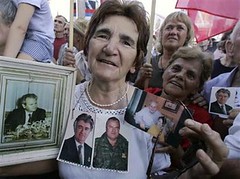
Milosevic posters appear in divided Kosovo town
Text of report by Serbia-Montenegrin radio Kontakt Plus on 28 June
[Announcer] A rally entitled "The truth about Kosovo-Metohija" is in progress in Sumadija Square [in northern part of Kosovska Mitrovica] attended by several hundred people. [Serbian Orthodox Church] Bishop of Milesevo Filaret, an academician and a member of the Bulgarian Academy [of Arts and Sciences], Velko Valkanov, a Greek member of the Parliamentary Assembly of the Council of Europe, journalist and publisher Ljiljana Bulatovic, journalist and publisher Milovan Drecun, writer Momir Lazic, Kosta Bulatovic, Mitar Balevic, lawyer Dragoljub Tomasevic, Prof Kosta Galjak and others will hold speeches.
Along with posters calling on citizens to attend this, as they put it, people's rally entitled "The truth about Kosovo-Metohija", posters featuring pictures of the former Yugoslav and Serbian president, Slobodan Milosevic, also appeared in the northern part of Kosovska Mitrovica. Mirjana Milutinovic has a report.
[Reporter] UNMIK [UN Interim Administration Mission in Kosovo] spokesman Gyoergy Kakuk told Kontakt Plus radio that the posters had been put up by a group of people based in Belgrade, adding that they had very limited support from the Kosovo Serbs.
[Kakuk, in English, superimposed by voice of interpreter] We understand that the posters were put up by a group based in Belgrade, the posters with Milosevic's face, and it seems that they have very limited support in [Kosovska] Mitrovica, not to mention among Kosovo Serbs in general. You should just remember the manner in which Milosevic used to exploit Kosovo Serbs for his own political purposes, and you should just remember what terrible consequences all this had for all Kosovo citizens. There is no law against putting up such posters, but it seems that the majority of Kosovo citizens are indifferent towards this, and they look upon it with scorn. I repeat that Kosovo Serbs, who suffered at the hands of this terrible person together with others, did not do this, UNMIK spokesman Gyoergy Kakuk said.
Prompted by the rally held today in Kosovska Mitrovica, entitled "The truth about Kosovo-Metohija", Gyoergy Kakuk said that the police had approved the rally as a way of celebrating St Vitus Day, not as a rally supporting any particular person, including Milosevic.
[Kakuk] We and the KPS [Kosovo Police Service] remain vigilant to uphold the people's democratic right of assembly and freedom of speech, and we will see to it that this is not abused, and that rallies proceed in a peaceful and democratic manner. So, we are making sure that there is no hate speech and incitement of ethnic hatred, the UNMIK spokesman said.
Source: Kontakt Plus, Kosovska Mitrovica, in Serbian 1400 gmt 28 Jun 05
[Announcer] A rally entitled "The truth about Kosovo-Metohija" is in progress in Sumadija Square [in northern part of Kosovska Mitrovica] attended by several hundred people. [Serbian Orthodox Church] Bishop of Milesevo Filaret, an academician and a member of the Bulgarian Academy [of Arts and Sciences], Velko Valkanov, a Greek member of the Parliamentary Assembly of the Council of Europe, journalist and publisher Ljiljana Bulatovic, journalist and publisher Milovan Drecun, writer Momir Lazic, Kosta Bulatovic, Mitar Balevic, lawyer Dragoljub Tomasevic, Prof Kosta Galjak and others will hold speeches.
Along with posters calling on citizens to attend this, as they put it, people's rally entitled "The truth about Kosovo-Metohija", posters featuring pictures of the former Yugoslav and Serbian president, Slobodan Milosevic, also appeared in the northern part of Kosovska Mitrovica. Mirjana Milutinovic has a report.
[Reporter] UNMIK [UN Interim Administration Mission in Kosovo] spokesman Gyoergy Kakuk told Kontakt Plus radio that the posters had been put up by a group of people based in Belgrade, adding that they had very limited support from the Kosovo Serbs.
[Kakuk, in English, superimposed by voice of interpreter] We understand that the posters were put up by a group based in Belgrade, the posters with Milosevic's face, and it seems that they have very limited support in [Kosovska] Mitrovica, not to mention among Kosovo Serbs in general. You should just remember the manner in which Milosevic used to exploit Kosovo Serbs for his own political purposes, and you should just remember what terrible consequences all this had for all Kosovo citizens. There is no law against putting up such posters, but it seems that the majority of Kosovo citizens are indifferent towards this, and they look upon it with scorn. I repeat that Kosovo Serbs, who suffered at the hands of this terrible person together with others, did not do this, UNMIK spokesman Gyoergy Kakuk said.
Prompted by the rally held today in Kosovska Mitrovica, entitled "The truth about Kosovo-Metohija", Gyoergy Kakuk said that the police had approved the rally as a way of celebrating St Vitus Day, not as a rally supporting any particular person, including Milosevic.
[Kakuk] We and the KPS [Kosovo Police Service] remain vigilant to uphold the people's democratic right of assembly and freedom of speech, and we will see to it that this is not abused, and that rallies proceed in a peaceful and democratic manner. So, we are making sure that there is no hate speech and incitement of ethnic hatred, the UNMIK spokesman said.
Source: Kontakt Plus, Kosovska Mitrovica, in Serbian 1400 gmt 28 Jun 05
Supporters Rally In Belgrade In Support Of Milosevic
BELGRADE (AP)--Hardline supporters of Slobodan Milosevic rallied Tuesday in the Serbian capital to commemorate the fourth anniversary of the former Yugoslav president's extradition to the U.N. war crimes tribunal.
The rally organizers, from Milosevic's Socialist Party of Serbia, handed out copies of a printed statement to about 3,000 supporters at Belgrade's main Republic Square.
The statement demanded Milosevic "be set free instantly" and called for the "arrest of those who committed the act of kidnapping and unlawful" handover of Milosevic to the U.N. court at The Hague, Netherlands.
The protesters held Socialist Party banners and gold-framed photographs and posters of their former leader.
Milosevic's popularity has increased amid a resurgence of hardline Serb nationalism, which helped trigger the wars in the Balkans in the 1990s.
Following his ouster in October 2000, Milosevic was extradited to The Hague tribunal on June 28, 2001, to face charges of genocide for atrocities committed by Serb troops in the wars in Croatia, Bosnia and Kosovo.
Belgrade media reported that Milosevic himself coordinated the organization of the rally from his detention cell at The Hague.
However, it was a far cry from the frenzied nationalist gatherings staged by Milosevic during his years in power, when tens of thousands attended.
The reformists who removed Milosevic from power have failed to live up to citizens' expectations that they would substantially improve the republic's economic and political situation.
Milosevic has been regaining popularity in Serbia, with almost a third of people saying they trust him despite his war crimes trial, a recent survey showed.
The survey, conducted by Faktor Plus polling agency, also said that Milosevic - who was ousted in a massive popular revolt - enjoys more popular backing than the current prime minister, Vojislav Kostunica, who took over Milosevic's presidency in 2000.
Intermixed with Milosevic posters at the Tuesday rally were pictures of two top fugitive war crimes suspects sought by the U.N. court - Bosnian Serb wartime political leader Radovan Karadzic and military commander Ratko Mladic. [ 28-06-05 1635GMT ]
The rally organizers, from Milosevic's Socialist Party of Serbia, handed out copies of a printed statement to about 3,000 supporters at Belgrade's main Republic Square.
The statement demanded Milosevic "be set free instantly" and called for the "arrest of those who committed the act of kidnapping and unlawful" handover of Milosevic to the U.N. court at The Hague, Netherlands.
The protesters held Socialist Party banners and gold-framed photographs and posters of their former leader.
Milosevic's popularity has increased amid a resurgence of hardline Serb nationalism, which helped trigger the wars in the Balkans in the 1990s.
Following his ouster in October 2000, Milosevic was extradited to The Hague tribunal on June 28, 2001, to face charges of genocide for atrocities committed by Serb troops in the wars in Croatia, Bosnia and Kosovo.
Belgrade media reported that Milosevic himself coordinated the organization of the rally from his detention cell at The Hague.
However, it was a far cry from the frenzied nationalist gatherings staged by Milosevic during his years in power, when tens of thousands attended.
The reformists who removed Milosevic from power have failed to live up to citizens' expectations that they would substantially improve the republic's economic and political situation.
Milosevic has been regaining popularity in Serbia, with almost a third of people saying they trust him despite his war crimes trial, a recent survey showed.
The survey, conducted by Faktor Plus polling agency, also said that Milosevic - who was ousted in a massive popular revolt - enjoys more popular backing than the current prime minister, Vojislav Kostunica, who took over Milosevic's presidency in 2000.
Intermixed with Milosevic posters at the Tuesday rally were pictures of two top fugitive war crimes suspects sought by the U.N. court - Bosnian Serb wartime political leader Radovan Karadzic and military commander Ratko Mladic. [ 28-06-05 1635GMT ]
Bosnian Foreign Ministry protests against Draskovic's statements
SARAJEVO, June 28 (Hina) - The authorities of Bosnia-Herzegovina on Tuesday expressed their concern and dissatisfaction to the Ambassador of Serbia and Montenegro, Stanimir Vukicevic, with the latest statements by Serbia and Montenegro Foreign Minister Vuk Draskovic, who linked the solving of Kosovo's status with the respecting of Bosnian state borders, the Bosnian Foreign Ministry reported.
The statement said that Ambassador Vukicevic was called to the ministry where he was received by acting secretary general Adnan Hadzikapetanovic.
Hadzikapetanovic told the ambassador that Draskovic's statement did not contribute to the good-neighbourly relations and the development of the spirit of regional cooperation.
The Bosnian Foreign Ministry has also instructed Bosnian Ambassador in Belgrade Tomislav Leko to ask the Serbia and Montenegro Foreign Ministry to take an official position on Draskovic's statement.
The statement said that Ambassador Vukicevic was called to the ministry where he was received by acting secretary general Adnan Hadzikapetanovic.
Hadzikapetanovic told the ambassador that Draskovic's statement did not contribute to the good-neighbourly relations and the development of the spirit of regional cooperation.
The Bosnian Foreign Ministry has also instructed Bosnian Ambassador in Belgrade Tomislav Leko to ask the Serbia and Montenegro Foreign Ministry to take an official position on Draskovic's statement.
Blerim Shala: Return to the last century (Zëri)
In a front-page editorial in Zëri, Blerim Shala comments on a report by the Serbian Interior Ministry regarding the situation in Kosovo from November 2004 – April 2005.
Shala argues that the approach and the conclusions of the report are identical with the reports of the Interior Ministry from the period November 1998 – April 1999. ‘As if nothing happened in the meantime,’ he says.
‘Translating this report and sending it to the right addresses in the West would be the best possible argument in Kosovo’s favour.’
Something similar, claims Shala, can be done with the public presentations of Vuk Draskovic, the foreign minister of the Union of Serbia and Montenegro.
Commenting on Draskovic’s statements, Shala says that both Kosovars and this part of Europe have grown tired ‘with such logic and arguments’.
In closing, Shala notes that with all the ups and downs in the Kosovan political scene, at least there is no politician in Kosovo that uses the language and arguments of the last century, as happens with Draskovic and the Serbian Ministry of Interior Affairs.
Shala argues that the approach and the conclusions of the report are identical with the reports of the Interior Ministry from the period November 1998 – April 1999. ‘As if nothing happened in the meantime,’ he says.
‘Translating this report and sending it to the right addresses in the West would be the best possible argument in Kosovo’s favour.’
Something similar, claims Shala, can be done with the public presentations of Vuk Draskovic, the foreign minister of the Union of Serbia and Montenegro.
Commenting on Draskovic’s statements, Shala says that both Kosovars and this part of Europe have grown tired ‘with such logic and arguments’.
In closing, Shala notes that with all the ups and downs in the Kosovan political scene, at least there is no politician in Kosovo that uses the language and arguments of the last century, as happens with Draskovic and the Serbian Ministry of Interior Affairs.
U.S. House of Rep. Resolution on Srebrenica Genocide
In the House of Representatives, U.S.,
June 27, 2005.
Whereas in July 1995 thousands of men and boys who had sought safety in the United Nations-designated `safe area' of Srebrenica in Bosnia and Herzegovina under the protection of the United Nations Protection Force (UNPROFOR) were massacred by Serb forces operating in that country;
Whereas beginning in April 1992, aggression and ethnic cleansing perpetrated by Bosnian Serb forces, while taking control of the surrounding territory, resulted in a massive influx of Bosniaks seeking protection in Srebrenica and its environs, which the United Nations Security Council designated a `safe area' in Resolution 819 on April 16, 1993;
Whereas the UNPROFOR presence in Srebrenica consisted of a Dutch peacekeeping battalion, with representatives of the United Nations High Commissioner for Refugees, the International Committee of the Red Cross, and the humanitarian medical aid agency Medecins Sans Frontie.AE2res (Doctors Without Borders) helping to provide humanitarian relief to the displaced population living in conditions of massive overcrowding, destitution, and disease;
Whereas Bosnian Serb forces blockaded the enclave early in 1995, depriving the entire population of humanitarian aid and outside communication and contact, and effectively reducing the ability of the Dutch peacekeeping battalion to deter aggression or otherwise respond effectively to a deteriorating situation;
Whereas beginning on July 6, 1995, Bosnian Serb forces attacked UNPROFOR outposts, seized control of the isolated enclave, held captured Dutch soldiers hostage and, after skirmishes with local defenders, ultimately took control of the town of Srebrenica on July 11, 1995;
Whereas an estimated one-third of the population of Srebrenica , including a relatively small number of soldiers, made a desperate attempt to pass through the lines of Bosnian Serb forces to the relative safety of Bosnian-held territory, but many were killed by patrols and ambushes;
Whereas the remaining population sought protection with the Dutch peacekeeping battalion at its headquarters in the village of Potocari north of Srebrenica but many of these individuals were randomly seized by Bosnian Serb forces to be beaten, raped, or executed;
Whereas Bosnian Serb forces deported women, children, and the elderly in buses, held Bosniak males over 16 years of age at collection points and sites in northeastern Bosnia and Herzegovina under their control, and then summarily executed and buried the captives in mass graves;
Whereas approximately 20 percent of Srebrenica's total population at the time--at least 7,000 and perhaps thousands more--was either executed or killed;
Whereas the United Nations and its member states have largely acknowledged their failure to take actions and decisions that could have deterred the assault on Srebrenica and prevented the subsequent massacre;
Whereas Bosnian Serb forces, hoping to conceal evidence of the massacre at Srebrenica , subsequently moved corpses from initial mass grave sites to many secondary sites scattered throughout parts of northeastern Bosnia and Herzegovina under their control;
Whereas the massacre at Srebrenica was among the worst of many horrible atrocities to occur in the conflict in Bosnia and Herzegovina from April 1992 to November 1995, during which the policies of aggression and ethnic cleansing pursued by Bosnian Serb forces with the direct support of the Serbian regime of Slobodan Milosevic and its followers ultimately led to the displacement of more than 2,000,000 people, an estimated 200,000 killed, tens of thousands raped or otherwise tortured and abused, and the innocent civilians of Sarajevo and other urban centers repeatedly subjected to shelling and sniper attacks;
Whereas Article 2 of the Convention on the Prevention and Punishment of the Crime of Genocide (done at Paris on December 9, 1948, and entered into force with respect to the United States on February 23, 1989) defines genocide as `any of the following acts committed with intent to destroy, in whole or in part, a national, ethnical, racial or religious group, as such: (a) killing members of the group; (b) causing serious bodily or mental harm to members of the group; (c) deliberately inflicting on the group conditions of life calculated to bring about its physical destruction in whole or in part; (d) imposing measures intended to prevent births within the group; and (e) forcibly transferring children of the group to another group';
Whereas on May 25, 1993, the United Nations Security Council adopted Resolution 827 establishing the world's first international war crimes tribunal, the International Criminal Tribunal for the former Yugoslavia (ICTY), based in The Hague, the Netherlands, and charging the ICTY with responsibility for investigating and prosecuting individuals suspected of committing war crimes, genocide, crimes against humanity and grave breaches of the 1949 Geneva Conventions on the territory of the former Yugoslavia since 1991;
Whereas nineteen individuals at various levels of responsibility have been indicted, and in some cases convicted, for grave breaches of the 1949 Geneva Conventions, violations of the laws or customs of war, crimes against humanity, genocide, and complicity in genocide associated with the massacre at Srebrenica , three of whom, most notably Radovan Karadzic and Ratko Mladic, remain at large; and
Whereas the international community, including the United States, has continued to provide personnel and resources, including through direct military intervention, to prevent further aggression and ethnic cleansing, to negotiate the General Framework Agreement for Peace in Bosnia and Herzegovina (initialed in Dayton, Ohio, on November 21, 1995, and signed in Paris on December 14, 1995), and to help ensure its fullest implementation, including cooperation with the International Criminal Tribunal for the former Yugoslavia: Now, therefore, be it
Resolved, That it is the sense of the House of Representatives that--
(1) the thousands of innocent people executed at Srebrenica in Bosnia and Herzegovina in July 1995, along with all individuals who were victimized during the conflict and genocide in Bosnia and Herzegovina from 1992 to 1995, should be solemnly remembered and honored;
(2) the policies of aggression and ethnic cleansing as implemented by Serb forces in Bosnia and Herzegovina from 1992 to 1995 meet the terms defining the crime of genocide in Article 2 of the Convention on the Prevention and Punishment of the Crime of Genocide;
(3) foreign nationals, including United States citizens, who have risked and in some cases lost their lives in Bosnia and Herzegovina while working toward peace should be solemnly remembered and honored;
(4) the United Nations and its member states should accept their share of responsibility for allowing the Srebrenica massacre and genocide to occur in Bosnia and Herzegovina from 1992 to 1995 by failing to take sufficient, decisive, and timely action, and the United Nations and its member states should constantly seek to ensure that this failure is not repeated in future crises and conflicts;
(5) it is in the national interest of the United States that those individuals who are responsible for war crimes, genocide, crimes against humanity, and grave breaches of the 1949 Geneva Conventions, committed in Bosnia and Herzegovina, should be held accountable for their actions;
(6) all persons indicted by the International Criminal Tribunal for the former Yugoslavia (ICTY) should be apprehended and transferred to The Hague without further delay, and all countries should meet their obligations to cooperate fully with the ICTY at all times; and
(7) the United States should continue to support the independence and territorial integrity of Bosnia and Herzegovina, peace and stability in southeastern Europe as a whole, and the right of all people living in the region, regardless of national, racial, ethnic or religious background, to return to their homes and enjoy the benefits of democratic institutions, the rule of law, and economic opportunity, as well as to know the fate of missing relatives and friends.
June 27, 2005.
Whereas in July 1995 thousands of men and boys who had sought safety in the United Nations-designated `safe area' of Srebrenica in Bosnia and Herzegovina under the protection of the United Nations Protection Force (UNPROFOR) were massacred by Serb forces operating in that country;
Whereas beginning in April 1992, aggression and ethnic cleansing perpetrated by Bosnian Serb forces, while taking control of the surrounding territory, resulted in a massive influx of Bosniaks seeking protection in Srebrenica and its environs, which the United Nations Security Council designated a `safe area' in Resolution 819 on April 16, 1993;
Whereas the UNPROFOR presence in Srebrenica consisted of a Dutch peacekeeping battalion, with representatives of the United Nations High Commissioner for Refugees, the International Committee of the Red Cross, and the humanitarian medical aid agency Medecins Sans Frontie.AE2res (Doctors Without Borders) helping to provide humanitarian relief to the displaced population living in conditions of massive overcrowding, destitution, and disease;
Whereas Bosnian Serb forces blockaded the enclave early in 1995, depriving the entire population of humanitarian aid and outside communication and contact, and effectively reducing the ability of the Dutch peacekeeping battalion to deter aggression or otherwise respond effectively to a deteriorating situation;
Whereas beginning on July 6, 1995, Bosnian Serb forces attacked UNPROFOR outposts, seized control of the isolated enclave, held captured Dutch soldiers hostage and, after skirmishes with local defenders, ultimately took control of the town of Srebrenica on July 11, 1995;
Whereas an estimated one-third of the population of Srebrenica , including a relatively small number of soldiers, made a desperate attempt to pass through the lines of Bosnian Serb forces to the relative safety of Bosnian-held territory, but many were killed by patrols and ambushes;
Whereas the remaining population sought protection with the Dutch peacekeeping battalion at its headquarters in the village of Potocari north of Srebrenica but many of these individuals were randomly seized by Bosnian Serb forces to be beaten, raped, or executed;
Whereas Bosnian Serb forces deported women, children, and the elderly in buses, held Bosniak males over 16 years of age at collection points and sites in northeastern Bosnia and Herzegovina under their control, and then summarily executed and buried the captives in mass graves;
Whereas approximately 20 percent of Srebrenica's total population at the time--at least 7,000 and perhaps thousands more--was either executed or killed;
Whereas the United Nations and its member states have largely acknowledged their failure to take actions and decisions that could have deterred the assault on Srebrenica and prevented the subsequent massacre;
Whereas Bosnian Serb forces, hoping to conceal evidence of the massacre at Srebrenica , subsequently moved corpses from initial mass grave sites to many secondary sites scattered throughout parts of northeastern Bosnia and Herzegovina under their control;
Whereas the massacre at Srebrenica was among the worst of many horrible atrocities to occur in the conflict in Bosnia and Herzegovina from April 1992 to November 1995, during which the policies of aggression and ethnic cleansing pursued by Bosnian Serb forces with the direct support of the Serbian regime of Slobodan Milosevic and its followers ultimately led to the displacement of more than 2,000,000 people, an estimated 200,000 killed, tens of thousands raped or otherwise tortured and abused, and the innocent civilians of Sarajevo and other urban centers repeatedly subjected to shelling and sniper attacks;
Whereas Article 2 of the Convention on the Prevention and Punishment of the Crime of Genocide (done at Paris on December 9, 1948, and entered into force with respect to the United States on February 23, 1989) defines genocide as `any of the following acts committed with intent to destroy, in whole or in part, a national, ethnical, racial or religious group, as such: (a) killing members of the group; (b) causing serious bodily or mental harm to members of the group; (c) deliberately inflicting on the group conditions of life calculated to bring about its physical destruction in whole or in part; (d) imposing measures intended to prevent births within the group; and (e) forcibly transferring children of the group to another group';
Whereas on May 25, 1993, the United Nations Security Council adopted Resolution 827 establishing the world's first international war crimes tribunal, the International Criminal Tribunal for the former Yugoslavia (ICTY), based in The Hague, the Netherlands, and charging the ICTY with responsibility for investigating and prosecuting individuals suspected of committing war crimes, genocide, crimes against humanity and grave breaches of the 1949 Geneva Conventions on the territory of the former Yugoslavia since 1991;
Whereas nineteen individuals at various levels of responsibility have been indicted, and in some cases convicted, for grave breaches of the 1949 Geneva Conventions, violations of the laws or customs of war, crimes against humanity, genocide, and complicity in genocide associated with the massacre at Srebrenica , three of whom, most notably Radovan Karadzic and Ratko Mladic, remain at large; and
Whereas the international community, including the United States, has continued to provide personnel and resources, including through direct military intervention, to prevent further aggression and ethnic cleansing, to negotiate the General Framework Agreement for Peace in Bosnia and Herzegovina (initialed in Dayton, Ohio, on November 21, 1995, and signed in Paris on December 14, 1995), and to help ensure its fullest implementation, including cooperation with the International Criminal Tribunal for the former Yugoslavia: Now, therefore, be it
Resolved, That it is the sense of the House of Representatives that--
(1) the thousands of innocent people executed at Srebrenica in Bosnia and Herzegovina in July 1995, along with all individuals who were victimized during the conflict and genocide in Bosnia and Herzegovina from 1992 to 1995, should be solemnly remembered and honored;
(2) the policies of aggression and ethnic cleansing as implemented by Serb forces in Bosnia and Herzegovina from 1992 to 1995 meet the terms defining the crime of genocide in Article 2 of the Convention on the Prevention and Punishment of the Crime of Genocide;
(3) foreign nationals, including United States citizens, who have risked and in some cases lost their lives in Bosnia and Herzegovina while working toward peace should be solemnly remembered and honored;
(4) the United Nations and its member states should accept their share of responsibility for allowing the Srebrenica massacre and genocide to occur in Bosnia and Herzegovina from 1992 to 1995 by failing to take sufficient, decisive, and timely action, and the United Nations and its member states should constantly seek to ensure that this failure is not repeated in future crises and conflicts;
(5) it is in the national interest of the United States that those individuals who are responsible for war crimes, genocide, crimes against humanity, and grave breaches of the 1949 Geneva Conventions, committed in Bosnia and Herzegovina, should be held accountable for their actions;
(6) all persons indicted by the International Criminal Tribunal for the former Yugoslavia (ICTY) should be apprehended and transferred to The Hague without further delay, and all countries should meet their obligations to cooperate fully with the ICTY at all times; and
(7) the United States should continue to support the independence and territorial integrity of Bosnia and Herzegovina, peace and stability in southeastern Europe as a whole, and the right of all people living in the region, regardless of national, racial, ethnic or religious background, to return to their homes and enjoy the benefits of democratic institutions, the rule of law, and economic opportunity, as well as to know the fate of missing relatives and friends.
Madeline Albright to address Kosovo Assembly on 5 July
Zëri reports on the front page that former US Secretary of State Madeleine Albright will visit Kosovo on July 5th when she will give a speech at the Kosovo Assembly. The news was confirmed by the Media Office of the Assembly. The paper notes that Albright will visit Kosovo in the capacity of director of the National Democratic Institute.
Zëri also reports that the Kosovo Government and Prime Minister Kosumi will host a dinner for Albright in honour of her constant contribution. Albright is also expected to meet senior Kosovan leaders.
Zëri also reports that the Kosovo Government and Prime Minister Kosumi will host a dinner for Albright in honour of her constant contribution. Albright is also expected to meet senior Kosovan leaders.
KFOR: No threat of violence when status negotiations start
Zëri reports on the front page that KFOR is not planning to increase the number of its troops in Kosovo as there is no serious threat when the negotiations on the final status start.
On the other hand, UNMIK officials think that during the sensitive stage of the comprehensive review by ambassador Kai Eide, there could be people interested in causing violence.
International media have speculated over the last few days that with the launch of status talks, Serb militants in the northern part of Kosovo and supported by nationalists from Serbia could start violence.
On the other hand, UNMIK officials think that during the sensitive stage of the comprehensive review by ambassador Kai Eide, there could be people interested in causing violence.
International media have speculated over the last few days that with the launch of status talks, Serb militants in the northern part of Kosovo and supported by nationalists from Serbia could start violence.
Balkans can enter EU only after solution of Kosovo’s status
Koha Ditore covers a political discussion ‘Balkans and the road ahead to EU’ that was held in Pristina and was organized by International Forum UBT 2005.
‘Europe cannot ignore Kosovo problem,’ said Michel Cullin, director of Vienna Diplomatic Academy, and added that the ‘Balkans should be seen as a European whole with Kosovo having a place in it’.
Skender Hyseni, an advisor to President Rugova, said that ‘solution of Kosovo’s status is a precondition for integration of the Balkans into the EU’.
Participants in the conference concluded that the solution of Kosovo’s final status is important for the future of the European Union.
‘Europe cannot ignore Kosovo problem,’ said Michel Cullin, director of Vienna Diplomatic Academy, and added that the ‘Balkans should be seen as a European whole with Kosovo having a place in it’.
Skender Hyseni, an advisor to President Rugova, said that ‘solution of Kosovo’s status is a precondition for integration of the Balkans into the EU’.
Participants in the conference concluded that the solution of Kosovo’s final status is important for the future of the European Union.
Monday, June 27, 2005
Kosovo Protesters Hurl Eggs At Serbia-Montenegro Minister
PRISTINA (AP)--Protesters in Kosovo hurled eggs at a convoy carrying Serbia- Montenegro's foreign minister on his first visit to the disputed province since the end of the war six years ago.
Around 100 protesters massed outside the U.N. headquarters as the foreign minister, Vuk Draskovic, met with the deputy head of the U.N. mission in Kosovo, Larry Rossin.
Some of the demonstrators threw eggs from the balconies of nearby buildings as Draskovic's convoy arrived. Police arrested about a dozen protesters. Two local reporters were also detained during a melee that followed the arrests.
"His visit is unacceptable, because...Serbia is unacceptable," said a statement from the Kosovo Action Network, a group that organized the protests. " The state union that (Draskovic) represents was an accomplice in crimes here," it said.
Kosovo has been administered by the U.N. since mid-1999 when a NATO air war halted Serb forces' crackdown on ethnic Albanians seeking independence.
An estimated 10,000 ethnic Albanians were killed. After the end of the war, tens of thousands of Serbs fled the province in the face of attacks and threats from ethnic Albanian extremists.
Those Serbs remaining live mainly in isolated enclaves scattered around the province, and the two communities remain divided.
Talks to resolve Kosovo's status are expected later this year if Kosovo - legally a province of the Serbia-Montenegro union that replaced Yugoslavia - meets U.N.-set standards on democracy, human rights and rights of minorities.
Kosovo's ethnic Albanian majority demands independence, while Serbs want the province to remain within their borders.
Draskovic's visit follows one by Serbia's prime minister, Vojislav Kostunica, who attended a Serb Orthodox Mass in western Kosovo in January. Serbian President Boris Tadic toured Serb communities in Kosovo in February.
Draskovic later traveled to the Serb enclave of Gracanica to observe Vidovdan, or St. Vitus Day, a Serb holiday marking the 616th anniversary of an epic battle against Ottoman Turks.
(END) Dow Jones Newswires
Around 100 protesters massed outside the U.N. headquarters as the foreign minister, Vuk Draskovic, met with the deputy head of the U.N. mission in Kosovo, Larry Rossin.
Some of the demonstrators threw eggs from the balconies of nearby buildings as Draskovic's convoy arrived. Police arrested about a dozen protesters. Two local reporters were also detained during a melee that followed the arrests.
"His visit is unacceptable, because...Serbia is unacceptable," said a statement from the Kosovo Action Network, a group that organized the protests. " The state union that (Draskovic) represents was an accomplice in crimes here," it said.
Kosovo has been administered by the U.N. since mid-1999 when a NATO air war halted Serb forces' crackdown on ethnic Albanians seeking independence.
An estimated 10,000 ethnic Albanians were killed. After the end of the war, tens of thousands of Serbs fled the province in the face of attacks and threats from ethnic Albanian extremists.
Those Serbs remaining live mainly in isolated enclaves scattered around the province, and the two communities remain divided.
Talks to resolve Kosovo's status are expected later this year if Kosovo - legally a province of the Serbia-Montenegro union that replaced Yugoslavia - meets U.N.-set standards on democracy, human rights and rights of minorities.
Kosovo's ethnic Albanian majority demands independence, while Serbs want the province to remain within their borders.
Draskovic's visit follows one by Serbia's prime minister, Vojislav Kostunica, who attended a Serb Orthodox Mass in western Kosovo in January. Serbian President Boris Tadic toured Serb communities in Kosovo in February.
Draskovic later traveled to the Serb enclave of Gracanica to observe Vidovdan, or St. Vitus Day, a Serb holiday marking the 616th anniversary of an epic battle against Ottoman Turks.
(END) Dow Jones Newswires
OHR: THERE CAN BE NO MEDDLING WITH BiH’S BORDERS
SARAJEVO, June 27 (FENA) – The weekend’s statement by Serbia and Montenegro Foreign Minister Vuk Draskovic, suggesting a linkage between a settlement of the status of Kosovo and BiH are damaging, destabilizing and completely unacceptable, was announced by the OHR.
The Kosovo question is a matter solely for the international community and the Government of Serbia and Montenegro, and has no connection with Bosnia and Herzegovina, was announced.
"Bosnia and Herzegovina is a sovereign state, a member of the United Nations whose borders are internationally recognised, and guaranteed by treaty and by law. These borders are not a matter for negotiation and Serbia and Montenegro, as a Dayton signatory has an obligation to uphold them. The days when Belgrade brings into question Bosnia and Herzegovina ’s borders are long gone and will never be allowed return", was announced.
These kinds of comments damage Serbia and Montenegro's ability to be regarded as a stable influence in the region and a country on its way to Europe, was anounced by the OHR.
The Kosovo question is a matter solely for the international community and the Government of Serbia and Montenegro, and has no connection with Bosnia and Herzegovina, was announced.
"Bosnia and Herzegovina is a sovereign state, a member of the United Nations whose borders are internationally recognised, and guaranteed by treaty and by law. These borders are not a matter for negotiation and Serbia and Montenegro, as a Dayton signatory has an obligation to uphold them. The days when Belgrade brings into question Bosnia and Herzegovina ’s borders are long gone and will never be allowed return", was announced.
These kinds of comments damage Serbia and Montenegro's ability to be regarded as a stable influence in the region and a country on its way to Europe, was anounced by the OHR.
Petkovic: Those who don’t live here cannot decide for K-Serbs
Several dailies quote Returns and Communities Minister Slavisa Petkovic as saying that those who don’t live in Kosovo cannot decide for Kosovo Serbs. Zëri notes that Petkovic has called on Kosovo Serbs to take their fate in their own hands and not listen to others who don’t live with them in Kosovo.
‘When Belgrade called on us not to participate in elections, it didn’t tell us how we should pursue our interests in Kosovo and we still don’t have answer to this,’ Petkovic was quoted as saying.
‘When Belgrade called on us not to participate in elections, it didn’t tell us how we should pursue our interests in Kosovo and we still don’t have answer to this,’ Petkovic was quoted as saying.
Jessen-Petersen: I hope talks between Belgrade and Pristina will start in July
Epoka e Re reports that UNMIK chief Søren Jessen-Petersen told Vienna-based Standard newspaper that he hopes talks between Belgrade and Pristina would start in July. ‘For the time being, we are trying to organize the meeting between the two presidents. Both Ibrahim Rugova and Boris Tadic have accepted this. As soon as this meeting is held, nothing will stand in the way of the meeting of the two prime ministers,’ said Jessen-Petersen.
Sunday, June 26, 2005
Picture of the Day
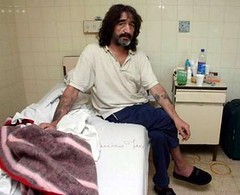
Serbian citizen Nebojsa Minic is seen at a hospital where he remains under police custody in Mendoza June 25, 2005. Serbia's special war crimes court on Wednesday urged the government to extradite Minic, who is suspected of murdering Kosovo Albanians in 1999, during the NATO bombing of Yugoslavia. REUTERS/Paulo Paez
1,000 UK troops on Kosovo standby to counter Serb militants
By Robert Fox in Pristina
26 June 2005
Britain is drawing up contingency plans to send up to 1,000 extra British troops and advisers to Kosovo as a crisis looms over the Balkan province's future.
Officially Kosovo remains a part of Serbia, although it has been under international control since 1999, when Nato troops took over in the wake of a bombing campaign against ex-president Slobodan Milosevic. But the province's restive Albanian majority, backed by the US, is demanding independence from "final status" talks later this year.
Serbs inside Kosovo, of whom about 125,000 remain, and the Serbian government still oppose Kosovo breaking away. Recently, however, Belgrade has shifted its position by declaring Kosovo should be granted something "more than autonomy, but less than independence". Either way, the interim Kosovo government of President Ibrahim Rugova and Prime Minister Bajram Kosumi believes there is a threat of serious violence once the talks get under way.
In March last year riots across the province killed 19 people, including one UN policeman, and seriously injured more than 200. A report into the riots by Kai Eide, a Norwegian diplomat, castigated Unmik, the UN mission to Kosovo, and K-For, the international military force, for incompetence, inertia and corruption. As the violence erupted, German UN troops were accused of hiding in their barracks. The 1st Battalion, the Royal Gloucester Wiltshire and Berkshire Regiment, then Nato's spearhead battalion, had to be flown in. As tensions rose this spring, the 1st Green Jackets had to be brought in for a similar mission.
As the "final status" talks begin, trouble is feared from Serb militants in Mitrovica and north-east Kosovo, with intelligence suggesting they could be supported by nationalists across the border in Serbia. More worrying, say intelligence analysts, is the possibility of another spontaneous nationalist uprising by militant Kosovo Albanians if independence is put off yet again. "We could face something like the KLA uprising in 1998, only this time we don't know who the new leaders will be," said one.
Britain has 200 troops and support personnel in Kosovo, and some 1,000 troops in Bosnia, where the international administration is run by Lord Ashdown. But his mission ends in October, and Britain hands over command of the EU force in Bosnia at the same time. The Ministry of Defence says officially there are no immediate plans to send troops to Kosovo, but "contingencies are under constant review". According to military sources, the timing means the British battalion in Bosnia could be switched to Kosovo, just when it might be needed.
26 June 2005
Britain is drawing up contingency plans to send up to 1,000 extra British troops and advisers to Kosovo as a crisis looms over the Balkan province's future.
Officially Kosovo remains a part of Serbia, although it has been under international control since 1999, when Nato troops took over in the wake of a bombing campaign against ex-president Slobodan Milosevic. But the province's restive Albanian majority, backed by the US, is demanding independence from "final status" talks later this year.
Serbs inside Kosovo, of whom about 125,000 remain, and the Serbian government still oppose Kosovo breaking away. Recently, however, Belgrade has shifted its position by declaring Kosovo should be granted something "more than autonomy, but less than independence". Either way, the interim Kosovo government of President Ibrahim Rugova and Prime Minister Bajram Kosumi believes there is a threat of serious violence once the talks get under way.
In March last year riots across the province killed 19 people, including one UN policeman, and seriously injured more than 200. A report into the riots by Kai Eide, a Norwegian diplomat, castigated Unmik, the UN mission to Kosovo, and K-For, the international military force, for incompetence, inertia and corruption. As the violence erupted, German UN troops were accused of hiding in their barracks. The 1st Battalion, the Royal Gloucester Wiltshire and Berkshire Regiment, then Nato's spearhead battalion, had to be flown in. As tensions rose this spring, the 1st Green Jackets had to be brought in for a similar mission.
As the "final status" talks begin, trouble is feared from Serb militants in Mitrovica and north-east Kosovo, with intelligence suggesting they could be supported by nationalists across the border in Serbia. More worrying, say intelligence analysts, is the possibility of another spontaneous nationalist uprising by militant Kosovo Albanians if independence is put off yet again. "We could face something like the KLA uprising in 1998, only this time we don't know who the new leaders will be," said one.
Britain has 200 troops and support personnel in Kosovo, and some 1,000 troops in Bosnia, where the international administration is run by Lord Ashdown. But his mission ends in October, and Britain hands over command of the EU force in Bosnia at the same time. The Ministry of Defence says officially there are no immediate plans to send troops to Kosovo, but "contingencies are under constant review". According to military sources, the timing means the British battalion in Bosnia could be switched to Kosovo, just when it might be needed.
Saturday, June 25, 2005
Most wanted: doctor death - The Independent
Ten years after Radovan Karadzic's troops killed 7,000 Muslims in Srebrenica, the former Serb leader remains at large. In this remarkable report from the heart of Bosnia, Antony Barnett goes on the trail of Europe's most notorious war criminal
Sunday June 26, 2005
The Observer
What strikes you first is the colour of the house. As you drive along the bumpy stone road that leads to the family home of Dr Radovan Karadzic, Europe's most wanted war criminal, its garish pink exterior bursts out in front of you. But despite its bright facade, it is a house that hides many dark secrets.
On Monday 11 July it will be 10 years since Karadzic's Bosnian Serb soldiers marched into the United Nations safe haven at Srebrenica and slaughtered more than 7,000 Bosnian Muslim men and boys. Yet Karadzic, the chief architect of this massacre - as well as the mastermind of the 1,000-day siege of Sarajevo that saw 10,000 civilians killed, 1,000 of them children - remains a free man.
Despite a $5 million (£2.7m) bounty on his head, Karadzic is a fugitive. Protected by a secret underground network made up of politicians, criminals, spies, businessmen and priests from the Orthodox church, Karadzic - a psychiatrist, children's author and poet in another life - is believed to be hiding in the mountains of eastern Bosnia close to the border with Montenegro.
His liberty remains a major embarrassment to the international community and an open sore in a country where 200,000 people were killed in a bitter ethnic war between Serb, Muslims and Croats. There can be no healing until Karadzic faces justice.
A decade after Srebenica and his indictment at The Hague, The Observer set out on a journey to reveal the network built to hide a man accused of committing the worst atrocities witnessed in Europe since the concentration camps of Nazi Germany.
Karadzic's pink family home is the obvious place to start. It stands on the outskirts of a town called Pale, cradled in the Bosnian mountains. Before the war in 1992 it was a ski village 10 miles south east of Sarajevo. Today it is the capital of the Republic of Sprska (pronounced Serbska), the semi-autonomous region of Bosnia that the Serbs like to call their own. It is a state within a state, where Karadzic's nationalist Serbian Democratic Party (SDP) still holds considerable power and is linked to an organised crime network run by Serb former paramilitary leaders and war criminals loyal to him. Most towns and villages there were ethnically cleansed, with Muslim communities expelled or exterminated. Mosques came down, Orthodox Serb churches went up.
Pale was a Karadzic stronghold in the war. It was from the Panorama hotel in the town centre that Karadzic and his cronies planned their brutal campaign. It takes only a few minutes to drive from the hotel to the Karadzic home.
As I arrive at the house the front door opens. None of the three people standing by the hall, who are thought to be part of Karadzic's extended family, will be interviewed, nor answer questions asked through the locked iron security gate. 'Have you seen Radovan? Where do you think he is? Can I speak to his wife Ljiljana? Has she seen him recently?'
All the questions are greeted with silence. After a while a tall, broad-shouldered man with closely-shaved dark hair, believed to be Karadzic's brother-in-law, comes to the gate and says they cannot help us. Karadzic's wife is not here. She is at another property, painting it after it was wrecked during a raid by Nato troops searching for clues to the whereabouts of her husband.
The next-door neighbours watch nervously from their first floor balcony. They too refuse to answer questions. A man in a scruffy red polo shirt with a walkie-talkie in hand comes over to ask for my ID papers. I ask for his. He claims he is with the Republic of Sprska police. He asks us to leave. I have doubts about the authenticity of his own ID, but decide to head into the centre of Pale.
Love letters from 'Radovan' to his beloved wife 'Lili', dated 2002, have recently been published showing that these two psychiatrists, who fell in love at medical school in Sarajevo, have met at a secret location. In one letter Karadzic tells his wife it would 'take a battalion' to discover his hiding place ... Of course, caution is necessary but there is not need of such fear and paranoia.'
His apparent lack of concern appears well founded. Despite being, like Osama bin Laden, one of the world's most wanted men and hiding in a country as small as Wales, the commitment to capture him by the 7,000 overseas troops still in Bosnia seems questionable. The French are regularly accused of being 'too close' to the Karadzic network, and even the British seem reticent.
One British officer serving in Bosnia, alluding to the fact that any attempt to snatch Karadzic is likely to lead to a shoot-out, said: 'If you think we would risk the life of one British soldier for these people, then you're wrong.'
This month - a week after a remarkable video appeared revealing the horror of the massacre in Srebrenica - Karadzic's brother, Luka, said: 'My brother has made a strategic decision to never surrender to the Hague Tribunal [set up try those accused of war crimes]. If he surrendered he would betray his people and God, which has protected him from the enemies for so long.'
To those hunting the so-called Butcher of Bosnia, these people make a web of clandestine supporters who form a protective financial and spiritual cloak around Karadzic that keeps him free. Such is their influence that one source claims trackers sent from The Hague to find Karadzic are sometimes spotted as arriving at Sarajevo airport and put under surveillance. Information is fed to Karadzic's army of bodyguards, who can move him at short notice should one of these investigators get a lucky break.
To these supporters Karadzic is a folk hero, a leader who helped protect them from the Muslim hordes. They inhabit a closed world, hostile to outsiders and suspicious of questions.
An orthodox priest, Father Jeremija Starovlah, gets up from his chair when he sees me approaching. His short silver hair and beard offer a striking contrast to his traditional black robes. The small, pretty white church that he runs is in the centre of Pale, a short drive from the Karadzic home.
A local newspaper reported last March that Starovlah was calling on Orthodox believers to shelter Karadzic. A few weeks later the international authorities said they had intelligence suggesting Karadzic was staying with the priest. Nato forces raided Starovlah's home, blowing up his front door and injuring his son. Karadzic was not found.
The raid provoked street protests by more than 2,000 Bosnian Serbs. Some wore masks of Karadzic while others waved the blue, red and white flags of the Republic of Sprska.
Now Starovlah refuses to speak or answer any questions. 'Has Karadzic been here?' I ask. 'Do you regard him as a hero? Where do you think he is now? Should he go to the Hague?' He says only: 'I have no comment to make. I do not wish to speak about this.'
Starovlah shows no desire to set the record straight. This is a priest in the Bosnian Serb capital, who is close to the Karadzic family. And in the Republic of Sprska, family secrets are closely guarded.
One of the most shocking parts of a recent film of Srebenica, showing six Muslims being bound and shot at close range, was that it began with a Serb Orthodox priest blessing the camouflaged paramilitary troops who carried out the massacre. Rumours persist that Karadzic is disguised as a priest and moving from monastery to monastery.
As well as the church in Pale, intelligence agencies have monitored phone calls that disclose he has hidden in the isolated mountain monastery of Ostrog. Karadzic's grandson was christened there. According to a diplomatic source it is estimated that Karadzic spends 80 per cent of his time in church property. The source says it is not a coincidence that since the war dozens of new Orthodox churches have been built at a cost of millions of pounds. It is alleged that most of this money comes from the same illicit sources that provide the funds to protect Karadzic.
Yet while the church may offer Karadzic spiritual and physical sanctuary, an altogether more criminal network funds the $200,000 a month operation to protect the 'Doctor in the Forest'.
Milovan Bjelica is waiting for me outside Cafe Iceberg in the town of Sokolac, a 45-minute drive from Sarajevo. Smoking a Malboro and drinking an espresso he beckons us over with his steel-blue eyes. A disfigured right hand hangs loosely by his side.
Nato arrested Bjelica twice last year, detaining him for a month at a time. Armed troops swooped on the town last August and questioned him for more than two hours a day for a whole month. They had heard he had gone to Belgrade and accused him of meeting supporters of Karadzic. Bjelica claims he was there to have surgery.
Bjelica has been accused by the US State Department and the European Union of funnelling money to the Karadzic network and running the security and intelligence units that guard him. His name is on the US list of international terrorists and he is banned from travelling to any EU country.
In March 2003 the US government described him as a 'long-time friend and business associate of Karadzic, [who] presides over a network of legal and illegal businesses that are also used to provide for the protection of Karadzic'.
Bjelica denies all this but there is no doubt he is a supporter of Karadzic and was a powerful figure in his Serbian Democratic Party. Bjelica was the party president in eastern Bosnia during the war and spent time with Karadzic.
Bjelica has agreed to meet us because he wants to ensure I understand that many Serbs were killed in the war and suffered Muslim ethnic cleansing. He takes my notebook and draws a sketch of Sarajevo, pointing out areas where he claims 5,000 Serbs were killed.
Bjelica has seen the video of Srebenica and thought it was 'terrible'. But he claims there are films of the Bosnian Muslims, or mujahideen, as he calls them, beheading Serbs. 'Why is that not shown on your TV?' he says.
Like many of Karadzic's closest allies, he believes their leader 'signed a contract' with Richard Holbrooke, President Bill Clinton's chief adviser during the Dayton Peace Accord in 1995 that ended the war. This stipulated that if Karadzic disappeared from frontline politics he would not be arrested.
'To over 90 per cent of Bosnian Serbs he is a hero,' says Bjelica. 'He protected the Serbian people during the war.'
So where does Bjelica, whose nickname 'Cicko' means pussycat, think his friend is hiding? He shrugs. Stubbing out his cigarette, he gets up from the table, shakes my hand and leaves.
The centre Sarajevo is a long way from the corridors of Westminster, but the heated complexity of Bosnian politics makes the hurly-burly of the House of Commons seem tame. Yet it is the former Liberal Democrat leader Paddy Ashdown, who, as the High Representative of the International Community in Bosnia, has overall responsibility for stability in the region. As part of Lord Ashdown's brief, the capture of Karadzic and other war criminals such as General Ratko Mladic, the former Bosnian Serb military commander, is pivotal.
'You can't have peace without justice,' says Ashdown. 'And only after that you can get to reconciliation. This can only happen when the major architects of these crimes are brought to justice.'
His office sits on the former front line of the Sarajevo's bloody battle, and the surrounding buildings are pockmarked with bullet holes. The former Bosnian parliament building across the street remains a burnt-out wreck, a vivid reminder of the horrors faced by civilians in the siege of the city that was inspired by Karadzic. It was largely Serbian sniper bullets and shells that rained down from the surrounding mountains killing those queuing for bread or buying fruit in the main street market.
So why, 10 years on, has Karadzic not been found? 'Catching war criminals is a campaign, not a commando raid,' says Ashdown. 'It requires changing the political climate, attacking corrupt networks, removing the money he uses to fund himself. It requires isolation by taking out lower-level war criminals. Then we have a better change of catching him.' Ashdown describes Karadzic as 'the head of a vast criminal organisation' that thrives on corruption and extortion. Visits are paid to businessmen from dark forces who ask for contributions for the 'doctor in the forest'. These organised crime networks make vast sums from smuggling drugs, petrol and tobacco as well as trafficking young girls for the sex trade.
Ashdown's office has carried out investigative audits on many of the state-owned companies, such as the electricity firm Electroprivreda and discovered tens of millions of dollars missing.
'We have just carried out an audit of Sprske Sume, the Serb forestry organisation, and found it riddled with political backhanders just siphoned out of the system. This is public money just disappearing into political parties such as the SDS. From there siphoning it to Karadzic is not a difficult thing to do.'
Ashdown's office believes that one of the key 'bankers' to Karadzic's network is Momcilo Mandic, a former minister who commanded Karadzic's police force. Mandic has made a fortune from running petrol stations, a bank and other businesses. Like Bjelica he is on a number of international blacklists but lives freely in Belgrade. The US has described him as a 'major funding source for Karadzic through his control of an elaborate network of criminal enterprises engaged in embezzlement, business fraud and fictitious loans'. He too has denied the claims.
Another Bosnian Serb accused of providing money for the Karadzic network is Radomir Kojic, who is also on the US terrorist list and banned from travelling. Last month an Observer investigation discovered that his mine-clearing company, Unipak, won many lucrative contracts from foreign governments including six from the UK Department for International Development. Kojic, a wartime Serb commander in the hills around Sarajevo, rejects the claims, saying his he is the victim of false rumours spread by business rivals who have provided no evidence of wrongdoing.
Meeting us outside his hotel in the ski resort of Jahorina, where Sarajevo's Winter Olympics was held in 1984, he claims his business now faces ruin. 'It is better for my family if I kill myself,' Kojic says. He does, however, admit he was a member of Karadzic's party in 1990 and the property developer who built Karadzic's family home in Pale. The pink house, it seems, is never far from the centre from the story.
They call the area the heart of darkness. The geographical triangle created by the towns of Visegrad, Cajnice and Foca in the Republic of Sprska in the far east of Bosnia is indeed a cold, dark place. But these are not adjectives used to describe the region's physical appearance. It is rich in natural beauty, with the majestic River Drina snaking its way through the glorious pine forests in the valley as the peaks of the Zelengora mountains tower above.
The chill comes from the history that swept across the nearby borders of Serbia and Montenegro and whipped up a storm of ethnic hatred that brutalised a generation. It remains a hotbed of fervent Serb nationalism where some of the worst genocidal crimes of the Bosnian war were committed. Ten years ago it was not dead branches from the pine trees that the Drina carried in its fast-flowing, but the bodies of hundreds of butchered Muslims that were swept along in its bloodstained water.
It is among these mountains and remote villages of his loyal supporters that many believe Karadzic is hiding. It is close enough to the porous borders of Montenegro, the country of Karadzic's birth, that the 'Doctor from the Forest' can easily slip through out of the clutches of Nato and European Union forces.
At the apex of the triangle is Foca, a place renowned for harbouring war criminals. Before the war more than half of the town's 40,000 population was Muslim, now there are none. Rape, torture and murder changed that.
Today the centre of Foca is a scene of normality. Teenagers wearing fashion able sunglasses sip beer and smoke cigarettes at cafes overlooking the river while rock music pumps from the speakers. At Cafe Uno, a group of four older men sit around a table eating the traditional local Bosnian dish of cevapi, small sausages made of lamb and beef.
I ask if they will talk about Karadzic. At first nobody wants to speak. 'We don't want to talk about politics,' said one. 'Do you think of him as a hero or a war criminal?' I ask. After a pause, one of them, a chubby man with curly hair, barks: 'A hero, of course. He protected us.'
The oldest in the group, with a moustache and fine grey hair, then takes over. He snarls: 'You English and Americans, you know where he is. You are protecting him. If you wanted to arrest him you could.' The others around the table nod in agreement. They want us to leave.
As I start driving high into the mountains towards the Montenegro border, it becomes increasingly clear why it has been so difficult to catch Karadzic. Not only is he among people who view in him as one of a long line of Serb heroes who have fought off foreign invaders. But the terrain itself is almost impassable in a normal car. The roads are practically dirt tracks and wind their way up steep mountainous slopes that rise into the clouds. If Karadzic was hiding anywhere here, his security people would see anybody coming from miles away.
As I leave Foca and head back to Sarajevo there is a sign for Niksic, the home town of Karadzic's mother, which is 105km east in Montenegro. As I drive on, three young boys coming from a game of football pass by. They raise their hands in the infamous three-fingered salute of Serb nationalists.
Fugitives from justice
General Ratko Mladic
Mladic was commander of Serbian troops in Bosnia during the war. Along with Karadzic he is charged with genocide for ordering the massacre of Muslims in Srebrenica and the siege of Sarajevo in which 10,000 civilians were killed. He is blamed for abetting the 'systematic' campaign of sniping at civilians in the city over the past three years and for the seizure and use as human shields of 284 UN peacekeepers in May and June 1995. He is accused of shelling the towns of Tuzla and Srebrenica 'in order to kill, terrorise and demoralise the Bosnian Muslim and Bosnian Croat civilian population'. Aged 50.
Ante Gotovina
A Croatian, he is the Hague tribunal's third most wanted man. He is accused of the murder of hundreds of Serbs. Aged 49.
Milan Lukic
The notorious leader of the White Eagles paramilitary group, he is accused of masterminding the massacre of thousands of Muslims in the eastern Bosnian town of Visregrad. Many were burned alive. Women and children were forced across the bridge over the River Drina and shot. Thousands of local men were killed elsewhere. Aged 38.
Dragan Zelenovic
Zelenovic is charged with organising the mass rape and torture of Muslim women in the Bosnian town of Foca. Aged 44.
Sunday June 26, 2005
The Observer
What strikes you first is the colour of the house. As you drive along the bumpy stone road that leads to the family home of Dr Radovan Karadzic, Europe's most wanted war criminal, its garish pink exterior bursts out in front of you. But despite its bright facade, it is a house that hides many dark secrets.
On Monday 11 July it will be 10 years since Karadzic's Bosnian Serb soldiers marched into the United Nations safe haven at Srebrenica and slaughtered more than 7,000 Bosnian Muslim men and boys. Yet Karadzic, the chief architect of this massacre - as well as the mastermind of the 1,000-day siege of Sarajevo that saw 10,000 civilians killed, 1,000 of them children - remains a free man.
Despite a $5 million (£2.7m) bounty on his head, Karadzic is a fugitive. Protected by a secret underground network made up of politicians, criminals, spies, businessmen and priests from the Orthodox church, Karadzic - a psychiatrist, children's author and poet in another life - is believed to be hiding in the mountains of eastern Bosnia close to the border with Montenegro.
His liberty remains a major embarrassment to the international community and an open sore in a country where 200,000 people were killed in a bitter ethnic war between Serb, Muslims and Croats. There can be no healing until Karadzic faces justice.
A decade after Srebenica and his indictment at The Hague, The Observer set out on a journey to reveal the network built to hide a man accused of committing the worst atrocities witnessed in Europe since the concentration camps of Nazi Germany.
Karadzic's pink family home is the obvious place to start. It stands on the outskirts of a town called Pale, cradled in the Bosnian mountains. Before the war in 1992 it was a ski village 10 miles south east of Sarajevo. Today it is the capital of the Republic of Sprska (pronounced Serbska), the semi-autonomous region of Bosnia that the Serbs like to call their own. It is a state within a state, where Karadzic's nationalist Serbian Democratic Party (SDP) still holds considerable power and is linked to an organised crime network run by Serb former paramilitary leaders and war criminals loyal to him. Most towns and villages there were ethnically cleansed, with Muslim communities expelled or exterminated. Mosques came down, Orthodox Serb churches went up.
Pale was a Karadzic stronghold in the war. It was from the Panorama hotel in the town centre that Karadzic and his cronies planned their brutal campaign. It takes only a few minutes to drive from the hotel to the Karadzic home.
As I arrive at the house the front door opens. None of the three people standing by the hall, who are thought to be part of Karadzic's extended family, will be interviewed, nor answer questions asked through the locked iron security gate. 'Have you seen Radovan? Where do you think he is? Can I speak to his wife Ljiljana? Has she seen him recently?'
All the questions are greeted with silence. After a while a tall, broad-shouldered man with closely-shaved dark hair, believed to be Karadzic's brother-in-law, comes to the gate and says they cannot help us. Karadzic's wife is not here. She is at another property, painting it after it was wrecked during a raid by Nato troops searching for clues to the whereabouts of her husband.
The next-door neighbours watch nervously from their first floor balcony. They too refuse to answer questions. A man in a scruffy red polo shirt with a walkie-talkie in hand comes over to ask for my ID papers. I ask for his. He claims he is with the Republic of Sprska police. He asks us to leave. I have doubts about the authenticity of his own ID, but decide to head into the centre of Pale.
Love letters from 'Radovan' to his beloved wife 'Lili', dated 2002, have recently been published showing that these two psychiatrists, who fell in love at medical school in Sarajevo, have met at a secret location. In one letter Karadzic tells his wife it would 'take a battalion' to discover his hiding place ... Of course, caution is necessary but there is not need of such fear and paranoia.'
His apparent lack of concern appears well founded. Despite being, like Osama bin Laden, one of the world's most wanted men and hiding in a country as small as Wales, the commitment to capture him by the 7,000 overseas troops still in Bosnia seems questionable. The French are regularly accused of being 'too close' to the Karadzic network, and even the British seem reticent.
One British officer serving in Bosnia, alluding to the fact that any attempt to snatch Karadzic is likely to lead to a shoot-out, said: 'If you think we would risk the life of one British soldier for these people, then you're wrong.'
This month - a week after a remarkable video appeared revealing the horror of the massacre in Srebrenica - Karadzic's brother, Luka, said: 'My brother has made a strategic decision to never surrender to the Hague Tribunal [set up try those accused of war crimes]. If he surrendered he would betray his people and God, which has protected him from the enemies for so long.'
To those hunting the so-called Butcher of Bosnia, these people make a web of clandestine supporters who form a protective financial and spiritual cloak around Karadzic that keeps him free. Such is their influence that one source claims trackers sent from The Hague to find Karadzic are sometimes spotted as arriving at Sarajevo airport and put under surveillance. Information is fed to Karadzic's army of bodyguards, who can move him at short notice should one of these investigators get a lucky break.
To these supporters Karadzic is a folk hero, a leader who helped protect them from the Muslim hordes. They inhabit a closed world, hostile to outsiders and suspicious of questions.
An orthodox priest, Father Jeremija Starovlah, gets up from his chair when he sees me approaching. His short silver hair and beard offer a striking contrast to his traditional black robes. The small, pretty white church that he runs is in the centre of Pale, a short drive from the Karadzic home.
A local newspaper reported last March that Starovlah was calling on Orthodox believers to shelter Karadzic. A few weeks later the international authorities said they had intelligence suggesting Karadzic was staying with the priest. Nato forces raided Starovlah's home, blowing up his front door and injuring his son. Karadzic was not found.
The raid provoked street protests by more than 2,000 Bosnian Serbs. Some wore masks of Karadzic while others waved the blue, red and white flags of the Republic of Sprska.
Now Starovlah refuses to speak or answer any questions. 'Has Karadzic been here?' I ask. 'Do you regard him as a hero? Where do you think he is now? Should he go to the Hague?' He says only: 'I have no comment to make. I do not wish to speak about this.'
Starovlah shows no desire to set the record straight. This is a priest in the Bosnian Serb capital, who is close to the Karadzic family. And in the Republic of Sprska, family secrets are closely guarded.
One of the most shocking parts of a recent film of Srebenica, showing six Muslims being bound and shot at close range, was that it began with a Serb Orthodox priest blessing the camouflaged paramilitary troops who carried out the massacre. Rumours persist that Karadzic is disguised as a priest and moving from monastery to monastery.
As well as the church in Pale, intelligence agencies have monitored phone calls that disclose he has hidden in the isolated mountain monastery of Ostrog. Karadzic's grandson was christened there. According to a diplomatic source it is estimated that Karadzic spends 80 per cent of his time in church property. The source says it is not a coincidence that since the war dozens of new Orthodox churches have been built at a cost of millions of pounds. It is alleged that most of this money comes from the same illicit sources that provide the funds to protect Karadzic.
Yet while the church may offer Karadzic spiritual and physical sanctuary, an altogether more criminal network funds the $200,000 a month operation to protect the 'Doctor in the Forest'.
Milovan Bjelica is waiting for me outside Cafe Iceberg in the town of Sokolac, a 45-minute drive from Sarajevo. Smoking a Malboro and drinking an espresso he beckons us over with his steel-blue eyes. A disfigured right hand hangs loosely by his side.
Nato arrested Bjelica twice last year, detaining him for a month at a time. Armed troops swooped on the town last August and questioned him for more than two hours a day for a whole month. They had heard he had gone to Belgrade and accused him of meeting supporters of Karadzic. Bjelica claims he was there to have surgery.
Bjelica has been accused by the US State Department and the European Union of funnelling money to the Karadzic network and running the security and intelligence units that guard him. His name is on the US list of international terrorists and he is banned from travelling to any EU country.
In March 2003 the US government described him as a 'long-time friend and business associate of Karadzic, [who] presides over a network of legal and illegal businesses that are also used to provide for the protection of Karadzic'.
Bjelica denies all this but there is no doubt he is a supporter of Karadzic and was a powerful figure in his Serbian Democratic Party. Bjelica was the party president in eastern Bosnia during the war and spent time with Karadzic.
Bjelica has agreed to meet us because he wants to ensure I understand that many Serbs were killed in the war and suffered Muslim ethnic cleansing. He takes my notebook and draws a sketch of Sarajevo, pointing out areas where he claims 5,000 Serbs were killed.
Bjelica has seen the video of Srebenica and thought it was 'terrible'. But he claims there are films of the Bosnian Muslims, or mujahideen, as he calls them, beheading Serbs. 'Why is that not shown on your TV?' he says.
Like many of Karadzic's closest allies, he believes their leader 'signed a contract' with Richard Holbrooke, President Bill Clinton's chief adviser during the Dayton Peace Accord in 1995 that ended the war. This stipulated that if Karadzic disappeared from frontline politics he would not be arrested.
'To over 90 per cent of Bosnian Serbs he is a hero,' says Bjelica. 'He protected the Serbian people during the war.'
So where does Bjelica, whose nickname 'Cicko' means pussycat, think his friend is hiding? He shrugs. Stubbing out his cigarette, he gets up from the table, shakes my hand and leaves.
The centre Sarajevo is a long way from the corridors of Westminster, but the heated complexity of Bosnian politics makes the hurly-burly of the House of Commons seem tame. Yet it is the former Liberal Democrat leader Paddy Ashdown, who, as the High Representative of the International Community in Bosnia, has overall responsibility for stability in the region. As part of Lord Ashdown's brief, the capture of Karadzic and other war criminals such as General Ratko Mladic, the former Bosnian Serb military commander, is pivotal.
'You can't have peace without justice,' says Ashdown. 'And only after that you can get to reconciliation. This can only happen when the major architects of these crimes are brought to justice.'
His office sits on the former front line of the Sarajevo's bloody battle, and the surrounding buildings are pockmarked with bullet holes. The former Bosnian parliament building across the street remains a burnt-out wreck, a vivid reminder of the horrors faced by civilians in the siege of the city that was inspired by Karadzic. It was largely Serbian sniper bullets and shells that rained down from the surrounding mountains killing those queuing for bread or buying fruit in the main street market.
So why, 10 years on, has Karadzic not been found? 'Catching war criminals is a campaign, not a commando raid,' says Ashdown. 'It requires changing the political climate, attacking corrupt networks, removing the money he uses to fund himself. It requires isolation by taking out lower-level war criminals. Then we have a better change of catching him.' Ashdown describes Karadzic as 'the head of a vast criminal organisation' that thrives on corruption and extortion. Visits are paid to businessmen from dark forces who ask for contributions for the 'doctor in the forest'. These organised crime networks make vast sums from smuggling drugs, petrol and tobacco as well as trafficking young girls for the sex trade.
Ashdown's office has carried out investigative audits on many of the state-owned companies, such as the electricity firm Electroprivreda and discovered tens of millions of dollars missing.
'We have just carried out an audit of Sprske Sume, the Serb forestry organisation, and found it riddled with political backhanders just siphoned out of the system. This is public money just disappearing into political parties such as the SDS. From there siphoning it to Karadzic is not a difficult thing to do.'
Ashdown's office believes that one of the key 'bankers' to Karadzic's network is Momcilo Mandic, a former minister who commanded Karadzic's police force. Mandic has made a fortune from running petrol stations, a bank and other businesses. Like Bjelica he is on a number of international blacklists but lives freely in Belgrade. The US has described him as a 'major funding source for Karadzic through his control of an elaborate network of criminal enterprises engaged in embezzlement, business fraud and fictitious loans'. He too has denied the claims.
Another Bosnian Serb accused of providing money for the Karadzic network is Radomir Kojic, who is also on the US terrorist list and banned from travelling. Last month an Observer investigation discovered that his mine-clearing company, Unipak, won many lucrative contracts from foreign governments including six from the UK Department for International Development. Kojic, a wartime Serb commander in the hills around Sarajevo, rejects the claims, saying his he is the victim of false rumours spread by business rivals who have provided no evidence of wrongdoing.
Meeting us outside his hotel in the ski resort of Jahorina, where Sarajevo's Winter Olympics was held in 1984, he claims his business now faces ruin. 'It is better for my family if I kill myself,' Kojic says. He does, however, admit he was a member of Karadzic's party in 1990 and the property developer who built Karadzic's family home in Pale. The pink house, it seems, is never far from the centre from the story.
They call the area the heart of darkness. The geographical triangle created by the towns of Visegrad, Cajnice and Foca in the Republic of Sprska in the far east of Bosnia is indeed a cold, dark place. But these are not adjectives used to describe the region's physical appearance. It is rich in natural beauty, with the majestic River Drina snaking its way through the glorious pine forests in the valley as the peaks of the Zelengora mountains tower above.
The chill comes from the history that swept across the nearby borders of Serbia and Montenegro and whipped up a storm of ethnic hatred that brutalised a generation. It remains a hotbed of fervent Serb nationalism where some of the worst genocidal crimes of the Bosnian war were committed. Ten years ago it was not dead branches from the pine trees that the Drina carried in its fast-flowing, but the bodies of hundreds of butchered Muslims that were swept along in its bloodstained water.
It is among these mountains and remote villages of his loyal supporters that many believe Karadzic is hiding. It is close enough to the porous borders of Montenegro, the country of Karadzic's birth, that the 'Doctor from the Forest' can easily slip through out of the clutches of Nato and European Union forces.
At the apex of the triangle is Foca, a place renowned for harbouring war criminals. Before the war more than half of the town's 40,000 population was Muslim, now there are none. Rape, torture and murder changed that.
Today the centre of Foca is a scene of normality. Teenagers wearing fashion able sunglasses sip beer and smoke cigarettes at cafes overlooking the river while rock music pumps from the speakers. At Cafe Uno, a group of four older men sit around a table eating the traditional local Bosnian dish of cevapi, small sausages made of lamb and beef.
I ask if they will talk about Karadzic. At first nobody wants to speak. 'We don't want to talk about politics,' said one. 'Do you think of him as a hero or a war criminal?' I ask. After a pause, one of them, a chubby man with curly hair, barks: 'A hero, of course. He protected us.'
The oldest in the group, with a moustache and fine grey hair, then takes over. He snarls: 'You English and Americans, you know where he is. You are protecting him. If you wanted to arrest him you could.' The others around the table nod in agreement. They want us to leave.
As I start driving high into the mountains towards the Montenegro border, it becomes increasingly clear why it has been so difficult to catch Karadzic. Not only is he among people who view in him as one of a long line of Serb heroes who have fought off foreign invaders. But the terrain itself is almost impassable in a normal car. The roads are practically dirt tracks and wind their way up steep mountainous slopes that rise into the clouds. If Karadzic was hiding anywhere here, his security people would see anybody coming from miles away.
As I leave Foca and head back to Sarajevo there is a sign for Niksic, the home town of Karadzic's mother, which is 105km east in Montenegro. As I drive on, three young boys coming from a game of football pass by. They raise their hands in the infamous three-fingered salute of Serb nationalists.
Fugitives from justice
General Ratko Mladic
Mladic was commander of Serbian troops in Bosnia during the war. Along with Karadzic he is charged with genocide for ordering the massacre of Muslims in Srebrenica and the siege of Sarajevo in which 10,000 civilians were killed. He is blamed for abetting the 'systematic' campaign of sniping at civilians in the city over the past three years and for the seizure and use as human shields of 284 UN peacekeepers in May and June 1995. He is accused of shelling the towns of Tuzla and Srebrenica 'in order to kill, terrorise and demoralise the Bosnian Muslim and Bosnian Croat civilian population'. Aged 50.
Ante Gotovina
A Croatian, he is the Hague tribunal's third most wanted man. He is accused of the murder of hundreds of Serbs. Aged 49.
Milan Lukic
The notorious leader of the White Eagles paramilitary group, he is accused of masterminding the massacre of thousands of Muslims in the eastern Bosnian town of Visregrad. Many were burned alive. Women and children were forced across the bridge over the River Drina and shot. Thousands of local men were killed elsewhere. Aged 38.
Dragan Zelenovic
Zelenovic is charged with organising the mass rape and torture of Muslim women in the Bosnian town of Foca. Aged 44.
Subscribe to:
Posts (Atom)