 A Kosovo police guard salutes as Kosovo Prime Minister Bajram Kosumi arrives at President Ibrahim Rugova's residence to express his condolences in Kosovo's capital Pristina on Saturday, Jan. 21, 2006. Rugova who had been suffering from lung cancer, died on Saturday, Jan. 21, 2006 according to officials. Rugova had been at the forefront of ethnic Albanian demand for independence from Serbia since the early 1990s, when he started leading a nonviolent movement against the policies of Slobodan Milosevic, then president of Yugoslavia. (AP Photo / Visar Kryeziu)
Saturday, January 21, 2006
A Kosovo police guard salutes as Kosovo Prime Minister Bajram Kosumi arrives at President Ibrahim Rugova's residence to express his condolences in Kosovo's capital Pristina on Saturday, Jan. 21, 2006. Rugova who had been suffering from lung cancer, died on Saturday, Jan. 21, 2006 according to officials. Rugova had been at the forefront of ethnic Albanian demand for independence from Serbia since the early 1990s, when he started leading a nonviolent movement against the policies of Slobodan Milosevic, then president of Yugoslavia. (AP Photo / Visar Kryeziu)


 Flags fly at half staff on top of Kosovo's President Ibrahim Rugova's residence as Kosovo Police officers guard the building in Kosovo's capital Pristina on Saturday, Jan 21, 2006. Rugova, who had been suffering from lung cancer, died on Saturday, Jan. 21, 2006 according to officials. Rugova had been at the forefront of ethnic Albanian demand for independence from Serbia since the early 1990s, when he started leading a nonviolent movement against the policies of Slobodan Milosevic, then president of Yugoslavia. (AP Photo / Visar Kryeziu)
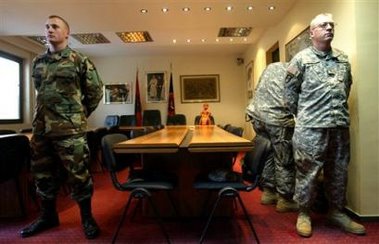 U.S. army medics who were treating the late cancer striken Kosovo President Ibrahim Rugova stand guard at his residence in Kosovo's capital Pristina on Saturday, Jan. 21, 2006. Rugova who had been suffering from lung cancer, died on Saturday, Jan. 21, 2006 according to officials. Rugova had been at the forefront of ethnic Albanian demand for independence from Serbia since the early 1990s, when he started leading a nonviolent movement against the policies of Slobodan Milosevic, then president of Yugoslavia. (AP Photo / Visar Kryeziu)
Breaking News: Talks On Kosovo's Future Status Postponed Until Feb -UN
PRISTINA, Serbia-Montenegro (AP)--The start of U.N.-mediated talks to determine the future status of Kosovo have been postponed until February following the death of Kosovo President Ibrahim Rugova, the spokeswoman for the chief U.N. negotiator said Saturday.
Hua Jiag said face-to-face talks planned for Wednesday in Vienna were postponed "due to the mourning period." The negotiations between Serbs and ethnic Albanians aim to determine whether Kosovo will become independent or remain part of Serbia-Montenegro.
Hua Jiag said face-to-face talks planned for Wednesday in Vienna were postponed "due to the mourning period." The negotiations between Serbs and ethnic Albanians aim to determine whether Kosovo will become independent or remain part of Serbia-Montenegro.
SRSG statement on the passing of President Ibrahim Rugova
PRISTINA - SRSG Søren Jessen-Petersen issued the following statement upon learning of the passing of President Ibrahim Rugova:
“This is a moment of profound sorrow for Kosovo and I share your sadness and grief.
I wish first of all to extend my heartfelt condolences, in my own name and on behalf of all of UNMIK, to President Rugova’s family – may you find strength and comfort in each other and in your faith to see you through this very painful moment.
I also want to extend my condolences to the people of Kosovo and the PISG. President Rugova’s unwavering belief in his vision for Kosovo, which he pursued so determinedly throughout his life, earned him the respect of not only the people of Kosovo but also the wider international community.
I have had the pleasure and privilege of meeting the President very frequently. I will always remember him as a wise, thoughtful, committed and warm person.
It is particularly tragic that President Rugova should leave us at this very decisive moment for the future of Kosovo.
The best tribute we can pay to President Rugova and his legacy is to stay united during the coming months.
Indeed, this is the moment for all the people and political leaders of Kosovo to pull together and show the maturity and wisdom that would serve Kosovo well now and in the future.
President Rugova was a unifying force, a talented and highly-committed leader who continued to work tirelessly for Kosovo until his last days.
He leaves behind a legacy of determination and perseverance, and dialogue.
He will always have a unique place in the history of Kosovo.”
“This is a moment of profound sorrow for Kosovo and I share your sadness and grief.
I wish first of all to extend my heartfelt condolences, in my own name and on behalf of all of UNMIK, to President Rugova’s family – may you find strength and comfort in each other and in your faith to see you through this very painful moment.
I also want to extend my condolences to the people of Kosovo and the PISG. President Rugova’s unwavering belief in his vision for Kosovo, which he pursued so determinedly throughout his life, earned him the respect of not only the people of Kosovo but also the wider international community.
I have had the pleasure and privilege of meeting the President very frequently. I will always remember him as a wise, thoughtful, committed and warm person.
It is particularly tragic that President Rugova should leave us at this very decisive moment for the future of Kosovo.
The best tribute we can pay to President Rugova and his legacy is to stay united during the coming months.
Indeed, this is the moment for all the people and political leaders of Kosovo to pull together and show the maturity and wisdom that would serve Kosovo well now and in the future.
President Rugova was a unifying force, a talented and highly-committed leader who continued to work tirelessly for Kosovo until his last days.
He leaves behind a legacy of determination and perseverance, and dialogue.
He will always have a unique place in the history of Kosovo.”
Kosovo leader Ibrahim Rugova dies
Kosovo President Ibrahim Rugova has died after losing a battle with lung cancer, officials have announced.
Mr Rugova, 61, regarded as a moderate ethnic Albanian, came to prominence in the 1990s as leader of the ethnic Albanian resistance against Serbia.
Kosovo has been under UN administration since 1999 when a Nato bombing campaign stopped Serb forces expelling ethnic Albanians during a separatist war.
Rugova's death will complicate talks on the future of Kosovo, observers say.
Friday, January 20, 2006
Kosovars Mourn Slovak NATO Peacekeepers
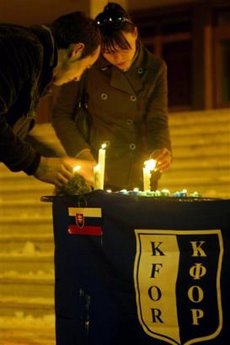
Kosovo Albanians light candles in the capital Pristina in memory of Slovak soldiers who served in the NATO-led peacekeeping mission in Kosovo on Friday, Jan. 20, 2006. A Slovak military plane crashed into a mountain in eastern Hungary on Thursday night, killing 42 people, mostly peacekeepers returning from the NATO mission in Kosovo. Around 100 Slovak are based in the province as part of the NATO-led peace force. (AP Photo/Visar Kryeziu)
Kosovo leaders regret loss of Slovakian peacekeepers
PRISTINA, Jan 20, 2006 (AFP) -
Senior political and military leaders in Kosovo expressed condolences Friday to Bratislava over the loss of Slovak peacekeepers in an airplane crash in Hungary.
Bajram Kosumi, the prime minister of Kosovo where the peacekeepers were serving, said his government and people were "deeply sorry for the tragic death of Slovakian soldiers while they were returning to their families from their honourable mission in building peace in Kosovo".
"We will honor the memory of the lost soldiers and their professionalism by continuing to operate with the same vigour and enthusiasm they displayed," said Italian General Giuseppe Valotto, commander of NATO-led forces in Kosovo (KFOR).
KFOR has about 17,000 troops from 35 nations.
The soldiers are in charge of establishing and maintaining a secure environment in the province, including public safety and aiding the UN mission in Kosovo.
Kosovo is technically part of Serbia but has been a UN protectorate since NATO intervened in 1999 to end clashes between Serbian forces and separatist guerrillas.
Since their mission started, more than 110 international peacekeepers have lost their lives in Kosovo in various accidents.
Senior political and military leaders in Kosovo expressed condolences Friday to Bratislava over the loss of Slovak peacekeepers in an airplane crash in Hungary.
Bajram Kosumi, the prime minister of Kosovo where the peacekeepers were serving, said his government and people were "deeply sorry for the tragic death of Slovakian soldiers while they were returning to their families from their honourable mission in building peace in Kosovo".
"We will honor the memory of the lost soldiers and their professionalism by continuing to operate with the same vigour and enthusiasm they displayed," said Italian General Giuseppe Valotto, commander of NATO-led forces in Kosovo (KFOR).
KFOR has about 17,000 troops from 35 nations.
The soldiers are in charge of establishing and maintaining a secure environment in the province, including public safety and aiding the UN mission in Kosovo.
Kosovo is technically part of Serbia but has been a UN protectorate since NATO intervened in 1999 to end clashes between Serbian forces and separatist guerrillas.
Since their mission started, more than 110 international peacekeepers have lost their lives in Kosovo in various accidents.
Thursday, January 19, 2006
Kosovo's future: Independent thinking
From The Economist print edition
Jan 19th 2006
IF YOU were to assess the future of Kosovo only from the local media, you might think that megaphone diplomacy was all that was happening. Kosovo will be Serbian forever, trumpet Serbia's leaders. The province's Albanian majority retort that nothing less than full independence will do for Kosovo's 2m people, more than 90% of whom are ethnic Albanians. It seems an impasse.
Yet behind the megaphones, tough negotiation has already taken place—albeit not between Serbs and Albanians. Since the end of the Kosovo war in 1999, Serbia's southern province has been under the jurisdiction of the UN, which last November appointed Martti Ahtisaari, a former Finnish president, to start talks on Kosovo's future status. The Serbs and Kosovo Albanians have assembled negotiating teams that are due to meet for the first time next week in Vienna.
But much of the hard bargaining has already happened, among interested outside powers: Britain, France, America and Russia. Given these countries' foreign-policy differences, the degree of consensus on Kosovo is surprising. Even Russian diplomats, who insist publicly that they will back the Serbs, say the opposite in private. The four powers all agree that Kosovo should have “conditional independence”, code for full independence after a transitional period, but with certain safeguards for Kosovo's remaining Serbs.
The only dispute is over tactics. At present, all are pretending that the future of Kosovo is to be settled in Mr Ahtisaari's talks. But in private it is accepted that, since the two sides will never agree, the decisions will have to be taken for them. British diplomats argue that the sooner an explicit guarantee is given to the Kosovo Albanians that independence in some form is coming, the greater the concessions they will be ready to make to Kosovo's 100,000-odd remaining Serbs. The French are more cautious, fearing that going public too soon may mean that the Serbs refuse to engage in any talks at all.
If the outcome is already agreed, what is the point of Mr Ahtisaari's negotiations? The answer, in the words of one diplomat, is that they “are not about the status of Kosovo...[but about] negotiating the status of the Serbs in Kosovo.” The Serbian government may still insist that Kosovo belongs to Serbia under international law, but such a position needs outside backing if it is to be credible. Realising that Russia's support is uncertain, the Serbs appealed last month to France. The French replied that they would support Serbia's legitimate interests, but only if they were realistic—and keeping Kosovo was not that.
A disappointed Boris Tadic, Serbia's president, is now preparing a fallback position. If Kosovo's independence cannot be prevented, he is putting out feelers to see if Serbia can, at least, stop the Kosovo Albanians having their own army and, for the foreseeable future, a separate seat at the UN. The Serbs give warning that, if Kosovo is lost completely, radical nationalists may come to power. A recent poll showed support for the nationalists holding up better than for other parties.
Yet this threat may not be that worrying, either. What would happen if the nationalists were to take control? Not much, shrugs one diplomat. Serbia's choice is, he says, “Belarus or Brussels”—isolation or Europe. As with Hobson's choice, it is really no choice at all.
Jan 19th 2006
IF YOU were to assess the future of Kosovo only from the local media, you might think that megaphone diplomacy was all that was happening. Kosovo will be Serbian forever, trumpet Serbia's leaders. The province's Albanian majority retort that nothing less than full independence will do for Kosovo's 2m people, more than 90% of whom are ethnic Albanians. It seems an impasse.
Yet behind the megaphones, tough negotiation has already taken place—albeit not between Serbs and Albanians. Since the end of the Kosovo war in 1999, Serbia's southern province has been under the jurisdiction of the UN, which last November appointed Martti Ahtisaari, a former Finnish president, to start talks on Kosovo's future status. The Serbs and Kosovo Albanians have assembled negotiating teams that are due to meet for the first time next week in Vienna.
But much of the hard bargaining has already happened, among interested outside powers: Britain, France, America and Russia. Given these countries' foreign-policy differences, the degree of consensus on Kosovo is surprising. Even Russian diplomats, who insist publicly that they will back the Serbs, say the opposite in private. The four powers all agree that Kosovo should have “conditional independence”, code for full independence after a transitional period, but with certain safeguards for Kosovo's remaining Serbs.
The only dispute is over tactics. At present, all are pretending that the future of Kosovo is to be settled in Mr Ahtisaari's talks. But in private it is accepted that, since the two sides will never agree, the decisions will have to be taken for them. British diplomats argue that the sooner an explicit guarantee is given to the Kosovo Albanians that independence in some form is coming, the greater the concessions they will be ready to make to Kosovo's 100,000-odd remaining Serbs. The French are more cautious, fearing that going public too soon may mean that the Serbs refuse to engage in any talks at all.
If the outcome is already agreed, what is the point of Mr Ahtisaari's negotiations? The answer, in the words of one diplomat, is that they “are not about the status of Kosovo...[but about] negotiating the status of the Serbs in Kosovo.” The Serbian government may still insist that Kosovo belongs to Serbia under international law, but such a position needs outside backing if it is to be credible. Realising that Russia's support is uncertain, the Serbs appealed last month to France. The French replied that they would support Serbia's legitimate interests, but only if they were realistic—and keeping Kosovo was not that.
A disappointed Boris Tadic, Serbia's president, is now preparing a fallback position. If Kosovo's independence cannot be prevented, he is putting out feelers to see if Serbia can, at least, stop the Kosovo Albanians having their own army and, for the foreseeable future, a separate seat at the UN. The Serbs give warning that, if Kosovo is lost completely, radical nationalists may come to power. A recent poll showed support for the nationalists holding up better than for other parties.
Yet this threat may not be that worrying, either. What would happen if the nationalists were to take control? Not much, shrugs one diplomat. Serbia's choice is, he says, “Belarus or Brussels”—isolation or Europe. As with Hobson's choice, it is really no choice at all.
EU warns Serbia over Mladic hunt
The EU has warned Serbia that moves towards eventual EU membership may be halted if Belgrade fails to hand over top war crimes suspect Ratko Mladic.
The former Bosnian Serb wartime general has been on the run since 1995. He has been charged with genocide and other crimes related to the Bosnian war.
EU Enlargement Commissioner Olli Rehn said suspending negotiations was an option if Belgrade did not co-operate.
The UN's chief war crimes prosecutor said Gen Mladic was hiding in Serbia.
Carla del Ponte accused elements in the Serbian army of sheltering him.
"Mladic is in Serbia, and as you know, Mladic is protected with power of the army," she said after a meeting with Mr Rehn.
She had urged Belgrade to hand over Gen Mladic to the war crimes tribunal in The Hague in 2005.
The former Bosnian Serb political leader, Radovan Karadzic, also tops the list of suspects most wanted by the tribunal.
Belgrade's choice
Mr Rehn warned it would be extremely difficult for the EU to conclude an association agreement with Belgrade unless Gen Mladic and other wanted war crimes suspects were handed over.
An association agreement would be the first step on the road to EU membership for Serbia.
"I hope Belgrade takes this message very seriously and starts acting accordingly," Mr Rehn said.
"The suspension of negotiations is certainly one alternative... Serbia has to choose now between the nationalist past and a European future. I hope they choose the European future."
Ms del Ponte said she wanted to put Gen Mladic in the dock in July, along with the other suspects indicted for the killing of 8,000 Muslim men and boys in the Bosnian town of Srebrenica - the worst atrocity in Europe since World War II.
The Serbia-Montenegro Defence Minister, Zoran Stankovic, insisted that Belgrade was still looking for Gen Mladic, the Associated Press reported.
He said he had recently met Gen Mladic's wife and son.
"The operation to catch Mladic is under way... All available army personnel are engaged in this," he said.
Story from BBC NEWS: http://news.bbc.co.uk/go/pr/fr/-/2/hi/europe/4629174.stm
The former Bosnian Serb wartime general has been on the run since 1995. He has been charged with genocide and other crimes related to the Bosnian war.
EU Enlargement Commissioner Olli Rehn said suspending negotiations was an option if Belgrade did not co-operate.
The UN's chief war crimes prosecutor said Gen Mladic was hiding in Serbia.
Carla del Ponte accused elements in the Serbian army of sheltering him.
"Mladic is in Serbia, and as you know, Mladic is protected with power of the army," she said after a meeting with Mr Rehn.
She had urged Belgrade to hand over Gen Mladic to the war crimes tribunal in The Hague in 2005.
The former Bosnian Serb political leader, Radovan Karadzic, also tops the list of suspects most wanted by the tribunal.
Belgrade's choice
Mr Rehn warned it would be extremely difficult for the EU to conclude an association agreement with Belgrade unless Gen Mladic and other wanted war crimes suspects were handed over.
An association agreement would be the first step on the road to EU membership for Serbia.
"I hope Belgrade takes this message very seriously and starts acting accordingly," Mr Rehn said.
"The suspension of negotiations is certainly one alternative... Serbia has to choose now between the nationalist past and a European future. I hope they choose the European future."
Ms del Ponte said she wanted to put Gen Mladic in the dock in July, along with the other suspects indicted for the killing of 8,000 Muslim men and boys in the Bosnian town of Srebrenica - the worst atrocity in Europe since World War II.
The Serbia-Montenegro Defence Minister, Zoran Stankovic, insisted that Belgrade was still looking for Gen Mladic, the Associated Press reported.
He said he had recently met Gen Mladic's wife and son.
"The operation to catch Mladic is under way... All available army personnel are engaged in this," he said.
Story from BBC NEWS: http://news.bbc.co.uk/go/pr/fr/-/2/hi/europe/4629174.stm
Wednesday, January 18, 2006
Here Comes Montenegro - The Wall Street Journal
By Janusz Bugajski
18 January 2006
(Copyright (c) 2006, Dow Jones & Company, Inc.)
It's decision-time in the Western Balkans. As the final status of Kosovo will be determined over the coming months, Serbia and Montenegro are approaching a formal divorce once the smaller of the remaining Yugoslav republics holds a referendum on independence in April.
International involvement is needed to help these three quasi-states resolve all this peacefully and successfully. Attempts to prevent democratic choices for national self-determination would exacerbate conflicts in the years ahead. The alternative to establishing legitimate states is growing nationalist resentments that will be increasingly directed against the EU, NATO and others on the ground in the Balkans.
Although the status of Kosovo took center stage last year with the appointment of former Finnish President Martti Ahtisaari as the UN mediator, it is tempting but wrong to link this issue to Montenegro, the mountainous coastal republic of less than a million people, where no international mediation is necessary. Unlike Kosovo, Montenegro was a federal republic in the defunct Yugoslavia with the same right to independence as all countries emerging from this failed state, including Slovenia, now an EU and NATO member.
Montenegro postponed its independence vote three years ago after EU representatives pressured the government in Podgorica to temporarily sacrifice the republic's national aspirations in the hope of pacifying Serbia. But the Serbia-Montenegro Union has proved to be a dysfunctional and expensive arrangement that has worsened relations between the two capitals and slowed down their reform programs.
Some EU diplomats calculate that pressing Montenegro to annul its planned referendum on statehood will compensate Serbia for the loss of Kosovo. But manipulating the destiny of Montenegro will not assuage regional nationalisms. It is likely to further embolden radicals in Serbia and distract attention from the country's internal reforms. It will also generate resentment among the pro-European and pro-American portion of the Montenegrin population that supports independence. Although a narrow majority is in favor of statehood, opinion polls show this to be the most educated, reformist and entrepreneurial part of the population that sees Montenegro's future in the EU and NATO.
Montenegro's governing coalition, led by Prime Minister Milo Djukanovic, includes post-communist reformers, social democrats and representatives of the Albanian minority who seek to build a multi-ethnic state based on civic principles rather than ethno-national identity. However, the reform process has been stalled because of Montenegro's isolation from Western institutions and its continuing links with an even less reformed Serbia. Additionally, Belgrade has sought to discredit the independence movement by charging the Montenegrin authorities with criminal connections.
During the Milosevic era, Podgorica kept itself afloat by bypassing international sanctions on ex-Yugoslavia and building its own state institutions in opposition to Milosevic. Montenegro's independence will help to make the government more transparent and its aspirations to join the EU will enable it to meet the required international standards for good governance.
Montenegro's plan to hold a democratic referendum was legitimized by the EU when it established the current State Union. The arrangement stipulated that either republic had the right to hold an independence referendum after three years, and this period expires in February. The EU troika also acknowledged Montenegro's right to a plebiscite once the recommendations of the Venice Commission on voting principles were issued in December. Having validated its compliance with international standards, Podgorica is planning to announce the date of the referendum in the coming weeks.
Paradoxically, one of the longest existing states in the Balkans is poised to be one of the last to restore its independence. While the rest of the peninsula was under Ottoman control for almost 500 years, Montenegro preserved its sovereignty and its royal family was linked by marriage to almost every European monarchy. Serbia deposed the Montenegrin king when it gained control of Montenegro after World War I and manipulated the close ethnic affinity and common language of the two nations to claim that Montenegro was simply a province of Serbia.
Montenegrin officials point out that a reaffirmation of statehood will serve to improve relations with Serbia by removing fears of domination and assimilation. At the same time, borders will become increasingly redundant as both states move toward membership in Europe's institutions.
The greatest benefit to Serbia from casting off Kosovo and Montenegro will be its own independence, which has been thwarted by three failed Yugoslavias. Freed from incessant disputes with Podgorica and Pristina over state structures, administrative responsibilities and financial obligations, Belgrade will finally be in a position to build a strong Serbia, pursue more rigorous structural and economic reforms, and move forward on NATO and EU membership.
The surest path to international integration is through legitimate statehood. Only sovereign countries can enter NATO and the EU, not unstable entities, joint states or international dependencies. If the EU disqualifies any legitimate Balkan state from the European project, it will lose credibility and effectiveness as a democratic bloc. Delaying the status question would increase opportunities for cross-border criminal networks, encourage depopulation as locals escape to the richer EU countries and radicalize a younger generation with diminished prospects for employment. It would be less costly and less disruptive to accept three new countries that commit themselves to a process of Europeanization.
---
Mr. Bugajski, director of the New European Democracies project at the Center for Strategic and International Studies, is co-author with Ilona Teleki of the "Atlantic Bridges: America's New European Allies," forthcoming from Rowan and Littlefield.
18 January 2006
(Copyright (c) 2006, Dow Jones & Company, Inc.)
It's decision-time in the Western Balkans. As the final status of Kosovo will be determined over the coming months, Serbia and Montenegro are approaching a formal divorce once the smaller of the remaining Yugoslav republics holds a referendum on independence in April.
International involvement is needed to help these three quasi-states resolve all this peacefully and successfully. Attempts to prevent democratic choices for national self-determination would exacerbate conflicts in the years ahead. The alternative to establishing legitimate states is growing nationalist resentments that will be increasingly directed against the EU, NATO and others on the ground in the Balkans.
Although the status of Kosovo took center stage last year with the appointment of former Finnish President Martti Ahtisaari as the UN mediator, it is tempting but wrong to link this issue to Montenegro, the mountainous coastal republic of less than a million people, where no international mediation is necessary. Unlike Kosovo, Montenegro was a federal republic in the defunct Yugoslavia with the same right to independence as all countries emerging from this failed state, including Slovenia, now an EU and NATO member.
Montenegro postponed its independence vote three years ago after EU representatives pressured the government in Podgorica to temporarily sacrifice the republic's national aspirations in the hope of pacifying Serbia. But the Serbia-Montenegro Union has proved to be a dysfunctional and expensive arrangement that has worsened relations between the two capitals and slowed down their reform programs.
Some EU diplomats calculate that pressing Montenegro to annul its planned referendum on statehood will compensate Serbia for the loss of Kosovo. But manipulating the destiny of Montenegro will not assuage regional nationalisms. It is likely to further embolden radicals in Serbia and distract attention from the country's internal reforms. It will also generate resentment among the pro-European and pro-American portion of the Montenegrin population that supports independence. Although a narrow majority is in favor of statehood, opinion polls show this to be the most educated, reformist and entrepreneurial part of the population that sees Montenegro's future in the EU and NATO.
Montenegro's governing coalition, led by Prime Minister Milo Djukanovic, includes post-communist reformers, social democrats and representatives of the Albanian minority who seek to build a multi-ethnic state based on civic principles rather than ethno-national identity. However, the reform process has been stalled because of Montenegro's isolation from Western institutions and its continuing links with an even less reformed Serbia. Additionally, Belgrade has sought to discredit the independence movement by charging the Montenegrin authorities with criminal connections.
During the Milosevic era, Podgorica kept itself afloat by bypassing international sanctions on ex-Yugoslavia and building its own state institutions in opposition to Milosevic. Montenegro's independence will help to make the government more transparent and its aspirations to join the EU will enable it to meet the required international standards for good governance.
Montenegro's plan to hold a democratic referendum was legitimized by the EU when it established the current State Union. The arrangement stipulated that either republic had the right to hold an independence referendum after three years, and this period expires in February. The EU troika also acknowledged Montenegro's right to a plebiscite once the recommendations of the Venice Commission on voting principles were issued in December. Having validated its compliance with international standards, Podgorica is planning to announce the date of the referendum in the coming weeks.
Paradoxically, one of the longest existing states in the Balkans is poised to be one of the last to restore its independence. While the rest of the peninsula was under Ottoman control for almost 500 years, Montenegro preserved its sovereignty and its royal family was linked by marriage to almost every European monarchy. Serbia deposed the Montenegrin king when it gained control of Montenegro after World War I and manipulated the close ethnic affinity and common language of the two nations to claim that Montenegro was simply a province of Serbia.
Montenegrin officials point out that a reaffirmation of statehood will serve to improve relations with Serbia by removing fears of domination and assimilation. At the same time, borders will become increasingly redundant as both states move toward membership in Europe's institutions.
The greatest benefit to Serbia from casting off Kosovo and Montenegro will be its own independence, which has been thwarted by three failed Yugoslavias. Freed from incessant disputes with Podgorica and Pristina over state structures, administrative responsibilities and financial obligations, Belgrade will finally be in a position to build a strong Serbia, pursue more rigorous structural and economic reforms, and move forward on NATO and EU membership.
The surest path to international integration is through legitimate statehood. Only sovereign countries can enter NATO and the EU, not unstable entities, joint states or international dependencies. If the EU disqualifies any legitimate Balkan state from the European project, it will lose credibility and effectiveness as a democratic bloc. Delaying the status question would increase opportunities for cross-border criminal networks, encourage depopulation as locals escape to the richer EU countries and radicalize a younger generation with diminished prospects for employment. It would be less costly and less disruptive to accept three new countries that commit themselves to a process of Europeanization.
---
Mr. Bugajski, director of the New European Democracies project at the Center for Strategic and International Studies, is co-author with Ilona Teleki of the "Atlantic Bridges: America's New European Allies," forthcoming from Rowan and Littlefield.
Montenegro breakaway vote to be fixed in February
PODGORICA, Serbia and Montenegro, Jan 18 (Reuters) - Montenegro President Filip Vujanovic called for a special February 7 session of parliament on Wednesday to schedule a referendum by the end of April on independence from Serbia.
Vujanovic made the request in a letter to parliamentary speaker Ranko Krivokapic and the speaker promptly complied.
A minimum of 45 days must elapse between setting a date and holding a vote, and the vote must take place before local elections due at the end of April, Vujnaovic's office said.
That leaves a five-week period in which the date can be set.
Montenegro's ruling coalition is intent on holding an independence vote this year to break away from the loose union it formed with Serbia in 2003 under European Union pressure, replacing what was left of Yugoslavia.
The EU would rather not see Montenegro become independent, in order to avoid further messy fragmentation of the Balkans. It has grudgingly acknowledged the Adriatic republic's right to hold the plebiscite, but wants clear, internationally accepted rules so there is no dispute about the outcome. Brussels has appointed Miroslav Lajcak of Slovakia as special envoy to help negotiate the terms of the vote with the Montenegrin government and opposition, which favours preserving the union with Serbia.
The staunchly pro-independence government is certain the result of the vote would be a majority "Yes" for breaking up the state union, despite polls which suggest the republic is split almost down the middle on the issue.
Serbia's 7.5 million people have separate laws and currency from Montenegro's 650,000 and the EU is negotiating separate economic terms for an association agreement, although it says a final deal would be signed with one country - Serbia-Montenegro.
The EU warns that a split would inevitably interrupt Stabilisation and Association Agreement talks on eventual EU membership, a first phase that is supposed to be concluded by the end of the year.
The EU also worries that a divorce between Serbia and Montenegro could complicate talks on the status of United Nations-run Kosovo province, formally a part of Serbia, which started late last year and are expected to end this year.
Vujanovic made the request in a letter to parliamentary speaker Ranko Krivokapic and the speaker promptly complied.
A minimum of 45 days must elapse between setting a date and holding a vote, and the vote must take place before local elections due at the end of April, Vujnaovic's office said.
That leaves a five-week period in which the date can be set.
Montenegro's ruling coalition is intent on holding an independence vote this year to break away from the loose union it formed with Serbia in 2003 under European Union pressure, replacing what was left of Yugoslavia.
The EU would rather not see Montenegro become independent, in order to avoid further messy fragmentation of the Balkans. It has grudgingly acknowledged the Adriatic republic's right to hold the plebiscite, but wants clear, internationally accepted rules so there is no dispute about the outcome. Brussels has appointed Miroslav Lajcak of Slovakia as special envoy to help negotiate the terms of the vote with the Montenegrin government and opposition, which favours preserving the union with Serbia.
The staunchly pro-independence government is certain the result of the vote would be a majority "Yes" for breaking up the state union, despite polls which suggest the republic is split almost down the middle on the issue.
Serbia's 7.5 million people have separate laws and currency from Montenegro's 650,000 and the EU is negotiating separate economic terms for an association agreement, although it says a final deal would be signed with one country - Serbia-Montenegro.
The EU warns that a split would inevitably interrupt Stabilisation and Association Agreement talks on eventual EU membership, a first phase that is supposed to be concluded by the end of the year.
The EU also worries that a divorce between Serbia and Montenegro could complicate talks on the status of United Nations-run Kosovo province, formally a part of Serbia, which started late last year and are expected to end this year.
Anti-UN Protesters In Kosovo Clash With Police; 4 Injured
PRISTINA (AP)--Activists painting anti-U.N. slogans in Kosovo clashed with police Wednesday, slightly injuring four officers, officials said.
The fight was triggered when police moved in to arrest one of the demonstrators in the tense northern town of Kosovska Mitrovica, police spokesman Larry Miller said.
Three people were detained before being released, Miller said.
But Albin Kurti, the leader of the protest group, said two of its members were arrested and beaten inside the police station before being released.
The protesters were from a group calling itself "Self-Determination," which has staged regular protests to demand that the U.N. leave Kosovo and painted slogans opposing the upcoming talks on Kosovo's future.
The group was painting the slogans on U.N. offices in the town, which has been divided for more than six years between an ethnic Albanian south and a Serb-dominated north.
Kosovo has been administered by the U.N. since a 1999 NATO air war halted the Serb offensive.
The ethnic Albanian majority wants independence, while Serbs living in Kosovo demand that it remain part of Serbia. Talks to discuss Kosovo's future are expected to begin next week in the Austrian capital, Vienna. [ 18-01-06 1451GMT ]
The fight was triggered when police moved in to arrest one of the demonstrators in the tense northern town of Kosovska Mitrovica, police spokesman Larry Miller said.
Three people were detained before being released, Miller said.
But Albin Kurti, the leader of the protest group, said two of its members were arrested and beaten inside the police station before being released.
The protesters were from a group calling itself "Self-Determination," which has staged regular protests to demand that the U.N. leave Kosovo and painted slogans opposing the upcoming talks on Kosovo's future.
The group was painting the slogans on U.N. offices in the town, which has been divided for more than six years between an ethnic Albanian south and a Serb-dominated north.
Kosovo has been administered by the U.N. since a 1999 NATO air war halted the Serb offensive.
The ethnic Albanian majority wants independence, while Serbs living in Kosovo demand that it remain part of Serbia. Talks to discuss Kosovo's future are expected to begin next week in the Austrian capital, Vienna. [ 18-01-06 1451GMT ]
Kosovo leader discusses future of contested province with U.N. mediator
VIENNA, Austria (AP) - The leader of Kosovo's largest opposition group, Hashim Thaci, said Wednesday he was optimistic about the outcome of the negotiations on the future of the contested province.
"I am very optimistic about the negotiations process, because what we stand for is something that the Kosovars want," Thaci told reporters in Vienna.
He made the remarks after meeting with the U.N. mediator on Kosovo, Martti Ahtisaari, with whom he had discussed the agenda of status talks set to begin Jan. 25.
The talks will focus on the decentralization of Kosovo's administration and the protection of minorities and cultural objects in the contested province.
Ethnic Albanians, who make up 90 percent of Kosovo's 2 million people, want nothing short of full independence. They argue that Serbia lost the right to govern the province following the war that left an estimated 10,000 ethnic Albanians dead.
"What we want is full independence and not autonomy," Thaci said, adding that Kosovo was not the property of Belgrade. "All people of Kosovo will benefit from independence, not just the ethnic Albanians."
Serb leaders, however, insist on keeping at least some formal control over the troubled province -- a place many Serbs consider the heart of their nation.
U.N. officials have said reforming the local government -- with a focus on the rights of Serbs and other minorities in the province -- will be a key factor in determining Kosovo's future status. They see it as a way to forestall the division of the province along ethnic lines.
Ethnic Albanian leaders insist the process is an internal matter for Kosovo and should not be a subject of negotiations with Serbia.
However, they did not oppose the possibility of a meeting to discuss the issue in Vienna.
According to Thaci, the process will start with a one-day meeting on Jan. 25, where both sides will table their positions. On Jan. 31, the foreign ministers of the Contact Group on Kosovo will meet in London with Ahtisaari.
Belgrade and the province's Serbs demand broad autonomy in areas where they constitute a majority. Kosovo's government has put forward a plan that envisages new municipalities run by Serbs, albeit in smaller units than they demanded earlier.
Ahtisaari, a former Finish president, has dealt with Kosovo in the past.
In 1999, he negotiated a deal with then-Yugoslav President Slobodan Milosevic that put an end to the NATO bombing of Serb forces -- a campaign aimed at stopping the crackdown on independence-seeking ethnic Albanians.
That deal put Kosovo under U.N. administration but left its status unresolved.
"I am very optimistic about the negotiations process, because what we stand for is something that the Kosovars want," Thaci told reporters in Vienna.
He made the remarks after meeting with the U.N. mediator on Kosovo, Martti Ahtisaari, with whom he had discussed the agenda of status talks set to begin Jan. 25.
The talks will focus on the decentralization of Kosovo's administration and the protection of minorities and cultural objects in the contested province.
Ethnic Albanians, who make up 90 percent of Kosovo's 2 million people, want nothing short of full independence. They argue that Serbia lost the right to govern the province following the war that left an estimated 10,000 ethnic Albanians dead.
"What we want is full independence and not autonomy," Thaci said, adding that Kosovo was not the property of Belgrade. "All people of Kosovo will benefit from independence, not just the ethnic Albanians."
Serb leaders, however, insist on keeping at least some formal control over the troubled province -- a place many Serbs consider the heart of their nation.
U.N. officials have said reforming the local government -- with a focus on the rights of Serbs and other minorities in the province -- will be a key factor in determining Kosovo's future status. They see it as a way to forestall the division of the province along ethnic lines.
Ethnic Albanian leaders insist the process is an internal matter for Kosovo and should not be a subject of negotiations with Serbia.
However, they did not oppose the possibility of a meeting to discuss the issue in Vienna.
According to Thaci, the process will start with a one-day meeting on Jan. 25, where both sides will table their positions. On Jan. 31, the foreign ministers of the Contact Group on Kosovo will meet in London with Ahtisaari.
Belgrade and the province's Serbs demand broad autonomy in areas where they constitute a majority. Kosovo's government has put forward a plan that envisages new municipalities run by Serbs, albeit in smaller units than they demanded earlier.
Ahtisaari, a former Finish president, has dealt with Kosovo in the past.
In 1999, he negotiated a deal with then-Yugoslav President Slobodan Milosevic that put an end to the NATO bombing of Serb forces -- a campaign aimed at stopping the crackdown on independence-seeking ethnic Albanians.
That deal put Kosovo under U.N. administration but left its status unresolved.
Czech Republic to send diplomat to U.N. mission in Kosovo
PRAGUE, Jan 18 (CTK) - The Czech Republic intends to open a diplomatic office at the U.N. mission in Kosovo in the next few months, Deputy Foreign Minister Tomas Pojar told CTK today.
The Czech representative who will cooperate with his Slovak counterpart would inform the ministry about developments in the south Serbian province of Kosovo at a time when talks on its future are beginning, Pojar said.
He said that a concrete candidate had not yet been discussed.
"It should be a person who has monitored the developments in the Balkans and Kosovo for a long time and could be either from Prague or a member of the Czech embassy in the region," Pojar said.
At present, the Foreign Ministry receives information from Kosovo from the Czech embassy in Belgrade. Most European Union countries have their representatives in Kosovo, he added.
Regarding the Czech Republic's position on Kosovo, Pojar again stressed that Prime Minister Jiri Paroubek's (senior governing Social Democrats, CSSD) last year's proposal to divide the region along the ethnic lines is not the Czech Republic's official position.
vv/dr/pv
The Czech representative who will cooperate with his Slovak counterpart would inform the ministry about developments in the south Serbian province of Kosovo at a time when talks on its future are beginning, Pojar said.
He said that a concrete candidate had not yet been discussed.
"It should be a person who has monitored the developments in the Balkans and Kosovo for a long time and could be either from Prague or a member of the Czech embassy in the region," Pojar said.
At present, the Foreign Ministry receives information from Kosovo from the Czech embassy in Belgrade. Most European Union countries have their representatives in Kosovo, he added.
Regarding the Czech Republic's position on Kosovo, Pojar again stressed that Prime Minister Jiri Paroubek's (senior governing Social Democrats, CSSD) last year's proposal to divide the region along the ethnic lines is not the Czech Republic's official position.
vv/dr/pv
Tuesday, January 17, 2006
Talks near on Kosovo's future - Granting Independence for Kosovo
By Nicholas Wood The New York Times
TUESDAY, JANUARY 17, 2006
BABIN MOST, Kosovo The concrete barrier that encircles this Serbian village is supposed to prevent anyone traveling on one of the main roads of Kosovo from taking a potshot at any of its 1,000 inhabitants.
The last attack was in 2000 when two Kosovo Albanian gunmen shot and killed a local Serb shopkeeper and the wall, 4 meters, or more than 12 feet, high was built as a defense.
Its continued existence is a reminder of the deep divisions remaining despite six and half years of international supervision of Kosovo, a province of Serbia that is populated chiefly by separatist ethnic Albanians.
On Jan. 25, talks are to start in Vienna that both Serb and Albanian leaders hope will lead to the removal of the barrier in Babin Most and others like it.
Interethnic violence has bubbled up ever since Kosovo was placed under the authority of the United Nations in June 1999. At the time Serb-led security forces, accused of widespread atrocities in the province, were forced to leave under the weight of a NATO bombing campaign. To this day, Serb and Albanian communities live overwhelmingly separate lives.
International officials say that without an agreement on the province's future, there is little chance of reconciliation.
The negotiations chaired by Martti Ahtissari, a former Finnish president and a veteran negotiator, were approved by the UN in October and ultimately will determine whether Kosovo becomes an independent state, the goal desired by the ethnic Albanian majority, or remains a part of Serbia.
That core issue is one of the most intractable problems left over from the breakup of Yugoslavia, a process that began with the wars of the 1990s.
Serbs regard Kosovo as intrinsically linked with their religion, history and identity. But Albanians make up more than 90 percent of the population and after brutal repression during the 1990s are adamantly opposed to a return to Serbian rule.
Officials in the Serbian capital, Belgrade, rule out independence for Kosovo but, speaking practically, they concede that they cannot regain control over the province. They have ruled out direct rule from Belgrade, and acknowledge that a return of Serbian forces could provoke a new conflict.
"We don't want to have troops that could be seen as an occupying force," said Alexander Simic, an adviser to the Serbian prime minister, Vojislav Kostunica, and the Serbian negotiating team. "We don't want to provoke the future instability of the region."
Still there are many problems.
The negotiations, which are expected to last at least throughout the summer, are to cover the protection of Serb patrimonial and cultural sights in Kosovo, the freedom of movement of minorities and the protection of minority rights in a new constitution.
Both sides agree that the key to reconciliation lies in giving those Serbs living in Kosovo more say in running their affairs. By this, both the UN and the Albanian majority tacitly agree that the current government in Kosovo has failed to meet the needs of the Serbs.
"If I get a traffic ticket I have to go to Pristina to pay it," said Zlatibor Ristic, a Serb living in Babin Most, referring to the provincial capital. "But in order to go to Pristina, I have to have a police escort, because it is too dangerous for Serbs to travel alone there."
The Serb government in Belgrade wants to establish municipalities in areas with Serbian majorities so they can elect and appoint Serbs to the police, the judiciary and to health and education postings.
These issues will quickly touch on matters of sovereignty, where there seems to be little room for compromise.
Albanian negotiators say they may be willing to grant a degree of autonomy to Serb-dominated localities provided that they are linked to the government in Pristina in a Kosovo that is independent. But the Serbs refuse to countenance discussions of Kosovo's independence from Belgrade.
Albanians also worry that the Serbs will try to link the municipalities into "entities" linked to Belgrade. That, the Albanians fear, could lead to new divisions and undercut an independent Kosovo.
"This is code for partition," said Blerim Shala, technical coordinator for the Kosovo Albanian team. "Even the smell of partition is problematic for Albanians and also for the international community."
Other hurdles exist away from the negotiation room.
In Belgrade, the government has a slim working majority in Parliament and may call elections this spring. That could delay the completion of talks by several months.
Also, the head of the Albanian team, Ibrahim Rugova, the president of Kosovo, is being treated for cancer and is not expected to see the end of negotiating process. His death could provoke a fierce dispute over his successor as the leader of Kosovo's largest ethnic Albanian party, the Democratic League of Kosovo.
Western diplomats do not want the negotiations to drag out, fearing that if they do, extremist sentiment could revive.
At a certain point, according to these diplomats in the region and Western capitals, a solution might have to be imposed by the West, granting independence for Kosovo and certain rights for the Serbs living there.
TUESDAY, JANUARY 17, 2006
BABIN MOST, Kosovo The concrete barrier that encircles this Serbian village is supposed to prevent anyone traveling on one of the main roads of Kosovo from taking a potshot at any of its 1,000 inhabitants.
The last attack was in 2000 when two Kosovo Albanian gunmen shot and killed a local Serb shopkeeper and the wall, 4 meters, or more than 12 feet, high was built as a defense.
Its continued existence is a reminder of the deep divisions remaining despite six and half years of international supervision of Kosovo, a province of Serbia that is populated chiefly by separatist ethnic Albanians.
On Jan. 25, talks are to start in Vienna that both Serb and Albanian leaders hope will lead to the removal of the barrier in Babin Most and others like it.
Interethnic violence has bubbled up ever since Kosovo was placed under the authority of the United Nations in June 1999. At the time Serb-led security forces, accused of widespread atrocities in the province, were forced to leave under the weight of a NATO bombing campaign. To this day, Serb and Albanian communities live overwhelmingly separate lives.
International officials say that without an agreement on the province's future, there is little chance of reconciliation.
The negotiations chaired by Martti Ahtissari, a former Finnish president and a veteran negotiator, were approved by the UN in October and ultimately will determine whether Kosovo becomes an independent state, the goal desired by the ethnic Albanian majority, or remains a part of Serbia.
That core issue is one of the most intractable problems left over from the breakup of Yugoslavia, a process that began with the wars of the 1990s.
Serbs regard Kosovo as intrinsically linked with their religion, history and identity. But Albanians make up more than 90 percent of the population and after brutal repression during the 1990s are adamantly opposed to a return to Serbian rule.
Officials in the Serbian capital, Belgrade, rule out independence for Kosovo but, speaking practically, they concede that they cannot regain control over the province. They have ruled out direct rule from Belgrade, and acknowledge that a return of Serbian forces could provoke a new conflict.
"We don't want to have troops that could be seen as an occupying force," said Alexander Simic, an adviser to the Serbian prime minister, Vojislav Kostunica, and the Serbian negotiating team. "We don't want to provoke the future instability of the region."
Still there are many problems.
The negotiations, which are expected to last at least throughout the summer, are to cover the protection of Serb patrimonial and cultural sights in Kosovo, the freedom of movement of minorities and the protection of minority rights in a new constitution.
Both sides agree that the key to reconciliation lies in giving those Serbs living in Kosovo more say in running their affairs. By this, both the UN and the Albanian majority tacitly agree that the current government in Kosovo has failed to meet the needs of the Serbs.
"If I get a traffic ticket I have to go to Pristina to pay it," said Zlatibor Ristic, a Serb living in Babin Most, referring to the provincial capital. "But in order to go to Pristina, I have to have a police escort, because it is too dangerous for Serbs to travel alone there."
The Serb government in Belgrade wants to establish municipalities in areas with Serbian majorities so they can elect and appoint Serbs to the police, the judiciary and to health and education postings.
These issues will quickly touch on matters of sovereignty, where there seems to be little room for compromise.
Albanian negotiators say they may be willing to grant a degree of autonomy to Serb-dominated localities provided that they are linked to the government in Pristina in a Kosovo that is independent. But the Serbs refuse to countenance discussions of Kosovo's independence from Belgrade.
Albanians also worry that the Serbs will try to link the municipalities into "entities" linked to Belgrade. That, the Albanians fear, could lead to new divisions and undercut an independent Kosovo.
"This is code for partition," said Blerim Shala, technical coordinator for the Kosovo Albanian team. "Even the smell of partition is problematic for Albanians and also for the international community."
Other hurdles exist away from the negotiation room.
In Belgrade, the government has a slim working majority in Parliament and may call elections this spring. That could delay the completion of talks by several months.
Also, the head of the Albanian team, Ibrahim Rugova, the president of Kosovo, is being treated for cancer and is not expected to see the end of negotiating process. His death could provoke a fierce dispute over his successor as the leader of Kosovo's largest ethnic Albanian party, the Democratic League of Kosovo.
Western diplomats do not want the negotiations to drag out, fearing that if they do, extremist sentiment could revive.
At a certain point, according to these diplomats in the region and Western capitals, a solution might have to be imposed by the West, granting independence for Kosovo and certain rights for the Serbs living there.
Serbs In Kosovo Demand Separation From Ethnic Albanians
KOSOVSKA MITROVICA, Serbia-Montenegro (AP)--Kosovo Serbs on Tuesday demanded autonomy for their dwindling community, and called for a "decentralization" of the troubled province that would effectively keep them apart from Kosovo's dominant ethnic Albanians.
Anticipating that upcoming international talks on Kosovo's future may meet the ethnic Albanian demands for Kosovo's independence from Serbia, the Association of Serb Communities in Kosovo issued a proclamation saying that "whatever the ( ethnic) Albanians are given in relation to Belgrade, (Kosovo) Serbs must get the same from Pristina."
Pristina is the capital of Kosovo, the southern province that has been a U.N. and NATO protectorate since the 1998-1999 war between Serbs and ethnic Albanians.
NATO bombing in 1999 forced Serbia to relinquish control over its southern province, the final status of which is to be decided this year under the auspices of the U.S., Russia, the U.K., France, Germany and Italy.
About 200,000 Serbs fled Kosovo in 1999, and the remaining 100,000 mostly live in scattered enclaves, under occasional attacks by ethnic Albanian militants.
The leader of the Association of Serb Communities in Kosovo, Marko Jaksic, said that "if (ethnic) Albanians do not wish that Belgrade rules over them, there is no reason for Pristina to rule over Serbs" in Kosovo.
He described the decentralization as allowing self-rule to the Serb enclaves in Kosovo, where ethnic Albanians make up about 90% of the population.
"Decentralization is the key factor for our survival and the possible return of Serb refugees" to their Kosovo homes, he said.
Anticipating that upcoming international talks on Kosovo's future may meet the ethnic Albanian demands for Kosovo's independence from Serbia, the Association of Serb Communities in Kosovo issued a proclamation saying that "whatever the ( ethnic) Albanians are given in relation to Belgrade, (Kosovo) Serbs must get the same from Pristina."
Pristina is the capital of Kosovo, the southern province that has been a U.N. and NATO protectorate since the 1998-1999 war between Serbs and ethnic Albanians.
NATO bombing in 1999 forced Serbia to relinquish control over its southern province, the final status of which is to be decided this year under the auspices of the U.S., Russia, the U.K., France, Germany and Italy.
About 200,000 Serbs fled Kosovo in 1999, and the remaining 100,000 mostly live in scattered enclaves, under occasional attacks by ethnic Albanian militants.
The leader of the Association of Serb Communities in Kosovo, Marko Jaksic, said that "if (ethnic) Albanians do not wish that Belgrade rules over them, there is no reason for Pristina to rule over Serbs" in Kosovo.
He described the decentralization as allowing self-rule to the Serb enclaves in Kosovo, where ethnic Albanians make up about 90% of the population.
"Decentralization is the key factor for our survival and the possible return of Serb refugees" to their Kosovo homes, he said.
Not-So-Great Pretender
By Stephen Schwartz
The Weekly Standard
23 January 2006
Weekly Standard
Volume 11 Issue 18
English
Copyright (c) 2006, News Corporation, Weekly Standard. All Rights Reserved
The Successor
by Ismail Kadare
Arcade, 216 pp., $24
ISMAIL KADARE IS THE ONLY Albanian intellectual well known outside the lands where that language is spoken. The Successor, originally published in 2003, is his most recent novel rendered in English. The word "translation" does not really apply here because David Bellos, a Princeton professor of French, does not know Albanian, and reworked this version, and his earlier such efforts with Kadare's writings, from French editions.
Kadare's novels fall into two categories. Volumes like Doruntine, published here in 1990, The Three-Arched Bridge (1997), Broken April (1998), and Spring Flowers, Spring Frost (2002) revive ancient Balkan legends. They sometimes center on a woeful but enduring tradition, the blood feud, which remains a serious problem in northern Albania.
These titles have been successful with Western readers thanks to their exoticism, an occasional air of menace and suspense, and touches of romance. The other stream of Kadare narratives is political: The General of the Dead Army, published here in 1990, and The Concert (1998). They reproduce the ideological issues and convoluted relationships in Communist Albania under the dictatorship created by Enver Hoxha, who ruled the country from 1944 until his death in 1985.
The common element in all of Kadare's fiction is stylistic detachment. The landscape of the Albanian lands is diverse and sometimes spectacular: the high, stunningly lonely peaks known as "the Accursed Mountains," and other impressive ranges, as well as immense lakes and the green fields of Kosovo. Greek, Roman, Slav, Venetian, and Ottoman architectural gems are numerous. But Kadare does not excel at description, and seems a stranger in his native country, even as his stories, which transpire mainly in the minds of his characters, incorporate many an obscure note. These include references to the Kanun, or Albanian customary law, which must be incomprehensible to foreigners. Anyone who has traveled among the Albanians cannot but wonder what impression Kadare's tales make on those who have not. Still, their disengaged temper and insubstantial tissue, set in a fantasy land best called Kadaria, appeal to Western European readers, who take them as simple, undemanding fables perfect for beach reading.
The Successor stands among Kadare's works with overtly political themes, but its indeterminate and formulaic style serves as a thin shroud for its subject: The very real death, in December 1981, in the capital of Tirana, of Mehmet Shehu, the 68-year-old second-in-command to Hoxha. This book may be called a roman à clef--but only barely, since its dust jacket and other publicity matter explicitly identify it with Shehu's demise. It never names the two main figures, Hoxha and Shehu, except as the Guide and (eponymously) the Successor. Yet an introductory note by Kadare states that the resemblance of the characters and circumstances in the book to real individuals and events is "inevitable." As will be seen, it is genuinely fictional, but in a way destined to be overlooked by most non-Albanians.
Kadare presents the death of Shehu as a mystery, and the primary enigma is whether Shehu killed himself or was murdered. A number of potential suspects are introduced, ranging from the dictator to the dead man's wife, and from a potential successor to the Successor to an architect working on the Successor's residence. Much of the plot is taken up with speculation, and even dreams, about these figures. It is also revealed, in passing, that the Successor's daughter Suzana has been involved with a man whose family has roots in the pre-Communist epoch and who is, therefore, politically suspect. In Kadare's quotation from the rhetoric of the time, the Successor "had pushed his daughter into the enemy's clutches."
But finally, The Successor's recounting of the Shehu case is evanescent, ending in confusion. Phrases in Hungarian and Mongolian are gratuitously introduced, apparently to heighten the sense of the bizarre. The final chapter is a monologue by the dead Shehu, which leaves the "mystery" unresolved.
And now, the backstory. In reality, there is little that is puzzling about the death of Mehmet Shehu, aside from whether he was simply killed outright or forced to commit "suicide." From the moment of his death, everybody in Albania and abroad understood that Hoxha, dominated by paranoia, had eliminated a rival--by no means the first, or the only one, whose liquidation was arbitrary and brutal. Mehmet Shehu, an adventurer and soldier, had always excited jealousy in the feckless and effete Hoxha, who affected expensive Italian suits and boutique footwear, and preferred party offices to army fortresses.
By contrast, Shehu was a veteran of the International Brigades in the Spanish civil war, where, like other Albanians, he refused assignment to a battalion under Yugoslav Communist officers. The Albanians preferred to fight alongside the Italian antifascists, which appears logical since Mussolini sent mercenaries to Spain while pursuing imperialist designs on the small Balkan land. (More important, the Albanians feared and distrusted all Serbs, including Communists.) Shehu was a battlefield commander of Albanian partisans during World War II, and became a notably cruel Communist boss in his own right. When Albania sided with China against Russia at the beginning of the 1960s, Shehu was said by Anastas Mikoyan to have declared, "Anyone who disagrees with our leadership on any point will get spit in the face, a blow on his chin, and, if necessary, a bullet in his head."
The immediate pretext for Shehu's downfall has long been known--the seemingly trivial romantic alliance of his child with a member of an anti-Communist family, as mentioned in The Successor without serious elaboration. In the real incident, a wedding engagement linked a son of Shehu, rather than a daughter, with a relative of Arshi Pipa, a dissident author and scholar. Pipa defected to the United States in 1958 and died in Washington in 1997. Although Muslim, Pipa was a strong defender of the Catholic minority in Albania, a particular bête noire of Hoxha. After Shehu's death, Hoxha produced a thick book entitled The Titoites, portraying Shehu as a traitor beginning with his service in Spain, and specifically condemning him for letting a member of his tribe consort with the clan of Pipa.
Ismail Kadare, a long-serving functionary of the Democratic Front, the Albanian ruling authority under communism, does not come to the Shehu-Pipa case with clean hands. In 1990, while the Albanian Communists still enjoyed absolute power, the future author of The Successor published a book titled Invitation to the Studio. (He then left for France, where sales of his writing in translation had provided him with a respectable bank account.) In Invitation to the Studio, Kadare denounced Pipa as "diabolical; to his misfortune mediocre; a snitch; absolutely a spy; an old hyena; a new Salieri." Kadare referred to this Muslim opponent of dictatorship by the Serbian name Pipitch, which he compared to the sound of urination. Kadare himself thus contributed to the original and unmysterious mystification about the death of Shehu. If anyone alive knows the truth of how Shehu perished, it is Ismail Kadare--but he has chosen not to disclose it.
The Successor is, then, truly fictional in its intentional blurring of the facts in the Shehu case--not for literary purposes, but to shield Kadare himself. Since his departure from Albania, Kadare has made an extraordinary effort to present himself as an anti-Hoxha dissident when, in fact, he was a figurehead for the most tyrannical order in Balkan history, and a persecutor of intellectual dissidents. Kadare has been fairly successful at this game among non-Albanians; earlier this year he was awarded the first Man Booker International Prize by clueless judges who treated him as a champion of creative freedom. But this led to numerous protests by Albanians and their friends, as well as by experts on Albanian culture and history, who are not fooled. It has also led, in response, to loud, defensive squeals from Professor Bellos at Princeton, who has made the promotion of Kadare his main résumé item.
Such is the state of literature today. A Communist hack reinvents himself as a martyr to liberty; his books, in a little-known language, are introduced to American readers by a man "translating" at second hand, missing references and nuances present in a foreign idiom. Prizes are awarded, and the chests of bien-pensants swell with pride.
Kadare has tried for years to get the Nobel Prize. Given the recent record of the Swedish Academy in presenting that honor to such charlatans as last year's recipient, Harold Pinter, Kadare should not have much longer to wait. But Albanians have enduring memories--strong enough to recall the case of Mehmet Shehu without help from an obfuscating novelist--and should Kadare get the Nobel Prize, Albanians and their genuine friends will not be fooled.
Stephen Schwartz has published three books in Albanian, including a recent translation of The Two Faces of Islam.
The Weekly Standard
23 January 2006
Weekly Standard
Volume 11 Issue 18
English
Copyright (c) 2006, News Corporation, Weekly Standard. All Rights Reserved
The Successor
by Ismail Kadare
Arcade, 216 pp., $24
ISMAIL KADARE IS THE ONLY Albanian intellectual well known outside the lands where that language is spoken. The Successor, originally published in 2003, is his most recent novel rendered in English. The word "translation" does not really apply here because David Bellos, a Princeton professor of French, does not know Albanian, and reworked this version, and his earlier such efforts with Kadare's writings, from French editions.
Kadare's novels fall into two categories. Volumes like Doruntine, published here in 1990, The Three-Arched Bridge (1997), Broken April (1998), and Spring Flowers, Spring Frost (2002) revive ancient Balkan legends. They sometimes center on a woeful but enduring tradition, the blood feud, which remains a serious problem in northern Albania.
These titles have been successful with Western readers thanks to their exoticism, an occasional air of menace and suspense, and touches of romance. The other stream of Kadare narratives is political: The General of the Dead Army, published here in 1990, and The Concert (1998). They reproduce the ideological issues and convoluted relationships in Communist Albania under the dictatorship created by Enver Hoxha, who ruled the country from 1944 until his death in 1985.
The common element in all of Kadare's fiction is stylistic detachment. The landscape of the Albanian lands is diverse and sometimes spectacular: the high, stunningly lonely peaks known as "the Accursed Mountains," and other impressive ranges, as well as immense lakes and the green fields of Kosovo. Greek, Roman, Slav, Venetian, and Ottoman architectural gems are numerous. But Kadare does not excel at description, and seems a stranger in his native country, even as his stories, which transpire mainly in the minds of his characters, incorporate many an obscure note. These include references to the Kanun, or Albanian customary law, which must be incomprehensible to foreigners. Anyone who has traveled among the Albanians cannot but wonder what impression Kadare's tales make on those who have not. Still, their disengaged temper and insubstantial tissue, set in a fantasy land best called Kadaria, appeal to Western European readers, who take them as simple, undemanding fables perfect for beach reading.
The Successor stands among Kadare's works with overtly political themes, but its indeterminate and formulaic style serves as a thin shroud for its subject: The very real death, in December 1981, in the capital of Tirana, of Mehmet Shehu, the 68-year-old second-in-command to Hoxha. This book may be called a roman à clef--but only barely, since its dust jacket and other publicity matter explicitly identify it with Shehu's demise. It never names the two main figures, Hoxha and Shehu, except as the Guide and (eponymously) the Successor. Yet an introductory note by Kadare states that the resemblance of the characters and circumstances in the book to real individuals and events is "inevitable." As will be seen, it is genuinely fictional, but in a way destined to be overlooked by most non-Albanians.
Kadare presents the death of Shehu as a mystery, and the primary enigma is whether Shehu killed himself or was murdered. A number of potential suspects are introduced, ranging from the dictator to the dead man's wife, and from a potential successor to the Successor to an architect working on the Successor's residence. Much of the plot is taken up with speculation, and even dreams, about these figures. It is also revealed, in passing, that the Successor's daughter Suzana has been involved with a man whose family has roots in the pre-Communist epoch and who is, therefore, politically suspect. In Kadare's quotation from the rhetoric of the time, the Successor "had pushed his daughter into the enemy's clutches."
But finally, The Successor's recounting of the Shehu case is evanescent, ending in confusion. Phrases in Hungarian and Mongolian are gratuitously introduced, apparently to heighten the sense of the bizarre. The final chapter is a monologue by the dead Shehu, which leaves the "mystery" unresolved.
And now, the backstory. In reality, there is little that is puzzling about the death of Mehmet Shehu, aside from whether he was simply killed outright or forced to commit "suicide." From the moment of his death, everybody in Albania and abroad understood that Hoxha, dominated by paranoia, had eliminated a rival--by no means the first, or the only one, whose liquidation was arbitrary and brutal. Mehmet Shehu, an adventurer and soldier, had always excited jealousy in the feckless and effete Hoxha, who affected expensive Italian suits and boutique footwear, and preferred party offices to army fortresses.
By contrast, Shehu was a veteran of the International Brigades in the Spanish civil war, where, like other Albanians, he refused assignment to a battalion under Yugoslav Communist officers. The Albanians preferred to fight alongside the Italian antifascists, which appears logical since Mussolini sent mercenaries to Spain while pursuing imperialist designs on the small Balkan land. (More important, the Albanians feared and distrusted all Serbs, including Communists.) Shehu was a battlefield commander of Albanian partisans during World War II, and became a notably cruel Communist boss in his own right. When Albania sided with China against Russia at the beginning of the 1960s, Shehu was said by Anastas Mikoyan to have declared, "Anyone who disagrees with our leadership on any point will get spit in the face, a blow on his chin, and, if necessary, a bullet in his head."
The immediate pretext for Shehu's downfall has long been known--the seemingly trivial romantic alliance of his child with a member of an anti-Communist family, as mentioned in The Successor without serious elaboration. In the real incident, a wedding engagement linked a son of Shehu, rather than a daughter, with a relative of Arshi Pipa, a dissident author and scholar. Pipa defected to the United States in 1958 and died in Washington in 1997. Although Muslim, Pipa was a strong defender of the Catholic minority in Albania, a particular bête noire of Hoxha. After Shehu's death, Hoxha produced a thick book entitled The Titoites, portraying Shehu as a traitor beginning with his service in Spain, and specifically condemning him for letting a member of his tribe consort with the clan of Pipa.
Ismail Kadare, a long-serving functionary of the Democratic Front, the Albanian ruling authority under communism, does not come to the Shehu-Pipa case with clean hands. In 1990, while the Albanian Communists still enjoyed absolute power, the future author of The Successor published a book titled Invitation to the Studio. (He then left for France, where sales of his writing in translation had provided him with a respectable bank account.) In Invitation to the Studio, Kadare denounced Pipa as "diabolical; to his misfortune mediocre; a snitch; absolutely a spy; an old hyena; a new Salieri." Kadare referred to this Muslim opponent of dictatorship by the Serbian name Pipitch, which he compared to the sound of urination. Kadare himself thus contributed to the original and unmysterious mystification about the death of Shehu. If anyone alive knows the truth of how Shehu perished, it is Ismail Kadare--but he has chosen not to disclose it.
The Successor is, then, truly fictional in its intentional blurring of the facts in the Shehu case--not for literary purposes, but to shield Kadare himself. Since his departure from Albania, Kadare has made an extraordinary effort to present himself as an anti-Hoxha dissident when, in fact, he was a figurehead for the most tyrannical order in Balkan history, and a persecutor of intellectual dissidents. Kadare has been fairly successful at this game among non-Albanians; earlier this year he was awarded the first Man Booker International Prize by clueless judges who treated him as a champion of creative freedom. But this led to numerous protests by Albanians and their friends, as well as by experts on Albanian culture and history, who are not fooled. It has also led, in response, to loud, defensive squeals from Professor Bellos at Princeton, who has made the promotion of Kadare his main résumé item.
Such is the state of literature today. A Communist hack reinvents himself as a martyr to liberty; his books, in a little-known language, are introduced to American readers by a man "translating" at second hand, missing references and nuances present in a foreign idiom. Prizes are awarded, and the chests of bien-pensants swell with pride.
Kadare has tried for years to get the Nobel Prize. Given the recent record of the Swedish Academy in presenting that honor to such charlatans as last year's recipient, Harold Pinter, Kadare should not have much longer to wait. But Albanians have enduring memories--strong enough to recall the case of Mehmet Shehu without help from an obfuscating novelist--and should Kadare get the Nobel Prize, Albanians and their genuine friends will not be fooled.
Stephen Schwartz has published three books in Albanian, including a recent translation of The Two Faces of Islam.
EU Envoy To Visit Kosovo For Talks On Status, Future Role
PRISTINA, Kosovo (AP)--The European Union envoy for Kosovo was to arrive in the province Kosovo Tuesday to discuss the E.U.'s role in the province's status process, an official said.
Stefan Lehne, who will represent the E.U. in the upcoming U.N.-mediated talks, will meet with Kosovo's leaders and U.N. officials, said Torbjorn Sohlstrom, an E.U. official in the province.
The two-day visit will include discussions on the status talks process but also on the E.U.'s future role in Kosovo, in fields such as justice and policing, after its status is decided, Sohlstrom said.
Lehne was appointed last year as the E.U.'s representative to help former Finnish President Martii Ahtisaari, who will lead those discussions. He currently serves as director for southeastern Europe at E.U. headquarters and is a senior adviser to E.U. foreign policy chief Javier Solana.
E.U. officials recommended late last year the bloc take over policing duties in Kosovo from the U.N., which has been administering the province since 1999, adding the E.U. had a responsibility to help rebuild the troubled Balkan province.
A report drafted by Solana and E.U. Enlargement Commissioner Olli Rehn suggested the E.U. prepare for a police mission, which would be deployed after Kosovo's future status has been decided.
Although still technically a province within the loose union of Serbia and Montenegro, Kosovo has been administered by the U.N. since a 1999 NATO bombing campaign halted ex-president Slobodan Milosevic's crackdown against ethnic Albanian separatists.
Serbian leaders want Kosovo to be split administratively between its majority Albanians and minority Serbs, granting Albanians self-government while keeping the province part of Serbia. Ethnic Albanians are pressing for complete independence from Belgrade.
U.N.-sponsored final status discussions for Kosovo are expected to begin next week in Vienna, Austria.
Stefan Lehne, who will represent the E.U. in the upcoming U.N.-mediated talks, will meet with Kosovo's leaders and U.N. officials, said Torbjorn Sohlstrom, an E.U. official in the province.
The two-day visit will include discussions on the status talks process but also on the E.U.'s future role in Kosovo, in fields such as justice and policing, after its status is decided, Sohlstrom said.
Lehne was appointed last year as the E.U.'s representative to help former Finnish President Martii Ahtisaari, who will lead those discussions. He currently serves as director for southeastern Europe at E.U. headquarters and is a senior adviser to E.U. foreign policy chief Javier Solana.
E.U. officials recommended late last year the bloc take over policing duties in Kosovo from the U.N., which has been administering the province since 1999, adding the E.U. had a responsibility to help rebuild the troubled Balkan province.
A report drafted by Solana and E.U. Enlargement Commissioner Olli Rehn suggested the E.U. prepare for a police mission, which would be deployed after Kosovo's future status has been decided.
Although still technically a province within the loose union of Serbia and Montenegro, Kosovo has been administered by the U.N. since a 1999 NATO bombing campaign halted ex-president Slobodan Milosevic's crackdown against ethnic Albanian separatists.
Serbian leaders want Kosovo to be split administratively between its majority Albanians and minority Serbs, granting Albanians self-government while keeping the province part of Serbia. Ethnic Albanians are pressing for complete independence from Belgrade.
U.N.-sponsored final status discussions for Kosovo are expected to begin next week in Vienna, Austria.
Kosovo's ex-fighters disgusted by talks with Serbia
By Matthew Robinson
PRISTINA, Serbia and Montenegro (Reuters) - Veterans of the Kosovo Albanian guerrilla army expressed disgust on Tuesday at the idea of negotiating with Serbia on the future of the province, and said protests were possible.
"Based on the blood that was shed ... on the historic, political and legal arguments, these talks are imposed and unjust," said Sherif Krasniqi, head of the Kosovo Liberation Army (KLA) veterans.
"We're afraid the aim of these talks on status is to convince the people of Kosovo to accept whatever is served up to them. Kosovo Albanians want only recognition of their right to self-determination, to decide their own future," he told Reuters in his rundown office in Pristina's "KLA" street.
Serbian and Kosovo Albanian officials hold direct talks next week in Vienna, the first since the United Nations launched a mission late last year to decide the fate of Serbia's southern province, a U.N. protectorate for almost seven years.
Two million Kosovo Albanians, roughly 90 percent of the population, say independence is non-negotiable. Serbia insists Kosovo is the sacred cradle of the Serb nation and can never become a separate state.
The KLA emerged in 1997 as Kosovo Albanians grew tired of a policy of passive resistance to Serb repression. Its guerrilla war drew a brutal response by Serb forces, accused of killing 10,000 Albanian civilians and expelling 800,000 more.
"We talked with Serbia through the war we fought," said Krasniqi, who was based in the hardline Drenica region.
SACRIFICE
Lords of their own manor since NATO bombs drove out Serb troops in 1999, Kosovo Albanians are in no mood to compromise. They look on the U.N.-led process of negotiation with Belgrade with deep suspicion and distaste.
"From the promises of the local and international politicians ... we don't believe the status of Kosovo will match what the people fought for," said Krasniqi, a small, grey-haired man in a brown striped suit.
He said the possibility of protests "cannot be excluded". Asked if Kosovo's U.N. overseers should be concerned about the veterans, he replied: "They should be. Our members have sacrificed the most and deserve to be respected".
The major powers have not publicly stated their intentions, but Western diplomats say Kosovo will almost certainly win independence by the end of 2006.
But there will be strings attached, including significant concessions and guarantees for the beleaguered Serb minority and some form of continued international supervision.
Keeping a lid on the frustrations and fears felt by Krasniqi and others like him will be key. Diplomats say a repeat of Albanian mob riots against Serbs in March 2004, in which 19 people died, could derail the entire process.
(Additional reporting by Shaban Buza)
PRISTINA, Serbia and Montenegro (Reuters) - Veterans of the Kosovo Albanian guerrilla army expressed disgust on Tuesday at the idea of negotiating with Serbia on the future of the province, and said protests were possible.
"Based on the blood that was shed ... on the historic, political and legal arguments, these talks are imposed and unjust," said Sherif Krasniqi, head of the Kosovo Liberation Army (KLA) veterans.
"We're afraid the aim of these talks on status is to convince the people of Kosovo to accept whatever is served up to them. Kosovo Albanians want only recognition of their right to self-determination, to decide their own future," he told Reuters in his rundown office in Pristina's "KLA" street.
Serbian and Kosovo Albanian officials hold direct talks next week in Vienna, the first since the United Nations launched a mission late last year to decide the fate of Serbia's southern province, a U.N. protectorate for almost seven years.
Two million Kosovo Albanians, roughly 90 percent of the population, say independence is non-negotiable. Serbia insists Kosovo is the sacred cradle of the Serb nation and can never become a separate state.
The KLA emerged in 1997 as Kosovo Albanians grew tired of a policy of passive resistance to Serb repression. Its guerrilla war drew a brutal response by Serb forces, accused of killing 10,000 Albanian civilians and expelling 800,000 more.
"We talked with Serbia through the war we fought," said Krasniqi, who was based in the hardline Drenica region.
SACRIFICE
Lords of their own manor since NATO bombs drove out Serb troops in 1999, Kosovo Albanians are in no mood to compromise. They look on the U.N.-led process of negotiation with Belgrade with deep suspicion and distaste.
"From the promises of the local and international politicians ... we don't believe the status of Kosovo will match what the people fought for," said Krasniqi, a small, grey-haired man in a brown striped suit.
He said the possibility of protests "cannot be excluded". Asked if Kosovo's U.N. overseers should be concerned about the veterans, he replied: "They should be. Our members have sacrificed the most and deserve to be respected".
The major powers have not publicly stated their intentions, but Western diplomats say Kosovo will almost certainly win independence by the end of 2006.
But there will be strings attached, including significant concessions and guarantees for the beleaguered Serb minority and some form of continued international supervision.
Keeping a lid on the frustrations and fears felt by Krasniqi and others like him will be key. Diplomats say a repeat of Albanian mob riots against Serbs in March 2004, in which 19 people died, could derail the entire process.
(Additional reporting by Shaban Buza)
Subscribe to:
Posts (Atom)