PRISTINA, Serbia and Montenegro (Reuters) - Kosovo will accept international "observation" or advice after United Nations mediation on its fate, but the West can no longer place conditions on its independence from Serbia, the province's ethnic Albanian prime minister says.
"There definitely cannot be any conditions or new interim phases since they are obstructing economic progress," Bajram Kosumi told Reuters in an interview before the UN Security Council launches talks on the future of the disputed territory at a session on Monday.
He said he expected an international "observation or advisory" mission after talks as "a psychological and practical guarantee for ethnic groups that their rights are observed."
"But Kosovo must be an independent and sovereign state."
Kosumi's comments mark a shift toward the compromise urged by the United States and European Union as they move to decide the status of the majority Albanian province, legally part of Serbia but run by the United Nations since the 1998-99 war.
But they differ from what diplomats say some Western capitals are considering -- an independent Kosovo without full sovereignty, where the international community would reserve certain powers for years to come, particularly over human rights and minority protection.
Diplomats say the West, though publicly refusing to back any particular solution, is preparing to push for "conditional independence" in talks that could last until spring next year.
Serbia says independence is impossible, conditional or not.
Serbs say Kosovo, home to scores of centuries-old Orthodox religious sites, is sacred land. A clue to the diplomatic minefield ahead was Belgrade's cancellation last week of a visit by the Slovenian president after he backed independence for Kosovo.
The West has all but written off Serbia's official offer of broad autonomy as unworkable, a red rag to 2 million Albanians -- 90 percent of the population -- who reject a return to Serb control.
"Belgrade will never have the right to decide Kosovo's future," said Kosumi. "If Belgrade was asked, Kosovo might not even exist today," he said, echoing some foreign observers who say Serbia lost the moral right to govern the province in 1999. Continued ...
Sunday, October 23, 2005


For Kosovo, only one way forward - The International Herald Tribune
Soren Jessen-Petersen International Herald Tribune
SUNDAY, OCTOBER 23, 2005
PRISTINA, Kosovo The UN Security Council meets in New York on Monday to discuss Kosovo, six years, four months and 14 days after the passage of Resolution 1244, which marked the end of Slobodan Milosevic's reign of terror in Kosovo, and the beginning of a period of UN interim international administration there.
Six years, four months and 14 days is a long time for any place to be under interim administration. But it is not unprecedented. In Bosnia, 10 years after the end of its horrific war, the international community retains a large degree of executive authority through the Office of the High Representative. What is perhaps unique about Kosovo, though, is that its ultimate destination - its future status - has been undefined throughout this period.
This legal limbo, in which Kosovo remains part of the State Union of Serbia and Montenegro (the successor state to Yugoslavia) but administered by the United Nations pending a final resolution of its status, has ceased to be sustainable. It is blocking efforts toward reconciliation in Kosovo.
The majority, the Kosovo Albanians, are worried about returning to the past and the Kosovo Serbs are worried about an uncertain future. The uncertainty that this situation engenders has a corrosive effect on regional politics. And its effects are also damaging economically, making investors chary of committing their money and preventing access to much-needed capital markets and international financial institutions.
In June, the UN secretary general, Kofi Annan, appointed a special envoy, Kai Eide, to undertake a comprehensive overview of the situation in Kosovo. On the basis of that report, the secretary general has recommended to the Security Council that the process of settling Kosovo's status should commence "very soon."
If, as I hope, the Security Council agrees with the secretary general to open the status process, then Annan will appoint a special envoy who will begin what is likely, at least at first, to be an exhausting round of shuttle diplomacy between Belgrade and Pristina, regional capitals and the capitals of key European countries, as well as the United States.
Despite its manifest importance, however, the resolution of Kosovo's status will not - as too many people in Kosovo believe - prove to be a panacea. There are many practical issues to be dealt with, during and after status talks.
Most pressing from a human perspective is the question of minority rights. Too many Serbs and members of other minorities in Kosovo still fear for their safety. It is shameful to all of us that about 20 percent of Kosovo's Serbs do not feel free to move around safely within Kosovo.
Intimidation and a lack of freedom of movement are unacceptable and we will continue to work closely with the provisional government of Kosovo and with the representatives of the Serbian community to do everything we can to improve their quality of life. And while we are continuing to integrate the Kosovo Serbs into society, it is important that Belgrade finally allow them to take part in the political life of Kosovo and thereby give them a chance to reshape their own future.
Meanwhile Kosovo's economy remains in the doldrums, despite a large, young workforce and impressive mineral resources. Part of the problem lies with Kosovo's unresolved status, as I have mentioned, but unclear property rights also play a role. Kosovo's property records were removed to Belgrade in 1999 and have not been returned. These records are of little use to anyone in Belgrade, but would be of incalculable benefit to all if brought back to Pristina - a small gesture that could have a large effect.
The expectations attached to the status process are high in Kosovo. And so they should be. It is not every day that a process as historic as this is set in motion by the Security Council. We have come to this historic moment because there is broad agreement that the status quo is not sustainable.
An early resolution of the status question will finally allow Kosovo and the wider region to bury the past and focus on urgent social and economic priorities. It will also allow Kosovo and its neighbors to speed up their journey toward Europe.
(Soren Jessen-Petersen is the special representative of the UN secretary general and head of the UN Interim Administration Mission in Kosovo.)
SUNDAY, OCTOBER 23, 2005
PRISTINA, Kosovo The UN Security Council meets in New York on Monday to discuss Kosovo, six years, four months and 14 days after the passage of Resolution 1244, which marked the end of Slobodan Milosevic's reign of terror in Kosovo, and the beginning of a period of UN interim international administration there.
Six years, four months and 14 days is a long time for any place to be under interim administration. But it is not unprecedented. In Bosnia, 10 years after the end of its horrific war, the international community retains a large degree of executive authority through the Office of the High Representative. What is perhaps unique about Kosovo, though, is that its ultimate destination - its future status - has been undefined throughout this period.
This legal limbo, in which Kosovo remains part of the State Union of Serbia and Montenegro (the successor state to Yugoslavia) but administered by the United Nations pending a final resolution of its status, has ceased to be sustainable. It is blocking efforts toward reconciliation in Kosovo.
The majority, the Kosovo Albanians, are worried about returning to the past and the Kosovo Serbs are worried about an uncertain future. The uncertainty that this situation engenders has a corrosive effect on regional politics. And its effects are also damaging economically, making investors chary of committing their money and preventing access to much-needed capital markets and international financial institutions.
In June, the UN secretary general, Kofi Annan, appointed a special envoy, Kai Eide, to undertake a comprehensive overview of the situation in Kosovo. On the basis of that report, the secretary general has recommended to the Security Council that the process of settling Kosovo's status should commence "very soon."
If, as I hope, the Security Council agrees with the secretary general to open the status process, then Annan will appoint a special envoy who will begin what is likely, at least at first, to be an exhausting round of shuttle diplomacy between Belgrade and Pristina, regional capitals and the capitals of key European countries, as well as the United States.
Despite its manifest importance, however, the resolution of Kosovo's status will not - as too many people in Kosovo believe - prove to be a panacea. There are many practical issues to be dealt with, during and after status talks.
Most pressing from a human perspective is the question of minority rights. Too many Serbs and members of other minorities in Kosovo still fear for their safety. It is shameful to all of us that about 20 percent of Kosovo's Serbs do not feel free to move around safely within Kosovo.
Intimidation and a lack of freedom of movement are unacceptable and we will continue to work closely with the provisional government of Kosovo and with the representatives of the Serbian community to do everything we can to improve their quality of life. And while we are continuing to integrate the Kosovo Serbs into society, it is important that Belgrade finally allow them to take part in the political life of Kosovo and thereby give them a chance to reshape their own future.
Meanwhile Kosovo's economy remains in the doldrums, despite a large, young workforce and impressive mineral resources. Part of the problem lies with Kosovo's unresolved status, as I have mentioned, but unclear property rights also play a role. Kosovo's property records were removed to Belgrade in 1999 and have not been returned. These records are of little use to anyone in Belgrade, but would be of incalculable benefit to all if brought back to Pristina - a small gesture that could have a large effect.
The expectations attached to the status process are high in Kosovo. And so they should be. It is not every day that a process as historic as this is set in motion by the Security Council. We have come to this historic moment because there is broad agreement that the status quo is not sustainable.
An early resolution of the status question will finally allow Kosovo and the wider region to bury the past and focus on urgent social and economic priorities. It will also allow Kosovo and its neighbors to speed up their journey toward Europe.
(Soren Jessen-Petersen is the special representative of the UN secretary general and head of the UN Interim Administration Mission in Kosovo.)
Fleeing past, meeting his death - The Chicago Tribune
By Colin McMahon Tribune foreign correspondent 30 minutes ago
Nebojsa Minic looked pitiable on his deathbed, shriveled beyond recognition, eyes rolling in his head, a misshapen mouth struggling to utter the simplest of words.
But pity often eludes those who fail to show it themselves. And according to the survivors of ethnic Albanian families massacred by Serb militias in Kosovo, Minic never showed humanity, much less pity. If Nebojsa Minic, commander of the notorious Lightning paramilitary group, was rotting on the other side of the world, he would get no sympathy from the Albanian town of Pec.
"Home," Minic said repeatedly in a tense interview Tuesday night, 36 hours before he died. It was one of the few words besides "yes" or "no" that Minic could say clearly, and he kept coming back to it like a prayer.
But it was not Pec he meant by home; it was his apartment in the western Argentine city of Mendoza.
Kosovo? "No," Minic said. He did not want to go there.
Minic's run from his blood-soaked past began in 1999 after the men of Lightning were accused of dozens of rapes, robberies and murders of Albanian Muslims in Kosovo. It ended Thursday in a cramped public hospital in Mendoza, on a plastic mattress with soiled linen, when Minic, 41, stopped breathing and freed the hand of his devoted Argentine girlfriend.
In between those bookends of death, Minic stumbled through a half-dozen countries, through moneymaking schemes that sometimes worked and sometimes didn't. The odyssey bought Minic time, but it never brought him peace.
Minic could not escape a Mendoza state police investigator. He could not escape a jilted lover who gave Minic a roof, food and money only to be repaid with intimidation. He could not escape cancer and AIDS.
Nor could he escape the horrors of Kosovo or the nickname he adopted there: "Mrtvi," the Serbian word for "dead."
"He seems tremendously sad," Minic's attorney, Alejandra Ruiz, said the day before he died. "He cannot imagine a life without war. . . . The thing is: He could have led a normal life here, and now he's dying."
Minic's "normal" life in Mendoza was a mess of irregularities. He told people he was rich but often had no pocket money. He opened a pizzeria called La Bomba without a proper permit. He came into Argentina on a false passport, was arrested for using a second false passport and then freed and allowed to stay in Mendoza using his first false identity.
Friends, lovers and even Minic's guards at the hospital called him "Vlada" until the day he died. But the real Vlada Radivojevic, whose identity Minic had assumed, was somewhere in Europe, according to a police trace of passport and immigration records.
"I was shocked when I saw the files," said Omar Perez Botti, Mendoza's top police investigator when authorities were tipped about Minic's true identity in March 2005.
Ghastly crimes
The crimes Minic was accused of ordering or participating in were ghastly. Munja, or Lightning, was a loose grouping of police, thugs and self-proclaimed Serb patriots who engaged in violent "ethnic cleansing" of Albanians from Pec and other Kosovo communities.
Testimony collected by human-rights activists and Serbian prosecutors accuses Minic of joining a Serb paramilitary raid on the village of Cuska in which 41 ethnic Albanians were executed. Minic was also accused of ordering the rape, torture and murder of members of the Bala family in Pec.
In the interview Tuesday night, Minic responded to a series of questions with "yes" or "no." Occasionally he forced out a clear word or a phrase, fighting the paralysis that had spread through most of his body. His lack of teeth made it worse--Minic had yanked several out himself when they rotted in his mouth.
Minic's girlfriend, Anahi Escobedo, manipulated Minic's mouth to help him articulate. She stroked his head, which lacked the long black and gray hair that had given him a bohemian look a few months before, and held cigarettes up to his mouth.
Minic held the gaze of his questioners, and there was plenty of fire left in the blue eyes that had so unnerved and intimidated Lightning's victims. He acknowledged knowing other members of Lightning. But he reacted with disdain when confronted with the accusations and when told that many people in Kosovo hated him.
"No," Minic said, giving his head a slight shake, he did not kill innocent civilians.
"No," the war was not about religion.
"Yes," God still loved him.
"No," he did not regret anything he had done.
"I am not a criminal," Minic said. "I am a soldier."
Minic's definition of soldier is as loose as his definition of war. Anything went in war, he told friends, lovers and people he merely ran into through his travels. There could be no such thing as a war crime, Minic said. And if you were not there, if you did not see the fallen comrades and the civilians tortured by the other side, then you cannot know what war is, nor can you judge.
"He would say he was the kind of person who leads," said Iris Palomares, a 52-year-old science professor in Mendoza who thought that she and Minic were in love but now believes he was just using her.
"He said, `Some people could say I was a criminal, but others would say I was a leader who defended my country.'"
Palomares and others said Minic spent hours talking about his life, especially about the Kosovo war. At times he would say he was a "very bad person."
Then one night, during a typical conversation in the kitchen, Minic told Palomares and her son that he was on the Internet. He spoke his real name, even wrote it down, and suggested she look for him on the Web. She and her son tried, she said, with Minic by their side. But maybe because the connection was poor, nothing came up. Minic appeared surprised.
"I never have understood why he told me that story. He did not tell me the details. He just gave me the name and told me it was a nom de guerre," Palomares said. "Maybe he wanted me to turn him in."
Whatever Minic's motive, writing down his real name led to his arrest.
After Minic and Palomares had a falling out, things turned ugly. There were disputes over money, with Palomares estimating she loaned Minic thousands of dollars to get travel documents and start his business ventures. Minic accused Palomares of stalking him. He even went to the police for a restraining order.
Then one day, angry and suspicious, Palomares found the name scribbled among some papers. She went to an Internet cafe and ran a full search. The screen filled with hit after hit.
"I wanted to die," she said, futilely trying to hold back tears during a 90-minute interview. "That I had a person like this with such a past in my house with my children.
"He was always making you feel sorry for him and making you help him," Palomares said. "I don't understand how I as a grown woman did not see this."
Palomares went to the local police, and eventually her information reached Perez Botti. In mid-May, Minic was arrested while being treated at the hospital for lung cancer and AIDS.
Within weeks, Serbian war crimes prosecutors would request Minic's extradition. That process was working its way through Argentine courts when Minic died.
`Not the same man'
On the morning of Minic's death, Escobedo stood by the corpse and idly rubbed Minic's ankle and calf. She had dressed him in jeans and a light blue shirt. She had closed his eyes. And she had wrapped a bandage around his head to keep his jaw closed. It gave Nebojsa Minic a cartoonish look, like a corpse with a toothache.
"This man called Nebojsa, this is not the same man I know as Vlada," Escobedo said.
And she was right. The man lying there was a picture of impotence and frailty. Minic had decayed from the inside out, and whatever fear, rage and hate he had been hauling around were no longer dangerous or frightening or volatile. It was still there, spent, stuck inside him.
Nebojsa Minic looked pitiable on his deathbed, shriveled beyond recognition, eyes rolling in his head, a misshapen mouth struggling to utter the simplest of words.
But pity often eludes those who fail to show it themselves. And according to the survivors of ethnic Albanian families massacred by Serb militias in Kosovo, Minic never showed humanity, much less pity. If Nebojsa Minic, commander of the notorious Lightning paramilitary group, was rotting on the other side of the world, he would get no sympathy from the Albanian town of Pec.
"Home," Minic said repeatedly in a tense interview Tuesday night, 36 hours before he died. It was one of the few words besides "yes" or "no" that Minic could say clearly, and he kept coming back to it like a prayer.
But it was not Pec he meant by home; it was his apartment in the western Argentine city of Mendoza.
Kosovo? "No," Minic said. He did not want to go there.
Minic's run from his blood-soaked past began in 1999 after the men of Lightning were accused of dozens of rapes, robberies and murders of Albanian Muslims in Kosovo. It ended Thursday in a cramped public hospital in Mendoza, on a plastic mattress with soiled linen, when Minic, 41, stopped breathing and freed the hand of his devoted Argentine girlfriend.
In between those bookends of death, Minic stumbled through a half-dozen countries, through moneymaking schemes that sometimes worked and sometimes didn't. The odyssey bought Minic time, but it never brought him peace.
Minic could not escape a Mendoza state police investigator. He could not escape a jilted lover who gave Minic a roof, food and money only to be repaid with intimidation. He could not escape cancer and AIDS.
Nor could he escape the horrors of Kosovo or the nickname he adopted there: "Mrtvi," the Serbian word for "dead."
"He seems tremendously sad," Minic's attorney, Alejandra Ruiz, said the day before he died. "He cannot imagine a life without war. . . . The thing is: He could have led a normal life here, and now he's dying."
Minic's "normal" life in Mendoza was a mess of irregularities. He told people he was rich but often had no pocket money. He opened a pizzeria called La Bomba without a proper permit. He came into Argentina on a false passport, was arrested for using a second false passport and then freed and allowed to stay in Mendoza using his first false identity.
Friends, lovers and even Minic's guards at the hospital called him "Vlada" until the day he died. But the real Vlada Radivojevic, whose identity Minic had assumed, was somewhere in Europe, according to a police trace of passport and immigration records.
"I was shocked when I saw the files," said Omar Perez Botti, Mendoza's top police investigator when authorities were tipped about Minic's true identity in March 2005.
Ghastly crimes
The crimes Minic was accused of ordering or participating in were ghastly. Munja, or Lightning, was a loose grouping of police, thugs and self-proclaimed Serb patriots who engaged in violent "ethnic cleansing" of Albanians from Pec and other Kosovo communities.
Testimony collected by human-rights activists and Serbian prosecutors accuses Minic of joining a Serb paramilitary raid on the village of Cuska in which 41 ethnic Albanians were executed. Minic was also accused of ordering the rape, torture and murder of members of the Bala family in Pec.
In the interview Tuesday night, Minic responded to a series of questions with "yes" or "no." Occasionally he forced out a clear word or a phrase, fighting the paralysis that had spread through most of his body. His lack of teeth made it worse--Minic had yanked several out himself when they rotted in his mouth.
Minic's girlfriend, Anahi Escobedo, manipulated Minic's mouth to help him articulate. She stroked his head, which lacked the long black and gray hair that had given him a bohemian look a few months before, and held cigarettes up to his mouth.
Minic held the gaze of his questioners, and there was plenty of fire left in the blue eyes that had so unnerved and intimidated Lightning's victims. He acknowledged knowing other members of Lightning. But he reacted with disdain when confronted with the accusations and when told that many people in Kosovo hated him.
"No," Minic said, giving his head a slight shake, he did not kill innocent civilians.
"No," the war was not about religion.
"Yes," God still loved him.
"No," he did not regret anything he had done.
"I am not a criminal," Minic said. "I am a soldier."
Minic's definition of soldier is as loose as his definition of war. Anything went in war, he told friends, lovers and people he merely ran into through his travels. There could be no such thing as a war crime, Minic said. And if you were not there, if you did not see the fallen comrades and the civilians tortured by the other side, then you cannot know what war is, nor can you judge.
"He would say he was the kind of person who leads," said Iris Palomares, a 52-year-old science professor in Mendoza who thought that she and Minic were in love but now believes he was just using her.
"He said, `Some people could say I was a criminal, but others would say I was a leader who defended my country.'"
Palomares and others said Minic spent hours talking about his life, especially about the Kosovo war. At times he would say he was a "very bad person."
Then one night, during a typical conversation in the kitchen, Minic told Palomares and her son that he was on the Internet. He spoke his real name, even wrote it down, and suggested she look for him on the Web. She and her son tried, she said, with Minic by their side. But maybe because the connection was poor, nothing came up. Minic appeared surprised.
"I never have understood why he told me that story. He did not tell me the details. He just gave me the name and told me it was a nom de guerre," Palomares said. "Maybe he wanted me to turn him in."
Whatever Minic's motive, writing down his real name led to his arrest.
After Minic and Palomares had a falling out, things turned ugly. There were disputes over money, with Palomares estimating she loaned Minic thousands of dollars to get travel documents and start his business ventures. Minic accused Palomares of stalking him. He even went to the police for a restraining order.
Then one day, angry and suspicious, Palomares found the name scribbled among some papers. She went to an Internet cafe and ran a full search. The screen filled with hit after hit.
"I wanted to die," she said, futilely trying to hold back tears during a 90-minute interview. "That I had a person like this with such a past in my house with my children.
"He was always making you feel sorry for him and making you help him," Palomares said. "I don't understand how I as a grown woman did not see this."
Palomares went to the local police, and eventually her information reached Perez Botti. In mid-May, Minic was arrested while being treated at the hospital for lung cancer and AIDS.
Within weeks, Serbian war crimes prosecutors would request Minic's extradition. That process was working its way through Argentine courts when Minic died.
`Not the same man'
On the morning of Minic's death, Escobedo stood by the corpse and idly rubbed Minic's ankle and calf. She had dressed him in jeans and a light blue shirt. She had closed his eyes. And she had wrapped a bandage around his head to keep his jaw closed. It gave Nebojsa Minic a cartoonish look, like a corpse with a toothache.
"This man called Nebojsa, this is not the same man I know as Vlada," Escobedo said.
And she was right. The man lying there was a picture of impotence and frailty. Minic had decayed from the inside out, and whatever fear, rage and hate he had been hauling around were no longer dangerous or frightening or volatile. It was still there, spent, stuck inside him.
Saturday, October 22, 2005
Serbian PM says he will never accept the independence of Kosovo
BELGRADE, Serbia-Montenegro (AP) - Serbia's prime minister said Saturday that he would never accept the granting of independence to the republic's U.N.-run Kosovo province.
Vojislav Kostunica spoke shortly before leaving Belgrade for New York where he will head Serbia's delegation at a key United Nations Security Council session on Kosovo on Monday.
The Security Council is expected to announce the start of U.N-mediated talks -- possibly as early as next month -- which are to determine the future status of Serbia's volatile province.
Kosovo, formally part of Serbia, has been an international protectorate for more than six years and its majority ethnic Albanian population overwhelmingly favors independence for the region.
But Kostunica said Serbia would never accept such "legal violence" against Serbia.
"Kosovo is an integral part of Serbia, always has been and must remain that way," Kostunica said.
Kosovo has been administered by the United Nations and NATO since the Alliance launched an air war in 1999 against Serbia to end its crackdown against separatist ethnic Albanians.
The Kosovo status is a tense issue, as the ethnic Albanians refuse to settle for anything less than independence and Serbia insists the region must not break away.
Kostunica said that Serbia is "ready for a compromise," which would include "substantial autonomy" for Kosovo but within the boundaries of Serbia-Montenegro.
Kosovo's ethnic Albanians in the past have rejected such offers from Belgrade.
Vojislav Kostunica spoke shortly before leaving Belgrade for New York where he will head Serbia's delegation at a key United Nations Security Council session on Kosovo on Monday.
The Security Council is expected to announce the start of U.N-mediated talks -- possibly as early as next month -- which are to determine the future status of Serbia's volatile province.
Kosovo, formally part of Serbia, has been an international protectorate for more than six years and its majority ethnic Albanian population overwhelmingly favors independence for the region.
But Kostunica said Serbia would never accept such "legal violence" against Serbia.
"Kosovo is an integral part of Serbia, always has been and must remain that way," Kostunica said.
Kosovo has been administered by the United Nations and NATO since the Alliance launched an air war in 1999 against Serbia to end its crackdown against separatist ethnic Albanians.
The Kosovo status is a tense issue, as the ethnic Albanians refuse to settle for anything less than independence and Serbia insists the region must not break away.
Kostunica said that Serbia is "ready for a compromise," which would include "substantial autonomy" for Kosovo but within the boundaries of Serbia-Montenegro.
Kosovo's ethnic Albanians in the past have rejected such offers from Belgrade.
Serbia minister linked to Mladic
A retired general with links to war crimes fugitive Ratko Mladic has been appointed the new defence minister for Serbia and Montenegro.
Zoran Stankovic, 50, a former head of Belgrade military hospital, was voted in by parliament with a large majority.
He replaces Prvoslav Davinic, who resigned amid claims he misused funds.
Mr Stankovic's appointment has prompted media speculation he may negotiate Gen Mladic's surrender. He met the top UN war crimes prosecutor last month.
Mr Stankovic, a pathologist, says he developed a "special relationship" with Gen Mladic after carrying out an autopsy on his daughter when she killed herself in 1994.
However, he said he had not seen the former Bosnian Serb army commander for six years and did not know his current whereabouts.
'Not realistic'
Speaking to Belgrade TV channel B92 shortly after his appointment, Mr Stankovic said he would ensure Serbia's security forces kept up their hunt for Gen Mladic.
But, he added: "It is not realistic to think that a defence minister will run after Mladic through the mountains."
He said he had met prosecutor Carla del Ponte to hear what the UN war crimes tribunal wanted from the army.
Several officers are on trial in the Hague over crimes allegedly committed during the 1992-1995 Bosnian war.
Gen Mladic, on the run since 1995, is accused of orchestrating the killing of nearly 8,000 Muslim men and boys at Srebrenica - the worst single atrocity in Europe since World War II.
Ms del Ponte has urged the Serbian authorities to arrest him by mid-December to face charges of genocide.
The tribunal believes Gen Mladic is being hidden within Serbia's borders by hardliners in the military.
Mr Stankovic was the choice of Serbia for the post of defence minister for Serbia and Montenegro. The union retains a common army and council of ministers.
Mr Davinic resigned after he was accused of ordering more than double the amount of military equipment needed in a $300m (£164m) private deal.
Zoran Stankovic, 50, a former head of Belgrade military hospital, was voted in by parliament with a large majority.
He replaces Prvoslav Davinic, who resigned amid claims he misused funds.
Mr Stankovic's appointment has prompted media speculation he may negotiate Gen Mladic's surrender. He met the top UN war crimes prosecutor last month.
Mr Stankovic, a pathologist, says he developed a "special relationship" with Gen Mladic after carrying out an autopsy on his daughter when she killed herself in 1994.
However, he said he had not seen the former Bosnian Serb army commander for six years and did not know his current whereabouts.
'Not realistic'
Speaking to Belgrade TV channel B92 shortly after his appointment, Mr Stankovic said he would ensure Serbia's security forces kept up their hunt for Gen Mladic.
But, he added: "It is not realistic to think that a defence minister will run after Mladic through the mountains."
He said he had met prosecutor Carla del Ponte to hear what the UN war crimes tribunal wanted from the army.
Several officers are on trial in the Hague over crimes allegedly committed during the 1992-1995 Bosnian war.
Gen Mladic, on the run since 1995, is accused of orchestrating the killing of nearly 8,000 Muslim men and boys at Srebrenica - the worst single atrocity in Europe since World War II.
Ms del Ponte has urged the Serbian authorities to arrest him by mid-December to face charges of genocide.
The tribunal believes Gen Mladic is being hidden within Serbia's borders by hardliners in the military.
Mr Stankovic was the choice of Serbia for the post of defence minister for Serbia and Montenegro. The union retains a common army and council of ministers.
Mr Davinic resigned after he was accused of ordering more than double the amount of military equipment needed in a $300m (£164m) private deal.
Friday, October 21, 2005
Kosovo Continues to Bury War Victims
 Relatives attend the burial of 30 Kosovo Albanians October 21, 2005, who were killed during the 1998-99 war between Serb forces and separatist guerrillas and buried in mass graves 350 kilometres north in Belgrade. The funeral took place in Kosovo Polje, just outside Kosovo's capital Pristina after the remains were returned from Serbia. REUTERS/Hazir Reka
I, Ramush - Salon.com
Former Kosovar rebel and prime minister Ramush Haradinaj is a local hero. He also faces war crime charges.
By Ginanne Brownell
Oct. 21, 2005 | Ramush Haradinaj was locked up in a jail cell in The Hague from March until June this year, charged with heinous war crimes committed during Kosovo's war against its parent state, Serbia, in the 1990s. Formerly a commander in the guerrilla group the Kosovo Liberation Army, Haradinaj was elected prime minister in December 2004. His political reign ended after only three months, when he stepped down to face charges brought by the ICTY (International Criminal Tribunal for the Former Yugoslavia).
Still, this summer, images of the darkly handsome 37-year-old loomed large across the region. Billboards bearing his name towered over Pristina, the capital. Shopkeepers along "Bill Klinton" Boulevard taped up fliers showing their support for him. Across the countryside, young and old alike wore T-shirts emblazoned with the phrase "Our Prime has a job to do here."
This fall may be the most integral time in Kosovo's history. In early October, Kai Eide, Kofi Annan's special envoy to Kosovo, presented a report outlining whether the perennially wartorn region had met the various democratic and human rights standards set out by the United Nations in 2003. It is expected that Eide's report will open the door for negotiations to begin in November on whether Kosovo will be granted nationhood by the U.N.
Currently, conventional wisdom says it's a matter of when rather than if Kosovo, whose ethnic population is 90 percent Albanian, will be granted conditional independence. Says one former international official familiar with Balkan politics: "The road ahead may be rocky, but the international community wants it to end in some form of independence, because everyone realizes that the Albanian majority will accept nothing else."
If so, it would be a momentous occasion for Kosovo. And for anyone who wants to understand the embattled land, its conflicted leaders, and its tenuous relationship with the West, perhaps the best place to begin is with the story of Ramush Haradinaj.
The man and the myth are impossible to separate in a region that is a dense thicket of dangerous innuendoes, rumors and propaganda. He has been described as highly intelligent and disciplined. A native of Kosovo and an ethnic Albanian, he is almost universally credited with leading his fragile nation toward independence from Serbia, and doing more in his 100 days in office than the previous government had done in three years.
But there is another side to Ramush -- his first name alone is universal across Kosovo. He is a scrappy man who, when provoked, can lash out with chilling results. Earlier this spring he caustically told a group of protesters at a rally to shut up or "I'll fuck your mothers." His detractors describe him as a ruthless military "psychopath" who terrorized his own men and the local population into loyalty. And his ICTY rap sheet details 17 crimes against humanity including overseeing murder, rape and the displacement of people.
Haradinaj's trial is scheduled to begin in January 2007. Provisions of his release from The Hague in June meant that he was not allowed to contact politicians, attend public events or speak with journalists. That time expired in early September and now Haradinaj is planning a return to the political scene. It could not have come at a more effective time. Haradinaj's prime ministerial successor, Bajram Kosumi, has been hit with corruption and sex allegations, and has had a weak support base. Earlier this summer, it was revealed that Kosovo's President Ibrahim Rugova, who has no heir apparent, is battling lung cancer. So there is no single figurehead for Kosovo at the moment.
Politics in Kosovo have historically been a slippery slope of intrigues and mudslinging, and there are no guarantees that it will be granted independence by the United Nations. Serbs are certainly hellbent not to let Kosovo go. Serbia's President Boris Tadic has said his nation would be open to "more than autonomy" but it would be political suicide in Serbia to be seen to even consider independence for Kosovo. His main concern is that losing Kosovo might bring ultra-nationalist parties back into power. The northern regions of Kosovo also happen to have the greatest concentration of mineral wealth in all of southeastern Europe. And those resources are worth fighting for.
Kosovo has long been fought over as Serbs across the Balkans consider the region to be their holy land. Ethnic Serbs consider Kosovo the original seat of their Orthodox church, while Kosovar Albanians claim to be the original inhabitants. Kosovo was the place where the disintegration of Yugoslavia began in 1989, when Slobodan Milosevic whipped up Serbian nationalism at a speech at the historic site of Kosovo Polje, where the Serb Empire had been defeated by the Turks in 1389. Four wars erupted in quick succession -- in Slovenia, Croatia, Bosnia and Kosovo -- with violence, mayhem and the birth of the term "ethnic cleansing."
Today, Haradinaj's reputation within Kosovo and among those in the international community has not been crippled by his upcoming trial. Although many observers doubt that he can hold an elected position while he awaits his trial, there is a sense in Kosovo that he could emerge as a statesman-like figure in the status negotiations. "Ramush can play a 'Nixon goes to China' role by pursuing ethnic reconciliation on a daily basis," says Scott Bates, senior fellow for national security at the Center for National Policy. "He has the guts and street credibility to change the tone in Kosovo."
Haradinaj's bare-knuckles beginnings were exactly what Kosovo, battling for independence from Serbia, sought in a leader. His mix of raw intelligence and street smarts jived with Kosovars who were looking to follow someone who embodied the rural Kosovar spirit -- and not someone crowned with traditional Western credentials.
The second of 10 children, Haradinaj was the star kid of the large family. His mother, Ruki, says he was always a respectful and polite child, who from an early age seemed to know innately what was the right thing to do. "He was a child who felt for other people, and though I can try to take credit for teaching him that, it would not be true -- he was born with that gift."
Haradinaj's shopkeeper father, Hilmi, was a member of the Communist Party, and he raised his sprawling family in a part of Kosovo with strong nationalist traditions. "Culturally, Ramush was like someone who came from Arkansas or Tennessee, which is very different than coming from New York," says journalist James Pettifer, author of "Kosova Express." He excelled in school, often being given the opportunity to lead the class in schoolwork, and he used every opportunity to learn. "When he was very little he would write down numbers in the dirt and then erase them and write them over again and as he got older he would read lots of books, even when he was herding sheep he would be reading as he walked," his mother says.
His plans after graduating at the top of his class in 1987 were to volunteer in the Yugoslavian army for a year and then head to Pristina University to study astronomy. That, however, was never to be, though Haradinaj did obtain a university education by completing a law degree last year while serving in government.
Although he impressed his superiors enough to be promoted to corporal (something rare for an ethnic Albanian), the economic situation for the family was becoming bleaker and Haradinaj became an economic migrant. Working odd jobs in Switzerland, France and Italy as a nightclub bouncer, a martial arts teacher and a security guard at rock concerts, Haradinaj also fell in love for the first time. Joanna Carlsson, a young Finnish woman, was his live-in love for several years and is the mother of his eldest son. Their relationship ended around 2001, and in 2003 Haradinaj married a pretty TV presenter, Anita Mucaj, who is the mother of his son, Gjini.
While Haradinaj was living in Western Europe, learning French and English, back home Kosovo was simmering over with tensions as Serbian President Slobodan Milosevic kicked ethnic Albanians out of their state jobs and refused to admit them to university. Many in the diaspora, tired of how the Albanian leadership was preaching passive resistance, decided they must fight for their independence and Haradinaj took up the cause, smuggling weapons such as guns and grenades back to his parents' house on trips home.
In 1997, the nation of Albania, which borders Kosovo, fell into anarchy when a series of pyramid investment schemes went bust. Huge caches of weapons were thrown open to everyone, and the KLA, which had formed in 1993 and had been up to that point involved in small-scale guerrilla warfare against the Serbs, reaped the gold mine. The same year that Haradinaj witnessed his brother Luan being killed in an ambush, while smuggling arms across the mountain border between Kosovo and Albania, he proved his dedication to Kosovo by moving back to the region and becoming a point person for the KLA.
Haradinaj would later lose a second brother in the war and a third brother was murdered this past April in what was apparently a blood feud. The Haradinaj home became a guerrilla compound, and in 1998, the Serbs attacked the house and surrounding area hoping to dent the KLA operations in the region. During intense fighting, Haradinaj was shot in the leg, arm and lower stomach. Unable to see through all the smoke, he spoke to a silhouette he believed to be his father, telling him to take cover. The figure was a policeman who fired at Haradinaj. One "bullet hit me [in] the pocket where the keys were, so [it] did not have the full effect, but it caused me 12 different holes where the pieces of metal had gone," Haradinaj later recalled. Running into a room, he found some cheese and used it as a compress on his leg to stop the bleeding. He continued to fight against Serb forces until they eventually retreated several hours later.
The KLA continued to grow from a guerrilla operation to a small, organized army. Both the United States and NATO would eventually back the KLA, a controversial decision. At one point, the KLA was branded a terrorist organization by the State Department and funds going to the KLA were declared illegal. However, as the West was drawn closer and closer into war with Serbia, the KLA was seen as the key organization for providing intelligence.
Haradinaj moved up the ranks to become a senior commander. During a cease-fire in 1998, he came into contact with U.S. and British intelligence agents; realizing that Haradinaj controlled western Kosovo, they nurtured relations with him that would prove invaluable to all parties. The West gained important battlefield intelligence and Haradinaj made contacts that led to his rise as a politician. In March 1999, after months of shuttle diplomacy by the international community, hoping to get Serbia to end the ethnic cleansing in Kosovo, NATO began a bombing campaign that would last three months. Haradinaj, equipped with a satellite phone supplied by the alliance, helped to pinpoint targets for bombing and continued to command his fighting troops.
"Ramush really struck me because he was just so calm and professional and very different from your average KLA soldier," says journalist Stacy Sullivan, author of "Be Not Afraid, for You Have Sons in America," which chronicles the links between U.S. Albanian émigrés and the KLA. But Haradinaj was also said to be a strict commander who would beat his men to maintain discipline. A British military official told London's Observer newspaper in 2000 he had seen Haradinaj beat two Albanian men who supposedly had let Serb police into their home. "Someone would pass [Haradinaj] information and he would disappear for two hours. The end result would be several bodies in a ditch," the source stated.
The ICTY states that Haradinaj's KLA unit kidnapped and murdered 40 Serb civilians, some of whose remains were found decomposing in a canal and had marks of torture. Reports on Kosovo.com, a pro-Serb Web site, say that other bodies were stuffed into wells and that Haradinaj's troops also killed Albanians believed to have been helping Serbs. "[The Serbs] accused us of perpetrating acts so they could justify their actions to domestic public opinion," Haradinaj has said. "I cannot say we were perfect during the war, we were human, [and we reacted] when they attacked our family and values."
After the Kosovo War ended in June 1999, diplomats in Kosovo claimed that Haradinaj was persuaded to enter the political fray by British and American intelligence, which wanted to see the KLA's support split between Haradinaj and another former KLA commander, Hashim Thaci, a more radical and unruly candidate. Haradinaj founded the Alliance for the Future of Kosovo (AAK), a political party that was considered to be moderate, in the spring of 2000 and began building up clout. Quickly moving his way up the ranks, Haradinaj positioned himself to become the prime minister of the ruling coalition.
There were glitches along the way. In 2000, he was involved in a punch-up with Russian peacekeepers and was injured in a murky attack on his neighbors. During July of that year, in what was allegedly a drunken squabble, Haradinaj was hit in the neck with shrapnel from a grenade and was treated first at Camp Bondsteel and then taken by helevac to another U.S. base in Germany for treatment. In 2001, when reports circulated that Haradinaj was funding his party with profits from petrol and cigarette smuggling, the United Nations forced him to shut down the smuggling operation.
But detractors began to give Haradinaj credit as he quickly turned himself into a polished statesman; instead of running on the obvious issue of independence, Haradinaj tackled issues such as improving education and basic infrastructure. "He seemed young and decisive, able to make the shift from guerrilla leader to political leader, rather like Michael Collins of the Irish Republican Army did in the early 1920s," says Britain's former Europe minister Denis MacShane. At a dinner held soon after Kosovo's first assembly elections in 2001, members were asked to mix and mingle. Haradinaj headed straight over to a Serbian delegate, where he sat down and conversed all evening with him about judo.
An array of Western advisors coached him on how to dress, act and master the subtle nuances of spin. Haradinaj proved to be an able leader, lobbying heavily to have a Serb become his minister of returns. "What was striking was that when he became prime minister, he seemed to grow into the role immediately," says Carne Ross, whose group, International Diplomat, advises the Kosovar government.
Haradinaj's indictment on war crimes was not unexpected, and his reaction to it only reinforced his newfound statesman persona. "He of course had the option to bolt for the hills and become a fugitive, and although if he had run he would have always found a home and a refuge, he chose not to," says a source familiar with Haradinaj. Instead, he stood down from his role as prime minister and told Kosovars to remain calm. However, according to an International Crisis Group report, Haradinaj in private told colleagues a week before his indictment, "They won't take me alive." Some say he meant it as joke, while others say no, he meant exactly what he said.
Haradinaj declared his innocence and said he would do whatever he was asked to do by the ICTY. But he didn't hesitate to declare that the international community had made a grave mistake. "[The ICTY] is treating liberation fighters the same as aggressors who destroyed entire nations and turned the region into ruins," he said, as some of his bodyguards and ministers wept. He also claimed he was a victim of "horse-trading" between The Hague and Belgrade, Serbia's capital, to encourage the hand-over of Serbs such as Gen. Ratko Mladic, who is wanted on war crimes charges in Bosnia, and still remains at large.
Although conspiracy theorists claim that Haradinaj's indictment on war crimes was an act of sabotage to destabilize the region, what it really shows, observers say, is that the ICTY is an equal opportunity prosecutor: Serbs can no longer claim they are the only ones being prosecuted, as Croatians, Bosnians and now Kosovars have been charged with crimes.
"There is a misguided attempt by the ICTY to prosecute Serbs, Croatian, Kosovars equally," says Niccolo Figa-Talamanca, who works for No Peace Without Justice, a nonprofit organization, and was involved in investigating war crimes during the war in Kosovo. Milosevic, currently on trial at The Hague, is the ICTY's most famous catch and someone whom Carla Del Ponte, the chief prosecutor at ICTY, fought hard to get and prosecute. Haradinaj says he was charged solely because of his Albanian ethnicity. "If the same accusations were leveled against a Serb, it would not be near the scale of gravity, whether they were true or not," he says.
Of course, whether the charges of rape, murder and ethnic cleansing stick depends upon the evidence. But in Kosovo, there are few people willing to even acknowledge his war crimes. "We investigated cases of kidnapping, disappearances, but we never managed to search cases related to Haradinaj," says Natasa Kandic, founder of the Humanitarian Law Center in Belgrade. "No one from Kosovo will talk about that because all people are afraid to speak about his indictment and his responsibility. I think you will not find anyone to talk to you."
The U.S. put Kosovo on the back burner after Sept. 11, focusing on more pressing issues in Afghanistan and Iraq. But it seeks to retain good relations with Kosovo because Camp Bondsteel in central Kosovo is likely to remain a permanent military base for jumping-off points in Eastern Europe. There is also the feeling that though Kosovar Albanians tend to be secular -- 95 percent are Muslim and 5 percent are Catholic -- there exists the possibility that because of the lack of opportunities for growth and a 60 percent unemployment rate, the province could prove fertile ground for regional Islamic terrorism. "The U.S. is feeling that the situation needs to be resolved before it could potentially be a terrorist haven," says James Lyon of the International Crisis Group. "It is an Islamic majority so you have the potential."
Before his indictment on war crimes, Haradinaj's star seemed to shine bright in the U.S. State Department. "Ramush is the kind of man Americans could get excited about," says Whit Mason, an advisor to the Kosovar government. "Ramush built his career on the basis of charisma and vision, which is something that Americans expect of a politician, and [while] the other parties were practicing mudslinging, Haradinaj practically claimed to be apolitical, which is something the Americans found refreshing."
Delaware Sen. Joseph Biden has described Haradinaj as "a tough guy [who] looks as if he could lift an ox out of a ditch," and this March paid tribute to him on the Senate floor. "I want to publicly salute him for his personal courage, for the statesmanship he has demonstrated over the last two years [and] I wish him well," Biden said.
However, the U.S. began to distance itself from Haradinaj when Del Ponte and her ICTY colleagues brought his possible war crimes to light. "[The Americans] have been backing him for the long term, and they wanted him to be one of their main vectors of influence here for the next 10 or 20 years," Mason says. "So they did not want him to be prime minister now, they wanted him to deal with these charges, beat them and hoped he would come back and be a powerful leader who is sympathetic to the U.S."
Today, there are strong feelings among Kosovars as well as international observers that if Haradinaj is found not guilty, or even has to serve a short prison term, he is still likely to be a political star in Kosovo. "If the U.S. government is smart they will continue to have quiet, sotto voce conversations with Ramush [to] keep a little bit of oil on the water as we move through this period," says John Norris, a former State Department official during the Clinton administration, and author of "Collision Course: Nato, Russia and Kosovo."
"Ramush is a revolutionary and revolutionaries are capable of greatness and brutality, and if you push them into a corner, you don't know what they will do," says Sullivan. "If Ramush thought it was necessary to kill Serb civilians to get his independent Kosovo, he probably would have done it. On the other hand, when he saw that helping Serbs return was necessary for an independent Kosovo, he made sure the Serbs were allowed to return."
Haradinaj, it seems, has done whatever it takes to help Kosovars become independent. Judges in The Hague, who earlier this month ruled that Haradinaj could return to politics, are reviewing an appeal by Del Ponte, who is unhappy with the thought of Haradinaj getting involved in Kosovo affairs. Rumors are circulating that Haradinaj's AAK party might merge with another party, the LDK, led by President Ibrahim Rugova, to become the Democratic Union of Kosovo. If that happens, it is believed that Haradinaj would be the head, making the party strong and united with both the president and prime minister of Kosovo as members. Regardless of The Hague's decision over Haradinaj's reentry into the political life of Kosovo, what is certain is that Haradinaj's presence and influence are still felt across the region. That brings comfort to many and sends shivers up the spines of others.
-- By Ginanne Brownell
By Ginanne Brownell
Oct. 21, 2005 | Ramush Haradinaj was locked up in a jail cell in The Hague from March until June this year, charged with heinous war crimes committed during Kosovo's war against its parent state, Serbia, in the 1990s. Formerly a commander in the guerrilla group the Kosovo Liberation Army, Haradinaj was elected prime minister in December 2004. His political reign ended after only three months, when he stepped down to face charges brought by the ICTY (International Criminal Tribunal for the Former Yugoslavia).
Still, this summer, images of the darkly handsome 37-year-old loomed large across the region. Billboards bearing his name towered over Pristina, the capital. Shopkeepers along "Bill Klinton" Boulevard taped up fliers showing their support for him. Across the countryside, young and old alike wore T-shirts emblazoned with the phrase "Our Prime has a job to do here."
This fall may be the most integral time in Kosovo's history. In early October, Kai Eide, Kofi Annan's special envoy to Kosovo, presented a report outlining whether the perennially wartorn region had met the various democratic and human rights standards set out by the United Nations in 2003. It is expected that Eide's report will open the door for negotiations to begin in November on whether Kosovo will be granted nationhood by the U.N.
Currently, conventional wisdom says it's a matter of when rather than if Kosovo, whose ethnic population is 90 percent Albanian, will be granted conditional independence. Says one former international official familiar with Balkan politics: "The road ahead may be rocky, but the international community wants it to end in some form of independence, because everyone realizes that the Albanian majority will accept nothing else."
If so, it would be a momentous occasion for Kosovo. And for anyone who wants to understand the embattled land, its conflicted leaders, and its tenuous relationship with the West, perhaps the best place to begin is with the story of Ramush Haradinaj.
The man and the myth are impossible to separate in a region that is a dense thicket of dangerous innuendoes, rumors and propaganda. He has been described as highly intelligent and disciplined. A native of Kosovo and an ethnic Albanian, he is almost universally credited with leading his fragile nation toward independence from Serbia, and doing more in his 100 days in office than the previous government had done in three years.
But there is another side to Ramush -- his first name alone is universal across Kosovo. He is a scrappy man who, when provoked, can lash out with chilling results. Earlier this spring he caustically told a group of protesters at a rally to shut up or "I'll fuck your mothers." His detractors describe him as a ruthless military "psychopath" who terrorized his own men and the local population into loyalty. And his ICTY rap sheet details 17 crimes against humanity including overseeing murder, rape and the displacement of people.
Haradinaj's trial is scheduled to begin in January 2007. Provisions of his release from The Hague in June meant that he was not allowed to contact politicians, attend public events or speak with journalists. That time expired in early September and now Haradinaj is planning a return to the political scene. It could not have come at a more effective time. Haradinaj's prime ministerial successor, Bajram Kosumi, has been hit with corruption and sex allegations, and has had a weak support base. Earlier this summer, it was revealed that Kosovo's President Ibrahim Rugova, who has no heir apparent, is battling lung cancer. So there is no single figurehead for Kosovo at the moment.
Politics in Kosovo have historically been a slippery slope of intrigues and mudslinging, and there are no guarantees that it will be granted independence by the United Nations. Serbs are certainly hellbent not to let Kosovo go. Serbia's President Boris Tadic has said his nation would be open to "more than autonomy" but it would be political suicide in Serbia to be seen to even consider independence for Kosovo. His main concern is that losing Kosovo might bring ultra-nationalist parties back into power. The northern regions of Kosovo also happen to have the greatest concentration of mineral wealth in all of southeastern Europe. And those resources are worth fighting for.
Kosovo has long been fought over as Serbs across the Balkans consider the region to be their holy land. Ethnic Serbs consider Kosovo the original seat of their Orthodox church, while Kosovar Albanians claim to be the original inhabitants. Kosovo was the place where the disintegration of Yugoslavia began in 1989, when Slobodan Milosevic whipped up Serbian nationalism at a speech at the historic site of Kosovo Polje, where the Serb Empire had been defeated by the Turks in 1389. Four wars erupted in quick succession -- in Slovenia, Croatia, Bosnia and Kosovo -- with violence, mayhem and the birth of the term "ethnic cleansing."
Today, Haradinaj's reputation within Kosovo and among those in the international community has not been crippled by his upcoming trial. Although many observers doubt that he can hold an elected position while he awaits his trial, there is a sense in Kosovo that he could emerge as a statesman-like figure in the status negotiations. "Ramush can play a 'Nixon goes to China' role by pursuing ethnic reconciliation on a daily basis," says Scott Bates, senior fellow for national security at the Center for National Policy. "He has the guts and street credibility to change the tone in Kosovo."
Haradinaj's bare-knuckles beginnings were exactly what Kosovo, battling for independence from Serbia, sought in a leader. His mix of raw intelligence and street smarts jived with Kosovars who were looking to follow someone who embodied the rural Kosovar spirit -- and not someone crowned with traditional Western credentials.
The second of 10 children, Haradinaj was the star kid of the large family. His mother, Ruki, says he was always a respectful and polite child, who from an early age seemed to know innately what was the right thing to do. "He was a child who felt for other people, and though I can try to take credit for teaching him that, it would not be true -- he was born with that gift."
Haradinaj's shopkeeper father, Hilmi, was a member of the Communist Party, and he raised his sprawling family in a part of Kosovo with strong nationalist traditions. "Culturally, Ramush was like someone who came from Arkansas or Tennessee, which is very different than coming from New York," says journalist James Pettifer, author of "Kosova Express." He excelled in school, often being given the opportunity to lead the class in schoolwork, and he used every opportunity to learn. "When he was very little he would write down numbers in the dirt and then erase them and write them over again and as he got older he would read lots of books, even when he was herding sheep he would be reading as he walked," his mother says.
His plans after graduating at the top of his class in 1987 were to volunteer in the Yugoslavian army for a year and then head to Pristina University to study astronomy. That, however, was never to be, though Haradinaj did obtain a university education by completing a law degree last year while serving in government.
Although he impressed his superiors enough to be promoted to corporal (something rare for an ethnic Albanian), the economic situation for the family was becoming bleaker and Haradinaj became an economic migrant. Working odd jobs in Switzerland, France and Italy as a nightclub bouncer, a martial arts teacher and a security guard at rock concerts, Haradinaj also fell in love for the first time. Joanna Carlsson, a young Finnish woman, was his live-in love for several years and is the mother of his eldest son. Their relationship ended around 2001, and in 2003 Haradinaj married a pretty TV presenter, Anita Mucaj, who is the mother of his son, Gjini.
While Haradinaj was living in Western Europe, learning French and English, back home Kosovo was simmering over with tensions as Serbian President Slobodan Milosevic kicked ethnic Albanians out of their state jobs and refused to admit them to university. Many in the diaspora, tired of how the Albanian leadership was preaching passive resistance, decided they must fight for their independence and Haradinaj took up the cause, smuggling weapons such as guns and grenades back to his parents' house on trips home.
In 1997, the nation of Albania, which borders Kosovo, fell into anarchy when a series of pyramid investment schemes went bust. Huge caches of weapons were thrown open to everyone, and the KLA, which had formed in 1993 and had been up to that point involved in small-scale guerrilla warfare against the Serbs, reaped the gold mine. The same year that Haradinaj witnessed his brother Luan being killed in an ambush, while smuggling arms across the mountain border between Kosovo and Albania, he proved his dedication to Kosovo by moving back to the region and becoming a point person for the KLA.
Haradinaj would later lose a second brother in the war and a third brother was murdered this past April in what was apparently a blood feud. The Haradinaj home became a guerrilla compound, and in 1998, the Serbs attacked the house and surrounding area hoping to dent the KLA operations in the region. During intense fighting, Haradinaj was shot in the leg, arm and lower stomach. Unable to see through all the smoke, he spoke to a silhouette he believed to be his father, telling him to take cover. The figure was a policeman who fired at Haradinaj. One "bullet hit me [in] the pocket where the keys were, so [it] did not have the full effect, but it caused me 12 different holes where the pieces of metal had gone," Haradinaj later recalled. Running into a room, he found some cheese and used it as a compress on his leg to stop the bleeding. He continued to fight against Serb forces until they eventually retreated several hours later.
The KLA continued to grow from a guerrilla operation to a small, organized army. Both the United States and NATO would eventually back the KLA, a controversial decision. At one point, the KLA was branded a terrorist organization by the State Department and funds going to the KLA were declared illegal. However, as the West was drawn closer and closer into war with Serbia, the KLA was seen as the key organization for providing intelligence.
Haradinaj moved up the ranks to become a senior commander. During a cease-fire in 1998, he came into contact with U.S. and British intelligence agents; realizing that Haradinaj controlled western Kosovo, they nurtured relations with him that would prove invaluable to all parties. The West gained important battlefield intelligence and Haradinaj made contacts that led to his rise as a politician. In March 1999, after months of shuttle diplomacy by the international community, hoping to get Serbia to end the ethnic cleansing in Kosovo, NATO began a bombing campaign that would last three months. Haradinaj, equipped with a satellite phone supplied by the alliance, helped to pinpoint targets for bombing and continued to command his fighting troops.
"Ramush really struck me because he was just so calm and professional and very different from your average KLA soldier," says journalist Stacy Sullivan, author of "Be Not Afraid, for You Have Sons in America," which chronicles the links between U.S. Albanian émigrés and the KLA. But Haradinaj was also said to be a strict commander who would beat his men to maintain discipline. A British military official told London's Observer newspaper in 2000 he had seen Haradinaj beat two Albanian men who supposedly had let Serb police into their home. "Someone would pass [Haradinaj] information and he would disappear for two hours. The end result would be several bodies in a ditch," the source stated.
The ICTY states that Haradinaj's KLA unit kidnapped and murdered 40 Serb civilians, some of whose remains were found decomposing in a canal and had marks of torture. Reports on Kosovo.com, a pro-Serb Web site, say that other bodies were stuffed into wells and that Haradinaj's troops also killed Albanians believed to have been helping Serbs. "[The Serbs] accused us of perpetrating acts so they could justify their actions to domestic public opinion," Haradinaj has said. "I cannot say we were perfect during the war, we were human, [and we reacted] when they attacked our family and values."
After the Kosovo War ended in June 1999, diplomats in Kosovo claimed that Haradinaj was persuaded to enter the political fray by British and American intelligence, which wanted to see the KLA's support split between Haradinaj and another former KLA commander, Hashim Thaci, a more radical and unruly candidate. Haradinaj founded the Alliance for the Future of Kosovo (AAK), a political party that was considered to be moderate, in the spring of 2000 and began building up clout. Quickly moving his way up the ranks, Haradinaj positioned himself to become the prime minister of the ruling coalition.
There were glitches along the way. In 2000, he was involved in a punch-up with Russian peacekeepers and was injured in a murky attack on his neighbors. During July of that year, in what was allegedly a drunken squabble, Haradinaj was hit in the neck with shrapnel from a grenade and was treated first at Camp Bondsteel and then taken by helevac to another U.S. base in Germany for treatment. In 2001, when reports circulated that Haradinaj was funding his party with profits from petrol and cigarette smuggling, the United Nations forced him to shut down the smuggling operation.
But detractors began to give Haradinaj credit as he quickly turned himself into a polished statesman; instead of running on the obvious issue of independence, Haradinaj tackled issues such as improving education and basic infrastructure. "He seemed young and decisive, able to make the shift from guerrilla leader to political leader, rather like Michael Collins of the Irish Republican Army did in the early 1920s," says Britain's former Europe minister Denis MacShane. At a dinner held soon after Kosovo's first assembly elections in 2001, members were asked to mix and mingle. Haradinaj headed straight over to a Serbian delegate, where he sat down and conversed all evening with him about judo.
An array of Western advisors coached him on how to dress, act and master the subtle nuances of spin. Haradinaj proved to be an able leader, lobbying heavily to have a Serb become his minister of returns. "What was striking was that when he became prime minister, he seemed to grow into the role immediately," says Carne Ross, whose group, International Diplomat, advises the Kosovar government.
Haradinaj's indictment on war crimes was not unexpected, and his reaction to it only reinforced his newfound statesman persona. "He of course had the option to bolt for the hills and become a fugitive, and although if he had run he would have always found a home and a refuge, he chose not to," says a source familiar with Haradinaj. Instead, he stood down from his role as prime minister and told Kosovars to remain calm. However, according to an International Crisis Group report, Haradinaj in private told colleagues a week before his indictment, "They won't take me alive." Some say he meant it as joke, while others say no, he meant exactly what he said.
Haradinaj declared his innocence and said he would do whatever he was asked to do by the ICTY. But he didn't hesitate to declare that the international community had made a grave mistake. "[The ICTY] is treating liberation fighters the same as aggressors who destroyed entire nations and turned the region into ruins," he said, as some of his bodyguards and ministers wept. He also claimed he was a victim of "horse-trading" between The Hague and Belgrade, Serbia's capital, to encourage the hand-over of Serbs such as Gen. Ratko Mladic, who is wanted on war crimes charges in Bosnia, and still remains at large.
Although conspiracy theorists claim that Haradinaj's indictment on war crimes was an act of sabotage to destabilize the region, what it really shows, observers say, is that the ICTY is an equal opportunity prosecutor: Serbs can no longer claim they are the only ones being prosecuted, as Croatians, Bosnians and now Kosovars have been charged with crimes.
"There is a misguided attempt by the ICTY to prosecute Serbs, Croatian, Kosovars equally," says Niccolo Figa-Talamanca, who works for No Peace Without Justice, a nonprofit organization, and was involved in investigating war crimes during the war in Kosovo. Milosevic, currently on trial at The Hague, is the ICTY's most famous catch and someone whom Carla Del Ponte, the chief prosecutor at ICTY, fought hard to get and prosecute. Haradinaj says he was charged solely because of his Albanian ethnicity. "If the same accusations were leveled against a Serb, it would not be near the scale of gravity, whether they were true or not," he says.
Of course, whether the charges of rape, murder and ethnic cleansing stick depends upon the evidence. But in Kosovo, there are few people willing to even acknowledge his war crimes. "We investigated cases of kidnapping, disappearances, but we never managed to search cases related to Haradinaj," says Natasa Kandic, founder of the Humanitarian Law Center in Belgrade. "No one from Kosovo will talk about that because all people are afraid to speak about his indictment and his responsibility. I think you will not find anyone to talk to you."
The U.S. put Kosovo on the back burner after Sept. 11, focusing on more pressing issues in Afghanistan and Iraq. But it seeks to retain good relations with Kosovo because Camp Bondsteel in central Kosovo is likely to remain a permanent military base for jumping-off points in Eastern Europe. There is also the feeling that though Kosovar Albanians tend to be secular -- 95 percent are Muslim and 5 percent are Catholic -- there exists the possibility that because of the lack of opportunities for growth and a 60 percent unemployment rate, the province could prove fertile ground for regional Islamic terrorism. "The U.S. is feeling that the situation needs to be resolved before it could potentially be a terrorist haven," says James Lyon of the International Crisis Group. "It is an Islamic majority so you have the potential."
Before his indictment on war crimes, Haradinaj's star seemed to shine bright in the U.S. State Department. "Ramush is the kind of man Americans could get excited about," says Whit Mason, an advisor to the Kosovar government. "Ramush built his career on the basis of charisma and vision, which is something that Americans expect of a politician, and [while] the other parties were practicing mudslinging, Haradinaj practically claimed to be apolitical, which is something the Americans found refreshing."
Delaware Sen. Joseph Biden has described Haradinaj as "a tough guy [who] looks as if he could lift an ox out of a ditch," and this March paid tribute to him on the Senate floor. "I want to publicly salute him for his personal courage, for the statesmanship he has demonstrated over the last two years [and] I wish him well," Biden said.
However, the U.S. began to distance itself from Haradinaj when Del Ponte and her ICTY colleagues brought his possible war crimes to light. "[The Americans] have been backing him for the long term, and they wanted him to be one of their main vectors of influence here for the next 10 or 20 years," Mason says. "So they did not want him to be prime minister now, they wanted him to deal with these charges, beat them and hoped he would come back and be a powerful leader who is sympathetic to the U.S."
Today, there are strong feelings among Kosovars as well as international observers that if Haradinaj is found not guilty, or even has to serve a short prison term, he is still likely to be a political star in Kosovo. "If the U.S. government is smart they will continue to have quiet, sotto voce conversations with Ramush [to] keep a little bit of oil on the water as we move through this period," says John Norris, a former State Department official during the Clinton administration, and author of "Collision Course: Nato, Russia and Kosovo."
"Ramush is a revolutionary and revolutionaries are capable of greatness and brutality, and if you push them into a corner, you don't know what they will do," says Sullivan. "If Ramush thought it was necessary to kill Serb civilians to get his independent Kosovo, he probably would have done it. On the other hand, when he saw that helping Serbs return was necessary for an independent Kosovo, he made sure the Serbs were allowed to return."
Haradinaj, it seems, has done whatever it takes to help Kosovars become independent. Judges in The Hague, who earlier this month ruled that Haradinaj could return to politics, are reviewing an appeal by Del Ponte, who is unhappy with the thought of Haradinaj getting involved in Kosovo affairs. Rumors are circulating that Haradinaj's AAK party might merge with another party, the LDK, led by President Ibrahim Rugova, to become the Democratic Union of Kosovo. If that happens, it is believed that Haradinaj would be the head, making the party strong and united with both the president and prime minister of Kosovo as members. Regardless of The Hague's decision over Haradinaj's reentry into the political life of Kosovo, what is certain is that Haradinaj's presence and influence are still felt across the region. That brings comfort to many and sends shivers up the spines of others.
-- By Ginanne Brownell
Kosovo Sept CPI Up 0.8% M/M - Table
PRISTINA (Serbia and Montenegro), October 20 (SeeNews) - The September consumer price index (CPI) of the U.N.-run province of Kosovo increased by 0.8% compared to the previous month, after rising by a 0.2% in August, statistics showed on Thursday.
Kosovo Consumer Prices Index (pct change):
..............................................................Y/Y.....................M/M
TOTAL..................................................+1.3.....................+0.8
Food+Drink...........................................-0.1.....................+0.5
Spirits+Tobacco....................................+14.5....................0.0
Clothing+Shoes....................................-4.0.......................-0.1
Rents+Energy+Water..........................-4.4.......................+1.3
Furnishings+Household Equipment.......-1.9......................-0.1
Health Care...........................................-0.8........................0.0
Transport..............................................+14.1...................+4.4
Communications....................................-0.5.......................0.0
Culture+Entertainment..........................-1.6.......................0.0
Education..............................................-4.2.......................-0.5
Hotels+Cafes+Restaurants.....................-0.2.....................-0.2
Other.....................................................-0.1.......................0.0
NOTE: Kosovo, a province of two million people, the province was put under United Nations administration after NATO bombed Serbia in 1999 to halt the Serb repression of the ethnic Albanian majority in Kosovo.
Kosovo Consumer Prices Index (pct change):
..............................................................Y/Y.....................M/M
TOTAL..................................................+1.3.....................+0.8
Food+Drink...........................................-0.1.....................+0.5
Spirits+Tobacco....................................+14.5....................0.0
Clothing+Shoes....................................-4.0.......................-0.1
Rents+Energy+Water..........................-4.4.......................+1.3
Furnishings+Household Equipment.......-1.9......................-0.1
Health Care...........................................-0.8........................0.0
Transport..............................................+14.1...................+4.4
Communications....................................-0.5.......................0.0
Culture+Entertainment..........................-1.6.......................0.0
Education..............................................-4.2.......................-0.5
Hotels+Cafes+Restaurants.....................-0.2.....................-0.2
Other.....................................................-0.1.......................0.0
NOTE: Kosovo, a province of two million people, the province was put under United Nations administration after NATO bombed Serbia in 1999 to halt the Serb repression of the ethnic Albanian majority in Kosovo.
Slovene president sends plan for Kosovo status talks to UN, EU Commission
Excerpt from report by Slovene television on 20 October
[Presenter] A few minutes ago, the authorities in Belgrade responded with harsh criticism to the statement which Slovene President Janez Drnovsek made yesterday about independence being the only realistic option for Kosovo. Serbia-Montenegro President Svetozar Marovic cancelled Drnovsek's visit to Belgrade which had been planned for the beginning of November.
President Drnovsek today sent a plan for the Kosovo status negotiations to [UN] Secretary-General Kofi Annan and European Commission President Jose Manuel Barroso.
[Reporter Polona Fijavz] President Drnovsek yesterday presented his thoughts on the unclear and complicated Kosovo status. Today, he put forward a specific plan for solving this question. The plan, which he sent to Annan, Barroso and the presidents of states involved in the Kosovo contact group, envisages:
[Drnovsek] I think that security will first of all have to be provided for the Serb minority in Kosovo. Kosovo Serbs should enjoy a relevant level of autonomy so that they will be able to put forward their interests within Kosovo's parliament and government. I am of the opinion that a special status should be granted to Serbian historic monuments in Kosovo.
[Reporter] The plan envisages that Kosovo bodies would take over all authorities from the international community within 18 months. Parliamentary, government and presidential elections should be called in that period of time. According to Drnovsek's plan, smaller international forces would stay in Kosovo for further five years. If basic conditions are met, Kosovo would in that time be granted international legal status.
Drnovsek's plan also includes the EU which would prepare an economic development plan for Kosovo so that Kosovo would be able to survive economically and become economically independent. [Passage omitted]
Source: Television Slovenia, Ljubljana, in Slovene 1700 gmt 20 Oct 05
[Presenter] A few minutes ago, the authorities in Belgrade responded with harsh criticism to the statement which Slovene President Janez Drnovsek made yesterday about independence being the only realistic option for Kosovo. Serbia-Montenegro President Svetozar Marovic cancelled Drnovsek's visit to Belgrade which had been planned for the beginning of November.
President Drnovsek today sent a plan for the Kosovo status negotiations to [UN] Secretary-General Kofi Annan and European Commission President Jose Manuel Barroso.
[Reporter Polona Fijavz] President Drnovsek yesterday presented his thoughts on the unclear and complicated Kosovo status. Today, he put forward a specific plan for solving this question. The plan, which he sent to Annan, Barroso and the presidents of states involved in the Kosovo contact group, envisages:
[Drnovsek] I think that security will first of all have to be provided for the Serb minority in Kosovo. Kosovo Serbs should enjoy a relevant level of autonomy so that they will be able to put forward their interests within Kosovo's parliament and government. I am of the opinion that a special status should be granted to Serbian historic monuments in Kosovo.
[Reporter] The plan envisages that Kosovo bodies would take over all authorities from the international community within 18 months. Parliamentary, government and presidential elections should be called in that period of time. According to Drnovsek's plan, smaller international forces would stay in Kosovo for further five years. If basic conditions are met, Kosovo would in that time be granted international legal status.
Drnovsek's plan also includes the EU which would prepare an economic development plan for Kosovo so that Kosovo would be able to survive economically and become economically independent. [Passage omitted]
Source: Television Slovenia, Ljubljana, in Slovene 1700 gmt 20 Oct 05
Vajgl Pessimistic after Kosovo Talks in Belgrade
Belgrade, 21 October (STA) - Ivo Vajgl, the foreign policy advisor to
Slovenian President Janez Drnovsek, was not optimistic after Friday's
talks in Belgrade, where he presented Drnovsek's plan for the status of
Kosovo to Serbia-Montenegro officials.
The Serbian side was "hard and unyielding" about the independence of
Kosovo. "I don't think I convinced anyone that their arguments are flawed.
I was convincing people that they must negotiate," Vajgl told STA.
"Negotiations mean being ready for compromise and ready to defend it, not
attack it from the onset," Vajlg said, adding that the Serbian side was
very defensive about the status of the restive province.
According to him, the main objective of Drnovsek's nine-point plan is to
speed up negotiations on Kosovo, which are set to start after the UN
Security Council session of 24 October.
"The main reason why the president decided for that is to resolve a
problem which is a burden on the entire region, an obstacle to its
Euro-Atlantic integration and where it is obvious that the status quo only
means the situation in Kosovo is deteriorating every day," Vajgl said.
Vajgl noted that the outcome of the talks will probably be "a compromise
which no side will be 100% pleased with." "It is important that each side
prepares their people for a compromise, as the negotiators will have to
defend the outcome."
Vajgl also presented the proposal that Slovenia host a meeting on Kosovo,
but said that "the atmosphere is not right at this point."
Vajgl held talks with Serbia-Montenegro Foreign Minister Vuk Draskovic and
Radomir Diklic, advisor to Serbia-Montenegro President Svetozar Marovic. He
is expected in Pristina later today.
His visit comes just a day after Marovic cancelled the planned visit by
Drnovsek to Serbia-Montenegro, scheduled for 2 November, because of the
Drnovsek's statement that under the appropriate conditions, independence
is the only realistic option for Kosovo.
Slovenian President Janez Drnovsek, was not optimistic after Friday's
talks in Belgrade, where he presented Drnovsek's plan for the status of
Kosovo to Serbia-Montenegro officials.
The Serbian side was "hard and unyielding" about the independence of
Kosovo. "I don't think I convinced anyone that their arguments are flawed.
I was convincing people that they must negotiate," Vajgl told STA.
"Negotiations mean being ready for compromise and ready to defend it, not
attack it from the onset," Vajlg said, adding that the Serbian side was
very defensive about the status of the restive province.
According to him, the main objective of Drnovsek's nine-point plan is to
speed up negotiations on Kosovo, which are set to start after the UN
Security Council session of 24 October.
"The main reason why the president decided for that is to resolve a
problem which is a burden on the entire region, an obstacle to its
Euro-Atlantic integration and where it is obvious that the status quo only
means the situation in Kosovo is deteriorating every day," Vajgl said.
Vajgl noted that the outcome of the talks will probably be "a compromise
which no side will be 100% pleased with." "It is important that each side
prepares their people for a compromise, as the negotiators will have to
defend the outcome."
Vajgl also presented the proposal that Slovenia host a meeting on Kosovo,
but said that "the atmosphere is not right at this point."
Vajgl held talks with Serbia-Montenegro Foreign Minister Vuk Draskovic and
Radomir Diklic, advisor to Serbia-Montenegro President Svetozar Marovic. He
is expected in Pristina later today.
His visit comes just a day after Marovic cancelled the planned visit by
Drnovsek to Serbia-Montenegro, scheduled for 2 November, because of the
Drnovsek's statement that under the appropriate conditions, independence
is the only realistic option for Kosovo.
Thursday, October 20, 2005
Independence for Kosovo
From Foreign Affairs, November/December 2005
By Charles A. Kupchan
Summary: Given the atrocities they have suffered in the past and the autonomy they are enjoying now, Kosovo's Albanians will never accept continued Serbian sovereignty. The time has come to give them what they want -- independence.
CHARLES A. KUPCHAN is Professor of International Affairs at Georgetown University and Senior Fellow at the Council on Foreign Relations. His most recent book is "The End of the American Era: U.S. Foreign Policy and the Geopolitics of the Twenty-first Century."
YIELDING TO BALKAN REALITY
Amid the unraveling of Yugoslavia that began in the early 1990s, the United States and its European allies have staunchly defended multiethnic society in the Balkans. The military interventions in Bosnia and Kosovo, the ongoing peacekeeping missions there, the hundreds of millions of dollars given annually in economic aid -- these sacrifices have been made to preserve the individual states that once constituted a federal Yugoslavia and to prevent bloodshed among the numerous ethnic groups that populate them. Now, however, the time has come to let pragmatism triumph over principle -- and move decisively toward independence for Kosovo.
The most important piece of unfinished business in the Balkans is the final status of Kosovo, the southern province of Serbia, which has been under international trusteeship since NATO's intervention in 1999. Anxious to scale back its obligations in the region and confronted with growing impatience among Kosovo's population, the international community is finally gearing up for negotiations over Kosovo's political future, as provided for under UN Security Council Resolution 1244.
Serbs, for whom Kosovo is an ancestral homeland and the site of many important Serbian Orthodox churches and monasteries, insist that the area remain under Serbian sovereignty. Broader opposition to separating Kosovo from Serbia stems from concern about the potential precedent that would be set by redrawing boundaries along ethnic lines and the likely impact this move would have on the integrity of the borders of Macedonia, Montenegro, and Bosnia.
Nevertheless, harsh realities on the ground make independence for Kosovo the only viable option. In the current state of limbo, relations between the Albanian majority, which is mostly Muslim, and the Serbian minority, which is mostly Orthodox Christian, have reached the boiling point. The Albanian leadership in Pristina, which governs Kosovo in an uneasy partnership with UN authorities, wants nothing to do with Belgrade. Kosovo has already left Serbia's orbit. And throughout the area, walls of hostility divide ordinary Albanians and Serbs. In spirit as well as fact, multiethnic society is nowhere to be found.
Pretending otherwise and denying or delaying independence risks a return to disorder and bloodshed -- and is therefore the greater of two evils. The formal separation of Kosovo from Serbia instead offers the best hope for rebuilding moderation and tolerance among ethnic Albanians, making it far more likely that they will eventually live in peace with Serbs, Roma, and the other minority groups among them.
A HOUSE DIVIDED
Driving from central Serbia into Kosovo already feels like crossing a national boundary, and a militarized one at that: Serbian border guards, then a no man's land, then a border control staffed by Kosovo police as well as UN and NATO personnel. In the no man's land, drivers change their license plates; cars with Serbian tags will sometimes be attacked in Kosovo, and those with Kosovar plates are equally at risk in Serbia.
In Kosovo, signs abound that the area has been poisoned by intercommunal violence. NATO troops, armed UN guards, and members of the Kosovo Police Service are ubiquitous, keeping the palpable ethnic tensions in check. Serbs live in fortified enclaves, their access roads often guarded by NATO patrols. Before the war, two of Kosovo's largest cities, Pristina and Prizren, were home to tens of thousands of Serbs. They are now virtually Serb-free. A few smaller towns, such as Orahovac, have maintained their multiethnic character, but the Serbs there live in isolated ghettos, set off from Albanian neighborhoods by a block or two of burned-out homes. Serbs rarely venture into the Albanian section of town, fearful of abuse or worse.
Roughly 90 percent of Kosovo's population of some two million is ethnic Albanian, and most of the rest of the population is Serbian. This ethnic imbalance was long in the making, a result primarily of successive Serbian exoduses to the north during the Ottoman era and, more recently, higher birthrates among Albanians. Since World War II, political power has shifted back and forth between the two communities. In Tito's Yugoslavia, Kosovo's Albanians enjoyed a significant degree of autonomy. Beginning in the late 1980s, Serbia's nationalist leader Slobodan Milosevic tightened Belgrade's grip, and ethnic Albanians suffered repression and political and economic exploitation. Milosevic responded to armed Albanian resistance with a campaign of ethnic cleansing that began in 1998, killing at least 10,000 Albanians and driving hundreds of thousands from their homes.
After NATO's intervention and the eventual withdrawal of Serbian forces, ethnic Albanians exacted their revenge. During the war and the retribution that followed, at least a thousand Serbs were killed, while tens of thousands fled; their ransacked homes, stores, and churches still mar the landscape. To this day, Albanians continue to dish back the ethnic discrimination they suffered during the 1990s. In many Serbian enclaves, no one holds a steady job; the communities rely on handouts from aid organizations and from Belgrade. As one Serbian resident of Orahovac told me in July, "We don't call this life, we call it an imitation of life."
Although outbreaks of actual ethnic violence are now uncommon, Serbs remain on guard. In March 2004, Albanians rioted across Kosovo, leading to widespread attacks on Serbs, forcing thousands to flee and undoing what little progress had been made in repairing intercommunal ties. This past August, two Serbs were killed in a drive-by shooting.
The communities are so polarized that simple dialogue is hard to find. In a conversation with Serbian residents in Lipljan, one of the few multiethnic towns left near Pristina, a participant invited passing Albanians to join the discussion. One after another scurried away. "Most Albanians are no longer willing to have contact with us," a Serb commented. In Prizren, about 35 miles southwest of Lipljan, one of the few remaining Serbs there explained that she still meets with Albanian friends behind closed doors. "But in public, they pretend not to recognize me," she lamented, "as it is not good for Albanians to be seen with Serbs."
By any measure, the political conditions in Kosovo fall well short of the standards that the international community has set as preconditions for moving to final-status negotiations. Serbs do not enjoy freedom of movement, one of the main reasons that only a handful of those who fled since 1999 have returned. The process of decentralization meant to empower local communities has proved stillborn. Political and legal institutions have yet to mature, stymied by infighting among political parties, crime and corruption, and patronage systems deeply embedded in the clannish structure of Albanian society. Poverty is pervasive, with unemployment topping 50 percent even among ethnic Albanians. An inadequate power supply makes for daily blackouts, and Kosovo's uncertain political status leaves it unable to attract the foreign capital it needs to invest in basic infrastructure.
The case for independence, however, rests not on Kosovo's readiness, but on the lack of realistic alternatives. Ethnic Albanians are now in command, and they are adamant about breaking away from Serbia. As Kosovo's prime minister, Bajram Kosumi, made clear in his office in Pristina, "The people of Kosovo will decide their own future. ... If Kosovo does not become independent, there will be serious consequences." Kosovo's Albanians have reached their limits; the atrocities and injustices of the past, combined with the empowerment of the present, make it all but impossible to envisage the continuation of Serbian sovereignty. Unfortunately, continued sovereignty is exactly what the Serbian government has in mind.
BLIND ALLEYS
"Less than independence, more than autonomy," Serbia's president, Boris Tadic, explained in a meeting in Belgrade. Under his formula, Kosovo would largely manage its own affairs but remain nominally a part of Serbia and forgo diplomatic representation abroad. "The independence of Kosovo is unacceptable for me, and for all of Serbia," he insisted. Tadic and his advisers fear that an independent Kosovo would imperil not only the Serbs living there, but also the course of democracy in Serbia itself. "Independence will drive a stake through the heart of Serbian democracy," one of Tadic's top aides said. The president agreed, noting that "if independence is imposed on Serbia, we will once more become a black hole of the Balkans. The Radicals [extreme nationalists] will be elected. And they will stay in power for a generation."
Kosovo's independence, however, should not be held hostage to Serbia's inability to trust itself to behave responsibly. The United States and its European partners were too timid in confronting Serbian nationalism throughout most of the 1990s, and much blood was shed as a result. The international community should not make the same mistake today. Serbia's darker instincts need to be extinguished, not accommodated.
It is true that extreme nationalists might come to power in Serbia in the wake of Kosovo's independence. But if Belgrade becomes more belligerent, turns its back on the war crimes tribunal operating in The Hague, and veers away from integration into Europe, Serbs will only find their country more isolated and impoverished. By making clear that the nationalist agenda has been leading the country down a blind alley, Serbia's loss of sovereignty over Kosovo could well result in the strengthening of Serbian centrists.
Rather than threatening doomsday scenarios if Kosovo becomes independent, Serbia's leaders should be doing just the opposite: talking about life after separation and preparing the public accordingly. Yet to date, only one high-ranking Serbian politician, former Foreign Minister Goran Svilanovic, has publicly endorsed letting Kosovo go. Prime Minister Vojislav Kostunica and President Tadic, both of whom have the nationalist credentials necessary to call for moderation and compromise, have failed to rise to the occasion.
Instead, the Serbian government has encouraged Kosovar Serbs to boycott elections in the province and distance themselves from Pristina, only intensifying the Serbian minority's political isolation. Belgrade has played down Serbia's culpability in the ethnic violence of the 1990s, tolerating nationalist myths and strengthening popular belief in the inviolability of Serbia's territorial claims. Belgrade is correct to worry about how Kosovar Serbs would fare after independence, but its behavior has done little either to strengthen its case for keeping Kosovo in the fold or to ready its citizens for the impending loss of their southern province.
MAKING THE INEVITABLE TOLERABLE
As it eases Kosovo away from Serbian sovereignty, the international community should make independence contingent on three conditions. first, Pristina must make substantial progress on putting in place the essentials of a functioning state. To accomplish this goal, Kosovo's government must strengthen democratic institutions and the rule of law, clamp down on corruption and crime, and redress widespread poverty and unemployment.
Second, Pristina must do much more to ensure the well-being of those Serbs who choose to stay put. Many Serbs intend to quit Kosovo if it becomes independent simply as a matter of principle. To encourage them to remain, ethnic Albanian leaders will need to capitalize on the prospect of independence to promote tolerance and protect minority rights. Reviving multiethnicity will become easier as Kosovo formally moves beyond Belgrade's reach, enabling Albanian moderates to neutralize militant voices. As Ruzhdi Saramati, a former brigade commander in the Kosovo Liberation Army, put it in a meeting in Prizren, "Independence will help end extremist elements within the Albanian community."
As part of its effort to safeguard minority rights, Pristina should also agree to put Christian sites throughout Kosovo under international supervision. Well over a hundred churches and monasteries have been destroyed or damaged since 1999, many of them during the 2004 riots. Numerous religious sites are now armed camps, guarded by NATO troops and barbed wire. To ensure that they remain secure and accessible, these sites should be given international protection for the indefinite future.
Third -- and most controversial -- the international community should reconsider its blanket opposition to the partition of Kosovo, indicating instead that it is prepared to accept partition provided that Pristina and Belgrade both consent. From the Ibar River north to the boundary with Serbia proper, Kosovo is populated almost exclusively by Serbs. The area is about 15 percent of Kosovo's territory and contains about one-third of its Serbs. Pristina makes no pretense of governing the region, which in most respects remains functionally a part of Serbia.
Granting northern Kosovo to Serbia while the rest of the province becomes independent would relieve Pristina of the futile task of trying to assert control over a region that, come what may, intends to maintain its links to Belgrade. In Mitrovica, the area's main city, Albanian and Serbian communities already reside on opposite sides of the Ibar, making it an attractive location for Serbs who choose to relocate from other parts of Kosovo. As long as Pristina is disabused of any hope of swapping northern Kosovo for Albanian enclaves in southern Serbia, partition would also represent a compromise of sorts, enabling Belgrade to claim that it has not been left empty-handed. As one of President Tadic's advisers stated, "If we are looking for a compromise solution, partition seems to be the easy way out."
Many in the international community insist that the partition of Kosovo along ethnic lines would send a dangerous signal, condoning ethnic segregation and fueling fragmentation elsewhere in the Balkans. This argument is not without merit. It would have been best if the peoples of the former Yugoslavia had been able to live together amicably in a unitary state. The breakup of Yugoslavia certainly violated the civic values on which multiethnic society rests -- as would the independence and partition of Kosovo. But when the best outcome proves impossible to achieve, the imperatives of stability ultimately require compromising the principle of multiethnicity. Just as these imperatives provide a compelling rationale for Kosovo's separation from Serbia, so might it be necessary for Kosovo itself to be partitioned in order to bring peace to the region.
Furthermore, Kosovo's situation is unique: its independence, and even its partition, is unlikely to trigger further unraveling in the Balkans. With or without the territory north of the Ibar, Kosovo's independence promises to stabilize Macedonia by forestalling the radicalization of its ethnic Albanians and neutralizing Albanian extremists throughout the region. Even if it does not, it is Macedonia's treatment of its Albanian minority that will do more to stabilize (or destabilize) the country than developments elsewhere. And although ethnic tensions continue to bedevil Bosnia, its future, like Montenegro's, will be little affected by Kosovo's ultimate political status or boundaries.
It is well worth keeping the option of Kosovo's partition on the table, therefore, especially if doing so would provide Belgrade with sufficient inducement to make a deal. The international community should also be prepared to sweeten the pot by offering Serbia more economic assistance, relief from its $13 billion in external debt, and a clear pathway to membership in NATO and the European Union.
Securing Kosovo's independence will ultimately require the approval of the UN Security Council. Russia and China, both of which struggle with separatist movements at home, are unlikely to relish an outcome that effectively embraces secession along ethnic lines. But neither country has compelling interests in the Balkans. Russia's affinity for its Slavic brethren in Serbia is of minimal political consequence, and both Moscow and Beijing are intent on maintaining good relations with the United States and Europe. It is difficult to imagine that either Russia or China would make serious trouble over the future of a small tract of land that has no oil, no nuclear weapons, and a GDP of less than $3 billion.
The peaceful separation of Kosovo from Serbia will require sustained and adept diplomacy from the international community, courageous leadership from Belgrade, and tolerance and good governance from Kosovar Albanians -- all commodities that have been in dangerously short supply. Nonetheless, Kosovo's independence is the best hope for finally settling one of the most intractable feuds in the Balkans, defeating the remnants of extreme nationalism in Serbia, and laying the foundations for a Balkan politics that focuses on the opportunities of the future rather than the wrongs of the past.
By Charles A. Kupchan
Summary: Given the atrocities they have suffered in the past and the autonomy they are enjoying now, Kosovo's Albanians will never accept continued Serbian sovereignty. The time has come to give them what they want -- independence.
CHARLES A. KUPCHAN is Professor of International Affairs at Georgetown University and Senior Fellow at the Council on Foreign Relations. His most recent book is "The End of the American Era: U.S. Foreign Policy and the Geopolitics of the Twenty-first Century."
YIELDING TO BALKAN REALITY
Amid the unraveling of Yugoslavia that began in the early 1990s, the United States and its European allies have staunchly defended multiethnic society in the Balkans. The military interventions in Bosnia and Kosovo, the ongoing peacekeeping missions there, the hundreds of millions of dollars given annually in economic aid -- these sacrifices have been made to preserve the individual states that once constituted a federal Yugoslavia and to prevent bloodshed among the numerous ethnic groups that populate them. Now, however, the time has come to let pragmatism triumph over principle -- and move decisively toward independence for Kosovo.
The most important piece of unfinished business in the Balkans is the final status of Kosovo, the southern province of Serbia, which has been under international trusteeship since NATO's intervention in 1999. Anxious to scale back its obligations in the region and confronted with growing impatience among Kosovo's population, the international community is finally gearing up for negotiations over Kosovo's political future, as provided for under UN Security Council Resolution 1244.
Serbs, for whom Kosovo is an ancestral homeland and the site of many important Serbian Orthodox churches and monasteries, insist that the area remain under Serbian sovereignty. Broader opposition to separating Kosovo from Serbia stems from concern about the potential precedent that would be set by redrawing boundaries along ethnic lines and the likely impact this move would have on the integrity of the borders of Macedonia, Montenegro, and Bosnia.
Nevertheless, harsh realities on the ground make independence for Kosovo the only viable option. In the current state of limbo, relations between the Albanian majority, which is mostly Muslim, and the Serbian minority, which is mostly Orthodox Christian, have reached the boiling point. The Albanian leadership in Pristina, which governs Kosovo in an uneasy partnership with UN authorities, wants nothing to do with Belgrade. Kosovo has already left Serbia's orbit. And throughout the area, walls of hostility divide ordinary Albanians and Serbs. In spirit as well as fact, multiethnic society is nowhere to be found.
Pretending otherwise and denying or delaying independence risks a return to disorder and bloodshed -- and is therefore the greater of two evils. The formal separation of Kosovo from Serbia instead offers the best hope for rebuilding moderation and tolerance among ethnic Albanians, making it far more likely that they will eventually live in peace with Serbs, Roma, and the other minority groups among them.
A HOUSE DIVIDED
Driving from central Serbia into Kosovo already feels like crossing a national boundary, and a militarized one at that: Serbian border guards, then a no man's land, then a border control staffed by Kosovo police as well as UN and NATO personnel. In the no man's land, drivers change their license plates; cars with Serbian tags will sometimes be attacked in Kosovo, and those with Kosovar plates are equally at risk in Serbia.
In Kosovo, signs abound that the area has been poisoned by intercommunal violence. NATO troops, armed UN guards, and members of the Kosovo Police Service are ubiquitous, keeping the palpable ethnic tensions in check. Serbs live in fortified enclaves, their access roads often guarded by NATO patrols. Before the war, two of Kosovo's largest cities, Pristina and Prizren, were home to tens of thousands of Serbs. They are now virtually Serb-free. A few smaller towns, such as Orahovac, have maintained their multiethnic character, but the Serbs there live in isolated ghettos, set off from Albanian neighborhoods by a block or two of burned-out homes. Serbs rarely venture into the Albanian section of town, fearful of abuse or worse.
Roughly 90 percent of Kosovo's population of some two million is ethnic Albanian, and most of the rest of the population is Serbian. This ethnic imbalance was long in the making, a result primarily of successive Serbian exoduses to the north during the Ottoman era and, more recently, higher birthrates among Albanians. Since World War II, political power has shifted back and forth between the two communities. In Tito's Yugoslavia, Kosovo's Albanians enjoyed a significant degree of autonomy. Beginning in the late 1980s, Serbia's nationalist leader Slobodan Milosevic tightened Belgrade's grip, and ethnic Albanians suffered repression and political and economic exploitation. Milosevic responded to armed Albanian resistance with a campaign of ethnic cleansing that began in 1998, killing at least 10,000 Albanians and driving hundreds of thousands from their homes.
After NATO's intervention and the eventual withdrawal of Serbian forces, ethnic Albanians exacted their revenge. During the war and the retribution that followed, at least a thousand Serbs were killed, while tens of thousands fled; their ransacked homes, stores, and churches still mar the landscape. To this day, Albanians continue to dish back the ethnic discrimination they suffered during the 1990s. In many Serbian enclaves, no one holds a steady job; the communities rely on handouts from aid organizations and from Belgrade. As one Serbian resident of Orahovac told me in July, "We don't call this life, we call it an imitation of life."
Although outbreaks of actual ethnic violence are now uncommon, Serbs remain on guard. In March 2004, Albanians rioted across Kosovo, leading to widespread attacks on Serbs, forcing thousands to flee and undoing what little progress had been made in repairing intercommunal ties. This past August, two Serbs were killed in a drive-by shooting.
The communities are so polarized that simple dialogue is hard to find. In a conversation with Serbian residents in Lipljan, one of the few multiethnic towns left near Pristina, a participant invited passing Albanians to join the discussion. One after another scurried away. "Most Albanians are no longer willing to have contact with us," a Serb commented. In Prizren, about 35 miles southwest of Lipljan, one of the few remaining Serbs there explained that she still meets with Albanian friends behind closed doors. "But in public, they pretend not to recognize me," she lamented, "as it is not good for Albanians to be seen with Serbs."
By any measure, the political conditions in Kosovo fall well short of the standards that the international community has set as preconditions for moving to final-status negotiations. Serbs do not enjoy freedom of movement, one of the main reasons that only a handful of those who fled since 1999 have returned. The process of decentralization meant to empower local communities has proved stillborn. Political and legal institutions have yet to mature, stymied by infighting among political parties, crime and corruption, and patronage systems deeply embedded in the clannish structure of Albanian society. Poverty is pervasive, with unemployment topping 50 percent even among ethnic Albanians. An inadequate power supply makes for daily blackouts, and Kosovo's uncertain political status leaves it unable to attract the foreign capital it needs to invest in basic infrastructure.
The case for independence, however, rests not on Kosovo's readiness, but on the lack of realistic alternatives. Ethnic Albanians are now in command, and they are adamant about breaking away from Serbia. As Kosovo's prime minister, Bajram Kosumi, made clear in his office in Pristina, "The people of Kosovo will decide their own future. ... If Kosovo does not become independent, there will be serious consequences." Kosovo's Albanians have reached their limits; the atrocities and injustices of the past, combined with the empowerment of the present, make it all but impossible to envisage the continuation of Serbian sovereignty. Unfortunately, continued sovereignty is exactly what the Serbian government has in mind.
BLIND ALLEYS
"Less than independence, more than autonomy," Serbia's president, Boris Tadic, explained in a meeting in Belgrade. Under his formula, Kosovo would largely manage its own affairs but remain nominally a part of Serbia and forgo diplomatic representation abroad. "The independence of Kosovo is unacceptable for me, and for all of Serbia," he insisted. Tadic and his advisers fear that an independent Kosovo would imperil not only the Serbs living there, but also the course of democracy in Serbia itself. "Independence will drive a stake through the heart of Serbian democracy," one of Tadic's top aides said. The president agreed, noting that "if independence is imposed on Serbia, we will once more become a black hole of the Balkans. The Radicals [extreme nationalists] will be elected. And they will stay in power for a generation."
Kosovo's independence, however, should not be held hostage to Serbia's inability to trust itself to behave responsibly. The United States and its European partners were too timid in confronting Serbian nationalism throughout most of the 1990s, and much blood was shed as a result. The international community should not make the same mistake today. Serbia's darker instincts need to be extinguished, not accommodated.
It is true that extreme nationalists might come to power in Serbia in the wake of Kosovo's independence. But if Belgrade becomes more belligerent, turns its back on the war crimes tribunal operating in The Hague, and veers away from integration into Europe, Serbs will only find their country more isolated and impoverished. By making clear that the nationalist agenda has been leading the country down a blind alley, Serbia's loss of sovereignty over Kosovo could well result in the strengthening of Serbian centrists.
Rather than threatening doomsday scenarios if Kosovo becomes independent, Serbia's leaders should be doing just the opposite: talking about life after separation and preparing the public accordingly. Yet to date, only one high-ranking Serbian politician, former Foreign Minister Goran Svilanovic, has publicly endorsed letting Kosovo go. Prime Minister Vojislav Kostunica and President Tadic, both of whom have the nationalist credentials necessary to call for moderation and compromise, have failed to rise to the occasion.
Instead, the Serbian government has encouraged Kosovar Serbs to boycott elections in the province and distance themselves from Pristina, only intensifying the Serbian minority's political isolation. Belgrade has played down Serbia's culpability in the ethnic violence of the 1990s, tolerating nationalist myths and strengthening popular belief in the inviolability of Serbia's territorial claims. Belgrade is correct to worry about how Kosovar Serbs would fare after independence, but its behavior has done little either to strengthen its case for keeping Kosovo in the fold or to ready its citizens for the impending loss of their southern province.
MAKING THE INEVITABLE TOLERABLE
As it eases Kosovo away from Serbian sovereignty, the international community should make independence contingent on three conditions. first, Pristina must make substantial progress on putting in place the essentials of a functioning state. To accomplish this goal, Kosovo's government must strengthen democratic institutions and the rule of law, clamp down on corruption and crime, and redress widespread poverty and unemployment.
Second, Pristina must do much more to ensure the well-being of those Serbs who choose to stay put. Many Serbs intend to quit Kosovo if it becomes independent simply as a matter of principle. To encourage them to remain, ethnic Albanian leaders will need to capitalize on the prospect of independence to promote tolerance and protect minority rights. Reviving multiethnicity will become easier as Kosovo formally moves beyond Belgrade's reach, enabling Albanian moderates to neutralize militant voices. As Ruzhdi Saramati, a former brigade commander in the Kosovo Liberation Army, put it in a meeting in Prizren, "Independence will help end extremist elements within the Albanian community."
As part of its effort to safeguard minority rights, Pristina should also agree to put Christian sites throughout Kosovo under international supervision. Well over a hundred churches and monasteries have been destroyed or damaged since 1999, many of them during the 2004 riots. Numerous religious sites are now armed camps, guarded by NATO troops and barbed wire. To ensure that they remain secure and accessible, these sites should be given international protection for the indefinite future.
Third -- and most controversial -- the international community should reconsider its blanket opposition to the partition of Kosovo, indicating instead that it is prepared to accept partition provided that Pristina and Belgrade both consent. From the Ibar River north to the boundary with Serbia proper, Kosovo is populated almost exclusively by Serbs. The area is about 15 percent of Kosovo's territory and contains about one-third of its Serbs. Pristina makes no pretense of governing the region, which in most respects remains functionally a part of Serbia.
Granting northern Kosovo to Serbia while the rest of the province becomes independent would relieve Pristina of the futile task of trying to assert control over a region that, come what may, intends to maintain its links to Belgrade. In Mitrovica, the area's main city, Albanian and Serbian communities already reside on opposite sides of the Ibar, making it an attractive location for Serbs who choose to relocate from other parts of Kosovo. As long as Pristina is disabused of any hope of swapping northern Kosovo for Albanian enclaves in southern Serbia, partition would also represent a compromise of sorts, enabling Belgrade to claim that it has not been left empty-handed. As one of President Tadic's advisers stated, "If we are looking for a compromise solution, partition seems to be the easy way out."
Many in the international community insist that the partition of Kosovo along ethnic lines would send a dangerous signal, condoning ethnic segregation and fueling fragmentation elsewhere in the Balkans. This argument is not without merit. It would have been best if the peoples of the former Yugoslavia had been able to live together amicably in a unitary state. The breakup of Yugoslavia certainly violated the civic values on which multiethnic society rests -- as would the independence and partition of Kosovo. But when the best outcome proves impossible to achieve, the imperatives of stability ultimately require compromising the principle of multiethnicity. Just as these imperatives provide a compelling rationale for Kosovo's separation from Serbia, so might it be necessary for Kosovo itself to be partitioned in order to bring peace to the region.
Furthermore, Kosovo's situation is unique: its independence, and even its partition, is unlikely to trigger further unraveling in the Balkans. With or without the territory north of the Ibar, Kosovo's independence promises to stabilize Macedonia by forestalling the radicalization of its ethnic Albanians and neutralizing Albanian extremists throughout the region. Even if it does not, it is Macedonia's treatment of its Albanian minority that will do more to stabilize (or destabilize) the country than developments elsewhere. And although ethnic tensions continue to bedevil Bosnia, its future, like Montenegro's, will be little affected by Kosovo's ultimate political status or boundaries.
It is well worth keeping the option of Kosovo's partition on the table, therefore, especially if doing so would provide Belgrade with sufficient inducement to make a deal. The international community should also be prepared to sweeten the pot by offering Serbia more economic assistance, relief from its $13 billion in external debt, and a clear pathway to membership in NATO and the European Union.
Securing Kosovo's independence will ultimately require the approval of the UN Security Council. Russia and China, both of which struggle with separatist movements at home, are unlikely to relish an outcome that effectively embraces secession along ethnic lines. But neither country has compelling interests in the Balkans. Russia's affinity for its Slavic brethren in Serbia is of minimal political consequence, and both Moscow and Beijing are intent on maintaining good relations with the United States and Europe. It is difficult to imagine that either Russia or China would make serious trouble over the future of a small tract of land that has no oil, no nuclear weapons, and a GDP of less than $3 billion.
The peaceful separation of Kosovo from Serbia will require sustained and adept diplomacy from the international community, courageous leadership from Belgrade, and tolerance and good governance from Kosovar Albanians -- all commodities that have been in dangerously short supply. Nonetheless, Kosovo's independence is the best hope for finally settling one of the most intractable feuds in the Balkans, defeating the remnants of extreme nationalism in Serbia, and laying the foundations for a Balkan politics that focuses on the opportunities of the future rather than the wrongs of the past.
Picture of the Day
A comparison of Saddam, Milosevic trials
By DUSAN STOJANOVIC, Associated Press Writer
In this combo image, Former Yugoslav President Slobodan Milosevic sits in the court of the International Criminal Tribunal for the former Yugoslavia in The Hague, Dec. 11, 2001, left, and deposed Iraqi leader Saddam Hussein sits in the Iraqi Special Tribunal at an initial appearance in Baghdad, July 21, 2005. The trial of deposed Iraqi leader Saddam Hussein was barely under way, but it carried a striking resemblance to the war crimes trial of former Yugoslav President Slobodan Milosevic. Both the former strongmen were defiant, refused to recognize the courts that are trying them, bickered with judges and insisted they were innocent.
(Published October 20‚ 2005)
BELGRADE, Serbia-Montenegro (AP) - Both Saddam Hussein and Slobodan Milosevic have displayed defiance in the courtroom, tangled with judges and proclaimed their innocence. But the two deposed strongmen are being tried in two very different ways: the former Iraqi leader in a U.S.-backed national court and the former Yugoslav president by a U.N. tribunal.
And if the Milosevic trial is any measure, Iraqis' quest for justice could take years.
Aside from the defiant behavior of Saddam and Milosevic at their opening trial sessions, the parallels between the judicial proceedings in Baghdad and The Hague, Netherlands, could be misleading.
"Although Milosevic and Saddam may have similar personalities, and both don't recognize courts which are trying them, there is a vast difference over the legal proceedings against them," said Branislav Tapuskovic, a former court-appointed lawyer for Milosevic in The Hague.
"The fact that the Baghdad court was set up by an interested party leads to worries that it is not impartial and raises fears of a show trial," Tapuskovic said.
Saddam pleaded not guilty to charges of murder and torture when his long-awaited trial opened Wednesday, with the one-time dictator arguing about the legitimacy of the court and scuffling with guards.
The first session of Saddam's trial lasted about three hours, and the judge ordered an adjournment until Nov. 28, though a cancer-stricken prosecution witness will testify Sunday.
The trial of Milosevic, who faces 66 war crimes counts for alleged offenses during the decade-long breakup of the former Yugoslavia, has been going off and on for more than three years, with no end in sight following frequent delays because of Milosevic's chronic heart problems.
"The case against Saddam focuses on a concrete event, while the charges against Milosevic are a bit vague and sometimes political," Tapuskovic said, pointing to another difference between the two trials.
Saddam could face the death penalty if convicted for the 1982 massacre of nearly 150 Shiite Muslims in the town of Dujail. The Hague court has no death penalty, and Milosevic could be sentenced to life in prison if found guilty.
While Saddam grudgingly said: "I'm not guilty" after an argument with a judge Wednesday, Milosevic refused to enter a plea when his trial opened at the U.N. tribunal in February 2002.
A three-judge panel had to enter a not guilty plea for Milosevic, who repeatedly questioned the legitimacy of The Hague tribunal, claiming it was established by his longtime enemy - the United States - to "unjustly" punish him and the Serbian people.
Like Saddam on Wednesday, Milosevic repeatedly has addressed the judges as "the so-called court," and still refuses to say "prosecution," calling its representatives "the other side."
Because he doesn't recognize the court, Milosevic, a law graduate who never practiced law, has refused to appoint a lawyer and is defending himself. Saddam has an attorney.
Another difference appears to be the determination of the Iraqi authorities to avoid a repetition of Milosevic's successful use of his trial to embarrass the prosecution by highlighting the involvement of the major powers in the conflict in former Yugoslavia.
In contrast to the case against Milosevic, which consists of charges for crimes allegedly committed in Croatia, Bosnia and Kosovo, Saddam is being tried - thus far - on tightly focused charges.
This will make it difficult for him to emulate Milosevic's expansive arguments, and the judges will likely prevent Saddam from introducing evidence of outside support for his policies during the 1980s because it would not be relevant to the charge he is facing.
Another similarity is a huge public interest in the country for the start of the two trials, and diverse reactions they have prompted among local supporters and opponents.
The idea by a private television network to beam the Milosevic trial to Serbian households was meant to confront Serbs with the atrocities he allegedly masterminded.
Years later, many are asking whether the initiative has backfired and actually increased Milosevic's approval ratings.
"When I watched Saddam on trial yesterday, I almost saw Slobo," Belgrade law student Milica Petrovic said, referring to Milosevic by his nickname. "For the sake of the Iraqis, I wish their quest for justice is swifter than ours."
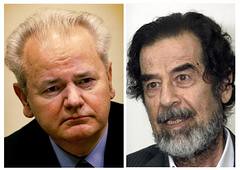
By DUSAN STOJANOVIC, Associated Press Writer
In this combo image, Former Yugoslav President Slobodan Milosevic sits in the court of the International Criminal Tribunal for the former Yugoslavia in The Hague, Dec. 11, 2001, left, and deposed Iraqi leader Saddam Hussein sits in the Iraqi Special Tribunal at an initial appearance in Baghdad, July 21, 2005. The trial of deposed Iraqi leader Saddam Hussein was barely under way, but it carried a striking resemblance to the war crimes trial of former Yugoslav President Slobodan Milosevic. Both the former strongmen were defiant, refused to recognize the courts that are trying them, bickered with judges and insisted they were innocent.
(Published October 20‚ 2005)
BELGRADE, Serbia-Montenegro (AP) - Both Saddam Hussein and Slobodan Milosevic have displayed defiance in the courtroom, tangled with judges and proclaimed their innocence. But the two deposed strongmen are being tried in two very different ways: the former Iraqi leader in a U.S.-backed national court and the former Yugoslav president by a U.N. tribunal.
And if the Milosevic trial is any measure, Iraqis' quest for justice could take years.
Aside from the defiant behavior of Saddam and Milosevic at their opening trial sessions, the parallels between the judicial proceedings in Baghdad and The Hague, Netherlands, could be misleading.
"Although Milosevic and Saddam may have similar personalities, and both don't recognize courts which are trying them, there is a vast difference over the legal proceedings against them," said Branislav Tapuskovic, a former court-appointed lawyer for Milosevic in The Hague.
"The fact that the Baghdad court was set up by an interested party leads to worries that it is not impartial and raises fears of a show trial," Tapuskovic said.
Saddam pleaded not guilty to charges of murder and torture when his long-awaited trial opened Wednesday, with the one-time dictator arguing about the legitimacy of the court and scuffling with guards.
The first session of Saddam's trial lasted about three hours, and the judge ordered an adjournment until Nov. 28, though a cancer-stricken prosecution witness will testify Sunday.
The trial of Milosevic, who faces 66 war crimes counts for alleged offenses during the decade-long breakup of the former Yugoslavia, has been going off and on for more than three years, with no end in sight following frequent delays because of Milosevic's chronic heart problems.
"The case against Saddam focuses on a concrete event, while the charges against Milosevic are a bit vague and sometimes political," Tapuskovic said, pointing to another difference between the two trials.
Saddam could face the death penalty if convicted for the 1982 massacre of nearly 150 Shiite Muslims in the town of Dujail. The Hague court has no death penalty, and Milosevic could be sentenced to life in prison if found guilty.
While Saddam grudgingly said: "I'm not guilty" after an argument with a judge Wednesday, Milosevic refused to enter a plea when his trial opened at the U.N. tribunal in February 2002.
A three-judge panel had to enter a not guilty plea for Milosevic, who repeatedly questioned the legitimacy of The Hague tribunal, claiming it was established by his longtime enemy - the United States - to "unjustly" punish him and the Serbian people.
Like Saddam on Wednesday, Milosevic repeatedly has addressed the judges as "the so-called court," and still refuses to say "prosecution," calling its representatives "the other side."
Because he doesn't recognize the court, Milosevic, a law graduate who never practiced law, has refused to appoint a lawyer and is defending himself. Saddam has an attorney.
Another difference appears to be the determination of the Iraqi authorities to avoid a repetition of Milosevic's successful use of his trial to embarrass the prosecution by highlighting the involvement of the major powers in the conflict in former Yugoslavia.
In contrast to the case against Milosevic, which consists of charges for crimes allegedly committed in Croatia, Bosnia and Kosovo, Saddam is being tried - thus far - on tightly focused charges.
This will make it difficult for him to emulate Milosevic's expansive arguments, and the judges will likely prevent Saddam from introducing evidence of outside support for his policies during the 1980s because it would not be relevant to the charge he is facing.
Another similarity is a huge public interest in the country for the start of the two trials, and diverse reactions they have prompted among local supporters and opponents.
The idea by a private television network to beam the Milosevic trial to Serbian households was meant to confront Serbs with the atrocities he allegedly masterminded.
Years later, many are asking whether the initiative has backfired and actually increased Milosevic's approval ratings.
"When I watched Saddam on trial yesterday, I almost saw Slobo," Belgrade law student Milica Petrovic said, referring to Milosevic by his nickname. "For the sake of the Iraqis, I wish their quest for justice is swifter than ours."
Albanian premier tones down stance on Kosovo - daily
Text of report by Albanian newspaper Shekulli on 19 October
Prime Minister Sali Berisha has toned down his stand on Kosova's [Kosovo] independence. While on a visit to Montenegro, where an international meeting on the conservation of Shkoder Lake is taking place, he presented his latest stand on the issue of Kosova's independence at a meeting he had with Montenegrin Prime Minister Milo Djukanovic.
According to a press release from the Prime Minister's Office, Berisha said that the Albanian government held that the Kosova issue should be resolved in accordance with the will of the Kosova people and in cooperation with the Contact Group.
The Albanian prime minister also stressed that guaranteeing the rights and freedom of the ethnic Serbian and other minorities as well as the Prishtina [Pristina]-Belgrade dialogue were of particular importance. The two interlocutors seem to have been in agreement on this point.
According to Deutsche Welle , for his part, Djukanovic said, "I voiced our desire to the effect that, according to the planned dynamics, the problem of Kosova's status should be settled through a Belgrade-Prishtina dialogue and with the mediation of the international community at the end of this year or in the middle of next year."
Djukanovic added that next spring, Podgorica intended to hold a referendum about the state status of Montenegro.
At his meeting with Berisha, there was also a discussion about deepening cooperation between the two countries. The two heads of government agreed to step up joint efforts in the struggle against organized crime.
The Albanian prime minister expounded his opinion about broader and more efficient coordination of the work of the law-enforcement institutions in the context of this struggle.
Berisha also said that cooperation in the field of tourism could be improved, enabling tourists to visit both countries on the same trip. Likewise, Albania and Montenegro could also support each other by integrating the energy system at a regional level.
Speaking about the infrastructure that links the two counties, Berisha termed the current road "a symbol of past relations," adding that this road should be improved as soon as possible to enable normal transport between Albania and its northern neighbour.
Appraising Montenegro's cooperation with Albania, Djukanovic stressed that it was a positive example of cross-border relations for the whole region.
At a dinner the Montenegrin prime minister gave in honour of Prime Minister Berisha there were also representatives of the Albanian political parties in Montenegro. There was a discussion of the rights of ethnic minorities both in Montenegro and the region in general.
Yesterday morning the two prime ministers attended the inauguration of a regional seminar sponsored by UNESCO, the Council of Europe, and the World Wildlife Fund.
Source: Shekulli, Tirana, in Albanian 19 Oct 05 p 4
Prime Minister Sali Berisha has toned down his stand on Kosova's [Kosovo] independence. While on a visit to Montenegro, where an international meeting on the conservation of Shkoder Lake is taking place, he presented his latest stand on the issue of Kosova's independence at a meeting he had with Montenegrin Prime Minister Milo Djukanovic.
According to a press release from the Prime Minister's Office, Berisha said that the Albanian government held that the Kosova issue should be resolved in accordance with the will of the Kosova people and in cooperation with the Contact Group.
The Albanian prime minister also stressed that guaranteeing the rights and freedom of the ethnic Serbian and other minorities as well as the Prishtina [Pristina]-Belgrade dialogue were of particular importance. The two interlocutors seem to have been in agreement on this point.
According to Deutsche Welle , for his part, Djukanovic said, "I voiced our desire to the effect that, according to the planned dynamics, the problem of Kosova's status should be settled through a Belgrade-Prishtina dialogue and with the mediation of the international community at the end of this year or in the middle of next year."
Djukanovic added that next spring, Podgorica intended to hold a referendum about the state status of Montenegro.
At his meeting with Berisha, there was also a discussion about deepening cooperation between the two countries. The two heads of government agreed to step up joint efforts in the struggle against organized crime.
The Albanian prime minister expounded his opinion about broader and more efficient coordination of the work of the law-enforcement institutions in the context of this struggle.
Berisha also said that cooperation in the field of tourism could be improved, enabling tourists to visit both countries on the same trip. Likewise, Albania and Montenegro could also support each other by integrating the energy system at a regional level.
Speaking about the infrastructure that links the two counties, Berisha termed the current road "a symbol of past relations," adding that this road should be improved as soon as possible to enable normal transport between Albania and its northern neighbour.
Appraising Montenegro's cooperation with Albania, Djukanovic stressed that it was a positive example of cross-border relations for the whole region.
At a dinner the Montenegrin prime minister gave in honour of Prime Minister Berisha there were also representatives of the Albanian political parties in Montenegro. There was a discussion of the rights of ethnic minorities both in Montenegro and the region in general.
Yesterday morning the two prime ministers attended the inauguration of a regional seminar sponsored by UNESCO, the Council of Europe, and the World Wildlife Fund.
Source: Shekulli, Tirana, in Albanian 19 Oct 05 p 4
Serbian war criminal Minic dies in Argentina
BUENOS AIRES, Oct 20 (AFP) -
Nebjosa Minic, a Serbian police commander accused of war crimes in the former Yugoslavia, has died in Argentina where he had been detained since May, local officials in Mendoza province said.
Minic, 40, suffered from AIDS and lung cancer, but the cause of death at a hospital in Mendoza was not given.
The UN war crimes court for the former Yugoslavia had sought his extradition for trial for allegedly ordering war crimes against the civilian population in Kosovo in 1999.
He was stopped in Mendoza after an anonymous tip to authorities. He was carrying a fake passport in the name of Goran Petrovic, a former minister of Yugoslav president Slobodan Milosevic.
Nebjosa Minic, a Serbian police commander accused of war crimes in the former Yugoslavia, has died in Argentina where he had been detained since May, local officials in Mendoza province said.
Minic, 40, suffered from AIDS and lung cancer, but the cause of death at a hospital in Mendoza was not given.
The UN war crimes court for the former Yugoslavia had sought his extradition for trial for allegedly ordering war crimes against the civilian population in Kosovo in 1999.
He was stopped in Mendoza after an anonymous tip to authorities. He was carrying a fake passport in the name of Goran Petrovic, a former minister of Yugoslav president Slobodan Milosevic.
Kosovo, Serbian authorities to sign agreement on displaced persons
Text of report in English by independent internet news agency KosovaLive
Prishtina [Pristina], 20 October: Minister of Local Self-Administration Lutfi Haziri said today in Prishtina that very soon they will sign an agreement with the Serbian government on a lasting return of displaced persons.
Haziri made these comments in a regular meeting of the working group for Standard III - Freedom of Movement - and Standard IV - Lasting Return.
In relation with the lasting return, Haziri said that the situation is still the same.
"This is one of the standards that needs time, but we are working actively to implement the government plan on a lasting return. At this stage, we are pending to sign a protocol for lasting return with the Belgrade government," said Haziri.
Haziri said that the biggest obstacle to the implementation of the lasting return was the negative stance of the Belgrade government, which continues to manipulate the displaced persons.
"I hope that this document will change their stance, and they be more cooperative in the area of implementing this elementary right in the future," said Haziri.
In relation to the Standard III - Freedom of Movement - Haziri said that there are positive results in this aspect, if compared to the previous months.
Haziri also said that there is an increase of the minority employment.
Source: KosovaLive website, Pristina, in English 20 Oct 05
Prishtina [Pristina], 20 October: Minister of Local Self-Administration Lutfi Haziri said today in Prishtina that very soon they will sign an agreement with the Serbian government on a lasting return of displaced persons.
Haziri made these comments in a regular meeting of the working group for Standard III - Freedom of Movement - and Standard IV - Lasting Return.
In relation with the lasting return, Haziri said that the situation is still the same.
"This is one of the standards that needs time, but we are working actively to implement the government plan on a lasting return. At this stage, we are pending to sign a protocol for lasting return with the Belgrade government," said Haziri.
Haziri said that the biggest obstacle to the implementation of the lasting return was the negative stance of the Belgrade government, which continues to manipulate the displaced persons.
"I hope that this document will change their stance, and they be more cooperative in the area of implementing this elementary right in the future," said Haziri.
In relation to the Standard III - Freedom of Movement - Haziri said that there are positive results in this aspect, if compared to the previous months.
Haziri also said that there is an increase of the minority employment.
Source: KosovaLive website, Pristina, in English 20 Oct 05
UN Downsizing Operations In Kosovo - Spokesman
PRISTINA (AP)--The U.N. is downsizing its mission in Kosovo, a spokesman said Thursday.
The mission began to trim the number of people on a team that has dealt with the civil administration in a province, which it has run since 1999, said Neeraj Singh, the U.N. spokesman in Kosovo.
Kosovo, legally part of Serbia-Montenegro, the union that replaced Yugoslavia, has been administered by a U.N. mission since mid-1999 when a North Atlantic Treaty Organization air war forced Serbia to halt its crackdown on independence- seeking ethnic Albanians and relinquish control of the province.
Talks to determine Kosovo's future are expected to begin by the year's end. At the center of the issue are ethnic Albanian demands for an independent state, while Serbs want the province remains within their borders.
Recently, the U.N. has drafted plans to transfer responsibilities to the local authorities as it plans to decrease its presence while hoping to turn over some responsibilities to a possible European Union-led mission after the talks on the province's future.
The U.N. administration - in place since the conflict ended six years ago - runs the police, justice department and economy in the disputed region.
The province has an elected legislature, a president and a government working alongside the U.N. mission, which still remains the ultimate authority in the province's affairs.
(END) Dow Jones Newswires
The mission began to trim the number of people on a team that has dealt with the civil administration in a province, which it has run since 1999, said Neeraj Singh, the U.N. spokesman in Kosovo.
Kosovo, legally part of Serbia-Montenegro, the union that replaced Yugoslavia, has been administered by a U.N. mission since mid-1999 when a North Atlantic Treaty Organization air war forced Serbia to halt its crackdown on independence- seeking ethnic Albanians and relinquish control of the province.
Talks to determine Kosovo's future are expected to begin by the year's end. At the center of the issue are ethnic Albanian demands for an independent state, while Serbs want the province remains within their borders.
Recently, the U.N. has drafted plans to transfer responsibilities to the local authorities as it plans to decrease its presence while hoping to turn over some responsibilities to a possible European Union-led mission after the talks on the province's future.
The U.N. administration - in place since the conflict ended six years ago - runs the police, justice department and economy in the disputed region.
The province has an elected legislature, a president and a government working alongside the U.N. mission, which still remains the ultimate authority in the province's affairs.
(END) Dow Jones Newswires
Kosovo de facto independent – negotiations on independence de jure (Koha)
In the leading front-page story, Koha Ditore carries a report by the Danish Institute for International Relations, the conclusion of which is that Kosovo is de facto independent and negotiations on status are focused on how to make it a permanent status according to the wish of Kosovo Albanians. Koha notes that “the final report which is prepared especially on the eve of the UN Security Council suggests that four ‘red lines’ need to be determined before status negotiations: status to be a guarantee for internal security, to determine sovereignty, for EU and US to guarantee security, and long-term guarantees and support for the economic and financial sector.”
Ahtisaari talks to Solana about Kosovo (Koha)
Koha Ditore quotes sources from Brussels as saying that there are no dilemmas anymore on the name of the international envoy on status. The paper says the name of the former Finnish president Martti Ahtisaari has already received the support of all relevant international circles and that, in this context, Ahtisaari visited Brussels on Wednesday to, according to Koha, present some of his ideas to the EU High Representative Javier Solana on the future process in Kosovo.
Zëri, reporting on the meeting between Solana and Ahtisaari, carries a caption saying EU backs Ahtisaari for the post of chief-negotiator on Kosovo status.
Zëri, reporting on the meeting between Solana and Ahtisaari, carries a caption saying EU backs Ahtisaari for the post of chief-negotiator on Kosovo status.
Wednesday, October 19, 2005
US says Kosovo status quo 'cannot be sustained'
The situation in Kosovo, where UN and NATO missions are trying to keep the peace between ethnic Albanian and Serbians, cannot be sustained and must be changed through pivotal negotiations next month, a top US official said.
"There is no question that the status quo cannot be sustained and it has to be changed," Nicholas Burns, the undersecretary of state for political affairs, told reporters at the US embassy in Paris.
A UN Security Council meeting scheduled for Monday would ask UN Secretary General Kofi Annan to appoint a special UN envoy to handle negotiations, which will determine the future of the territory, he said.
"The Kosovo final status talks should begin in the month of November," Burns said, adding that he would be appointed the US negotiator.
"We don't know where this process is going to lead, but it has to lead to something better than the status quo that has not been conducive to either stability or peace in Kosovo over the course of the past several years."
The "US very firmly supports" the talks, he said.
Kosovo, technically part of Serbia, has been under UN administration since June 1999 when NATO forced Serbian armed forces to cease their crackdown on ethnic Albanians and to withdraw from the territory.
Since then, NATO peacekeepers, including US and French troops, have been trying to maintain peace amid frequent flare-ups of violence between the ethnic Albanians and the dwindling ethnic Serbian minority.
The ethnic Albanians are seeking full independence, but that has been rejected by Belgrade.
Burns said the issue was one of several he discussed with French officials during his one-day trip to Paris.
The head of the UN mission in Kosovo, Soren Jessen-Petersen, said in neighbouring Albania Wednesday that "we have all come to the conclusion that after six years ... the status quo is no longer tenable."
He confirmed that the UN Security Council session next week would set a timetable for the negotiations and that they would begin next month.
"There is an absolute agreement throughout the region, Europe and the world that the Kosovo that emerges from the decision (about its) status must be a stable, tolerant, multi-ethnic and democratic Kosovo," Petersen said.
"There is no question that the status quo cannot be sustained and it has to be changed," Nicholas Burns, the undersecretary of state for political affairs, told reporters at the US embassy in Paris.
A UN Security Council meeting scheduled for Monday would ask UN Secretary General Kofi Annan to appoint a special UN envoy to handle negotiations, which will determine the future of the territory, he said.
"The Kosovo final status talks should begin in the month of November," Burns said, adding that he would be appointed the US negotiator.
"We don't know where this process is going to lead, but it has to lead to something better than the status quo that has not been conducive to either stability or peace in Kosovo over the course of the past several years."
The "US very firmly supports" the talks, he said.
Kosovo, technically part of Serbia, has been under UN administration since June 1999 when NATO forced Serbian armed forces to cease their crackdown on ethnic Albanians and to withdraw from the territory.
Since then, NATO peacekeepers, including US and French troops, have been trying to maintain peace amid frequent flare-ups of violence between the ethnic Albanians and the dwindling ethnic Serbian minority.
The ethnic Albanians are seeking full independence, but that has been rejected by Belgrade.
Burns said the issue was one of several he discussed with French officials during his one-day trip to Paris.
The head of the UN mission in Kosovo, Soren Jessen-Petersen, said in neighbouring Albania Wednesday that "we have all come to the conclusion that after six years ... the status quo is no longer tenable."
He confirmed that the UN Security Council session next week would set a timetable for the negotiations and that they would begin next month.
"There is an absolute agreement throughout the region, Europe and the world that the Kosovo that emerges from the decision (about its) status must be a stable, tolerant, multi-ethnic and democratic Kosovo," Petersen said.
European Parliament will vote on a resolution on Kosovo’s independence in October (Koha)
The paper reports that the EP has instructed its Committee of Foreign Affairs to compile a report on Kosovo with special emphasis on how Kosovo’s independence will affect the situation in the region.
Staes stated that very soon there will be a report of a special envoy on Kosovo, based on which the EP will then will draft a resolution where EU responsible institutions for Foreign Affairs would be urged to support the independence of Kosovo and boost their role there.
Commenting on ‘conditional independence’ Staes said that he wasn’t certain of what international circles meant by that phrase. He further urged the local community in Kosovo to keep on working on Standards during the status talks, writes Koha.
Staes stated that very soon there will be a report of a special envoy on Kosovo, based on which the EP will then will draft a resolution where EU responsible institutions for Foreign Affairs would be urged to support the independence of Kosovo and boost their role there.
Commenting on ‘conditional independence’ Staes said that he wasn’t certain of what international circles meant by that phrase. He further urged the local community in Kosovo to keep on working on Standards during the status talks, writes Koha.
Subscribe to:
Posts (Atom)