By Kerin Hope
Published: July 1 2005 03:00 | Last updated: July 1 2005 03:00
Disco music booms across Lake Ohrid as voters in Sunday's general election gather to hear Edi Rama, mayor of Tirana and Albania's most popular politician, call for a third straight term for the governing Socialist party.
"Our future is Europe and we must work to get there," says Mr Rama, an artist who has become an international celebrity for having the capital's once drab Stalinist-era buildings painted in fluorescent orange and pink and upgrading its parks. The New Yorker magazine recently called him "inexhaustible".
Like many Albanian towns, Pogradec, a trout-fishing centre and would-be tourist resort, has imitated the capital, but in muted shades of green and ochre. Remittances from migrant workers in Greece have fuelled a construction boom. Its internet cafés feature brand-new flat-screen computers.
Under the Socialists, Albania has achieved growth rates of about 6 per cent of gross domestic product for four successive years. Per capita incomes have doubled to the level of Romania. Trade with Italy and neighbouring Balkan countries flourishes.
But talks on a European Union stabilisation and association pact, the first step towards closer integration with the Union, have stalled because of the government's failure to tackle organised crime and entrenched corruption in the police and judiciary.
Sunday's vote will decide whether Albania resumes those talks with the prospect of signing the agreement later this year. As the only country in the Balkans that has failed to carry out an uncontested election, it still has to prove its democratic credentials.
An opinion poll published earlier this week showed the Socialists trailing with 34 per cent of the vote to 35 per cent for the right- of-centre Democratic party. With support of around 10 per cent, the Socialist Movement for Integration led by Ilir Meta, a former Socialist prime minister, appeared set to hold the balance of power in the 140-seat parliament.
Polling will be closely monitored by 400 observers from the Organisation for Security and Co-operation in Europe and 3,500 Albanian observers, mainly from civil society groups. To prevent irregularities, unopened ballot boxes will be driven under guard to regional centres for votes to be counted.
"In 15 years we've made very little progress with applying democratic rules. But if we want to take the road to Europe, this election is a test we have to pass," says Remzi Lani, director of the Albanian Media Institute.
But the contest is so tight, diplomats and local analysts say, that both Socialists and Democrats will be tempted to make widespread use of intimidation and competitive vote-buying - tactics that have influenced the outcome of previous elections.
The bitter personal rivalry between Fatos Nano, the prime minister, and Sali Berisha, the former president and Democratic party leader, raises fears of violent protests if the fairness of the election result is called into doubt.
Mr Nano was jailed under a Berisha government on corruption charges. He was freed in 1997 in the turmoil that followed the collapse of a series of fraudulent pyramid savings schemes - tolerated by Mr Berisha - in which depositors lost an estimated $2bn (€1.6bn).
Thursday, June 30, 2005
Factsheet on Albania - AFP
TIRANA, June 30 (AFP) -
Albania, the southern Balkan state where legislative elections will be held on Sunday, is one of the poorest countries in Europe, after more than 50 years of communist dictatorship under Enver Hoxha who died in 1985.
- GEOGRAPHY: Covering some 28,748 square kilometers (11,099 square miles), Albania is a Mediterranean country which shares borders with Macedonia, Serbia-Montenegro and Greece. It has a coast on the Adriatic Sea in the west, and a coast on the Ionian Sea in the southwest.
- POPULATION: 3,1 million people.
- CAPITAL: Tirana (population of 500,000).
- RELIGION: Muslims (70 percent), Orthodox Christians (15 percent ), Catholics (8 percent).
- HISTORY: In 1912, after four centuries of the Ottoman empire's rule, Albania proclaimed independence in the southern town Vlora. Ahmed Zogu came to power in 1922 and in 1925, was elected president. He proclaimed a monarchy and became king in 1928, under the name Zog the First. In April 1939, Italy invaded the country and King Zog fled Albania, leaving the throne to Victor-Emmanuel III. Albanian communists, linked with Yugoslav leader Tito, launched a resistance movement against the fascists and Nazis, under the leadership of Stalinist Enver Hoxha.
In 1946, Hoxha proclaimed the People's Republic of Albania, which later become totally isolated. Hoxha ruled the country with an iron fist until his death in 1985. In 1990, his successor Ramiz Alia faced a popular revolt which he severely crushed. Thousands of Albanians fled the country but, under pressure from the street protests and unrest, Alia introduced a multi-party system and in December 1990 started the process of de-Stalinisation after 45 years of absolutist communist rule.
- POLITICS: President Alfred Moisiu, former defense minister, elected by the parliament on June 24, 2002. Prime Minister Fatos Nano, leader of the Socialist party since 1991.
In February and March 2004, social discontent provoked a series of protests, gathering thousands of people demanding Nano's dismissal.
In November 1998, more than 93.5 percent of voters adopted a new Constitution via a referendum.
- ECONOMY: After the communist regime was overthrown, Albania was left with an obsolete industrial base and a pattern of industrial capacity wholly unsuited to its needs.
In 1997, fraudulent pyramid schemes ruined the Albanian economy and left thousands without savings.
Almost half of the economically-active population is still engaged in agriculture, one fifth is believed to be working abroad, while unemployment is officially around 15 percent. According to UN data, a quarter of the population lives below the poverty line.
GNP: 2,414 dollars per inhabitant (World Bank 2004).
FOREIGN DEBT: 1.64 billion dollars (2004)
DEFENSE: Around 21.500 troops (IISS 2004/2005).
Albania is among the first ex-communist countries to join NATO Partnership for peace programme in 1994. In May 2003, together with Macedonia and Croatia, Albania signed an "Adriatic Chapter" with the United States, aimed at facilitating its integration into NATO.
Tirana was expected to sign an accord of stabilization and association with the European Union in 2004, but this was delayed after many European institutions strongly condemned Albania's failure to root out organized crime and corruption and the lack of political and economic progress.
Albania, the southern Balkan state where legislative elections will be held on Sunday, is one of the poorest countries in Europe, after more than 50 years of communist dictatorship under Enver Hoxha who died in 1985.
- GEOGRAPHY: Covering some 28,748 square kilometers (11,099 square miles), Albania is a Mediterranean country which shares borders with Macedonia, Serbia-Montenegro and Greece. It has a coast on the Adriatic Sea in the west, and a coast on the Ionian Sea in the southwest.
- POPULATION: 3,1 million people.
- CAPITAL: Tirana (population of 500,000).
- RELIGION: Muslims (70 percent), Orthodox Christians (15 percent ), Catholics (8 percent).
- HISTORY: In 1912, after four centuries of the Ottoman empire's rule, Albania proclaimed independence in the southern town Vlora. Ahmed Zogu came to power in 1922 and in 1925, was elected president. He proclaimed a monarchy and became king in 1928, under the name Zog the First. In April 1939, Italy invaded the country and King Zog fled Albania, leaving the throne to Victor-Emmanuel III. Albanian communists, linked with Yugoslav leader Tito, launched a resistance movement against the fascists and Nazis, under the leadership of Stalinist Enver Hoxha.
In 1946, Hoxha proclaimed the People's Republic of Albania, which later become totally isolated. Hoxha ruled the country with an iron fist until his death in 1985. In 1990, his successor Ramiz Alia faced a popular revolt which he severely crushed. Thousands of Albanians fled the country but, under pressure from the street protests and unrest, Alia introduced a multi-party system and in December 1990 started the process of de-Stalinisation after 45 years of absolutist communist rule.
- POLITICS: President Alfred Moisiu, former defense minister, elected by the parliament on June 24, 2002. Prime Minister Fatos Nano, leader of the Socialist party since 1991.
In February and March 2004, social discontent provoked a series of protests, gathering thousands of people demanding Nano's dismissal.
In November 1998, more than 93.5 percent of voters adopted a new Constitution via a referendum.
- ECONOMY: After the communist regime was overthrown, Albania was left with an obsolete industrial base and a pattern of industrial capacity wholly unsuited to its needs.
In 1997, fraudulent pyramid schemes ruined the Albanian economy and left thousands without savings.
Almost half of the economically-active population is still engaged in agriculture, one fifth is believed to be working abroad, while unemployment is officially around 15 percent. According to UN data, a quarter of the population lives below the poverty line.
GNP: 2,414 dollars per inhabitant (World Bank 2004).
FOREIGN DEBT: 1.64 billion dollars (2004)
DEFENSE: Around 21.500 troops (IISS 2004/2005).
Albania is among the first ex-communist countries to join NATO Partnership for peace programme in 1994. In May 2003, together with Macedonia and Croatia, Albania signed an "Adriatic Chapter" with the United States, aimed at facilitating its integration into NATO.
Tirana was expected to sign an accord of stabilization and association with the European Union in 2004, but this was delayed after many European institutions strongly condemned Albania's failure to root out organized crime and corruption and the lack of political and economic progress.
Council of Europe sends delegation to monitor Albania's election
Strasbourg, 30 June: A 15-member delegation of the Council of Europe Parliamentary Assembly (PACE) headed by Jerzy Smorawinski will observe the election in Albania on 3 July 2005, information sources in the Council of Europe (CE) announced.
The parliamentarians will meet party leaders, the chairman of the Central Election Commission, journalists and non-governmental organizations. On the Election Day, they will be deployed in the capital and in the towns around the country.
The observation of the election will be carried out in the framework of an international election observation mission (IEOM) composed of delegations from the Council of Europe and OSCE parliamentary assemblies, the European Parliament, and the Office for Democratic Institutions and Human Rights (ODIHR.).
According to the same sources, a pre-election delegation from PACE, which visited the country from 30 May to 1 June 2005, said in a statement that the truly democratic conduct of the election, in line with the commitments Albania subscribed to when it joined the Council of Europe, depends now on the political will of the authorities and parties participating in this election. The delegations will be accompanied by an expert from the Venice Commission, the Council of Europe's group of experts that made recommendations on the electoral law and the administration of the (local) election in Albania in October 2004.
The parliamentarians will meet party leaders, the chairman of the Central Election Commission, journalists and non-governmental organizations. On the Election Day, they will be deployed in the capital and in the towns around the country.
The observation of the election will be carried out in the framework of an international election observation mission (IEOM) composed of delegations from the Council of Europe and OSCE parliamentary assemblies, the European Parliament, and the Office for Democratic Institutions and Human Rights (ODIHR.).
According to the same sources, a pre-election delegation from PACE, which visited the country from 30 May to 1 June 2005, said in a statement that the truly democratic conduct of the election, in line with the commitments Albania subscribed to when it joined the Council of Europe, depends now on the political will of the authorities and parties participating in this election. The delegations will be accompanied by an expert from the Venice Commission, the Council of Europe's group of experts that made recommendations on the electoral law and the administration of the (local) election in Albania in October 2004.
President appeals to Albanians to "exercise right to vote"
Tirana, 30 June: The president of the Republic of Albania appealed Thursday [30 June] to all Albanian citizens "to participate in the polls and exercise their right to vote".
The information office of the president's office announced that, responding to the interest of media in the electoral campaign, which is almost completed, President [Alfred] Moisiu emphasized that "in spite of a few incidents that have occurred Albanians are showing that they have undergone great transformation in their democratic mentality and the political forces".
"I wish that the election makes smooth progress, in spite of the recent days' problems in the judiciary system. On this occasion, I invite the judiciary system to be very prudent and rigorously apply the demands of the constitution. The right of the citizens to vote should not be denied. The judiciary system should defend this right," President Moisiu underlined.
The president of the republic is expected to address Friday the Albanian people with a message on the occasion of elections.
Source: ATA news agency, Tirana, in English 1601 gmt 30 Jun 05
The information office of the president's office announced that, responding to the interest of media in the electoral campaign, which is almost completed, President [Alfred] Moisiu emphasized that "in spite of a few incidents that have occurred Albanians are showing that they have undergone great transformation in their democratic mentality and the political forces".
"I wish that the election makes smooth progress, in spite of the recent days' problems in the judiciary system. On this occasion, I invite the judiciary system to be very prudent and rigorously apply the demands of the constitution. The right of the citizens to vote should not be denied. The judiciary system should defend this right," President Moisiu underlined.
The president of the republic is expected to address Friday the Albanian people with a message on the occasion of elections.
Source: ATA news agency, Tirana, in English 1601 gmt 30 Jun 05
Albanian police, army troops protect major buildings ahead of election
Tirana, 30 June: Since 1700 hrs (1500 gmt) on Thursday [30 June], in entire Albania, the army troops have taken protection of state institutions and the buildings of special importance.
According to the public order ministry, this measure will be in effect up to 1200 hrs on 5 July 2005. The state police officers, who guard and secure the most important state objects, will be engaged in maintaining the order and tranquillity in the election process.
Source: ATA news agency, Tirana, in English 1720 gmt 30 Jun 05
According to the public order ministry, this measure will be in effect up to 1200 hrs on 5 July 2005. The state police officers, who guard and secure the most important state objects, will be engaged in maintaining the order and tranquillity in the election process.
Source: ATA news agency, Tirana, in English 1720 gmt 30 Jun 05
Ex-legislator to observe critical Albanian election
By Courtney Kinney
Post staff reporter
ADVERTISEMENT
Former state Sen. Joe Meyer is on his way to Albania to observe that country's elections, the second time in a year he has monitored elections in a fledgling democracy.
Meyer, an attorney from Covington, is one of 400 observers who will monitor the set-up of polling places, casting of ballots, counting of ballots and tabulation of results for the parliamentary election Sunday. The observers, who come from a variety of nations, work with the Office of Democratic Institutions and Human Rights, part of the international Organization for Security and Cooperation in Europe. Meyer is one of 45 Americans in the group.
Meyer in October observed municipal elections in Bosnia-Herzegovina, a Balkan state that was part of the former Yugoslavia until 1991. It was the country's first election under a new regime following years of civil war.
He left Tuesday for Albania and will return next Tuesday.
Meyer, who currently works as an adviser in the Kentucky Auditor's Office, said it is an honor to be a part of helping a new democracy.
"It's a wonderful opportunity to help the spread of democracy to countries that have not participated in it very much," said Meyer, a Democrat who served in the state Senate from 1989 to 1996 and in the state House from 1982 to 1988.
Meyer applied for the position, which is sponsored by the U.S. Department of State, in January of 2004 and was selected for the Bosnian election last fall.
"It's a tremendous educational opportunity. Plus, you get to go places you'd never otherwise go," he said.
Sunday's election is considered a milestone for Albania, a European country adjacent to Greece that broke with communism in the early 1990s. Elections since then have been fraught with irregularities and fraud, but officials have promised to be more vigilant this year. The country wants to join
NATO and the European Union, and free and fair elections are a requirement to join both.
Meyer and the other observers will be briefed on specific problems to watch for, then dispatched in pairs to polling stations across the country, which is roughly the size of Maryland.
The country was largely isolated from the rest of Europe and the world until the fall of communism in 1992, and still only has one international airport, no international railways and only 120,000 phone lines for its more than 3.5 million residents, Meyer said.
"Albania is a fascinating country about which I - and we as Americans - know very little," he said.
Post staff reporter
ADVERTISEMENT
Former state Sen. Joe Meyer is on his way to Albania to observe that country's elections, the second time in a year he has monitored elections in a fledgling democracy.
Meyer, an attorney from Covington, is one of 400 observers who will monitor the set-up of polling places, casting of ballots, counting of ballots and tabulation of results for the parliamentary election Sunday. The observers, who come from a variety of nations, work with the Office of Democratic Institutions and Human Rights, part of the international Organization for Security and Cooperation in Europe. Meyer is one of 45 Americans in the group.
Meyer in October observed municipal elections in Bosnia-Herzegovina, a Balkan state that was part of the former Yugoslavia until 1991. It was the country's first election under a new regime following years of civil war.
He left Tuesday for Albania and will return next Tuesday.
Meyer, who currently works as an adviser in the Kentucky Auditor's Office, said it is an honor to be a part of helping a new democracy.
"It's a wonderful opportunity to help the spread of democracy to countries that have not participated in it very much," said Meyer, a Democrat who served in the state Senate from 1989 to 1996 and in the state House from 1982 to 1988.
Meyer applied for the position, which is sponsored by the U.S. Department of State, in January of 2004 and was selected for the Bosnian election last fall.
"It's a tremendous educational opportunity. Plus, you get to go places you'd never otherwise go," he said.
Sunday's election is considered a milestone for Albania, a European country adjacent to Greece that broke with communism in the early 1990s. Elections since then have been fraught with irregularities and fraud, but officials have promised to be more vigilant this year. The country wants to join
NATO and the European Union, and free and fair elections are a requirement to join both.
Meyer and the other observers will be briefed on specific problems to watch for, then dispatched in pairs to polling stations across the country, which is roughly the size of Maryland.
The country was largely isolated from the rest of Europe and the world until the fall of communism in 1992, and still only has one international airport, no international railways and only 120,000 phone lines for its more than 3.5 million residents, Meyer said.
"Albania is a fascinating country about which I - and we as Americans - know very little," he said.
Council Special Report Calls for Rapid Resolution
June 30, 2005--The United States needs to push for a speedy resolution of Kosovo's final status and stay engaged in the Balkans, concludes a new Council Special Report. "The ongoing uncertainty over final status has increased tensions in Kosovo, fueling Serbia's political turmoil and threatening to destabilize the entire region," says the report.
Forgotten Intervention? What the United States Needs to Do in the Western Balkans is a follow-up to the 2002 Council-sponsored Independent Task Force report Balkans 2010, and was co-written by Council Senior Fellow and retired Army Major General William L. Nash and research associate Amelia Branczik. Nash, head of the Council's Center for Preventive Action, led U.S. troops into Bosnia after the Dayton Accords and was a UN administrator in Kosovo.
Kosovo remains the most significant unresolved question. "Finding a settlement acceptable to all sides will be difficult and will require an active U.S. role to establish a consensus on the specifics of final status, prepare the environment in Serbia and provide political cover for Belgrade, create a credible process, and implement a solution." Final status will most likely involve some sort of conditional independence. The U.S. needs to work with the UN and the European Union to prepare Belgrade for this outcome, using incentives such as guaranteeing full protection for Kosovo's Serb community, a promise of EU candidacy for Serbia as early as 2006, and compensation for its loss of territory.
The report also argues that the United States, the UN, and the EU should create a consultative review commission on what the specifics of final status would be. Meanwhile, the United States should maintain its current modest commitment of troops in Kosovo and Bosnia as part of NATO forces there. Any outbreak of fighting would require a strong U.S. response. "Current conditions require more active efforts to prevent a crisis in Kosovo that could undo years of international efforts to create conditions for lasting peace."
With the threat of terrorism looming large for the foreseeable future, the existence of strong and stable states in the western Balkans, with the ability to police their borders and control organized crime networks, is critical for U.S. national security. "There is a danger that the United States is withdrawing too rapidly," says the report. "This could lead to a vacuum of political leadership that will undermine U.S. foreign policy goals."
For the region as a whole, the report makes the following recommendations:
Stay Involved in the Western Balkans. "Although the broader U.S. objective is to pull out of a secure and stable region, a precipitous withdrawal of assistance will undermine stability and ultimately be counterproductive. Instead, the United States should continue to provide support for a greater EU role and promote the region's integration into the EU, which provides the best framework for securing political and economic stability in the long term."
Restore Economic and Democratization Assistance to 2002 Levels. "The dramatic decline in U.S. assistance across all sectors suggests an underestimation of the difficulties involved in EU accession goals, and which will not fully materialize for several years...To demonstrate its commitment, the United States should restore annual funding for assistance programs in the western Balkans to $440 million, the 2002 level of assistance."
Promote Governance Reform in Bosnia and Herzegovina. "Bosnia will not be a sustainable state as long as it maintains its current ineffective and inefficient government institutions. Reducing the cost of the public sector, reforming government structures within Bosnia's two entities, and making specific changes to the constitution introduced by Dayton will facilitate effective governance as the international community hands over greater sovereignty to local politicians."
Promote Further Reform of Serbia and Montenegro's Security Sector. While "the chief obstacle to Serbia and Montenegro's progress on EU accession continues to be lack of compliance with the International Criminal Tribunal for the former Yugoslavia (ICTY)," the United States "has an important role to play in encouraging and assisting further reform." While maintaining pressure to capture suspected war criminals Ratko Mladic and Radovan Karadzic, the United States can acknowledge Serbia's recent progress on ICTY compliance by providing more low-level assistance to Serbia and Montenegro's armed forces.
Forgotten Intervention? What the United States Needs to Do in the Western Balkans is a follow-up to the 2002 Council-sponsored Independent Task Force report Balkans 2010, and was co-written by Council Senior Fellow and retired Army Major General William L. Nash and research associate Amelia Branczik. Nash, head of the Council's Center for Preventive Action, led U.S. troops into Bosnia after the Dayton Accords and was a UN administrator in Kosovo.
Kosovo remains the most significant unresolved question. "Finding a settlement acceptable to all sides will be difficult and will require an active U.S. role to establish a consensus on the specifics of final status, prepare the environment in Serbia and provide political cover for Belgrade, create a credible process, and implement a solution." Final status will most likely involve some sort of conditional independence. The U.S. needs to work with the UN and the European Union to prepare Belgrade for this outcome, using incentives such as guaranteeing full protection for Kosovo's Serb community, a promise of EU candidacy for Serbia as early as 2006, and compensation for its loss of territory.
The report also argues that the United States, the UN, and the EU should create a consultative review commission on what the specifics of final status would be. Meanwhile, the United States should maintain its current modest commitment of troops in Kosovo and Bosnia as part of NATO forces there. Any outbreak of fighting would require a strong U.S. response. "Current conditions require more active efforts to prevent a crisis in Kosovo that could undo years of international efforts to create conditions for lasting peace."
With the threat of terrorism looming large for the foreseeable future, the existence of strong and stable states in the western Balkans, with the ability to police their borders and control organized crime networks, is critical for U.S. national security. "There is a danger that the United States is withdrawing too rapidly," says the report. "This could lead to a vacuum of political leadership that will undermine U.S. foreign policy goals."
For the region as a whole, the report makes the following recommendations:
Stay Involved in the Western Balkans. "Although the broader U.S. objective is to pull out of a secure and stable region, a precipitous withdrawal of assistance will undermine stability and ultimately be counterproductive. Instead, the United States should continue to provide support for a greater EU role and promote the region's integration into the EU, which provides the best framework for securing political and economic stability in the long term."
Restore Economic and Democratization Assistance to 2002 Levels. "The dramatic decline in U.S. assistance across all sectors suggests an underestimation of the difficulties involved in EU accession goals, and which will not fully materialize for several years...To demonstrate its commitment, the United States should restore annual funding for assistance programs in the western Balkans to $440 million, the 2002 level of assistance."
Promote Governance Reform in Bosnia and Herzegovina. "Bosnia will not be a sustainable state as long as it maintains its current ineffective and inefficient government institutions. Reducing the cost of the public sector, reforming government structures within Bosnia's two entities, and making specific changes to the constitution introduced by Dayton will facilitate effective governance as the international community hands over greater sovereignty to local politicians."
Promote Further Reform of Serbia and Montenegro's Security Sector. While "the chief obstacle to Serbia and Montenegro's progress on EU accession continues to be lack of compliance with the International Criminal Tribunal for the former Yugoslavia (ICTY)," the United States "has an important role to play in encouraging and assisting further reform." While maintaining pressure to capture suspected war criminals Ratko Mladic and Radovan Karadzic, the United States can acknowledge Serbia's recent progress on ICTY compliance by providing more low-level assistance to Serbia and Montenegro's armed forces.
Artists from Kosovo and Japan
An exhibition is featuring nine artists from Japan and Kosovo at Gallery Hibiya near Tokyo's Yurakucho Station.
The 11th International Exhibtion for Peace/Kosovo is featuring five artists from Japan: Atsushi Ogawa, Emiko Horimoto, Jeri Holey, Junko Matsushima and Toshihiko Sawai -- and four artists from Kosovo -- Arta Agani, Driton Hajredini, Hamdi Bardhi and Nysret Salihamixhiqi.
A solo exhibition -- "Message of Universal Love" -- featuring Horimoto is also being held in the same gallery.
The two exhibitions are open 11 a.m.-7 p.m. (to 5 p.m. on the last day) through July 7 at Gallery Hibiya (1-6-5 Yuraku-cho, Chiyoda-ku. Tel. [03] 3591-8948), along the Harumi Ave. near the JR tracks and a three-minute walk from JR Yurakucho Station.
The Japan Times: July 1, 2005
The 11th International Exhibtion for Peace/Kosovo is featuring five artists from Japan: Atsushi Ogawa, Emiko Horimoto, Jeri Holey, Junko Matsushima and Toshihiko Sawai -- and four artists from Kosovo -- Arta Agani, Driton Hajredini, Hamdi Bardhi and Nysret Salihamixhiqi.
A solo exhibition -- "Message of Universal Love" -- featuring Horimoto is also being held in the same gallery.
The two exhibitions are open 11 a.m.-7 p.m. (to 5 p.m. on the last day) through July 7 at Gallery Hibiya (1-6-5 Yuraku-cho, Chiyoda-ku. Tel. [03] 3591-8948), along the Harumi Ave. near the JR tracks and a three-minute walk from JR Yurakucho Station.
The Japan Times: July 1, 2005
Berisha, symbol of the fall of communism, ready to return to power
TIRANA, June 30 (AFP) -
Former Albanian president Sali Berisha, a symbol of the fall of the communist dictatorship, hopes to return to power in legislative elections on Sunday, after eight long years in opposition.
The first post-communist president of Albania is still regarded by many as the man who ended almost fifty years of isolation of the country under the rule of dictator Enver Hoxha.
But his rivals constantly recall the chaos that engulfed Albania at the end of his presidential mandate in 1997: armed unrest by hundreds of thousands of Albanians caused by the collapse of several fraudulent investment schemes he had allowed to function.
Born on October 15, 1944 into a Muslim farmer's family in Tropoja, in the mountainous north, former heart surgeon Berisha came to prominence by managing to transform an anti-communist student revolt into a general movement that eventually toppled the communist regime.
Detractors at the time said he had been hand-picked as an opposition leader by then communist President Ramiz Alija as a device to control the student protests. Berisha, a former party member, said he joined the anti-communist protests out of contrition for his earlier support of the regime.
After the multi-party system was introduced, Berisha, a big man with the stylish appeal of an actor, was one of the founders of the Democratic party. He was elected president in March 1992.
"I am opposed to the (Communists) because I feel co-responsible for the dictatorship," he said after the election.
Despite ending his country's isolation -- Albania was among the first former communist countries to join the NATO Partnership for peace programme -- and opening up Europe's poorest state to the world's market economy, Berisha soon squandered the goodwill he inherited after succeeding Alija.
In particular his intolerance of dissent within his own party and his use of the courts and secret police to intimidate the opposition cost him dearly in terms of support.
Although insisting that he was against a "witch-hunt" of former communist officials, he allowed the "genocide" trials of dozens of former leaders, some of whom were sentenced to life imprisonment.
Berisha has never managed to establish a dialogue with the opposition, thus provoking ongoing demands for his dismissal.
His ouster in 1997 was the culmination of years of growing discontent at government corruption, cronyism and authoritarian rule.
The rebellion in 1997 left almost 2,000 dead and the country lawless and divided, with large quantities of weaponry in private hands and the government holding little sway in the north and south of the country.
After the Socialists took power, Berisha went into opposition and has for eight years been condemning his main rival, Prime Minister Fatos Nano as a "dictator," accusing him of corruption and dictatorial rule.
Berisha seems to see Sunday elections as his last chance to return to power. To reach that goal, he has listened to his critics and changed his style, assuming the image of a "people's politician".
Advised by American experts, he attends local meetings, mingles with crowds, exchange handshakes and kisses with his supporters.
"Nano wants to transform elections into a personal battle. I will not follow him," Berisha insists.
Former Albanian president Sali Berisha, a symbol of the fall of the communist dictatorship, hopes to return to power in legislative elections on Sunday, after eight long years in opposition.
The first post-communist president of Albania is still regarded by many as the man who ended almost fifty years of isolation of the country under the rule of dictator Enver Hoxha.
But his rivals constantly recall the chaos that engulfed Albania at the end of his presidential mandate in 1997: armed unrest by hundreds of thousands of Albanians caused by the collapse of several fraudulent investment schemes he had allowed to function.
Born on October 15, 1944 into a Muslim farmer's family in Tropoja, in the mountainous north, former heart surgeon Berisha came to prominence by managing to transform an anti-communist student revolt into a general movement that eventually toppled the communist regime.
Detractors at the time said he had been hand-picked as an opposition leader by then communist President Ramiz Alija as a device to control the student protests. Berisha, a former party member, said he joined the anti-communist protests out of contrition for his earlier support of the regime.
After the multi-party system was introduced, Berisha, a big man with the stylish appeal of an actor, was one of the founders of the Democratic party. He was elected president in March 1992.
"I am opposed to the (Communists) because I feel co-responsible for the dictatorship," he said after the election.
Despite ending his country's isolation -- Albania was among the first former communist countries to join the NATO Partnership for peace programme -- and opening up Europe's poorest state to the world's market economy, Berisha soon squandered the goodwill he inherited after succeeding Alija.
In particular his intolerance of dissent within his own party and his use of the courts and secret police to intimidate the opposition cost him dearly in terms of support.
Although insisting that he was against a "witch-hunt" of former communist officials, he allowed the "genocide" trials of dozens of former leaders, some of whom were sentenced to life imprisonment.
Berisha has never managed to establish a dialogue with the opposition, thus provoking ongoing demands for his dismissal.
His ouster in 1997 was the culmination of years of growing discontent at government corruption, cronyism and authoritarian rule.
The rebellion in 1997 left almost 2,000 dead and the country lawless and divided, with large quantities of weaponry in private hands and the government holding little sway in the north and south of the country.
After the Socialists took power, Berisha went into opposition and has for eight years been condemning his main rival, Prime Minister Fatos Nano as a "dictator," accusing him of corruption and dictatorial rule.
Berisha seems to see Sunday elections as his last chance to return to power. To reach that goal, he has listened to his critics and changed his style, assuming the image of a "people's politician".
Advised by American experts, he attends local meetings, mingles with crowds, exchange handshakes and kisses with his supporters.
"Nano wants to transform elections into a personal battle. I will not follow him," Berisha insists.
Serbs Thwart Plan to Reopen Mitrovica Bridge - IWPR
United Nations plan to allow free movement in divided Kosovo town meets angry reception in Serb-run northern sector.
By Përparim Isufi in Prishtina (BCR No 563, 30-Jun-05)
Kosovo Serbs living in northern Mitrovica have given a hostile welcome to UNMIK’s new strategy for establishing freedom of movement in the divided town of Mitrovica
The strategy, launched in mid-June, aims to gradually open the bridge over the river Ibar - which divides the Serb-majority north from the mainly Albanian south - to civilian vehicular traffic.
Earlier, Kosovo’s NATO peacekeepers scrapped the checkpoints they had re-established on the bridge after ethnic riots shook Kosovo last March. Security on the bridge is now in the hands of the Kosovo Police Service, KPS.
During the first week of the UNMIK plan, which was put into action June 13, the bridge was opened for two hours per day, which increased to four hours in week two. UNMIK sources say that by mid-July, there will be no restrictions on cars or pedestrians moving between the two sections. However, the plan has run into resistance in the north of Mitrovica where many Serbs fear free movement over the Ibar will end in unification of the town and their loss of control over the districts they currently hold.
For eight days running, not one car driver ventured north after a solitary driver on June 13 met a volley of stones hurled by Serb crowds gathered at the square, just north of the bridge.
The Serb protesters have kept their vigil up ever since. Alex Anderson, Head of the International Crisis Group, ICG, in Pristina, said UNMIK appeared to lack a strategy that took into account the predictable opposition of many Serbs to the scheme.
“UNMIK does not appear to have planned a broad political initiative to accompany this measure and implementation seems to be very floppy on the ground,” he told IWPR.
“Serb ‘bridge watchers’ are demanding IDs from people who pass. They are being allowed to decide whom to let across.” The bridge watchers are organised groups of Serb civilians who patrol and monitor all traffic across the Ibar. Though supposed to comprise local volunteers, many Albanians believe they are ultimately controlled by Serbia’s security forces. Mitrovica has been a security hotspot throughout the UN’s six-year administration of Kosovo. Many displaced Serbs from other parts of Kosovo settled in the town in the turmoil of 1990-2000, occupying houses of Albanians who had fled south.
Ethnic tensions have frequently boiled over in Mitrovica since then, resulting in bloodshed. In incidents in 2000 and 2001, more than 20 Albanian inhabitants of the north were killed while peacekeepers failed to intervene.
In March 17, 2004, ethnic riots, starting in Mitrovica, then engulfed most of Kosovo, resulting in the loss of 19 lives over two days. Several thousand Serbs were forced from their homes by Albanian extremists, while dozens of Serbian churches and shrines were attacked and damaged. In spite of the hostile reaction from the Serbs in the north, UNMIK seems determined to go to ahead with its initiative for the bridge. “There is no reason to protest because the opening of the bridge in Mitrovica will help improve the freedom of movement in Kosovo,” said the UNMIK spokesperson, Neeraj Singh. Mitrovica Serbs do not agree, seeing UNMIK’s initiative as a prelude to an invasion of the north by Albanians concentrated in the southern part of town.
Milan Ivanovic, a Serb representative in northern Mitrovica, told IWPR, “UNMIK’s decision to allow the circulation of private vehicles over the bridge threatens the security of Serbs.”
The town’s Albanian mayor, Faruk Spahia, on the other hand, said the Serb protests “were to be expected”.
“[The local Serbs] are directly inspired and controlled by the government in Belgrade, which has an interest in obstructing the process leading to [Kosovo’s] final status,” he added. Serb concerns about the use of the bridge are linked to recent diplomatic developments over Kosovo.
Two months ago, the Contact Group of big nations said it had ruled out the partition of Kosovo into Serb and Albanian zones.
A partition line, following the current ethnic dividing line of the Ibar, has been one of Serbia’s reserve options in the event of its nightmare scenario, the international recognition of Kosovo’s independence.
Last year, the EU’s foreign policy supremo, Javier Solana, said the problem in Mitrovica had to be resolved before talks on final status began. Blerim Shala, a Kosovo Albanian political analyst, said the furore over the bridge represented “a counter-attack from Serbia to undermine UNMIK’s initiative”.
Whether UNMIK’s latest plan will succeed where so many others have failed remains to be seen.
Even the local Albanians are sceptical about the initiative’s chances. Without other major plans to reconcile the two communities, the problem of this divided town, of which the bridge is only a symbol, may well continue to haunt Kosovo. Përparim Isufi is a journalist with the newspaper Zëri in Pristina.
By Përparim Isufi in Prishtina (BCR No 563, 30-Jun-05)
Kosovo Serbs living in northern Mitrovica have given a hostile welcome to UNMIK’s new strategy for establishing freedom of movement in the divided town of Mitrovica
The strategy, launched in mid-June, aims to gradually open the bridge over the river Ibar - which divides the Serb-majority north from the mainly Albanian south - to civilian vehicular traffic.
Earlier, Kosovo’s NATO peacekeepers scrapped the checkpoints they had re-established on the bridge after ethnic riots shook Kosovo last March. Security on the bridge is now in the hands of the Kosovo Police Service, KPS.
During the first week of the UNMIK plan, which was put into action June 13, the bridge was opened for two hours per day, which increased to four hours in week two. UNMIK sources say that by mid-July, there will be no restrictions on cars or pedestrians moving between the two sections. However, the plan has run into resistance in the north of Mitrovica where many Serbs fear free movement over the Ibar will end in unification of the town and their loss of control over the districts they currently hold.
For eight days running, not one car driver ventured north after a solitary driver on June 13 met a volley of stones hurled by Serb crowds gathered at the square, just north of the bridge.
The Serb protesters have kept their vigil up ever since. Alex Anderson, Head of the International Crisis Group, ICG, in Pristina, said UNMIK appeared to lack a strategy that took into account the predictable opposition of many Serbs to the scheme.
“UNMIK does not appear to have planned a broad political initiative to accompany this measure and implementation seems to be very floppy on the ground,” he told IWPR.
“Serb ‘bridge watchers’ are demanding IDs from people who pass. They are being allowed to decide whom to let across.” The bridge watchers are organised groups of Serb civilians who patrol and monitor all traffic across the Ibar. Though supposed to comprise local volunteers, many Albanians believe they are ultimately controlled by Serbia’s security forces. Mitrovica has been a security hotspot throughout the UN’s six-year administration of Kosovo. Many displaced Serbs from other parts of Kosovo settled in the town in the turmoil of 1990-2000, occupying houses of Albanians who had fled south.
Ethnic tensions have frequently boiled over in Mitrovica since then, resulting in bloodshed. In incidents in 2000 and 2001, more than 20 Albanian inhabitants of the north were killed while peacekeepers failed to intervene.
In March 17, 2004, ethnic riots, starting in Mitrovica, then engulfed most of Kosovo, resulting in the loss of 19 lives over two days. Several thousand Serbs were forced from their homes by Albanian extremists, while dozens of Serbian churches and shrines were attacked and damaged. In spite of the hostile reaction from the Serbs in the north, UNMIK seems determined to go to ahead with its initiative for the bridge. “There is no reason to protest because the opening of the bridge in Mitrovica will help improve the freedom of movement in Kosovo,” said the UNMIK spokesperson, Neeraj Singh. Mitrovica Serbs do not agree, seeing UNMIK’s initiative as a prelude to an invasion of the north by Albanians concentrated in the southern part of town.
Milan Ivanovic, a Serb representative in northern Mitrovica, told IWPR, “UNMIK’s decision to allow the circulation of private vehicles over the bridge threatens the security of Serbs.”
The town’s Albanian mayor, Faruk Spahia, on the other hand, said the Serb protests “were to be expected”.
“[The local Serbs] are directly inspired and controlled by the government in Belgrade, which has an interest in obstructing the process leading to [Kosovo’s] final status,” he added. Serb concerns about the use of the bridge are linked to recent diplomatic developments over Kosovo.
Two months ago, the Contact Group of big nations said it had ruled out the partition of Kosovo into Serb and Albanian zones.
A partition line, following the current ethnic dividing line of the Ibar, has been one of Serbia’s reserve options in the event of its nightmare scenario, the international recognition of Kosovo’s independence.
Last year, the EU’s foreign policy supremo, Javier Solana, said the problem in Mitrovica had to be resolved before talks on final status began. Blerim Shala, a Kosovo Albanian political analyst, said the furore over the bridge represented “a counter-attack from Serbia to undermine UNMIK’s initiative”.
Whether UNMIK’s latest plan will succeed where so many others have failed remains to be seen.
Even the local Albanians are sceptical about the initiative’s chances. Without other major plans to reconcile the two communities, the problem of this divided town, of which the bridge is only a symbol, may well continue to haunt Kosovo. Përparim Isufi is a journalist with the newspaper Zëri in Pristina.
Kosovo government-appointed team to draft "action plan" on status
Prishtina [Pristina], 30 June: The action plan on Kosova's [Kosovo] final status will be drafted by experts selected by the government, Special Representative of the Secretary General Soeren Jessen-Petersen, Kosova Assembly, and the Political Forum, Prime Minister Bajram Kosumi declared yesterday.
Kosumi made this announcement during a meeting with representatives of the Parliamentary Committee for International Cooperation and Euro-Atlantic Integrations.
"This way we will create and maintain a consensus on major issues, such as final status," Kosumi said.
Kosumi also reported to the Parliamentary Committee on issues related to regional dialogue.
He repeated that there will be no dialogue with Belgrade about Kosova's final status. But he did not exclude the possibility of establishing more working groups for dialogue with Serbia on technical issues.
"Nobody - including Belgrade - can decide how we will live in ten years," Kosumi said.
During Kosumi's mandate, he has met several times with senior officials in Prishtina. He has also taken part in official visits to Albania, Macedonia, Slovenia, and Croatia.
Kosumi emphasized that, during these meetings, he had made several agreements on free trade, return of refugees, and other issues.
Kosumi expressed his readiness to respond to all concerns of MPs.
Kosumi made this announcement during a meeting with representatives of the Parliamentary Committee for International Cooperation and Euro-Atlantic Integrations.
"This way we will create and maintain a consensus on major issues, such as final status," Kosumi said.
Kosumi also reported to the Parliamentary Committee on issues related to regional dialogue.
He repeated that there will be no dialogue with Belgrade about Kosova's final status. But he did not exclude the possibility of establishing more working groups for dialogue with Serbia on technical issues.
"Nobody - including Belgrade - can decide how we will live in ten years," Kosumi said.
During Kosumi's mandate, he has met several times with senior officials in Prishtina. He has also taken part in official visits to Albania, Macedonia, Slovenia, and Croatia.
Kosumi emphasized that, during these meetings, he had made several agreements on free trade, return of refugees, and other issues.
Kosumi expressed his readiness to respond to all concerns of MPs.
R.N. Burns IV With Katja Gloger of Stern Magazine - Excerpt on Kosovo
QUESTION: And you will keep cooperate completely now, share the Balkans (inaudible) forward?
UNDER SECRETARY BURNS: Yeah. Look, German, American troops are together in Kosovo, in Bosnia, in Afghanistan and now in Darfur. So NATO is playing -- and NATO is in Iraq. NATO is playing a much more expansive role than it ever was before. You know, NATO was created, really because of the German problem back in the 1940s -- the division of Germany -- and we wanted to prevent a continental war. We wanted to prevent aggression by the Soviet Union with the Warsaw Pact. And now NATO had a very different purpose. It represents the will of the countries involved to be peacekeepers in Afghanistan, in Iraq, in Kosovo, in Bosnia, in Macedonia, in Darfur. And the world needs a military organization that can be the most successful peacekeeping organization in the world. I think NATO is that already. It's certainly the most in demand. We're being asked to go everywhere, it seems.
10 Years After Bosnia Massacre, Justice Not Yet Served- The Washington Post
Experts Doubt Top Suspects Will Be Tried Before U.N. Court Is Scheduled to Expire
By Daniel Williams
Washington Post Foreign Service
Thursday, June 30, 2005; A20
SREBRENICA, Bosnia -- Nearly 10 years after Serb troops massacred close to 7,000 Muslim prisoners around this mountain town, war crimes investigators have all but wound up their probe into the killings, but express doubts that all major suspects will be brought to justice before a U.N. tribunal's scheduled closure in 2008.
As forensic experts complete the examination of a newly discovered mass grave, the two main targets of the war crimes manhunt remain at large. Ratko Mladic, who commanded the military forces of the breakaway Bosnian Serb state during the 1992-95 war, and Radovan Karadzic, its political leader, have been wanted men for a decade.
Preparations are underway in the town of Potocari near here for a July 11 ceremony marking the 10th anniversary of the worst atrocity in Europe since World War II.
Serbian President Boris Tadic has announced that he will attend the event, to be held at a cemetery where 2,000 of the victims lie. Serbian Prime Minister Vojislav Kostunica recently issued a statement denouncing the "massive crime" of Srebrenica.
Serbia has surrendered close to a dozen other war crimes suspects to the U.N. court this year, and this month, a half-dozen people in the part of Bosnia dominated by ethnic Serbs were arrested for alleged involvement in the massacre.
Despite gestures like these, deep suspicions remain. The Serbian parliament has refused to issue a condemnation of the massacre. And some Bosnian Muslims have called for Tadic to stay away from the ceremonies, saying his presence would signal that Serbia considers Srebrenica part of its territory.
So far, the U.N. court in The Hague has convicted several Serb perpetrators, some of whom are appealing the verdicts. Former Yugoslav president Slobodan Milosevic is on trial, and several other suspects await hearings. Bosnian Muslims also committed atrocities, investigators say. Naser Oric, the Bosnian Muslim military commander for Srebrenica, is on trial for overseeing the killing and expulsion of Serb civilians in the years before the massacre.
But for now, the wait for the two big names continues. Carla del Ponte, the chief U.N. war crimes prosecutor, has said she will not attend the anniversary event unless Mladic and Karadzic are captured.
Fears that the tribunal might shut down before Mladic, Karadzic and other suspects come to trial prompted the court president, Theodor Meron, to call for an extension. "I can already predict that trials will have to run into 2009," he told the U.N. Security Council in a report this month.
Today, Srebrenica looks eerily the same as a decade ago. Gutted buildings dominate the winding main road. A pair of new mosques replace a couple that the Serbs razed. About 6,000 Serbs live in the town and nearby villages, along with 4,000 Muslims. Members of the two groups barely speak to each other, townspeople say.
The sum of information on Srebrenica points to a methodical killing campaign. The deaths took place not in a single orgy of destruction and bloodletting, but in a step-by-step process of capture, transfer, distribution and execution of thousands of detainees in multiple places around the town over four days, and by some accounts longer.
The killings took place two months before the end of the war. The United Nations had declared the town a "safe area" and stationed Dutch troops in it. But on July 11, 1995, Serb forces backed by tanks defied the United Nations and pushed straight into the town.
Hussein Karic, a Muslim who retired as a gamekeeper, returned from Sarajevo two years ago. He recalls being at his home above Srebrenica that day, when Serb forces started to descend from the mountains. He walked with a granddaughter to the town center, where hundreds of Muslims gathered. "I saw Mladic just a few feet away. He was trying to calm people. No one believed him," Karic said.
Karic joined a column of civilians heading for Potocari, down the valley. Occasionally, Muslim men were pulled out of the crowd and confined to buildings; there were screams and shots. "I kept circulating in the crowd. I didn't let anyone's eyes meet mine," Karic recalled.
Videos shot during the invasion showed Mladic moving about, patting little boys on the head and telling mothers not to wail. But at one point, he told Serbian television: "The time has come to take revenge on the Turks." Turks is the dismissive Serb label for Bosnian Muslims.
On July 13, buses arrived and a two-day evacuation began. Serb guards separated men from women and boys. Karic sneaked onto a bus for women and boys and stayed silent. He remembers looking into the eye of the driver. The driver did nothing. "I don't know why. It must be said some Serbs among the drivers knew there were men on board, but did not throw them off. It was God's will," Karic said.
Elsewhere, Serb guards were directing men and boys off the road, and women toward the trucks and buses. Sabaheta Fejzic recalls trying to shield her 16-year-old son. "The guards told me to go to the right, where the white buses were. 'Your son goes left.' . . . They grabbed him. I could not even cry, but my son was crying. I will never forget the tears falling from his eyes, his olive-colored eyes," she said, speaking slowly and pausing to recover from a sob.
"I knelt down and yelled out, 'Kill me.' One aimed a rifle at me. I said, 'Kill me.' But they said, 'Why waste the bullets?' And they threw me into a truck. It was all a haze after. I just see his olive eyes."
Captives were transported all over eastern Bosnia, war crimes investigators said: some just down the road to villages near the Drina River, others as far as 45 miles north, west as far as the outskirts of Sarajevo and several miles to the south.
Today, there are plenty of vivid traces of the operation. In the agricultural warehouse in Kravica, a few miles from Potocari, tribunal investigators say that scores of men and boys were packed into a long, white building and killed with bullets and grenades. Investigators have a photo of bodies piled up at the broad front doors.
Currently, the building is empty except for an occasional wandering goat. Bullet and shrapnel holes on the outside have been covered over. Inside, the walls are blackened by smoke and the bullets holes remain.
Similar remnants are visible in Pilica, 40 miles north, in a building called the Dom Kultura. Blackened flooring underneath a stage and pocked walls indicate shooting and fire within. There, on July 16, Serb soldiers killed prisoners, investigators say.
Drazen Erdemovic, a solder in the Serb army, confessed to shooting dozens of men in Pilica. In his defense, he said, "I had to do this. If I had refused, I would have been killed together with the victims. When I refused, they told me: 'If you are sorry for them, stand up, line up with them and we will kill you too.' " He was sentenced to five years in prison, his sentenced mitigated by his willingness to help investigators.
Investigators have identified numerous other places where prisoners were assembled and killed: a soccer field, a warehouse and a school in Bratunac, a warehouse in Konjevic Polje, a riverside at Drinjaca, a bend in the road at Nova Kasaba and a school and nearby dam at Petkovci. One of the worst mass executions occurred at a place called Branjevo farm, where more than 1,200 men and boys were shot down in a field.
Using aerial photographs, tribunal investigators have uncovered numerous grave sites filled with hundreds of bodies. Some of the bodies had been buried first at other sites, then dug up and moved in an attempt to hide evidence after the war ended. Many victims had their hands manacled or were blindfolded. In addition to the 2,000 corpses buried at the cemetery at Potocari, about 3,500 bodies remain in storage in Tuzla, Bosnia, where forensic experts are trying to identify them.
Last month, Serbian human rights campaigner Natasa Kandic, who has been investigating war crimes, provided a videotape of a unit of Serb soldiers called the Scorpions gunning down six Muslim men and boys at a house near Sarajevo. A vivid documentary account of an execution like this had never been found and shown before. It briefly set off a wave of soul-searching inside Serbia.
Nura Alispahic, a survivor of the killings, watched the tape at her home in Sarajevo. She later told reporters that her son Azmir was one of the prisoners: "I recognized his face, his shoes. That was my Azmir. They chased him, he turned around. I saw my enemies killing my child."
Azmir had left the family house in Srebrenica in an attempt to escape the town, but returned in a few minutes. "I forgot to kiss you, mother," Alispahic recalled him saying. That was the last time she saw him, or knew what happened to him, until the broadcast of the video in early June.
By Daniel Williams
Washington Post Foreign Service
Thursday, June 30, 2005; A20
SREBRENICA, Bosnia -- Nearly 10 years after Serb troops massacred close to 7,000 Muslim prisoners around this mountain town, war crimes investigators have all but wound up their probe into the killings, but express doubts that all major suspects will be brought to justice before a U.N. tribunal's scheduled closure in 2008.
As forensic experts complete the examination of a newly discovered mass grave, the two main targets of the war crimes manhunt remain at large. Ratko Mladic, who commanded the military forces of the breakaway Bosnian Serb state during the 1992-95 war, and Radovan Karadzic, its political leader, have been wanted men for a decade.
Preparations are underway in the town of Potocari near here for a July 11 ceremony marking the 10th anniversary of the worst atrocity in Europe since World War II.
Serbian President Boris Tadic has announced that he will attend the event, to be held at a cemetery where 2,000 of the victims lie. Serbian Prime Minister Vojislav Kostunica recently issued a statement denouncing the "massive crime" of Srebrenica.
Serbia has surrendered close to a dozen other war crimes suspects to the U.N. court this year, and this month, a half-dozen people in the part of Bosnia dominated by ethnic Serbs were arrested for alleged involvement in the massacre.
Despite gestures like these, deep suspicions remain. The Serbian parliament has refused to issue a condemnation of the massacre. And some Bosnian Muslims have called for Tadic to stay away from the ceremonies, saying his presence would signal that Serbia considers Srebrenica part of its territory.
So far, the U.N. court in The Hague has convicted several Serb perpetrators, some of whom are appealing the verdicts. Former Yugoslav president Slobodan Milosevic is on trial, and several other suspects await hearings. Bosnian Muslims also committed atrocities, investigators say. Naser Oric, the Bosnian Muslim military commander for Srebrenica, is on trial for overseeing the killing and expulsion of Serb civilians in the years before the massacre.
But for now, the wait for the two big names continues. Carla del Ponte, the chief U.N. war crimes prosecutor, has said she will not attend the anniversary event unless Mladic and Karadzic are captured.
Fears that the tribunal might shut down before Mladic, Karadzic and other suspects come to trial prompted the court president, Theodor Meron, to call for an extension. "I can already predict that trials will have to run into 2009," he told the U.N. Security Council in a report this month.
Today, Srebrenica looks eerily the same as a decade ago. Gutted buildings dominate the winding main road. A pair of new mosques replace a couple that the Serbs razed. About 6,000 Serbs live in the town and nearby villages, along with 4,000 Muslims. Members of the two groups barely speak to each other, townspeople say.
The sum of information on Srebrenica points to a methodical killing campaign. The deaths took place not in a single orgy of destruction and bloodletting, but in a step-by-step process of capture, transfer, distribution and execution of thousands of detainees in multiple places around the town over four days, and by some accounts longer.
The killings took place two months before the end of the war. The United Nations had declared the town a "safe area" and stationed Dutch troops in it. But on July 11, 1995, Serb forces backed by tanks defied the United Nations and pushed straight into the town.
Hussein Karic, a Muslim who retired as a gamekeeper, returned from Sarajevo two years ago. He recalls being at his home above Srebrenica that day, when Serb forces started to descend from the mountains. He walked with a granddaughter to the town center, where hundreds of Muslims gathered. "I saw Mladic just a few feet away. He was trying to calm people. No one believed him," Karic said.
Karic joined a column of civilians heading for Potocari, down the valley. Occasionally, Muslim men were pulled out of the crowd and confined to buildings; there were screams and shots. "I kept circulating in the crowd. I didn't let anyone's eyes meet mine," Karic recalled.
Videos shot during the invasion showed Mladic moving about, patting little boys on the head and telling mothers not to wail. But at one point, he told Serbian television: "The time has come to take revenge on the Turks." Turks is the dismissive Serb label for Bosnian Muslims.
On July 13, buses arrived and a two-day evacuation began. Serb guards separated men from women and boys. Karic sneaked onto a bus for women and boys and stayed silent. He remembers looking into the eye of the driver. The driver did nothing. "I don't know why. It must be said some Serbs among the drivers knew there were men on board, but did not throw them off. It was God's will," Karic said.
Elsewhere, Serb guards were directing men and boys off the road, and women toward the trucks and buses. Sabaheta Fejzic recalls trying to shield her 16-year-old son. "The guards told me to go to the right, where the white buses were. 'Your son goes left.' . . . They grabbed him. I could not even cry, but my son was crying. I will never forget the tears falling from his eyes, his olive-colored eyes," she said, speaking slowly and pausing to recover from a sob.
"I knelt down and yelled out, 'Kill me.' One aimed a rifle at me. I said, 'Kill me.' But they said, 'Why waste the bullets?' And they threw me into a truck. It was all a haze after. I just see his olive eyes."
Captives were transported all over eastern Bosnia, war crimes investigators said: some just down the road to villages near the Drina River, others as far as 45 miles north, west as far as the outskirts of Sarajevo and several miles to the south.
Today, there are plenty of vivid traces of the operation. In the agricultural warehouse in Kravica, a few miles from Potocari, tribunal investigators say that scores of men and boys were packed into a long, white building and killed with bullets and grenades. Investigators have a photo of bodies piled up at the broad front doors.
Currently, the building is empty except for an occasional wandering goat. Bullet and shrapnel holes on the outside have been covered over. Inside, the walls are blackened by smoke and the bullets holes remain.
Similar remnants are visible in Pilica, 40 miles north, in a building called the Dom Kultura. Blackened flooring underneath a stage and pocked walls indicate shooting and fire within. There, on July 16, Serb soldiers killed prisoners, investigators say.
Drazen Erdemovic, a solder in the Serb army, confessed to shooting dozens of men in Pilica. In his defense, he said, "I had to do this. If I had refused, I would have been killed together with the victims. When I refused, they told me: 'If you are sorry for them, stand up, line up with them and we will kill you too.' " He was sentenced to five years in prison, his sentenced mitigated by his willingness to help investigators.
Investigators have identified numerous other places where prisoners were assembled and killed: a soccer field, a warehouse and a school in Bratunac, a warehouse in Konjevic Polje, a riverside at Drinjaca, a bend in the road at Nova Kasaba and a school and nearby dam at Petkovci. One of the worst mass executions occurred at a place called Branjevo farm, where more than 1,200 men and boys were shot down in a field.
Using aerial photographs, tribunal investigators have uncovered numerous grave sites filled with hundreds of bodies. Some of the bodies had been buried first at other sites, then dug up and moved in an attempt to hide evidence after the war ended. Many victims had their hands manacled or were blindfolded. In addition to the 2,000 corpses buried at the cemetery at Potocari, about 3,500 bodies remain in storage in Tuzla, Bosnia, where forensic experts are trying to identify them.
Last month, Serbian human rights campaigner Natasa Kandic, who has been investigating war crimes, provided a videotape of a unit of Serb soldiers called the Scorpions gunning down six Muslim men and boys at a house near Sarajevo. A vivid documentary account of an execution like this had never been found and shown before. It briefly set off a wave of soul-searching inside Serbia.
Nura Alispahic, a survivor of the killings, watched the tape at her home in Sarajevo. She later told reporters that her son Azmir was one of the prisoners: "I recognized his face, his shoes. That was my Azmir. They chased him, he turned around. I saw my enemies killing my child."
Azmir had left the family house in Srebrenica in an attempt to escape the town, but returned in a few minutes. "I forgot to kiss you, mother," Alispahic recalled him saying. That was the last time she saw him, or knew what happened to him, until the broadcast of the video in early June.
Petritsch candidate for Kosovo status talks
Belgrade/ Vienna - One of Austria's most experienced Balkans diplomats, Wolfgang Petritsch, is the leading candidate for the post of chief negotiator in talks on the future status of Kosovo, says the Belgrade news agency BETA quoting diplomatic sources in Brussels.
In the Kosovo status talks due to begin this autumn, "everything points to the chief negotiator being a European. The decisive factor will be his experience in Balkans affairs."
"Also, his present activities should not have him openly favouring one or the other side in the Kosovo problem", said the agency. It added that the European chief negotiator would probably have a deputy from the United States.
Up till March 1999, at the beginning of the NATO war against then-Yugoslavia, Petritsch was E.U. special envoy for Kosovo.
In February 1999 he was one of three international mediators - alongside Christopher Hill of the U.S. and Boris Mayorsky of Russia - who took part in Kosovo negotiations in the French town of Rambouillet near Paris. At present he is Austrian ambassador to the United Nations Organizations in Geneva.
In the Kosovo status talks due to begin this autumn, "everything points to the chief negotiator being a European. The decisive factor will be his experience in Balkans affairs."
"Also, his present activities should not have him openly favouring one or the other side in the Kosovo problem", said the agency. It added that the European chief negotiator would probably have a deputy from the United States.
Up till March 1999, at the beginning of the NATO war against then-Yugoslavia, Petritsch was E.U. special envoy for Kosovo.
In February 1999 he was one of three international mediators - alongside Christopher Hill of the U.S. and Boris Mayorsky of Russia - who took part in Kosovo negotiations in the French town of Rambouillet near Paris. At present he is Austrian ambassador to the United Nations Organizations in Geneva.
As the EU struggles to contain a crisis, many in the Balkans fear the door is shutting
SPLIT, Croatia (AP) - In the shadows of a remarkably well-preserved Roman palace teeming with European tourists, a tattered poster depicts a fugitive general wanted on U.N. war crimes charges.
"Hero!" it declares, defying those who insist the man widely hailed as a patriot must be captured before Croatia can make it into the rapidly expanding European Union.
The scene in this sun-kissed Adriatic seaport -- well-off EU visitors sipping wine and snapping up souvenirs in a poor country with a turbulent past and an uncertain future -- underscores the disconnect between the nations of the Balkans and the coveted club they're struggling to join.
As the 25-nation bloc turns inward to deal with the crisis over its constitution, a bitter squabble over its budget, and jitters over mostly Muslim Turkey's quest for membership, debate is also growing over what to do with a rough neighborhood some call "Europe's ghetto."
Supporters of bringing Balkan nations into the bloc contend that taking in the region is the best way to ease the continent's largest security liability, and insist the EU will never be complete without it.
Opponents counter that it makes no sense to absorb countries where indicted war crimes suspects can elude capture with impunity, and where economies are heavily dependent on foreign aid and tourism.
"They are isolated from their own dreams," former Italian premier Giuliano Amato said of the region at a recent conference that called for an EU-Balkans summit next year.
Caught in the middle are ordinary citizens like Paula Lalic, a Croat innkeeper who's tired of seeing her homeland pressured to change its ways for nearly a decade by a Europe that suddenly appears to be withdrawing the carrot of membership.
"I'm not even sure what the point is any more," she said. "We have a beautiful country where everything works. They all come here to play, but if they don't want us, fine. Who needs them?"
Croatia had hoped to join in 2007 along with Bulgaria and Romania, but EU leaders have put membership talks on ice. Officially, the reason is Croatia's failure to capture Gen. Ante Gotovina, wanted since 1991 for wartime atrocities against Serbs.
But the backdrop is a growing sense that for problematic countries, the EU -- at least temporarily -- is closed for business.
In much of western Europe, there's been a backlash since the bloc took in 10 mostly ex-communist newcomers last year. It was evident in the recent French and Dutch rejections of the proposed EU constitution -- referendums seen as popular revolts that laid bare frustrations over a union many are convinced is already too unwieldy.
Although the incentives for joining are numerous -- lucrative subsidies, free trade and movement of workers and the promise of foreign investment -- people from Split to Sarajevo are losing heart.
"People here are not interested in Europe very much. They are occupied by their own problems, like how to survive and feed their children," said Milorad Zivanovic, a professor of philosophy in Banja Luka, the self-styled capital of Bosnia's Serb mini-state.
Two years ago, holding out the promise of prosperity to an economically shaky region still steeped in ethnic strife, EU leaders at a summit in Greece laid out an ambitious plan to give the Balkans a road map to membership -- perhaps as early as 2010.
But that plan has gone nowhere fast. The risks of absorbing the former Yugoslavia, which descended into a decade of bloodletting in the 1990s, are enormous.
Nationalism, corruption, cronyism and racketeering are rampant, and peacekeepers still patrol a region where human rights and the rule of law are patchy. As recently as 2001, Macedonia -- which hopes to open EU entry talks next year -- nearly imploded when ethnic Albanian insurgents took up arms to fight for greater rights.
German Foreign Minister Joschka Fischer has cautioned the EU not to abandon the region, pointing to its "common strategic interests in preserving peace and stability."
On a recent visit to Kosovo, U.S. Undersecretary of State Nicholas Burns echoed that view, saying the United States wants a Europe that is "united, secure and peaceful -- and that can only happen if the Balkans are part of it."
But to join, members must have functioning democracies and market economies and be ready to write into their national laws the entire package of EU rules and regulations, from agricultural standards to antitrust policy.
Many in countries whose leaders are struggling to slash spending, shrink black-market economies and shut down unprofitable state enterprises felt betrayed when EU External Relations Commissioner Benita Ferrero-Waldner called this month for an expansion slowdown because Europeans need "time to breathe."
"By the time we get there, the European Union will no longer exist," said Rajko Susic, 34, of Serbia.
Even in Croatia, the most advanced of the Balkan candidates, disillusionment abounds.
Fewer than one in two Croats backs EU entry -- the most lukewarm support the bloc has ever seen in a candidate country.
Many insist Croatia, which political analyst Ines Sabalic says is desperate "to escape the sewers of the Balkans," is far more stable and prosperous than Bulgaria or Romania. The Gotovina issue, they say, is a flimsy ruse to keep it out of the club.
"When Gotovina is extradited, those against us will think of something new to set us back," complained Mislav Racki, a law student in Zagreb.
"Hero!" it declares, defying those who insist the man widely hailed as a patriot must be captured before Croatia can make it into the rapidly expanding European Union.
The scene in this sun-kissed Adriatic seaport -- well-off EU visitors sipping wine and snapping up souvenirs in a poor country with a turbulent past and an uncertain future -- underscores the disconnect between the nations of the Balkans and the coveted club they're struggling to join.
As the 25-nation bloc turns inward to deal with the crisis over its constitution, a bitter squabble over its budget, and jitters over mostly Muslim Turkey's quest for membership, debate is also growing over what to do with a rough neighborhood some call "Europe's ghetto."
Supporters of bringing Balkan nations into the bloc contend that taking in the region is the best way to ease the continent's largest security liability, and insist the EU will never be complete without it.
Opponents counter that it makes no sense to absorb countries where indicted war crimes suspects can elude capture with impunity, and where economies are heavily dependent on foreign aid and tourism.
"They are isolated from their own dreams," former Italian premier Giuliano Amato said of the region at a recent conference that called for an EU-Balkans summit next year.
Caught in the middle are ordinary citizens like Paula Lalic, a Croat innkeeper who's tired of seeing her homeland pressured to change its ways for nearly a decade by a Europe that suddenly appears to be withdrawing the carrot of membership.
"I'm not even sure what the point is any more," she said. "We have a beautiful country where everything works. They all come here to play, but if they don't want us, fine. Who needs them?"
Croatia had hoped to join in 2007 along with Bulgaria and Romania, but EU leaders have put membership talks on ice. Officially, the reason is Croatia's failure to capture Gen. Ante Gotovina, wanted since 1991 for wartime atrocities against Serbs.
But the backdrop is a growing sense that for problematic countries, the EU -- at least temporarily -- is closed for business.
In much of western Europe, there's been a backlash since the bloc took in 10 mostly ex-communist newcomers last year. It was evident in the recent French and Dutch rejections of the proposed EU constitution -- referendums seen as popular revolts that laid bare frustrations over a union many are convinced is already too unwieldy.
Although the incentives for joining are numerous -- lucrative subsidies, free trade and movement of workers and the promise of foreign investment -- people from Split to Sarajevo are losing heart.
"People here are not interested in Europe very much. They are occupied by their own problems, like how to survive and feed their children," said Milorad Zivanovic, a professor of philosophy in Banja Luka, the self-styled capital of Bosnia's Serb mini-state.
Two years ago, holding out the promise of prosperity to an economically shaky region still steeped in ethnic strife, EU leaders at a summit in Greece laid out an ambitious plan to give the Balkans a road map to membership -- perhaps as early as 2010.
But that plan has gone nowhere fast. The risks of absorbing the former Yugoslavia, which descended into a decade of bloodletting in the 1990s, are enormous.
Nationalism, corruption, cronyism and racketeering are rampant, and peacekeepers still patrol a region where human rights and the rule of law are patchy. As recently as 2001, Macedonia -- which hopes to open EU entry talks next year -- nearly imploded when ethnic Albanian insurgents took up arms to fight for greater rights.
German Foreign Minister Joschka Fischer has cautioned the EU not to abandon the region, pointing to its "common strategic interests in preserving peace and stability."
On a recent visit to Kosovo, U.S. Undersecretary of State Nicholas Burns echoed that view, saying the United States wants a Europe that is "united, secure and peaceful -- and that can only happen if the Balkans are part of it."
But to join, members must have functioning democracies and market economies and be ready to write into their national laws the entire package of EU rules and regulations, from agricultural standards to antitrust policy.
Many in countries whose leaders are struggling to slash spending, shrink black-market economies and shut down unprofitable state enterprises felt betrayed when EU External Relations Commissioner Benita Ferrero-Waldner called this month for an expansion slowdown because Europeans need "time to breathe."
"By the time we get there, the European Union will no longer exist," said Rajko Susic, 34, of Serbia.
Even in Croatia, the most advanced of the Balkan candidates, disillusionment abounds.
Fewer than one in two Croats backs EU entry -- the most lukewarm support the bloc has ever seen in a candidate country.
Many insist Croatia, which political analyst Ines Sabalic says is desperate "to escape the sewers of the Balkans," is far more stable and prosperous than Bulgaria or Romania. The Gotovina issue, they say, is a flimsy ruse to keep it out of the club.
"When Gotovina is extradited, those against us will think of something new to set us back," complained Mislav Racki, a law student in Zagreb.
Condoleeza Rice and Kofi Annan discuss situation in Kosovo
Zëri reports on the front page that Condoleeza Rice paid the first visit in the capacity of US Secretary of State to the United Nations headquarters in New York. Rice said that Security Council reforms should not set aside other necessary reforms. A press release issued by the UN noted that Secretary General Annan and Rice discussed the situation in Kosovo, Iraq, Lebanon, Uzbekistan and Sudan.
Zëri publisher Blerim Shala writes that the frequent high-ranking meetings that discuss the situation in Kosovo prove that ‘we are already only one step away from the most important period in the new history of Kosovo’.
Shala however notes that while the high-ranking international structures are preoccupied with status developments, there are still no conditions in Kosovo where the main politicians could intensively engage in preparations for status talks.
Zëri publisher Blerim Shala writes that the frequent high-ranking meetings that discuss the situation in Kosovo prove that ‘we are already only one step away from the most important period in the new history of Kosovo’.
Shala however notes that while the high-ranking international structures are preoccupied with status developments, there are still no conditions in Kosovo where the main politicians could intensively engage in preparations for status talks.
Wednesday, June 29, 2005
Remember the Balkans - The Washington Times
By Helle Dale
June 29, 2005
Acceptance of the past is often crucial for unlocking the promise of the future. That lesson helped Germans rebuild their country after World War II. The Russians, to their own detriment, have come nowhere close to dealing with the bloody history of the Soviet era. In the Balkan wars of the 1990s, which split up the former Yugoslavia, much tragic history remains to be re-examined, but recent events may represent something of a breakthrough for Serbia, a nation in denial about war crimes committed in its name. If that is indeed the case, we may finally see the area of the Balkans make progress toward social healing and economic development.
On June 2, Serbian television broadcast a shocking, graphic piece of evidence of the horrors of the recent past. It was a tape — made by a Serbian hit squad, the Scorpions — of the brutal murder of six Bosnian men and boys in the Bosnian city of Srebrenica in 1995. The rest of the world has known Srebrenica as a place of infamy, where 8,000 Bosnian males of all ages were massacred by Serbian troops in horrible violation of the adage that "never again" must the horrors of genocide take place on European soil. In the Balkans, it did, while the rest of Europe was holding meetings about what to do to stop it.
The video came to light as part of the evidence in the war-crimes trial of former Serbian President Slobodan Milosevic, and has finally stirred a wrenching and overdue internal debate in Serbia, where most accusations of Serbian war crimes have previously been dismissed as enemy propaganda, and where the Hague war crimes tribunal been dismissed as victors' justice.
Immediate evidence of its impact came in the form of a new willingness in Belgrade to hand over suspected war criminals. Coming as this does just before the 10th anniversary of the massacre at Srebrenica on July 11, the tape is of critical importance. In the days since the video aired, Serbia has turned over a number of those wanted in The Hague; Serbia has been rewarded with the release of $10 million in U.S. aid that had been held up for lack of cooperation. Equally importantly, the Serbian government has opened its files on the most wanted of war criminals, Ratko Mladic, the man who ordered the Srebrenica massacre.
The timing of these developments is propitious. After years of relative neglect, the Balkans is back on the political agenda in Washington and Brussels, specifically the question of final status for the Serbian autonomous province of Kosovo, which has been left in political limbo for the past six years — since NATO bombing put an end to Serbian attempts to drive out the region's majority ethnic Albanian population.
Kosovo, whose Albanian population seeks independence from Serbia, has been a U.N. protectorate with more than 20,000 plus international troops stationed there, of whom 7,000 are Americans. This has produced an unstable peace, which was interrupted last spring by a vicious ethnic-cleansing campaign directed at Kosovo's Serbian minority population by Albanians.
Yet, enough political progress has been made that the U.S. government has decided to push strongly for negotiated final status talks for Kosovo this year. As stated by the administration's point man on the issue, Undersecretary for Political Affairs Nick Burns, "Kosovo has been put on the backburner for years. We have to go back and complete the job."
The Bush administration's preferred scenario is having a European chief negotiator with a strong American No. 2. Beyond calling for final status to be the target, the Americans have declined to come up with a formula. Yet, it is widely believed that a formula that allows some form of conditional independence for Kosovo — strong human-rights guarantees for the ethnic Serbian minority while precluding Kosovo from joining up with Albania — will be in the picture.
The real issues are whether Kosovars can be made to accept something less than 100 percent independence (at least for now) and whether Serbs will finally recognize that they have to let Kosovars determine their own future. Meanwhile, the role of the international community, specifically the United States and the European Union, is to offer Serbia, Kosovo and the other parts of the former Yugoslavia the inclusion in our institutions that offer them hope for the future. That would make 2005, 10 years after the nadir of the atrocities committed in the Balkans, a year to remember.
June 29, 2005
Acceptance of the past is often crucial for unlocking the promise of the future. That lesson helped Germans rebuild their country after World War II. The Russians, to their own detriment, have come nowhere close to dealing with the bloody history of the Soviet era. In the Balkan wars of the 1990s, which split up the former Yugoslavia, much tragic history remains to be re-examined, but recent events may represent something of a breakthrough for Serbia, a nation in denial about war crimes committed in its name. If that is indeed the case, we may finally see the area of the Balkans make progress toward social healing and economic development.
On June 2, Serbian television broadcast a shocking, graphic piece of evidence of the horrors of the recent past. It was a tape — made by a Serbian hit squad, the Scorpions — of the brutal murder of six Bosnian men and boys in the Bosnian city of Srebrenica in 1995. The rest of the world has known Srebrenica as a place of infamy, where 8,000 Bosnian males of all ages were massacred by Serbian troops in horrible violation of the adage that "never again" must the horrors of genocide take place on European soil. In the Balkans, it did, while the rest of Europe was holding meetings about what to do to stop it.
The video came to light as part of the evidence in the war-crimes trial of former Serbian President Slobodan Milosevic, and has finally stirred a wrenching and overdue internal debate in Serbia, where most accusations of Serbian war crimes have previously been dismissed as enemy propaganda, and where the Hague war crimes tribunal been dismissed as victors' justice.
Immediate evidence of its impact came in the form of a new willingness in Belgrade to hand over suspected war criminals. Coming as this does just before the 10th anniversary of the massacre at Srebrenica on July 11, the tape is of critical importance. In the days since the video aired, Serbia has turned over a number of those wanted in The Hague; Serbia has been rewarded with the release of $10 million in U.S. aid that had been held up for lack of cooperation. Equally importantly, the Serbian government has opened its files on the most wanted of war criminals, Ratko Mladic, the man who ordered the Srebrenica massacre.
The timing of these developments is propitious. After years of relative neglect, the Balkans is back on the political agenda in Washington and Brussels, specifically the question of final status for the Serbian autonomous province of Kosovo, which has been left in political limbo for the past six years — since NATO bombing put an end to Serbian attempts to drive out the region's majority ethnic Albanian population.
Kosovo, whose Albanian population seeks independence from Serbia, has been a U.N. protectorate with more than 20,000 plus international troops stationed there, of whom 7,000 are Americans. This has produced an unstable peace, which was interrupted last spring by a vicious ethnic-cleansing campaign directed at Kosovo's Serbian minority population by Albanians.
Yet, enough political progress has been made that the U.S. government has decided to push strongly for negotiated final status talks for Kosovo this year. As stated by the administration's point man on the issue, Undersecretary for Political Affairs Nick Burns, "Kosovo has been put on the backburner for years. We have to go back and complete the job."
The Bush administration's preferred scenario is having a European chief negotiator with a strong American No. 2. Beyond calling for final status to be the target, the Americans have declined to come up with a formula. Yet, it is widely believed that a formula that allows some form of conditional independence for Kosovo — strong human-rights guarantees for the ethnic Serbian minority while precluding Kosovo from joining up with Albania — will be in the picture.
The real issues are whether Kosovars can be made to accept something less than 100 percent independence (at least for now) and whether Serbs will finally recognize that they have to let Kosovars determine their own future. Meanwhile, the role of the international community, specifically the United States and the European Union, is to offer Serbia, Kosovo and the other parts of the former Yugoslavia the inclusion in our institutions that offer them hope for the future. That would make 2005, 10 years after the nadir of the atrocities committed in the Balkans, a year to remember.
Serbian army 'helped Gen Mladic' - BBC
The head of military intelligence in Serbia and Montenegro has said war crimes suspect Ratko Mladic was at times sheltered by the army up to 2002.
His comments to a Belgrade newspaper were the first official acknowledgement that the Serbian military had helped the wanted general.
Earlier this week, the head of Serbia's security agency said the authorities lost track of Gen Mladic in 2002.
Gen Mladic is wanted on charges of genocide and crimes against humanity.
He was indicted by the United Nations war crimes tribunal in The Hague in 1995.
Gen Svetko Kovac told the newspaper Blic that "until 2002, Gen Ratko Mladic was in his house at the address everyone knows. The army occasionally offered him hospitality in its installations".
He said the arrangement ended in 2002 after which "we lost all trace of Mladic".
He said the military intelligence service continued to receive reports that Gen Mladic was hiding on military bases, but none of these could be confirmed.
He also said military intelligence was in "no way involved in any current negotiations with Mladic" on his surrender, as some media have reported.
Belgrade is under increased international pressure to arrest Gen Mladic and former Serb leader Radovan Karadzic before 11 July - the 10th anniversary of the massacre of more than 7,000 Bosnian Muslims at Srebrenica.
The US has said it will resume aid to Serbia amid an expectation that Gen Mladic will soon be in custody.
Serbia and Montenegro has surrendered more than a dozen war crimes suspects in the past six months.
His comments to a Belgrade newspaper were the first official acknowledgement that the Serbian military had helped the wanted general.
Earlier this week, the head of Serbia's security agency said the authorities lost track of Gen Mladic in 2002.
Gen Mladic is wanted on charges of genocide and crimes against humanity.
He was indicted by the United Nations war crimes tribunal in The Hague in 1995.
Gen Svetko Kovac told the newspaper Blic that "until 2002, Gen Ratko Mladic was in his house at the address everyone knows. The army occasionally offered him hospitality in its installations".
He said the arrangement ended in 2002 after which "we lost all trace of Mladic".
He said the military intelligence service continued to receive reports that Gen Mladic was hiding on military bases, but none of these could be confirmed.
He also said military intelligence was in "no way involved in any current negotiations with Mladic" on his surrender, as some media have reported.
Belgrade is under increased international pressure to arrest Gen Mladic and former Serb leader Radovan Karadzic before 11 July - the 10th anniversary of the massacre of more than 7,000 Bosnian Muslims at Srebrenica.
The US has said it will resume aid to Serbia amid an expectation that Gen Mladic will soon be in custody.
Serbia and Montenegro has surrendered more than a dozen war crimes suspects in the past six months.
Kosovo's PM Rules Out Talks With Serbia On Future Status
TINA (AP)--Kosovo's prime minister has ruled out direct talks with Serbia about the province's future status, a government statement said Wednesday.
Bajram Kosumi said his government was ready to talk to authorities in Serbia about all other outstanding issues between the former foes.
But, "no one, Belgrade included, will determine how we will live in Kosovo after 10 years," Kosumi, an ethnic Albanian, told a parliamentary committee, a government statement said.
Kosovo, which officially remains a province of Serbia-Montenegro, has been administered by the United Nations since 1999 following NATO's air war aimed at stopping the crackdown of Serb troops on separatist ethnic Albanians.
Since then, the province remains disputed between the ethnic Albanians who want it to be independent and Serbia, which opposes the province's independence.
Talks to determine the province's future are expected later this year, if Kosovo reaches internationally set standards on rule of law, democratization and the rights of minorities.
If the result of the review is positive, U.N. Secretary-General Kofi Annan is expected to appoint a senior European representative as an envoy for those talks.
Direct contact between authorities in Kosovo and Serbia resumed this year on issues such as missing persons as a result of war, return of displaced persons, telecommunications and energy.
(END) Dow Jones Newswires
Bajram Kosumi said his government was ready to talk to authorities in Serbia about all other outstanding issues between the former foes.
But, "no one, Belgrade included, will determine how we will live in Kosovo after 10 years," Kosumi, an ethnic Albanian, told a parliamentary committee, a government statement said.
Kosovo, which officially remains a province of Serbia-Montenegro, has been administered by the United Nations since 1999 following NATO's air war aimed at stopping the crackdown of Serb troops on separatist ethnic Albanians.
Since then, the province remains disputed between the ethnic Albanians who want it to be independent and Serbia, which opposes the province's independence.
Talks to determine the province's future are expected later this year, if Kosovo reaches internationally set standards on rule of law, democratization and the rights of minorities.
If the result of the review is positive, U.N. Secretary-General Kofi Annan is expected to appoint a senior European representative as an envoy for those talks.
Direct contact between authorities in Kosovo and Serbia resumed this year on issues such as missing persons as a result of war, return of displaced persons, telecommunications and energy.
(END) Dow Jones Newswires
Seselj and Toma Grobar have blood of Kosovans on their hands
The paper writes that Natasa Kandic from the Humanitarian Law Fund accuses senior Serbian government officials of being involved in war crimes committed in Kosovo. Among them are Tomislav Nikolic – also known as Toma Grobar [Grobar being the Serbian word for gravedigger] - and Vojislav Seselj from the Radical Party.
‘I have recently been threatened by Tomislav Nikolic [also known as Toma Brobar] for investigating a case and I have obtained facts showing that both of them [Seselj and Nikolic] were involved in the war crimes in Croatia and Kosovo’, Kandic told Lajm.
Kandic says she has publicly stated the names of those who committed crimes in Kosovo some of whom still hold key positions within the Serbian Government. ‘Some of them even own factories where bodies were burnt, like in the factory of Bor and Mackatica’.
‘I have recently been threatened by Tomislav Nikolic [also known as Toma Brobar] for investigating a case and I have obtained facts showing that both of them [Seselj and Nikolic] were involved in the war crimes in Croatia and Kosovo’, Kandic told Lajm.
Kandic says she has publicly stated the names of those who committed crimes in Kosovo some of whom still hold key positions within the Serbian Government. ‘Some of them even own factories where bodies were burnt, like in the factory of Bor and Mackatica’.
Kosovo and FYROM finalize Free Trade Agreement
Daily newspapers report that Kosovan officials, UNMIK and the Macedonian Government have harmonized all positions on reaching a free trade agreement between Kosovo and FYR Macedonia.
‘This is a good step toward building a good climate between Kosovo and countries in the region. Such agreements are part of Standards and we hope that this will turn into a liberalization agreement,’ Trade and Industry Minister Bujar Dugolli was quoted as saying.
Zëri reports that the free trade agreement has been finalized and that technical issues must be signed by the respective representatives, and this should happen after the return of UNMIK chief Søren Jessen-Petersen to Kosovo, who is one of the two signatories from the Kosovan side.
The paper quotes PDSRSG Larry Rossin as saying, ‘We have reached agreement on all elements of the free trade agreement.’
‘This is a good step toward building a good climate between Kosovo and countries in the region. Such agreements are part of Standards and we hope that this will turn into a liberalization agreement,’ Trade and Industry Minister Bujar Dugolli was quoted as saying.
Zëri reports that the free trade agreement has been finalized and that technical issues must be signed by the respective representatives, and this should happen after the return of UNMIK chief Søren Jessen-Petersen to Kosovo, who is one of the two signatories from the Kosovan side.
The paper quotes PDSRSG Larry Rossin as saying, ‘We have reached agreement on all elements of the free trade agreement.’
Tuesday, June 28, 2005
A test for 'Europe whole and free' ; From Albania, of all places
There's an important election next Sunday, one that may make a significant difference not only to the prospects for consolidating a democratic transition, but also to regional peace, security and stability, and to the question of whether "Europe whole and free" still has meaning after the failure of the EU Constitutional Treaty in France and the Netherlands. It's in Albania. That's right, Albania.
During the Cold War, Albania was the ne plus ultra communist country of Eastern Europe, a place where strange little apparatchiks in ill-fitting black suits and plastic shoes had grown deeply suspicious about the fidelity of Leonid Brezhnev's Soviet Union and Mao's China to the principles of Marxism-Leninism and severed their ties accordingly. Albania was the North Korea of the Balkans, tucked at a far distant end of the earth past the point where the rail lines stop running. Even if you could get there, you couldn't. Albania was closed to the outside world, hermetically sealed by its deranged political class to prevent the intrusion of corrupting influences. Albania was the place people living under the thumb of the Soviet Union in its heyday could point to as consolation that things could be worse.
The post-communist transition was difficult. Albania's communist rulers held on a couple years longer than their brethren in Eastern and Central Europe, and it looked for a while like the poor Albanians - and by poor, I mean about as poor as possible in Europe, even in the Balkans - would long be fated to a choice of communist- era goons repackaged as "democrats" but more interested in seizing political control to enrich themselves and their cronies than in improving the lives of Albanians. On a good day, there's not much to steal in Albania; nevertheless, it beats working - at least for a certain sort of opportunistic political entrepreneur.
Sali Berisha was the first post-communist president of Albania. Elected in 1992 following his party's sweep of parliamentary elections, he had a golden opportunity to steer Albania into the modern world. He didn't. Instead, he cracked down on press freedoms and political rights in a fashion that earned the condemnation of Western human-rights groups; attempted to politicize the judiciary by firing and demoting judges who ruled against him; tried (and failed) to ram through a constitution in 1994 that would have consolidated his own power; and rigged the 1996 elections in favor of his party, prompting calls from European monitors for new elections.
Meanwhile, the Albanian economy had essentially been turned into a giant ponzi scheme. Albanians, though new to capitalism, took to it well enough to generate substantial savings (including remittances from the 400,000 or so Albanians then living abroad out of a total population of 3.5 million, according to a World Bank report). They weren't quite sophisticated enough to refrain from depositing their savings in accounts seductively offering sky-high interest rates. Fund managers made payments straight from the deposits of new investors, minus what the managers stole, until the whole scheme collapsed in 1997. People lost everything, the country dissolved into riots and chaos, and the Berisha government fell.
Now, Mr. Berisha wants back in. He is hoping to unseat the incumbent prime minister, Fatos Nano, who helped steer the country out of chaos as prime minister in 1997 and was named prime minister again in 2002. Mr. Nano's past is somewhat checkered in the manner of most of the country's politicians - the exception being his party- mate Edi Rama, the extraordinary mayor of Tirana. But what Mr. Nano has that Mr. Berisha lacks is a genuine record of performance: The economy has grown by nearly 7 percent per year since 1998, per capita GDP has increased from $800 to a little over $1,700 and unemployment has been falling.
Perhaps even more important, Mr. Nano has been energetic in seeking Albania's permanent integration into Western institutions. Albania, Croatia and Macedonia jointly created the Adriatic Charter for regional cooperation, a novelty in the war-ravaged Balkans. Mr. Nano's Albania has aspirations to join NATO and contributed a small contingent of troops to Iraq. Albania has also been working to strengthen ties with the European Union.
In truth, I don't know what Mr. Berisha would do in office. Perhaps he is a very different man from the one who was in charge a decade ago. But with Mr. Nano, we know that Albania will get someone who can keep pushing for his country's further integration into the West. This comes at an important time, with the European Union looking inward as a result of the crisis over the constitutional treaty and with crucial negotiations over the future of Kosovo looming. The danger posed by backsliding in the Balkans would be acute.
One test of the maturity of a democracy is that the United States need be no more concerned about which party wins the election than in the case of Britain, France or Germany. Albania may be getting closer, but it's not there yet. For Albanians, Europeans and Americans, Mr. Nano would be the better choice.
* Tod Lindberg is the editor of Policy Review magazine and a research fellow at the Hoover Institution. His column appears on Tuesdays. E-mail: lindberg@hoover.stanford.edu.
During the Cold War, Albania was the ne plus ultra communist country of Eastern Europe, a place where strange little apparatchiks in ill-fitting black suits and plastic shoes had grown deeply suspicious about the fidelity of Leonid Brezhnev's Soviet Union and Mao's China to the principles of Marxism-Leninism and severed their ties accordingly. Albania was the North Korea of the Balkans, tucked at a far distant end of the earth past the point where the rail lines stop running. Even if you could get there, you couldn't. Albania was closed to the outside world, hermetically sealed by its deranged political class to prevent the intrusion of corrupting influences. Albania was the place people living under the thumb of the Soviet Union in its heyday could point to as consolation that things could be worse.
The post-communist transition was difficult. Albania's communist rulers held on a couple years longer than their brethren in Eastern and Central Europe, and it looked for a while like the poor Albanians - and by poor, I mean about as poor as possible in Europe, even in the Balkans - would long be fated to a choice of communist- era goons repackaged as "democrats" but more interested in seizing political control to enrich themselves and their cronies than in improving the lives of Albanians. On a good day, there's not much to steal in Albania; nevertheless, it beats working - at least for a certain sort of opportunistic political entrepreneur.
Sali Berisha was the first post-communist president of Albania. Elected in 1992 following his party's sweep of parliamentary elections, he had a golden opportunity to steer Albania into the modern world. He didn't. Instead, he cracked down on press freedoms and political rights in a fashion that earned the condemnation of Western human-rights groups; attempted to politicize the judiciary by firing and demoting judges who ruled against him; tried (and failed) to ram through a constitution in 1994 that would have consolidated his own power; and rigged the 1996 elections in favor of his party, prompting calls from European monitors for new elections.
Meanwhile, the Albanian economy had essentially been turned into a giant ponzi scheme. Albanians, though new to capitalism, took to it well enough to generate substantial savings (including remittances from the 400,000 or so Albanians then living abroad out of a total population of 3.5 million, according to a World Bank report). They weren't quite sophisticated enough to refrain from depositing their savings in accounts seductively offering sky-high interest rates. Fund managers made payments straight from the deposits of new investors, minus what the managers stole, until the whole scheme collapsed in 1997. People lost everything, the country dissolved into riots and chaos, and the Berisha government fell.
Now, Mr. Berisha wants back in. He is hoping to unseat the incumbent prime minister, Fatos Nano, who helped steer the country out of chaos as prime minister in 1997 and was named prime minister again in 2002. Mr. Nano's past is somewhat checkered in the manner of most of the country's politicians - the exception being his party- mate Edi Rama, the extraordinary mayor of Tirana. But what Mr. Nano has that Mr. Berisha lacks is a genuine record of performance: The economy has grown by nearly 7 percent per year since 1998, per capita GDP has increased from $800 to a little over $1,700 and unemployment has been falling.
Perhaps even more important, Mr. Nano has been energetic in seeking Albania's permanent integration into Western institutions. Albania, Croatia and Macedonia jointly created the Adriatic Charter for regional cooperation, a novelty in the war-ravaged Balkans. Mr. Nano's Albania has aspirations to join NATO and contributed a small contingent of troops to Iraq. Albania has also been working to strengthen ties with the European Union.
In truth, I don't know what Mr. Berisha would do in office. Perhaps he is a very different man from the one who was in charge a decade ago. But with Mr. Nano, we know that Albania will get someone who can keep pushing for his country's further integration into the West. This comes at an important time, with the European Union looking inward as a result of the crisis over the constitutional treaty and with crucial negotiations over the future of Kosovo looming. The danger posed by backsliding in the Balkans would be acute.
One test of the maturity of a democracy is that the United States need be no more concerned about which party wins the election than in the case of Britain, France or Germany. Albania may be getting closer, but it's not there yet. For Albanians, Europeans and Americans, Mr. Nano would be the better choice.
* Tod Lindberg is the editor of Policy Review magazine and a research fellow at the Hoover Institution. His column appears on Tuesdays. E-mail: lindberg@hoover.stanford.edu.
CIA director visits Albania secretly: reports
TIRANA, June 27 (Xinhuanet) -- The US Central Intelligence Agency (CIA) Director Porter J. Goss had a secret visit to Albania on Friday, attending the conference of the southeastern European countries' intelligence services directors, local media reported Monday.
During his several-hours visiting in Tirana, Goss attended the opening of the conference and had meetings with the Albanian PrimeMinister Fatos Nano and the officials of the Albanian intelligenceservice. The CIA then left for Bosnia.
The official information about Goss's visiting to Albania had not been made public untill Monday.
In the meeting with Nano, Goss appreciated the splendid relations existing between the governments and intelligence services of Albania and the United States, the reports said.
The two were optimistic on future bilateral cooperation, the report said.
According to the local media's reports, the conference, which was held in Tirana from Friday to Sunday, was focused on the regional cooperation in fight against organized crimes and terrorism. Enditem
During his several-hours visiting in Tirana, Goss attended the opening of the conference and had meetings with the Albanian PrimeMinister Fatos Nano and the officials of the Albanian intelligenceservice. The CIA then left for Bosnia.
The official information about Goss's visiting to Albania had not been made public untill Monday.
In the meeting with Nano, Goss appreciated the splendid relations existing between the governments and intelligence services of Albania and the United States, the reports said.
The two were optimistic on future bilateral cooperation, the report said.
According to the local media's reports, the conference, which was held in Tirana from Friday to Sunday, was focused on the regional cooperation in fight against organized crimes and terrorism. Enditem
Picture of the Day
Hardline supporters show photos of Slobodan Milosevic,left, and Bosnian Serb war crimes fugitives Radovan Karadzic and Ratko Mladic, centre and right, during a rally in Belgrade, Tuesday June 28, 2005.
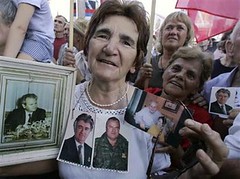
Milosevic posters appear in divided Kosovo town
Text of report by Serbia-Montenegrin radio Kontakt Plus on 28 June
[Announcer] A rally entitled "The truth about Kosovo-Metohija" is in progress in Sumadija Square [in northern part of Kosovska Mitrovica] attended by several hundred people. [Serbian Orthodox Church] Bishop of Milesevo Filaret, an academician and a member of the Bulgarian Academy [of Arts and Sciences], Velko Valkanov, a Greek member of the Parliamentary Assembly of the Council of Europe, journalist and publisher Ljiljana Bulatovic, journalist and publisher Milovan Drecun, writer Momir Lazic, Kosta Bulatovic, Mitar Balevic, lawyer Dragoljub Tomasevic, Prof Kosta Galjak and others will hold speeches.
Along with posters calling on citizens to attend this, as they put it, people's rally entitled "The truth about Kosovo-Metohija", posters featuring pictures of the former Yugoslav and Serbian president, Slobodan Milosevic, also appeared in the northern part of Kosovska Mitrovica. Mirjana Milutinovic has a report.
[Reporter] UNMIK [UN Interim Administration Mission in Kosovo] spokesman Gyoergy Kakuk told Kontakt Plus radio that the posters had been put up by a group of people based in Belgrade, adding that they had very limited support from the Kosovo Serbs.
[Kakuk, in English, superimposed by voice of interpreter] We understand that the posters were put up by a group based in Belgrade, the posters with Milosevic's face, and it seems that they have very limited support in [Kosovska] Mitrovica, not to mention among Kosovo Serbs in general. You should just remember the manner in which Milosevic used to exploit Kosovo Serbs for his own political purposes, and you should just remember what terrible consequences all this had for all Kosovo citizens. There is no law against putting up such posters, but it seems that the majority of Kosovo citizens are indifferent towards this, and they look upon it with scorn. I repeat that Kosovo Serbs, who suffered at the hands of this terrible person together with others, did not do this, UNMIK spokesman Gyoergy Kakuk said.
Prompted by the rally held today in Kosovska Mitrovica, entitled "The truth about Kosovo-Metohija", Gyoergy Kakuk said that the police had approved the rally as a way of celebrating St Vitus Day, not as a rally supporting any particular person, including Milosevic.
[Kakuk] We and the KPS [Kosovo Police Service] remain vigilant to uphold the people's democratic right of assembly and freedom of speech, and we will see to it that this is not abused, and that rallies proceed in a peaceful and democratic manner. So, we are making sure that there is no hate speech and incitement of ethnic hatred, the UNMIK spokesman said.
Source: Kontakt Plus, Kosovska Mitrovica, in Serbian 1400 gmt 28 Jun 05
[Announcer] A rally entitled "The truth about Kosovo-Metohija" is in progress in Sumadija Square [in northern part of Kosovska Mitrovica] attended by several hundred people. [Serbian Orthodox Church] Bishop of Milesevo Filaret, an academician and a member of the Bulgarian Academy [of Arts and Sciences], Velko Valkanov, a Greek member of the Parliamentary Assembly of the Council of Europe, journalist and publisher Ljiljana Bulatovic, journalist and publisher Milovan Drecun, writer Momir Lazic, Kosta Bulatovic, Mitar Balevic, lawyer Dragoljub Tomasevic, Prof Kosta Galjak and others will hold speeches.
Along with posters calling on citizens to attend this, as they put it, people's rally entitled "The truth about Kosovo-Metohija", posters featuring pictures of the former Yugoslav and Serbian president, Slobodan Milosevic, also appeared in the northern part of Kosovska Mitrovica. Mirjana Milutinovic has a report.
[Reporter] UNMIK [UN Interim Administration Mission in Kosovo] spokesman Gyoergy Kakuk told Kontakt Plus radio that the posters had been put up by a group of people based in Belgrade, adding that they had very limited support from the Kosovo Serbs.
[Kakuk, in English, superimposed by voice of interpreter] We understand that the posters were put up by a group based in Belgrade, the posters with Milosevic's face, and it seems that they have very limited support in [Kosovska] Mitrovica, not to mention among Kosovo Serbs in general. You should just remember the manner in which Milosevic used to exploit Kosovo Serbs for his own political purposes, and you should just remember what terrible consequences all this had for all Kosovo citizens. There is no law against putting up such posters, but it seems that the majority of Kosovo citizens are indifferent towards this, and they look upon it with scorn. I repeat that Kosovo Serbs, who suffered at the hands of this terrible person together with others, did not do this, UNMIK spokesman Gyoergy Kakuk said.
Prompted by the rally held today in Kosovska Mitrovica, entitled "The truth about Kosovo-Metohija", Gyoergy Kakuk said that the police had approved the rally as a way of celebrating St Vitus Day, not as a rally supporting any particular person, including Milosevic.
[Kakuk] We and the KPS [Kosovo Police Service] remain vigilant to uphold the people's democratic right of assembly and freedom of speech, and we will see to it that this is not abused, and that rallies proceed in a peaceful and democratic manner. So, we are making sure that there is no hate speech and incitement of ethnic hatred, the UNMIK spokesman said.
Source: Kontakt Plus, Kosovska Mitrovica, in Serbian 1400 gmt 28 Jun 05
Supporters Rally In Belgrade In Support Of Milosevic
BELGRADE (AP)--Hardline supporters of Slobodan Milosevic rallied Tuesday in the Serbian capital to commemorate the fourth anniversary of the former Yugoslav president's extradition to the U.N. war crimes tribunal.
The rally organizers, from Milosevic's Socialist Party of Serbia, handed out copies of a printed statement to about 3,000 supporters at Belgrade's main Republic Square.
The statement demanded Milosevic "be set free instantly" and called for the "arrest of those who committed the act of kidnapping and unlawful" handover of Milosevic to the U.N. court at The Hague, Netherlands.
The protesters held Socialist Party banners and gold-framed photographs and posters of their former leader.
Milosevic's popularity has increased amid a resurgence of hardline Serb nationalism, which helped trigger the wars in the Balkans in the 1990s.
Following his ouster in October 2000, Milosevic was extradited to The Hague tribunal on June 28, 2001, to face charges of genocide for atrocities committed by Serb troops in the wars in Croatia, Bosnia and Kosovo.
Belgrade media reported that Milosevic himself coordinated the organization of the rally from his detention cell at The Hague.
However, it was a far cry from the frenzied nationalist gatherings staged by Milosevic during his years in power, when tens of thousands attended.
The reformists who removed Milosevic from power have failed to live up to citizens' expectations that they would substantially improve the republic's economic and political situation.
Milosevic has been regaining popularity in Serbia, with almost a third of people saying they trust him despite his war crimes trial, a recent survey showed.
The survey, conducted by Faktor Plus polling agency, also said that Milosevic - who was ousted in a massive popular revolt - enjoys more popular backing than the current prime minister, Vojislav Kostunica, who took over Milosevic's presidency in 2000.
Intermixed with Milosevic posters at the Tuesday rally were pictures of two top fugitive war crimes suspects sought by the U.N. court - Bosnian Serb wartime political leader Radovan Karadzic and military commander Ratko Mladic. [ 28-06-05 1635GMT ]
The rally organizers, from Milosevic's Socialist Party of Serbia, handed out copies of a printed statement to about 3,000 supporters at Belgrade's main Republic Square.
The statement demanded Milosevic "be set free instantly" and called for the "arrest of those who committed the act of kidnapping and unlawful" handover of Milosevic to the U.N. court at The Hague, Netherlands.
The protesters held Socialist Party banners and gold-framed photographs and posters of their former leader.
Milosevic's popularity has increased amid a resurgence of hardline Serb nationalism, which helped trigger the wars in the Balkans in the 1990s.
Following his ouster in October 2000, Milosevic was extradited to The Hague tribunal on June 28, 2001, to face charges of genocide for atrocities committed by Serb troops in the wars in Croatia, Bosnia and Kosovo.
Belgrade media reported that Milosevic himself coordinated the organization of the rally from his detention cell at The Hague.
However, it was a far cry from the frenzied nationalist gatherings staged by Milosevic during his years in power, when tens of thousands attended.
The reformists who removed Milosevic from power have failed to live up to citizens' expectations that they would substantially improve the republic's economic and political situation.
Milosevic has been regaining popularity in Serbia, with almost a third of people saying they trust him despite his war crimes trial, a recent survey showed.
The survey, conducted by Faktor Plus polling agency, also said that Milosevic - who was ousted in a massive popular revolt - enjoys more popular backing than the current prime minister, Vojislav Kostunica, who took over Milosevic's presidency in 2000.
Intermixed with Milosevic posters at the Tuesday rally were pictures of two top fugitive war crimes suspects sought by the U.N. court - Bosnian Serb wartime political leader Radovan Karadzic and military commander Ratko Mladic. [ 28-06-05 1635GMT ]
Bosnian Foreign Ministry protests against Draskovic's statements
SARAJEVO, June 28 (Hina) - The authorities of Bosnia-Herzegovina on Tuesday expressed their concern and dissatisfaction to the Ambassador of Serbia and Montenegro, Stanimir Vukicevic, with the latest statements by Serbia and Montenegro Foreign Minister Vuk Draskovic, who linked the solving of Kosovo's status with the respecting of Bosnian state borders, the Bosnian Foreign Ministry reported.
The statement said that Ambassador Vukicevic was called to the ministry where he was received by acting secretary general Adnan Hadzikapetanovic.
Hadzikapetanovic told the ambassador that Draskovic's statement did not contribute to the good-neighbourly relations and the development of the spirit of regional cooperation.
The Bosnian Foreign Ministry has also instructed Bosnian Ambassador in Belgrade Tomislav Leko to ask the Serbia and Montenegro Foreign Ministry to take an official position on Draskovic's statement.
The statement said that Ambassador Vukicevic was called to the ministry where he was received by acting secretary general Adnan Hadzikapetanovic.
Hadzikapetanovic told the ambassador that Draskovic's statement did not contribute to the good-neighbourly relations and the development of the spirit of regional cooperation.
The Bosnian Foreign Ministry has also instructed Bosnian Ambassador in Belgrade Tomislav Leko to ask the Serbia and Montenegro Foreign Ministry to take an official position on Draskovic's statement.
Blerim Shala: Return to the last century (Zëri)
In a front-page editorial in Zëri, Blerim Shala comments on a report by the Serbian Interior Ministry regarding the situation in Kosovo from November 2004 – April 2005.
Shala argues that the approach and the conclusions of the report are identical with the reports of the Interior Ministry from the period November 1998 – April 1999. ‘As if nothing happened in the meantime,’ he says.
‘Translating this report and sending it to the right addresses in the West would be the best possible argument in Kosovo’s favour.’
Something similar, claims Shala, can be done with the public presentations of Vuk Draskovic, the foreign minister of the Union of Serbia and Montenegro.
Commenting on Draskovic’s statements, Shala says that both Kosovars and this part of Europe have grown tired ‘with such logic and arguments’.
In closing, Shala notes that with all the ups and downs in the Kosovan political scene, at least there is no politician in Kosovo that uses the language and arguments of the last century, as happens with Draskovic and the Serbian Ministry of Interior Affairs.
Shala argues that the approach and the conclusions of the report are identical with the reports of the Interior Ministry from the period November 1998 – April 1999. ‘As if nothing happened in the meantime,’ he says.
‘Translating this report and sending it to the right addresses in the West would be the best possible argument in Kosovo’s favour.’
Something similar, claims Shala, can be done with the public presentations of Vuk Draskovic, the foreign minister of the Union of Serbia and Montenegro.
Commenting on Draskovic’s statements, Shala says that both Kosovars and this part of Europe have grown tired ‘with such logic and arguments’.
In closing, Shala notes that with all the ups and downs in the Kosovan political scene, at least there is no politician in Kosovo that uses the language and arguments of the last century, as happens with Draskovic and the Serbian Ministry of Interior Affairs.
U.S. House of Rep. Resolution on Srebrenica Genocide
In the House of Representatives, U.S.,
June 27, 2005.
Whereas in July 1995 thousands of men and boys who had sought safety in the United Nations-designated `safe area' of Srebrenica in Bosnia and Herzegovina under the protection of the United Nations Protection Force (UNPROFOR) were massacred by Serb forces operating in that country;
Whereas beginning in April 1992, aggression and ethnic cleansing perpetrated by Bosnian Serb forces, while taking control of the surrounding territory, resulted in a massive influx of Bosniaks seeking protection in Srebrenica and its environs, which the United Nations Security Council designated a `safe area' in Resolution 819 on April 16, 1993;
Whereas the UNPROFOR presence in Srebrenica consisted of a Dutch peacekeeping battalion, with representatives of the United Nations High Commissioner for Refugees, the International Committee of the Red Cross, and the humanitarian medical aid agency Medecins Sans Frontie.AE2res (Doctors Without Borders) helping to provide humanitarian relief to the displaced population living in conditions of massive overcrowding, destitution, and disease;
Whereas Bosnian Serb forces blockaded the enclave early in 1995, depriving the entire population of humanitarian aid and outside communication and contact, and effectively reducing the ability of the Dutch peacekeeping battalion to deter aggression or otherwise respond effectively to a deteriorating situation;
Whereas beginning on July 6, 1995, Bosnian Serb forces attacked UNPROFOR outposts, seized control of the isolated enclave, held captured Dutch soldiers hostage and, after skirmishes with local defenders, ultimately took control of the town of Srebrenica on July 11, 1995;
Whereas an estimated one-third of the population of Srebrenica , including a relatively small number of soldiers, made a desperate attempt to pass through the lines of Bosnian Serb forces to the relative safety of Bosnian-held territory, but many were killed by patrols and ambushes;
Whereas the remaining population sought protection with the Dutch peacekeeping battalion at its headquarters in the village of Potocari north of Srebrenica but many of these individuals were randomly seized by Bosnian Serb forces to be beaten, raped, or executed;
Whereas Bosnian Serb forces deported women, children, and the elderly in buses, held Bosniak males over 16 years of age at collection points and sites in northeastern Bosnia and Herzegovina under their control, and then summarily executed and buried the captives in mass graves;
Whereas approximately 20 percent of Srebrenica's total population at the time--at least 7,000 and perhaps thousands more--was either executed or killed;
Whereas the United Nations and its member states have largely acknowledged their failure to take actions and decisions that could have deterred the assault on Srebrenica and prevented the subsequent massacre;
Whereas Bosnian Serb forces, hoping to conceal evidence of the massacre at Srebrenica , subsequently moved corpses from initial mass grave sites to many secondary sites scattered throughout parts of northeastern Bosnia and Herzegovina under their control;
Whereas the massacre at Srebrenica was among the worst of many horrible atrocities to occur in the conflict in Bosnia and Herzegovina from April 1992 to November 1995, during which the policies of aggression and ethnic cleansing pursued by Bosnian Serb forces with the direct support of the Serbian regime of Slobodan Milosevic and its followers ultimately led to the displacement of more than 2,000,000 people, an estimated 200,000 killed, tens of thousands raped or otherwise tortured and abused, and the innocent civilians of Sarajevo and other urban centers repeatedly subjected to shelling and sniper attacks;
Whereas Article 2 of the Convention on the Prevention and Punishment of the Crime of Genocide (done at Paris on December 9, 1948, and entered into force with respect to the United States on February 23, 1989) defines genocide as `any of the following acts committed with intent to destroy, in whole or in part, a national, ethnical, racial or religious group, as such: (a) killing members of the group; (b) causing serious bodily or mental harm to members of the group; (c) deliberately inflicting on the group conditions of life calculated to bring about its physical destruction in whole or in part; (d) imposing measures intended to prevent births within the group; and (e) forcibly transferring children of the group to another group';
Whereas on May 25, 1993, the United Nations Security Council adopted Resolution 827 establishing the world's first international war crimes tribunal, the International Criminal Tribunal for the former Yugoslavia (ICTY), based in The Hague, the Netherlands, and charging the ICTY with responsibility for investigating and prosecuting individuals suspected of committing war crimes, genocide, crimes against humanity and grave breaches of the 1949 Geneva Conventions on the territory of the former Yugoslavia since 1991;
Whereas nineteen individuals at various levels of responsibility have been indicted, and in some cases convicted, for grave breaches of the 1949 Geneva Conventions, violations of the laws or customs of war, crimes against humanity, genocide, and complicity in genocide associated with the massacre at Srebrenica , three of whom, most notably Radovan Karadzic and Ratko Mladic, remain at large; and
Whereas the international community, including the United States, has continued to provide personnel and resources, including through direct military intervention, to prevent further aggression and ethnic cleansing, to negotiate the General Framework Agreement for Peace in Bosnia and Herzegovina (initialed in Dayton, Ohio, on November 21, 1995, and signed in Paris on December 14, 1995), and to help ensure its fullest implementation, including cooperation with the International Criminal Tribunal for the former Yugoslavia: Now, therefore, be it
Resolved, That it is the sense of the House of Representatives that--
(1) the thousands of innocent people executed at Srebrenica in Bosnia and Herzegovina in July 1995, along with all individuals who were victimized during the conflict and genocide in Bosnia and Herzegovina from 1992 to 1995, should be solemnly remembered and honored;
(2) the policies of aggression and ethnic cleansing as implemented by Serb forces in Bosnia and Herzegovina from 1992 to 1995 meet the terms defining the crime of genocide in Article 2 of the Convention on the Prevention and Punishment of the Crime of Genocide;
(3) foreign nationals, including United States citizens, who have risked and in some cases lost their lives in Bosnia and Herzegovina while working toward peace should be solemnly remembered and honored;
(4) the United Nations and its member states should accept their share of responsibility for allowing the Srebrenica massacre and genocide to occur in Bosnia and Herzegovina from 1992 to 1995 by failing to take sufficient, decisive, and timely action, and the United Nations and its member states should constantly seek to ensure that this failure is not repeated in future crises and conflicts;
(5) it is in the national interest of the United States that those individuals who are responsible for war crimes, genocide, crimes against humanity, and grave breaches of the 1949 Geneva Conventions, committed in Bosnia and Herzegovina, should be held accountable for their actions;
(6) all persons indicted by the International Criminal Tribunal for the former Yugoslavia (ICTY) should be apprehended and transferred to The Hague without further delay, and all countries should meet their obligations to cooperate fully with the ICTY at all times; and
(7) the United States should continue to support the independence and territorial integrity of Bosnia and Herzegovina, peace and stability in southeastern Europe as a whole, and the right of all people living in the region, regardless of national, racial, ethnic or religious background, to return to their homes and enjoy the benefits of democratic institutions, the rule of law, and economic opportunity, as well as to know the fate of missing relatives and friends.
June 27, 2005.
Whereas in July 1995 thousands of men and boys who had sought safety in the United Nations-designated `safe area' of Srebrenica in Bosnia and Herzegovina under the protection of the United Nations Protection Force (UNPROFOR) were massacred by Serb forces operating in that country;
Whereas beginning in April 1992, aggression and ethnic cleansing perpetrated by Bosnian Serb forces, while taking control of the surrounding territory, resulted in a massive influx of Bosniaks seeking protection in Srebrenica and its environs, which the United Nations Security Council designated a `safe area' in Resolution 819 on April 16, 1993;
Whereas the UNPROFOR presence in Srebrenica consisted of a Dutch peacekeeping battalion, with representatives of the United Nations High Commissioner for Refugees, the International Committee of the Red Cross, and the humanitarian medical aid agency Medecins Sans Frontie.AE2res (Doctors Without Borders) helping to provide humanitarian relief to the displaced population living in conditions of massive overcrowding, destitution, and disease;
Whereas Bosnian Serb forces blockaded the enclave early in 1995, depriving the entire population of humanitarian aid and outside communication and contact, and effectively reducing the ability of the Dutch peacekeeping battalion to deter aggression or otherwise respond effectively to a deteriorating situation;
Whereas beginning on July 6, 1995, Bosnian Serb forces attacked UNPROFOR outposts, seized control of the isolated enclave, held captured Dutch soldiers hostage and, after skirmishes with local defenders, ultimately took control of the town of Srebrenica on July 11, 1995;
Whereas an estimated one-third of the population of Srebrenica , including a relatively small number of soldiers, made a desperate attempt to pass through the lines of Bosnian Serb forces to the relative safety of Bosnian-held territory, but many were killed by patrols and ambushes;
Whereas the remaining population sought protection with the Dutch peacekeeping battalion at its headquarters in the village of Potocari north of Srebrenica but many of these individuals were randomly seized by Bosnian Serb forces to be beaten, raped, or executed;
Whereas Bosnian Serb forces deported women, children, and the elderly in buses, held Bosniak males over 16 years of age at collection points and sites in northeastern Bosnia and Herzegovina under their control, and then summarily executed and buried the captives in mass graves;
Whereas approximately 20 percent of Srebrenica's total population at the time--at least 7,000 and perhaps thousands more--was either executed or killed;
Whereas the United Nations and its member states have largely acknowledged their failure to take actions and decisions that could have deterred the assault on Srebrenica and prevented the subsequent massacre;
Whereas Bosnian Serb forces, hoping to conceal evidence of the massacre at Srebrenica , subsequently moved corpses from initial mass grave sites to many secondary sites scattered throughout parts of northeastern Bosnia and Herzegovina under their control;
Whereas the massacre at Srebrenica was among the worst of many horrible atrocities to occur in the conflict in Bosnia and Herzegovina from April 1992 to November 1995, during which the policies of aggression and ethnic cleansing pursued by Bosnian Serb forces with the direct support of the Serbian regime of Slobodan Milosevic and its followers ultimately led to the displacement of more than 2,000,000 people, an estimated 200,000 killed, tens of thousands raped or otherwise tortured and abused, and the innocent civilians of Sarajevo and other urban centers repeatedly subjected to shelling and sniper attacks;
Whereas Article 2 of the Convention on the Prevention and Punishment of the Crime of Genocide (done at Paris on December 9, 1948, and entered into force with respect to the United States on February 23, 1989) defines genocide as `any of the following acts committed with intent to destroy, in whole or in part, a national, ethnical, racial or religious group, as such: (a) killing members of the group; (b) causing serious bodily or mental harm to members of the group; (c) deliberately inflicting on the group conditions of life calculated to bring about its physical destruction in whole or in part; (d) imposing measures intended to prevent births within the group; and (e) forcibly transferring children of the group to another group';
Whereas on May 25, 1993, the United Nations Security Council adopted Resolution 827 establishing the world's first international war crimes tribunal, the International Criminal Tribunal for the former Yugoslavia (ICTY), based in The Hague, the Netherlands, and charging the ICTY with responsibility for investigating and prosecuting individuals suspected of committing war crimes, genocide, crimes against humanity and grave breaches of the 1949 Geneva Conventions on the territory of the former Yugoslavia since 1991;
Whereas nineteen individuals at various levels of responsibility have been indicted, and in some cases convicted, for grave breaches of the 1949 Geneva Conventions, violations of the laws or customs of war, crimes against humanity, genocide, and complicity in genocide associated with the massacre at Srebrenica , three of whom, most notably Radovan Karadzic and Ratko Mladic, remain at large; and
Whereas the international community, including the United States, has continued to provide personnel and resources, including through direct military intervention, to prevent further aggression and ethnic cleansing, to negotiate the General Framework Agreement for Peace in Bosnia and Herzegovina (initialed in Dayton, Ohio, on November 21, 1995, and signed in Paris on December 14, 1995), and to help ensure its fullest implementation, including cooperation with the International Criminal Tribunal for the former Yugoslavia: Now, therefore, be it
Resolved, That it is the sense of the House of Representatives that--
(1) the thousands of innocent people executed at Srebrenica in Bosnia and Herzegovina in July 1995, along with all individuals who were victimized during the conflict and genocide in Bosnia and Herzegovina from 1992 to 1995, should be solemnly remembered and honored;
(2) the policies of aggression and ethnic cleansing as implemented by Serb forces in Bosnia and Herzegovina from 1992 to 1995 meet the terms defining the crime of genocide in Article 2 of the Convention on the Prevention and Punishment of the Crime of Genocide;
(3) foreign nationals, including United States citizens, who have risked and in some cases lost their lives in Bosnia and Herzegovina while working toward peace should be solemnly remembered and honored;
(4) the United Nations and its member states should accept their share of responsibility for allowing the Srebrenica massacre and genocide to occur in Bosnia and Herzegovina from 1992 to 1995 by failing to take sufficient, decisive, and timely action, and the United Nations and its member states should constantly seek to ensure that this failure is not repeated in future crises and conflicts;
(5) it is in the national interest of the United States that those individuals who are responsible for war crimes, genocide, crimes against humanity, and grave breaches of the 1949 Geneva Conventions, committed in Bosnia and Herzegovina, should be held accountable for their actions;
(6) all persons indicted by the International Criminal Tribunal for the former Yugoslavia (ICTY) should be apprehended and transferred to The Hague without further delay, and all countries should meet their obligations to cooperate fully with the ICTY at all times; and
(7) the United States should continue to support the independence and territorial integrity of Bosnia and Herzegovina, peace and stability in southeastern Europe as a whole, and the right of all people living in the region, regardless of national, racial, ethnic or religious background, to return to their homes and enjoy the benefits of democratic institutions, the rule of law, and economic opportunity, as well as to know the fate of missing relatives and friends.
Madeline Albright to address Kosovo Assembly on 5 July
Zëri reports on the front page that former US Secretary of State Madeleine Albright will visit Kosovo on July 5th when she will give a speech at the Kosovo Assembly. The news was confirmed by the Media Office of the Assembly. The paper notes that Albright will visit Kosovo in the capacity of director of the National Democratic Institute.
Zëri also reports that the Kosovo Government and Prime Minister Kosumi will host a dinner for Albright in honour of her constant contribution. Albright is also expected to meet senior Kosovan leaders.
KFOR: No threat of violence when status negotiations start
Zëri reports on the front page that KFOR is not planning to increase the number of its troops in Kosovo as there is no serious threat when the negotiations on the final status start.
On the other hand, UNMIK officials think that during the sensitive stage of the comprehensive review by ambassador Kai Eide, there could be people interested in causing violence.
International media have speculated over the last few days that with the launch of status talks, Serb militants in the northern part of Kosovo and supported by nationalists from Serbia could start violence.
On the other hand, UNMIK officials think that during the sensitive stage of the comprehensive review by ambassador Kai Eide, there could be people interested in causing violence.
International media have speculated over the last few days that with the launch of status talks, Serb militants in the northern part of Kosovo and supported by nationalists from Serbia could start violence.
Balkans can enter EU only after solution of Kosovo’s status
Koha Ditore covers a political discussion ‘Balkans and the road ahead to EU’ that was held in Pristina and was organized by International Forum UBT 2005.
‘Europe cannot ignore Kosovo problem,’ said Michel Cullin, director of Vienna Diplomatic Academy, and added that the ‘Balkans should be seen as a European whole with Kosovo having a place in it’.
Skender Hyseni, an advisor to President Rugova, said that ‘solution of Kosovo’s status is a precondition for integration of the Balkans into the EU’.
Participants in the conference concluded that the solution of Kosovo’s final status is important for the future of the European Union.
‘Europe cannot ignore Kosovo problem,’ said Michel Cullin, director of Vienna Diplomatic Academy, and added that the ‘Balkans should be seen as a European whole with Kosovo having a place in it’.
Skender Hyseni, an advisor to President Rugova, said that ‘solution of Kosovo’s status is a precondition for integration of the Balkans into the EU’.
Participants in the conference concluded that the solution of Kosovo’s final status is important for the future of the European Union.
Monday, June 27, 2005
Kosovo Protesters Hurl Eggs At Serbia-Montenegro Minister
PRISTINA (AP)--Protesters in Kosovo hurled eggs at a convoy carrying Serbia- Montenegro's foreign minister on his first visit to the disputed province since the end of the war six years ago.
Around 100 protesters massed outside the U.N. headquarters as the foreign minister, Vuk Draskovic, met with the deputy head of the U.N. mission in Kosovo, Larry Rossin.
Some of the demonstrators threw eggs from the balconies of nearby buildings as Draskovic's convoy arrived. Police arrested about a dozen protesters. Two local reporters were also detained during a melee that followed the arrests.
"His visit is unacceptable, because...Serbia is unacceptable," said a statement from the Kosovo Action Network, a group that organized the protests. " The state union that (Draskovic) represents was an accomplice in crimes here," it said.
Kosovo has been administered by the U.N. since mid-1999 when a NATO air war halted Serb forces' crackdown on ethnic Albanians seeking independence.
An estimated 10,000 ethnic Albanians were killed. After the end of the war, tens of thousands of Serbs fled the province in the face of attacks and threats from ethnic Albanian extremists.
Those Serbs remaining live mainly in isolated enclaves scattered around the province, and the two communities remain divided.
Talks to resolve Kosovo's status are expected later this year if Kosovo - legally a province of the Serbia-Montenegro union that replaced Yugoslavia - meets U.N.-set standards on democracy, human rights and rights of minorities.
Kosovo's ethnic Albanian majority demands independence, while Serbs want the province to remain within their borders.
Draskovic's visit follows one by Serbia's prime minister, Vojislav Kostunica, who attended a Serb Orthodox Mass in western Kosovo in January. Serbian President Boris Tadic toured Serb communities in Kosovo in February.
Draskovic later traveled to the Serb enclave of Gracanica to observe Vidovdan, or St. Vitus Day, a Serb holiday marking the 616th anniversary of an epic battle against Ottoman Turks.
(END) Dow Jones Newswires
Around 100 protesters massed outside the U.N. headquarters as the foreign minister, Vuk Draskovic, met with the deputy head of the U.N. mission in Kosovo, Larry Rossin.
Some of the demonstrators threw eggs from the balconies of nearby buildings as Draskovic's convoy arrived. Police arrested about a dozen protesters. Two local reporters were also detained during a melee that followed the arrests.
"His visit is unacceptable, because...Serbia is unacceptable," said a statement from the Kosovo Action Network, a group that organized the protests. " The state union that (Draskovic) represents was an accomplice in crimes here," it said.
Kosovo has been administered by the U.N. since mid-1999 when a NATO air war halted Serb forces' crackdown on ethnic Albanians seeking independence.
An estimated 10,000 ethnic Albanians were killed. After the end of the war, tens of thousands of Serbs fled the province in the face of attacks and threats from ethnic Albanian extremists.
Those Serbs remaining live mainly in isolated enclaves scattered around the province, and the two communities remain divided.
Talks to resolve Kosovo's status are expected later this year if Kosovo - legally a province of the Serbia-Montenegro union that replaced Yugoslavia - meets U.N.-set standards on democracy, human rights and rights of minorities.
Kosovo's ethnic Albanian majority demands independence, while Serbs want the province to remain within their borders.
Draskovic's visit follows one by Serbia's prime minister, Vojislav Kostunica, who attended a Serb Orthodox Mass in western Kosovo in January. Serbian President Boris Tadic toured Serb communities in Kosovo in February.
Draskovic later traveled to the Serb enclave of Gracanica to observe Vidovdan, or St. Vitus Day, a Serb holiday marking the 616th anniversary of an epic battle against Ottoman Turks.
(END) Dow Jones Newswires
OHR: THERE CAN BE NO MEDDLING WITH BiH’S BORDERS
SARAJEVO, June 27 (FENA) – The weekend’s statement by Serbia and Montenegro Foreign Minister Vuk Draskovic, suggesting a linkage between a settlement of the status of Kosovo and BiH are damaging, destabilizing and completely unacceptable, was announced by the OHR.
The Kosovo question is a matter solely for the international community and the Government of Serbia and Montenegro, and has no connection with Bosnia and Herzegovina, was announced.
"Bosnia and Herzegovina is a sovereign state, a member of the United Nations whose borders are internationally recognised, and guaranteed by treaty and by law. These borders are not a matter for negotiation and Serbia and Montenegro, as a Dayton signatory has an obligation to uphold them. The days when Belgrade brings into question Bosnia and Herzegovina ’s borders are long gone and will never be allowed return", was announced.
These kinds of comments damage Serbia and Montenegro's ability to be regarded as a stable influence in the region and a country on its way to Europe, was anounced by the OHR.
The Kosovo question is a matter solely for the international community and the Government of Serbia and Montenegro, and has no connection with Bosnia and Herzegovina, was announced.
"Bosnia and Herzegovina is a sovereign state, a member of the United Nations whose borders are internationally recognised, and guaranteed by treaty and by law. These borders are not a matter for negotiation and Serbia and Montenegro, as a Dayton signatory has an obligation to uphold them. The days when Belgrade brings into question Bosnia and Herzegovina ’s borders are long gone and will never be allowed return", was announced.
These kinds of comments damage Serbia and Montenegro's ability to be regarded as a stable influence in the region and a country on its way to Europe, was anounced by the OHR.
Petkovic: Those who don’t live here cannot decide for K-Serbs
Several dailies quote Returns and Communities Minister Slavisa Petkovic as saying that those who don’t live in Kosovo cannot decide for Kosovo Serbs. Zëri notes that Petkovic has called on Kosovo Serbs to take their fate in their own hands and not listen to others who don’t live with them in Kosovo.
‘When Belgrade called on us not to participate in elections, it didn’t tell us how we should pursue our interests in Kosovo and we still don’t have answer to this,’ Petkovic was quoted as saying.
Jessen-Petersen: I hope talks between Belgrade and Pristina will start in July
Epoka e Re reports that UNMIK chief Søren Jessen-Petersen told Vienna-based Standard newspaper that he hopes talks between Belgrade and Pristina would start in July. ‘For the time being, we are trying to organize the meeting between the two presidents. Both Ibrahim Rugova and Boris Tadic have accepted this. As soon as this meeting is held, nothing will stand in the way of the meeting of the two prime ministers,’ said Jessen-Petersen.
Sunday, June 26, 2005
Picture of the Day
Serbian citizen Nebojsa Minic is seen at a hospital where he remains under police custody in Mendoza June 25, 2005. Serbia's special war crimes court on Wednesday urged the government to extradite Minic, who is suspected of murdering Kosovo Albanians in 1999, during the NATO bombing of Yugoslavia. REUTERS/Paulo Paez
1,000 UK troops on Kosovo standby to counter Serb militants
By Robert Fox in Pristina
26 June 2005
Britain is drawing up contingency plans to send up to 1,000 extra British troops and advisers to Kosovo as a crisis looms over the Balkan province's future.
Officially Kosovo remains a part of Serbia, although it has been under international control since 1999, when Nato troops took over in the wake of a bombing campaign against ex-president Slobodan Milosevic. But the province's restive Albanian majority, backed by the US, is demanding independence from "final status" talks later this year.
Serbs inside Kosovo, of whom about 125,000 remain, and the Serbian government still oppose Kosovo breaking away. Recently, however, Belgrade has shifted its position by declaring Kosovo should be granted something "more than autonomy, but less than independence". Either way, the interim Kosovo government of President Ibrahim Rugova and Prime Minister Bajram Kosumi believes there is a threat of serious violence once the talks get under way.
In March last year riots across the province killed 19 people, including one UN policeman, and seriously injured more than 200. A report into the riots by Kai Eide, a Norwegian diplomat, castigated Unmik, the UN mission to Kosovo, and K-For, the international military force, for incompetence, inertia and corruption. As the violence erupted, German UN troops were accused of hiding in their barracks. The 1st Battalion, the Royal Gloucester Wiltshire and Berkshire Regiment, then Nato's spearhead battalion, had to be flown in. As tensions rose this spring, the 1st Green Jackets had to be brought in for a similar mission.
As the "final status" talks begin, trouble is feared from Serb militants in Mitrovica and north-east Kosovo, with intelligence suggesting they could be supported by nationalists across the border in Serbia. More worrying, say intelligence analysts, is the possibility of another spontaneous nationalist uprising by militant Kosovo Albanians if independence is put off yet again. "We could face something like the KLA uprising in 1998, only this time we don't know who the new leaders will be," said one.
Britain has 200 troops and support personnel in Kosovo, and some 1,000 troops in Bosnia, where the international administration is run by Lord Ashdown. But his mission ends in October, and Britain hands over command of the EU force in Bosnia at the same time. The Ministry of Defence says officially there are no immediate plans to send troops to Kosovo, but "contingencies are under constant review". According to military sources, the timing means the British battalion in Bosnia could be switched to Kosovo, just when it might be needed.
26 June 2005
Britain is drawing up contingency plans to send up to 1,000 extra British troops and advisers to Kosovo as a crisis looms over the Balkan province's future.
Officially Kosovo remains a part of Serbia, although it has been under international control since 1999, when Nato troops took over in the wake of a bombing campaign against ex-president Slobodan Milosevic. But the province's restive Albanian majority, backed by the US, is demanding independence from "final status" talks later this year.
Serbs inside Kosovo, of whom about 125,000 remain, and the Serbian government still oppose Kosovo breaking away. Recently, however, Belgrade has shifted its position by declaring Kosovo should be granted something "more than autonomy, but less than independence". Either way, the interim Kosovo government of President Ibrahim Rugova and Prime Minister Bajram Kosumi believes there is a threat of serious violence once the talks get under way.
In March last year riots across the province killed 19 people, including one UN policeman, and seriously injured more than 200. A report into the riots by Kai Eide, a Norwegian diplomat, castigated Unmik, the UN mission to Kosovo, and K-For, the international military force, for incompetence, inertia and corruption. As the violence erupted, German UN troops were accused of hiding in their barracks. The 1st Battalion, the Royal Gloucester Wiltshire and Berkshire Regiment, then Nato's spearhead battalion, had to be flown in. As tensions rose this spring, the 1st Green Jackets had to be brought in for a similar mission.
As the "final status" talks begin, trouble is feared from Serb militants in Mitrovica and north-east Kosovo, with intelligence suggesting they could be supported by nationalists across the border in Serbia. More worrying, say intelligence analysts, is the possibility of another spontaneous nationalist uprising by militant Kosovo Albanians if independence is put off yet again. "We could face something like the KLA uprising in 1998, only this time we don't know who the new leaders will be," said one.
Britain has 200 troops and support personnel in Kosovo, and some 1,000 troops in Bosnia, where the international administration is run by Lord Ashdown. But his mission ends in October, and Britain hands over command of the EU force in Bosnia at the same time. The Ministry of Defence says officially there are no immediate plans to send troops to Kosovo, but "contingencies are under constant review". According to military sources, the timing means the British battalion in Bosnia could be switched to Kosovo, just when it might be needed.
Saturday, June 25, 2005
Most wanted: doctor death - The Independent
Ten years after Radovan Karadzic's troops killed 7,000 Muslims in Srebrenica, the former Serb leader remains at large. In this remarkable report from the heart of Bosnia, Antony Barnett goes on the trail of Europe's most notorious war criminal
Sunday June 26, 2005
The Observer
What strikes you first is the colour of the house. As you drive along the bumpy stone road that leads to the family home of Dr Radovan Karadzic, Europe's most wanted war criminal, its garish pink exterior bursts out in front of you. But despite its bright facade, it is a house that hides many dark secrets.
On Monday 11 July it will be 10 years since Karadzic's Bosnian Serb soldiers marched into the United Nations safe haven at Srebrenica and slaughtered more than 7,000 Bosnian Muslim men and boys. Yet Karadzic, the chief architect of this massacre - as well as the mastermind of the 1,000-day siege of Sarajevo that saw 10,000 civilians killed, 1,000 of them children - remains a free man.
Despite a $5 million (£2.7m) bounty on his head, Karadzic is a fugitive. Protected by a secret underground network made up of politicians, criminals, spies, businessmen and priests from the Orthodox church, Karadzic - a psychiatrist, children's author and poet in another life - is believed to be hiding in the mountains of eastern Bosnia close to the border with Montenegro.
His liberty remains a major embarrassment to the international community and an open sore in a country where 200,000 people were killed in a bitter ethnic war between Serb, Muslims and Croats. There can be no healing until Karadzic faces justice.
A decade after Srebenica and his indictment at The Hague, The Observer set out on a journey to reveal the network built to hide a man accused of committing the worst atrocities witnessed in Europe since the concentration camps of Nazi Germany.
Karadzic's pink family home is the obvious place to start. It stands on the outskirts of a town called Pale, cradled in the Bosnian mountains. Before the war in 1992 it was a ski village 10 miles south east of Sarajevo. Today it is the capital of the Republic of Sprska (pronounced Serbska), the semi-autonomous region of Bosnia that the Serbs like to call their own. It is a state within a state, where Karadzic's nationalist Serbian Democratic Party (SDP) still holds considerable power and is linked to an organised crime network run by Serb former paramilitary leaders and war criminals loyal to him. Most towns and villages there were ethnically cleansed, with Muslim communities expelled or exterminated. Mosques came down, Orthodox Serb churches went up.
Pale was a Karadzic stronghold in the war. It was from the Panorama hotel in the town centre that Karadzic and his cronies planned their brutal campaign. It takes only a few minutes to drive from the hotel to the Karadzic home.
As I arrive at the house the front door opens. None of the three people standing by the hall, who are thought to be part of Karadzic's extended family, will be interviewed, nor answer questions asked through the locked iron security gate. 'Have you seen Radovan? Where do you think he is? Can I speak to his wife Ljiljana? Has she seen him recently?'
All the questions are greeted with silence. After a while a tall, broad-shouldered man with closely-shaved dark hair, believed to be Karadzic's brother-in-law, comes to the gate and says they cannot help us. Karadzic's wife is not here. She is at another property, painting it after it was wrecked during a raid by Nato troops searching for clues to the whereabouts of her husband.
The next-door neighbours watch nervously from their first floor balcony. They too refuse to answer questions. A man in a scruffy red polo shirt with a walkie-talkie in hand comes over to ask for my ID papers. I ask for his. He claims he is with the Republic of Sprska police. He asks us to leave. I have doubts about the authenticity of his own ID, but decide to head into the centre of Pale.
Love letters from 'Radovan' to his beloved wife 'Lili', dated 2002, have recently been published showing that these two psychiatrists, who fell in love at medical school in Sarajevo, have met at a secret location. In one letter Karadzic tells his wife it would 'take a battalion' to discover his hiding place ... Of course, caution is necessary but there is not need of such fear and paranoia.'
His apparent lack of concern appears well founded. Despite being, like Osama bin Laden, one of the world's most wanted men and hiding in a country as small as Wales, the commitment to capture him by the 7,000 overseas troops still in Bosnia seems questionable. The French are regularly accused of being 'too close' to the Karadzic network, and even the British seem reticent.
One British officer serving in Bosnia, alluding to the fact that any attempt to snatch Karadzic is likely to lead to a shoot-out, said: 'If you think we would risk the life of one British soldier for these people, then you're wrong.'
This month - a week after a remarkable video appeared revealing the horror of the massacre in Srebrenica - Karadzic's brother, Luka, said: 'My brother has made a strategic decision to never surrender to the Hague Tribunal [set up try those accused of war crimes]. If he surrendered he would betray his people and God, which has protected him from the enemies for so long.'
To those hunting the so-called Butcher of Bosnia, these people make a web of clandestine supporters who form a protective financial and spiritual cloak around Karadzic that keeps him free. Such is their influence that one source claims trackers sent from The Hague to find Karadzic are sometimes spotted as arriving at Sarajevo airport and put under surveillance. Information is fed to Karadzic's army of bodyguards, who can move him at short notice should one of these investigators get a lucky break.
To these supporters Karadzic is a folk hero, a leader who helped protect them from the Muslim hordes. They inhabit a closed world, hostile to outsiders and suspicious of questions.
An orthodox priest, Father Jeremija Starovlah, gets up from his chair when he sees me approaching. His short silver hair and beard offer a striking contrast to his traditional black robes. The small, pretty white church that he runs is in the centre of Pale, a short drive from the Karadzic home.
A local newspaper reported last March that Starovlah was calling on Orthodox believers to shelter Karadzic. A few weeks later the international authorities said they had intelligence suggesting Karadzic was staying with the priest. Nato forces raided Starovlah's home, blowing up his front door and injuring his son. Karadzic was not found.
The raid provoked street protests by more than 2,000 Bosnian Serbs. Some wore masks of Karadzic while others waved the blue, red and white flags of the Republic of Sprska.
Now Starovlah refuses to speak or answer any questions. 'Has Karadzic been here?' I ask. 'Do you regard him as a hero? Where do you think he is now? Should he go to the Hague?' He says only: 'I have no comment to make. I do not wish to speak about this.'
Starovlah shows no desire to set the record straight. This is a priest in the Bosnian Serb capital, who is close to the Karadzic family. And in the Republic of Sprska, family secrets are closely guarded.
One of the most shocking parts of a recent film of Srebenica, showing six Muslims being bound and shot at close range, was that it began with a Serb Orthodox priest blessing the camouflaged paramilitary troops who carried out the massacre. Rumours persist that Karadzic is disguised as a priest and moving from monastery to monastery.
As well as the church in Pale, intelligence agencies have monitored phone calls that disclose he has hidden in the isolated mountain monastery of Ostrog. Karadzic's grandson was christened there. According to a diplomatic source it is estimated that Karadzic spends 80 per cent of his time in church property. The source says it is not a coincidence that since the war dozens of new Orthodox churches have been built at a cost of millions of pounds. It is alleged that most of this money comes from the same illicit sources that provide the funds to protect Karadzic.
Yet while the church may offer Karadzic spiritual and physical sanctuary, an altogether more criminal network funds the $200,000 a month operation to protect the 'Doctor in the Forest'.
Milovan Bjelica is waiting for me outside Cafe Iceberg in the town of Sokolac, a 45-minute drive from Sarajevo. Smoking a Malboro and drinking an espresso he beckons us over with his steel-blue eyes. A disfigured right hand hangs loosely by his side.
Nato arrested Bjelica twice last year, detaining him for a month at a time. Armed troops swooped on the town last August and questioned him for more than two hours a day for a whole month. They had heard he had gone to Belgrade and accused him of meeting supporters of Karadzic. Bjelica claims he was there to have surgery.
Bjelica has been accused by the US State Department and the European Union of funnelling money to the Karadzic network and running the security and intelligence units that guard him. His name is on the US list of international terrorists and he is banned from travelling to any EU country.
In March 2003 the US government described him as a 'long-time friend and business associate of Karadzic, [who] presides over a network of legal and illegal businesses that are also used to provide for the protection of Karadzic'.
Bjelica denies all this but there is no doubt he is a supporter of Karadzic and was a powerful figure in his Serbian Democratic Party. Bjelica was the party president in eastern Bosnia during the war and spent time with Karadzic.
Bjelica has agreed to meet us because he wants to ensure I understand that many Serbs were killed in the war and suffered Muslim ethnic cleansing. He takes my notebook and draws a sketch of Sarajevo, pointing out areas where he claims 5,000 Serbs were killed.
Bjelica has seen the video of Srebenica and thought it was 'terrible'. But he claims there are films of the Bosnian Muslims, or mujahideen, as he calls them, beheading Serbs. 'Why is that not shown on your TV?' he says.
Like many of Karadzic's closest allies, he believes their leader 'signed a contract' with Richard Holbrooke, President Bill Clinton's chief adviser during the Dayton Peace Accord in 1995 that ended the war. This stipulated that if Karadzic disappeared from frontline politics he would not be arrested.
'To over 90 per cent of Bosnian Serbs he is a hero,' says Bjelica. 'He protected the Serbian people during the war.'
So where does Bjelica, whose nickname 'Cicko' means pussycat, think his friend is hiding? He shrugs. Stubbing out his cigarette, he gets up from the table, shakes my hand and leaves.
The centre Sarajevo is a long way from the corridors of Westminster, but the heated complexity of Bosnian politics makes the hurly-burly of the House of Commons seem tame. Yet it is the former Liberal Democrat leader Paddy Ashdown, who, as the High Representative of the International Community in Bosnia, has overall responsibility for stability in the region. As part of Lord Ashdown's brief, the capture of Karadzic and other war criminals such as General Ratko Mladic, the former Bosnian Serb military commander, is pivotal.
'You can't have peace without justice,' says Ashdown. 'And only after that you can get to reconciliation. This can only happen when the major architects of these crimes are brought to justice.'
His office sits on the former front line of the Sarajevo's bloody battle, and the surrounding buildings are pockmarked with bullet holes. The former Bosnian parliament building across the street remains a burnt-out wreck, a vivid reminder of the horrors faced by civilians in the siege of the city that was inspired by Karadzic. It was largely Serbian sniper bullets and shells that rained down from the surrounding mountains killing those queuing for bread or buying fruit in the main street market.
So why, 10 years on, has Karadzic not been found? 'Catching war criminals is a campaign, not a commando raid,' says Ashdown. 'It requires changing the political climate, attacking corrupt networks, removing the money he uses to fund himself. It requires isolation by taking out lower-level war criminals. Then we have a better change of catching him.' Ashdown describes Karadzic as 'the head of a vast criminal organisation' that thrives on corruption and extortion. Visits are paid to businessmen from dark forces who ask for contributions for the 'doctor in the forest'. These organised crime networks make vast sums from smuggling drugs, petrol and tobacco as well as trafficking young girls for the sex trade.
Ashdown's office has carried out investigative audits on many of the state-owned companies, such as the electricity firm Electroprivreda and discovered tens of millions of dollars missing.
'We have just carried out an audit of Sprske Sume, the Serb forestry organisation, and found it riddled with political backhanders just siphoned out of the system. This is public money just disappearing into political parties such as the SDS. From there siphoning it to Karadzic is not a difficult thing to do.'
Ashdown's office believes that one of the key 'bankers' to Karadzic's network is Momcilo Mandic, a former minister who commanded Karadzic's police force. Mandic has made a fortune from running petrol stations, a bank and other businesses. Like Bjelica he is on a number of international blacklists but lives freely in Belgrade. The US has described him as a 'major funding source for Karadzic through his control of an elaborate network of criminal enterprises engaged in embezzlement, business fraud and fictitious loans'. He too has denied the claims.
Another Bosnian Serb accused of providing money for the Karadzic network is Radomir Kojic, who is also on the US terrorist list and banned from travelling. Last month an Observer investigation discovered that his mine-clearing company, Unipak, won many lucrative contracts from foreign governments including six from the UK Department for International Development. Kojic, a wartime Serb commander in the hills around Sarajevo, rejects the claims, saying his he is the victim of false rumours spread by business rivals who have provided no evidence of wrongdoing.
Meeting us outside his hotel in the ski resort of Jahorina, where Sarajevo's Winter Olympics was held in 1984, he claims his business now faces ruin. 'It is better for my family if I kill myself,' Kojic says. He does, however, admit he was a member of Karadzic's party in 1990 and the property developer who built Karadzic's family home in Pale. The pink house, it seems, is never far from the centre from the story.
They call the area the heart of darkness. The geographical triangle created by the towns of Visegrad, Cajnice and Foca in the Republic of Sprska in the far east of Bosnia is indeed a cold, dark place. But these are not adjectives used to describe the region's physical appearance. It is rich in natural beauty, with the majestic River Drina snaking its way through the glorious pine forests in the valley as the peaks of the Zelengora mountains tower above.
The chill comes from the history that swept across the nearby borders of Serbia and Montenegro and whipped up a storm of ethnic hatred that brutalised a generation. It remains a hotbed of fervent Serb nationalism where some of the worst genocidal crimes of the Bosnian war were committed. Ten years ago it was not dead branches from the pine trees that the Drina carried in its fast-flowing, but the bodies of hundreds of butchered Muslims that were swept along in its bloodstained water.
It is among these mountains and remote villages of his loyal supporters that many believe Karadzic is hiding. It is close enough to the porous borders of Montenegro, the country of Karadzic's birth, that the 'Doctor from the Forest' can easily slip through out of the clutches of Nato and European Union forces.
At the apex of the triangle is Foca, a place renowned for harbouring war criminals. Before the war more than half of the town's 40,000 population was Muslim, now there are none. Rape, torture and murder changed that.
Today the centre of Foca is a scene of normality. Teenagers wearing fashion able sunglasses sip beer and smoke cigarettes at cafes overlooking the river while rock music pumps from the speakers. At Cafe Uno, a group of four older men sit around a table eating the traditional local Bosnian dish of cevapi, small sausages made of lamb and beef.
I ask if they will talk about Karadzic. At first nobody wants to speak. 'We don't want to talk about politics,' said one. 'Do you think of him as a hero or a war criminal?' I ask. After a pause, one of them, a chubby man with curly hair, barks: 'A hero, of course. He protected us.'
The oldest in the group, with a moustache and fine grey hair, then takes over. He snarls: 'You English and Americans, you know where he is. You are protecting him. If you wanted to arrest him you could.' The others around the table nod in agreement. They want us to leave.
As I start driving high into the mountains towards the Montenegro border, it becomes increasingly clear why it has been so difficult to catch Karadzic. Not only is he among people who view in him as one of a long line of Serb heroes who have fought off foreign invaders. But the terrain itself is almost impassable in a normal car. The roads are practically dirt tracks and wind their way up steep mountainous slopes that rise into the clouds. If Karadzic was hiding anywhere here, his security people would see anybody coming from miles away.
As I leave Foca and head back to Sarajevo there is a sign for Niksic, the home town of Karadzic's mother, which is 105km east in Montenegro. As I drive on, three young boys coming from a game of football pass by. They raise their hands in the infamous three-fingered salute of Serb nationalists.
Fugitives from justice
General Ratko Mladic
Mladic was commander of Serbian troops in Bosnia during the war. Along with Karadzic he is charged with genocide for ordering the massacre of Muslims in Srebrenica and the siege of Sarajevo in which 10,000 civilians were killed. He is blamed for abetting the 'systematic' campaign of sniping at civilians in the city over the past three years and for the seizure and use as human shields of 284 UN peacekeepers in May and June 1995. He is accused of shelling the towns of Tuzla and Srebrenica 'in order to kill, terrorise and demoralise the Bosnian Muslim and Bosnian Croat civilian population'. Aged 50.
Ante Gotovina
A Croatian, he is the Hague tribunal's third most wanted man. He is accused of the murder of hundreds of Serbs. Aged 49.
Milan Lukic
The notorious leader of the White Eagles paramilitary group, he is accused of masterminding the massacre of thousands of Muslims in the eastern Bosnian town of Visregrad. Many were burned alive. Women and children were forced across the bridge over the River Drina and shot. Thousands of local men were killed elsewhere. Aged 38.
Dragan Zelenovic
Zelenovic is charged with organising the mass rape and torture of Muslim women in the Bosnian town of Foca. Aged 44.
Sunday June 26, 2005
The Observer
What strikes you first is the colour of the house. As you drive along the bumpy stone road that leads to the family home of Dr Radovan Karadzic, Europe's most wanted war criminal, its garish pink exterior bursts out in front of you. But despite its bright facade, it is a house that hides many dark secrets.
On Monday 11 July it will be 10 years since Karadzic's Bosnian Serb soldiers marched into the United Nations safe haven at Srebrenica and slaughtered more than 7,000 Bosnian Muslim men and boys. Yet Karadzic, the chief architect of this massacre - as well as the mastermind of the 1,000-day siege of Sarajevo that saw 10,000 civilians killed, 1,000 of them children - remains a free man.
Despite a $5 million (£2.7m) bounty on his head, Karadzic is a fugitive. Protected by a secret underground network made up of politicians, criminals, spies, businessmen and priests from the Orthodox church, Karadzic - a psychiatrist, children's author and poet in another life - is believed to be hiding in the mountains of eastern Bosnia close to the border with Montenegro.
His liberty remains a major embarrassment to the international community and an open sore in a country where 200,000 people were killed in a bitter ethnic war between Serb, Muslims and Croats. There can be no healing until Karadzic faces justice.
A decade after Srebenica and his indictment at The Hague, The Observer set out on a journey to reveal the network built to hide a man accused of committing the worst atrocities witnessed in Europe since the concentration camps of Nazi Germany.
Karadzic's pink family home is the obvious place to start. It stands on the outskirts of a town called Pale, cradled in the Bosnian mountains. Before the war in 1992 it was a ski village 10 miles south east of Sarajevo. Today it is the capital of the Republic of Sprska (pronounced Serbska), the semi-autonomous region of Bosnia that the Serbs like to call their own. It is a state within a state, where Karadzic's nationalist Serbian Democratic Party (SDP) still holds considerable power and is linked to an organised crime network run by Serb former paramilitary leaders and war criminals loyal to him. Most towns and villages there were ethnically cleansed, with Muslim communities expelled or exterminated. Mosques came down, Orthodox Serb churches went up.
Pale was a Karadzic stronghold in the war. It was from the Panorama hotel in the town centre that Karadzic and his cronies planned their brutal campaign. It takes only a few minutes to drive from the hotel to the Karadzic home.
As I arrive at the house the front door opens. None of the three people standing by the hall, who are thought to be part of Karadzic's extended family, will be interviewed, nor answer questions asked through the locked iron security gate. 'Have you seen Radovan? Where do you think he is? Can I speak to his wife Ljiljana? Has she seen him recently?'
All the questions are greeted with silence. After a while a tall, broad-shouldered man with closely-shaved dark hair, believed to be Karadzic's brother-in-law, comes to the gate and says they cannot help us. Karadzic's wife is not here. She is at another property, painting it after it was wrecked during a raid by Nato troops searching for clues to the whereabouts of her husband.
The next-door neighbours watch nervously from their first floor balcony. They too refuse to answer questions. A man in a scruffy red polo shirt with a walkie-talkie in hand comes over to ask for my ID papers. I ask for his. He claims he is with the Republic of Sprska police. He asks us to leave. I have doubts about the authenticity of his own ID, but decide to head into the centre of Pale.
Love letters from 'Radovan' to his beloved wife 'Lili', dated 2002, have recently been published showing that these two psychiatrists, who fell in love at medical school in Sarajevo, have met at a secret location. In one letter Karadzic tells his wife it would 'take a battalion' to discover his hiding place ... Of course, caution is necessary but there is not need of such fear and paranoia.'
His apparent lack of concern appears well founded. Despite being, like Osama bin Laden, one of the world's most wanted men and hiding in a country as small as Wales, the commitment to capture him by the 7,000 overseas troops still in Bosnia seems questionable. The French are regularly accused of being 'too close' to the Karadzic network, and even the British seem reticent.
One British officer serving in Bosnia, alluding to the fact that any attempt to snatch Karadzic is likely to lead to a shoot-out, said: 'If you think we would risk the life of one British soldier for these people, then you're wrong.'
This month - a week after a remarkable video appeared revealing the horror of the massacre in Srebrenica - Karadzic's brother, Luka, said: 'My brother has made a strategic decision to never surrender to the Hague Tribunal [set up try those accused of war crimes]. If he surrendered he would betray his people and God, which has protected him from the enemies for so long.'
To those hunting the so-called Butcher of Bosnia, these people make a web of clandestine supporters who form a protective financial and spiritual cloak around Karadzic that keeps him free. Such is their influence that one source claims trackers sent from The Hague to find Karadzic are sometimes spotted as arriving at Sarajevo airport and put under surveillance. Information is fed to Karadzic's army of bodyguards, who can move him at short notice should one of these investigators get a lucky break.
To these supporters Karadzic is a folk hero, a leader who helped protect them from the Muslim hordes. They inhabit a closed world, hostile to outsiders and suspicious of questions.
An orthodox priest, Father Jeremija Starovlah, gets up from his chair when he sees me approaching. His short silver hair and beard offer a striking contrast to his traditional black robes. The small, pretty white church that he runs is in the centre of Pale, a short drive from the Karadzic home.
A local newspaper reported last March that Starovlah was calling on Orthodox believers to shelter Karadzic. A few weeks later the international authorities said they had intelligence suggesting Karadzic was staying with the priest. Nato forces raided Starovlah's home, blowing up his front door and injuring his son. Karadzic was not found.
The raid provoked street protests by more than 2,000 Bosnian Serbs. Some wore masks of Karadzic while others waved the blue, red and white flags of the Republic of Sprska.
Now Starovlah refuses to speak or answer any questions. 'Has Karadzic been here?' I ask. 'Do you regard him as a hero? Where do you think he is now? Should he go to the Hague?' He says only: 'I have no comment to make. I do not wish to speak about this.'
Starovlah shows no desire to set the record straight. This is a priest in the Bosnian Serb capital, who is close to the Karadzic family. And in the Republic of Sprska, family secrets are closely guarded.
One of the most shocking parts of a recent film of Srebenica, showing six Muslims being bound and shot at close range, was that it began with a Serb Orthodox priest blessing the camouflaged paramilitary troops who carried out the massacre. Rumours persist that Karadzic is disguised as a priest and moving from monastery to monastery.
As well as the church in Pale, intelligence agencies have monitored phone calls that disclose he has hidden in the isolated mountain monastery of Ostrog. Karadzic's grandson was christened there. According to a diplomatic source it is estimated that Karadzic spends 80 per cent of his time in church property. The source says it is not a coincidence that since the war dozens of new Orthodox churches have been built at a cost of millions of pounds. It is alleged that most of this money comes from the same illicit sources that provide the funds to protect Karadzic.
Yet while the church may offer Karadzic spiritual and physical sanctuary, an altogether more criminal network funds the $200,000 a month operation to protect the 'Doctor in the Forest'.
Milovan Bjelica is waiting for me outside Cafe Iceberg in the town of Sokolac, a 45-minute drive from Sarajevo. Smoking a Malboro and drinking an espresso he beckons us over with his steel-blue eyes. A disfigured right hand hangs loosely by his side.
Nato arrested Bjelica twice last year, detaining him for a month at a time. Armed troops swooped on the town last August and questioned him for more than two hours a day for a whole month. They had heard he had gone to Belgrade and accused him of meeting supporters of Karadzic. Bjelica claims he was there to have surgery.
Bjelica has been accused by the US State Department and the European Union of funnelling money to the Karadzic network and running the security and intelligence units that guard him. His name is on the US list of international terrorists and he is banned from travelling to any EU country.
In March 2003 the US government described him as a 'long-time friend and business associate of Karadzic, [who] presides over a network of legal and illegal businesses that are also used to provide for the protection of Karadzic'.
Bjelica denies all this but there is no doubt he is a supporter of Karadzic and was a powerful figure in his Serbian Democratic Party. Bjelica was the party president in eastern Bosnia during the war and spent time with Karadzic.
Bjelica has agreed to meet us because he wants to ensure I understand that many Serbs were killed in the war and suffered Muslim ethnic cleansing. He takes my notebook and draws a sketch of Sarajevo, pointing out areas where he claims 5,000 Serbs were killed.
Bjelica has seen the video of Srebenica and thought it was 'terrible'. But he claims there are films of the Bosnian Muslims, or mujahideen, as he calls them, beheading Serbs. 'Why is that not shown on your TV?' he says.
Like many of Karadzic's closest allies, he believes their leader 'signed a contract' with Richard Holbrooke, President Bill Clinton's chief adviser during the Dayton Peace Accord in 1995 that ended the war. This stipulated that if Karadzic disappeared from frontline politics he would not be arrested.
'To over 90 per cent of Bosnian Serbs he is a hero,' says Bjelica. 'He protected the Serbian people during the war.'
So where does Bjelica, whose nickname 'Cicko' means pussycat, think his friend is hiding? He shrugs. Stubbing out his cigarette, he gets up from the table, shakes my hand and leaves.
The centre Sarajevo is a long way from the corridors of Westminster, but the heated complexity of Bosnian politics makes the hurly-burly of the House of Commons seem tame. Yet it is the former Liberal Democrat leader Paddy Ashdown, who, as the High Representative of the International Community in Bosnia, has overall responsibility for stability in the region. As part of Lord Ashdown's brief, the capture of Karadzic and other war criminals such as General Ratko Mladic, the former Bosnian Serb military commander, is pivotal.
'You can't have peace without justice,' says Ashdown. 'And only after that you can get to reconciliation. This can only happen when the major architects of these crimes are brought to justice.'
His office sits on the former front line of the Sarajevo's bloody battle, and the surrounding buildings are pockmarked with bullet holes. The former Bosnian parliament building across the street remains a burnt-out wreck, a vivid reminder of the horrors faced by civilians in the siege of the city that was inspired by Karadzic. It was largely Serbian sniper bullets and shells that rained down from the surrounding mountains killing those queuing for bread or buying fruit in the main street market.
So why, 10 years on, has Karadzic not been found? 'Catching war criminals is a campaign, not a commando raid,' says Ashdown. 'It requires changing the political climate, attacking corrupt networks, removing the money he uses to fund himself. It requires isolation by taking out lower-level war criminals. Then we have a better change of catching him.' Ashdown describes Karadzic as 'the head of a vast criminal organisation' that thrives on corruption and extortion. Visits are paid to businessmen from dark forces who ask for contributions for the 'doctor in the forest'. These organised crime networks make vast sums from smuggling drugs, petrol and tobacco as well as trafficking young girls for the sex trade.
Ashdown's office has carried out investigative audits on many of the state-owned companies, such as the electricity firm Electroprivreda and discovered tens of millions of dollars missing.
'We have just carried out an audit of Sprske Sume, the Serb forestry organisation, and found it riddled with political backhanders just siphoned out of the system. This is public money just disappearing into political parties such as the SDS. From there siphoning it to Karadzic is not a difficult thing to do.'
Ashdown's office believes that one of the key 'bankers' to Karadzic's network is Momcilo Mandic, a former minister who commanded Karadzic's police force. Mandic has made a fortune from running petrol stations, a bank and other businesses. Like Bjelica he is on a number of international blacklists but lives freely in Belgrade. The US has described him as a 'major funding source for Karadzic through his control of an elaborate network of criminal enterprises engaged in embezzlement, business fraud and fictitious loans'. He too has denied the claims.
Another Bosnian Serb accused of providing money for the Karadzic network is Radomir Kojic, who is also on the US terrorist list and banned from travelling. Last month an Observer investigation discovered that his mine-clearing company, Unipak, won many lucrative contracts from foreign governments including six from the UK Department for International Development. Kojic, a wartime Serb commander in the hills around Sarajevo, rejects the claims, saying his he is the victim of false rumours spread by business rivals who have provided no evidence of wrongdoing.
Meeting us outside his hotel in the ski resort of Jahorina, where Sarajevo's Winter Olympics was held in 1984, he claims his business now faces ruin. 'It is better for my family if I kill myself,' Kojic says. He does, however, admit he was a member of Karadzic's party in 1990 and the property developer who built Karadzic's family home in Pale. The pink house, it seems, is never far from the centre from the story.
They call the area the heart of darkness. The geographical triangle created by the towns of Visegrad, Cajnice and Foca in the Republic of Sprska in the far east of Bosnia is indeed a cold, dark place. But these are not adjectives used to describe the region's physical appearance. It is rich in natural beauty, with the majestic River Drina snaking its way through the glorious pine forests in the valley as the peaks of the Zelengora mountains tower above.
The chill comes from the history that swept across the nearby borders of Serbia and Montenegro and whipped up a storm of ethnic hatred that brutalised a generation. It remains a hotbed of fervent Serb nationalism where some of the worst genocidal crimes of the Bosnian war were committed. Ten years ago it was not dead branches from the pine trees that the Drina carried in its fast-flowing, but the bodies of hundreds of butchered Muslims that were swept along in its bloodstained water.
It is among these mountains and remote villages of his loyal supporters that many believe Karadzic is hiding. It is close enough to the porous borders of Montenegro, the country of Karadzic's birth, that the 'Doctor from the Forest' can easily slip through out of the clutches of Nato and European Union forces.
At the apex of the triangle is Foca, a place renowned for harbouring war criminals. Before the war more than half of the town's 40,000 population was Muslim, now there are none. Rape, torture and murder changed that.
Today the centre of Foca is a scene of normality. Teenagers wearing fashion able sunglasses sip beer and smoke cigarettes at cafes overlooking the river while rock music pumps from the speakers. At Cafe Uno, a group of four older men sit around a table eating the traditional local Bosnian dish of cevapi, small sausages made of lamb and beef.
I ask if they will talk about Karadzic. At first nobody wants to speak. 'We don't want to talk about politics,' said one. 'Do you think of him as a hero or a war criminal?' I ask. After a pause, one of them, a chubby man with curly hair, barks: 'A hero, of course. He protected us.'
The oldest in the group, with a moustache and fine grey hair, then takes over. He snarls: 'You English and Americans, you know where he is. You are protecting him. If you wanted to arrest him you could.' The others around the table nod in agreement. They want us to leave.
As I start driving high into the mountains towards the Montenegro border, it becomes increasingly clear why it has been so difficult to catch Karadzic. Not only is he among people who view in him as one of a long line of Serb heroes who have fought off foreign invaders. But the terrain itself is almost impassable in a normal car. The roads are practically dirt tracks and wind their way up steep mountainous slopes that rise into the clouds. If Karadzic was hiding anywhere here, his security people would see anybody coming from miles away.
As I leave Foca and head back to Sarajevo there is a sign for Niksic, the home town of Karadzic's mother, which is 105km east in Montenegro. As I drive on, three young boys coming from a game of football pass by. They raise their hands in the infamous three-fingered salute of Serb nationalists.
Fugitives from justice
General Ratko Mladic
Mladic was commander of Serbian troops in Bosnia during the war. Along with Karadzic he is charged with genocide for ordering the massacre of Muslims in Srebrenica and the siege of Sarajevo in which 10,000 civilians were killed. He is blamed for abetting the 'systematic' campaign of sniping at civilians in the city over the past three years and for the seizure and use as human shields of 284 UN peacekeepers in May and June 1995. He is accused of shelling the towns of Tuzla and Srebrenica 'in order to kill, terrorise and demoralise the Bosnian Muslim and Bosnian Croat civilian population'. Aged 50.
Ante Gotovina
A Croatian, he is the Hague tribunal's third most wanted man. He is accused of the murder of hundreds of Serbs. Aged 49.
Milan Lukic
The notorious leader of the White Eagles paramilitary group, he is accused of masterminding the massacre of thousands of Muslims in the eastern Bosnian town of Visregrad. Many were burned alive. Women and children were forced across the bridge over the River Drina and shot. Thousands of local men were killed elsewhere. Aged 38.
Dragan Zelenovic
Zelenovic is charged with organising the mass rape and torture of Muslim women in the Bosnian town of Foca. Aged 44.
Globalist: Crack in Serb armor gives U.S. an opening
By Roger Cohen
SATURDAY, JUNE 25, 2005
NEW YORK A decade ago, on June 24, 1995, I sat in the ravaged city of Sarajevo and filed a piece to The New York Times that began: "Always the stomach contracts. When, through the still air, there comes the flat boom of rending and fracture that is the sound of another shell's impact, indifference can only be feigned. Even the war-hardened of this city feel the familiar knife in the gut."
That stomach, of course, was mine, along with those of another 280,000 people in a European city that had been living for more than three years with a dirt trench around it, subjected to regular bombardment by Serbian nationalist forces intent on denying the multiethnic character of Sarajevo.
The people of the city had become crazed by that summer. They raised their hands to their necks in a gesture of self-strangulation, saying they could no longer breathe. They burned books to heat stoves to cook the rabbits they raised in cages in their bedrooms. Gravediggers took shelter from shelling in the graves they dug.
That was Europe in 1995: bleeding in its Balkan backyard as the United States and the European Union dithered. The continent's 20th-century agony had begun with the bullets fired by a Serbian nationalist in Sarajevo on June 28, 1914; it seemed the century might end much as it began.
But within five months the Bosnian war was over, hustled to a conclusion by the American diplomat, Richard Holbrooke. Another U.S. diplomat, Nicholas Burns, was at Dayton, Ohio, when the peace accord was signed. Because what you see, as opposed to what you merely read about, is what drives you, that presence has become significant.
Burns this year became the under secretary of state for political affairs - and the torpid graph of American attention to the Balkans blipped upward. He visited the area in May. He pledged American involvement. And he made clear his view of the Balkans: "The status quo is neither stable nor sustainable."
What is that status quo? Bosnia is at peace, but its Muslim, Serb and Croat populations remain driven by the politics of ethnic rivalry, dependent on international aid, protected by an EU-led force, and gathered in what amounts to a tenuous state.
The two Serbs most wanted for war crimes - Radovan Karadzic and General Ratko Mladic - are still at large. Until recently very few Serbs believed they had done anything wrong.
But the first real dent in the crippling Serbian denial of their crimes was made this month with the showing of a video of the execution of six - yes, six - of the more than 7,000 Muslims killed at Srebrenica in July, 1995.
For once the ironclad Serbian self-image of perennial victim was breached.
Burns is eager to build on this tentative Serbian opening. In a wide-ranging telephone conversation, he described his linked plans for Bosnia and Kosovo, where the peace is even more tenuous.
"In both places we have outstanding business from 10 years ago," Burns said. "The release of the videotape had a big effect on Serbia. It has finally convinced people this shameful massacre happened."
Both President Boris Tadic and Prime Minister Vojislav Kostunica of Serbia have assured Burns that they have now made the decision to arrest and turn over Mladic, who is believed to be in Serbia, and Karadzic, who may be in Serb-controlled areas of Bosnia.
"I've told them, you have to get Mladic," Burns said. "I've told them that until you do, we are your biggest problem. You're never going to get into NATO."
Referring to the 10th anniversary of the Srebrenica massacre, Burns continued: "And I've made clear that they have a major anniversary coming up on July 11 and they need to atone and it would be good to get Mladic before then. I will remind them of that in the next couple of days."
Tadic has told Burns he will be at a Srebrenica ceremony, along with Svetozar Marovic, the president of the federation of Serbia and Montenegro. That in itself would be significant, a step toward Serbian confrontation with what national hysteria wrought.
The reward for Serbia would be movement toward NATO and the long-term prospect of European Union membership. The EU has assured the Bush administration that, despite its travails, it will keep the door open to Balkan countries, Burns said.
Close American-European cooperation is also envisaged in Kosovo, where Burns is anxious to move toward final-status talks this fall.
By then, Kai Eide, the Norwegian ambassador to NATO, will have completed a review in Kosovo, looking at guarantees of the rights of the area's Serb minority and other governance issues.
Kosovo's overwhelming Albanian majority is clamoring for independence from Serbia and believes America has promised to deliver it to the province, now effectively a ward of the international community. Serbia is countering with "more than autonomy, less than independence," a Delphic phrase. Burns is not pronouncing yet on the outcome, but is clear on procedure.
A leading EU politician, perhaps the former Finnish president, Martti Ahtisaari, would lead the talks, flanked by a senior American diplomat, who would probably not be Burns himself. "We might try sequestration a la Holbrooke in Dayton, or we might negotiate in some other way," Burns said.
Where would the process lead? A long-term outcome other than independence seems inconceivable when the overwhelming majority of Kosovars want that.
But the Kosovo Albanians would have to earn it - by decentralizing power, by providing real protection and rights to the Serb minority, and by accepting an international civil administration for a long transitional period.
If Serbia agrees to this, and has arrested Mladic and Karadzic, it will need prompt recognition in the form of convincingly open arms from NATO and the EU.
Two things are clear. Only America's involvement will deliver results because its credibility is unmatched. And, as Burns has said, the United States and its partners "cannot define averting disaster in the Balkans as success."
E-mail: rcohen@iht.com
SATURDAY, JUNE 25, 2005
NEW YORK A decade ago, on June 24, 1995, I sat in the ravaged city of Sarajevo and filed a piece to The New York Times that began: "Always the stomach contracts. When, through the still air, there comes the flat boom of rending and fracture that is the sound of another shell's impact, indifference can only be feigned. Even the war-hardened of this city feel the familiar knife in the gut."
That stomach, of course, was mine, along with those of another 280,000 people in a European city that had been living for more than three years with a dirt trench around it, subjected to regular bombardment by Serbian nationalist forces intent on denying the multiethnic character of Sarajevo.
The people of the city had become crazed by that summer. They raised their hands to their necks in a gesture of self-strangulation, saying they could no longer breathe. They burned books to heat stoves to cook the rabbits they raised in cages in their bedrooms. Gravediggers took shelter from shelling in the graves they dug.
That was Europe in 1995: bleeding in its Balkan backyard as the United States and the European Union dithered. The continent's 20th-century agony had begun with the bullets fired by a Serbian nationalist in Sarajevo on June 28, 1914; it seemed the century might end much as it began.
But within five months the Bosnian war was over, hustled to a conclusion by the American diplomat, Richard Holbrooke. Another U.S. diplomat, Nicholas Burns, was at Dayton, Ohio, when the peace accord was signed. Because what you see, as opposed to what you merely read about, is what drives you, that presence has become significant.
Burns this year became the under secretary of state for political affairs - and the torpid graph of American attention to the Balkans blipped upward. He visited the area in May. He pledged American involvement. And he made clear his view of the Balkans: "The status quo is neither stable nor sustainable."
What is that status quo? Bosnia is at peace, but its Muslim, Serb and Croat populations remain driven by the politics of ethnic rivalry, dependent on international aid, protected by an EU-led force, and gathered in what amounts to a tenuous state.
The two Serbs most wanted for war crimes - Radovan Karadzic and General Ratko Mladic - are still at large. Until recently very few Serbs believed they had done anything wrong.
But the first real dent in the crippling Serbian denial of their crimes was made this month with the showing of a video of the execution of six - yes, six - of the more than 7,000 Muslims killed at Srebrenica in July, 1995.
For once the ironclad Serbian self-image of perennial victim was breached.
Burns is eager to build on this tentative Serbian opening. In a wide-ranging telephone conversation, he described his linked plans for Bosnia and Kosovo, where the peace is even more tenuous.
"In both places we have outstanding business from 10 years ago," Burns said. "The release of the videotape had a big effect on Serbia. It has finally convinced people this shameful massacre happened."
Both President Boris Tadic and Prime Minister Vojislav Kostunica of Serbia have assured Burns that they have now made the decision to arrest and turn over Mladic, who is believed to be in Serbia, and Karadzic, who may be in Serb-controlled areas of Bosnia.
"I've told them, you have to get Mladic," Burns said. "I've told them that until you do, we are your biggest problem. You're never going to get into NATO."
Referring to the 10th anniversary of the Srebrenica massacre, Burns continued: "And I've made clear that they have a major anniversary coming up on July 11 and they need to atone and it would be good to get Mladic before then. I will remind them of that in the next couple of days."
Tadic has told Burns he will be at a Srebrenica ceremony, along with Svetozar Marovic, the president of the federation of Serbia and Montenegro. That in itself would be significant, a step toward Serbian confrontation with what national hysteria wrought.
The reward for Serbia would be movement toward NATO and the long-term prospect of European Union membership. The EU has assured the Bush administration that, despite its travails, it will keep the door open to Balkan countries, Burns said.
Close American-European cooperation is also envisaged in Kosovo, where Burns is anxious to move toward final-status talks this fall.
By then, Kai Eide, the Norwegian ambassador to NATO, will have completed a review in Kosovo, looking at guarantees of the rights of the area's Serb minority and other governance issues.
Kosovo's overwhelming Albanian majority is clamoring for independence from Serbia and believes America has promised to deliver it to the province, now effectively a ward of the international community. Serbia is countering with "more than autonomy, less than independence," a Delphic phrase. Burns is not pronouncing yet on the outcome, but is clear on procedure.
A leading EU politician, perhaps the former Finnish president, Martti Ahtisaari, would lead the talks, flanked by a senior American diplomat, who would probably not be Burns himself. "We might try sequestration a la Holbrooke in Dayton, or we might negotiate in some other way," Burns said.
Where would the process lead? A long-term outcome other than independence seems inconceivable when the overwhelming majority of Kosovars want that.
But the Kosovo Albanians would have to earn it - by decentralizing power, by providing real protection and rights to the Serb minority, and by accepting an international civil administration for a long transitional period.
If Serbia agrees to this, and has arrested Mladic and Karadzic, it will need prompt recognition in the form of convincingly open arms from NATO and the EU.
Two things are clear. Only America's involvement will deliver results because its credibility is unmatched. And, as Burns has said, the United States and its partners "cannot define averting disaster in the Balkans as success."
E-mail: rcohen@iht.com
Taming the Balkans - The Economist
Taming the Balkans
Could EU accession do the trick?
FOR a gruelling decade, the world viewed the Balkans through the prism of the region's most strife-torn country, says Ivan Krastev, a Bulgarian political scientist. In the early 1990s that country was Croatia or Bosnia. By 1999 it was Kosovo, illuminated by the bombing of Belgrade. Two years later attention shifted to Macedonia, brought to the brink of civil war by ethnic tensions between Macedonians and Albanians. These successive crises promoted the image of a whole region in continuing turmoil, even though the worst was over by 1995.
This pessimistic view did at least have one redeeming quality. It allowed outsiders to hope that, when peace was restored across the region, everything else would start to come right. Economic recovery would provide the foundations on which durable and free-standing democracies could be built. But now peace has indeed been restored, and yet the good news more or less ends there. Economic recovery has been patchy, and has not yet led to irreversible and locally rooted political change in most of the region.
The International Commission on the Balkans, a non-governmental body of experts led by Giuliano Amato, a former Italian prime minister, published a report in April that gloomily reflected:
The region is as close to failure as it is to success. For the moment, the wars are over but the smell of violence still hangs heavy in the air...Economic growth in these territories is low or non-existent; unemployment is high; corruption is pervasive; and the public is pessimistic and distrustful towards its nascent democratic institutions.
The Foreign Investors' Council of Serbia sounded only slightly less bleak when it published its annual White Book on business conditions in March. On paper things might be looking better, it said, but:
The adoption of laws without implementation and enforcement achieves little...[The] momentum which Serbia's transition process had gathered in earlier years has now dissipated.
There are patches of relative optimism here and there. This year the International Monetary Fund praised as “remarkable” and “commendable” the economic performance of Albania, where real incomes have doubled since 1998. Macedonia's constitutional order has been looking more robust since voters allowed a new law on local government to pass late last year. But by and large, the coming of peace to the Balkans has merely allowed the deep problems of state weakness, and of incomplete state-building projects, to be seen more clearly.
The “open status” issues of Kosovo and Montenegro obstruct the normalisation of political life in Serbia, the western Balkans' biggest country, and thus overshadow the whole region. International talks on the future of Kosovo, which legally is still part of Serbia, are due to begin later this year and may well lead to eventual independence. The future of Montenegro may be decided by a referendum next year. The choice is between independence on the one hand and the status quo—a loose federation with Serbia—on the other.
Outsiders hoped and assumed a few years ago that peace in the Balkans would free people in the region to concentrate on economic development. Voters would push leaders to worry much more about raising living standards and much less about re-opening quixotic and violent national questions. Why have things not turned out quite that way?
Part of the problem is that, even in times of peace, the power and assets of a weak state are still up for grabs, especially if the state has been federalised and if the constitutional order has not been entrenched beyond any expectation of change. The country will be restless, communities will compete, the rule of law will be fragile, the government will be fractious, private investment will be risky. So it is across the Balkans. Whatever the final constitutional order is going to be for any of these countries, the important thing is that its finality should be obvious to everyone, and universally accepted.
No loose ends
That is one argument for giving independence to Kosovo and Montenegro now. Independence for both would have an air of finality about it which a loose federation or a special jurisdiction never could. Separation would allow those new countries, and Serbia, to concentrate on the quotidian business of economic reconstruction, and of capacity-building in government, without national questions to distract them, and with nobody else to blame for their problems.
Opinion polls show that most communities in the Balkans are ready to accept the sort of order which most western governments would like to see installed there. This would mean independence for Kosovo, probably in stages, severing it from Serbia but denying it union with Albania. It would mean independence for Montenegro. And it would mean making the best of Bosnia as a hybrid state, half run by Serbs and half by Bosniaks and Croats.
Fears that independence for Kosovo might inspire fresh independence struggles among Serbs in Bosnia and Albanians in Macedonia may be exaggerated. Polls show that Bosnia is no longer what the Amato commission calls a “highly contested state”. Most Serbs in Serbia, and almost half the Serbs within Bosnia, do not want to break Bosnia up and join its Serb half with Serbia. Across the region, there is a consensus view that Serbia and Montenegro will probably go their separate ways (even though most Montenegrins currently want to keep the status quo), and that this separation will be a good thing.
Most Macedonians strongly reject the idea of dividing Macedonia into Macedonian and Albanian statelets, and joining the Albanian part of it with Albania itself. Albanians are very slightly in favour of it, but most do not think it will happen. The one possible upset is over the question of joining Albania with an independent Kosovo. Kosovo Albanians are keen on the idea, Albanians in Albania just about in favour, and both think it is more likely to happen than not.
If the commission and its polls are right, therefore, the public mood in the Balkans may be ready for some big steps forward. The acquiescence of the Serbian government in Belgrade will be the key to a peaceful break-up of the country and its approval by the United Nations. If the government in Belgrade objects, then China and Russia will probably take its side in the UN Security Council, blocking progress and perhaps provoking fresh unrest in Kosovo. The question is how to win Serbia over. Probably the only answer is by giving it a faster track towards EU membership.
The next question is whether the EU is ready for that. If that strategic bargain can be struck, then it will become harder to deny the remaining countries of the Balkans a fast track too. Otherwise, what will be left there? A sink of countries seemingly unable to generate the hope and confidence needed to trust their own governments, let alone the neighbouring ones, and obliging the rest of the world to keep them in order and in funds. On a per-head basis, the world has put 25 times as much money and 50 times as many troops into Kosovo as it has put into post-conflict Afghanistan. The aid the EU has given to the Balkans in recent years dwarfs the amounts given to other countries on its borders (see table 3).
Croatia's credentials
The road to EU membership is currently being explored by Croatia, which finished its territorial war and its ethnic cleansing in 1995. The completion of those projects, followed by the death in 1999 of the country's veteran leader, Franjo Tudjman, allowed a line of sorts to be drawn between wartime Croatia and its post-war continuation. Croatia re-cast itself as a more or less liberal democracy where nationalism had been tamed, a country still a little rough round the edges but ready and willing in principle to form part of a peaceful and orderly Europe, a place where “moderate nationalists could provide a soft landing for exhausted or failed nationalist projects”, in the words of Jacques Rupnik, a French political scientist.
But Croatia exaggerated the depth of its transformation for foreign consumption, and perhaps ended up believing some of its own publicity. It thought, wrongly, that other European countries were so keen to put the ghosts of the Balkan wars behind them that they would forgive Croatia's failure to co-operate fully with the United Nations war-crimes tribunal in The Hague. The tribunal's most wanted fugitives include Ante Gotovina, a Croat general charged with ethnic cleansing during Croatia's war with the Serbs. Carla del Ponte, the tribunal's chief prosecutor, said the Croats could do much more to help find him; the Croats said they had no idea where he was.
That was enough to derail Croatia's hopes of opening talks with the EU in mid-March. The EU postponed them the day before they were due to start, mainly at the urging of Britain, and over the objections of Austria and Hungary. The right outcome would be a reform of Croatia's intelligence services and special police to sack or demote those responsible for shielding Mr Gotovina. Even if that does not produce the man himself, it would at least show that the elected government had gained full authority over the state security services, which in March was still far from clear.
Croatia can scarcely afford to drag its feet. The job of reforming its public administration and its economy looks like at least five years' hard work. The state controls too much and delivers too little. Public spending accounts for fully half of GDP. Public debt rose from 30% of GDP in 1995 to 55% in 2003. External debt doubled from 41% of GDP in 1997 to 82% in 2003. Key health indicators are far below EU averages. Half the beneficiaries of social assistance are able-bodied but unemployed. Only 60% of adults have had more than eight years of schooling.
Working in Croatia's favour are two main factors. By the standards of EU candidates it is relatively rich, with a GDP per head of $7,700 last year, more than twice the level in Bulgaria or Romania. And it has a beautiful Adriatic coastline, making it a favourite holiday destination for millions of Europeans, a sentimental factor not to be underestimated. It can be hopeful of EU entry by, say, 2010 if only it can solve the Gotovina problem (and, of course, if the EU is still in business then).
But the graduation of Croatia from the badlands of the Balkans to the safe haven of the EU will only increase the sense of isolation and abandonment across its hinterland. The International Commission on the Balkans proposes a general solution that is admirable in its detail and its directness. It says that Kosovo should be launched on a phased transition towards full independence and sovereignty, for the first few years of which the international community would reserve powers over human rights and minorities. Once that was agreed, and Montenegro had decided whether to stay with Serbia or go it alone, the EU should convene a Balkan conference in 2006 and give each country its road map to membership.
Macedonia would be invited to start EU accession talks by the end of that year. Serbia and Montenegro, as one or two countries, would also be invited to start negotiations or, failing that, would be offered a “Europe Agreement” similar to those given to central European countries before they began negotiations. Albania would be offered the same sort of deal, and invited to join NATO. The powers of the Office of the High Representative in Bosnia would be transferred to the European Commission in Brussels, and vested in an EU accession negotiator there. The hope would be that all these processes could be completed, and the EU enlarged into the Balkans, by 2014. Europe's present mood does not favour that outcome, but it is hard to think of one that might work better.
The solution proposed by the Amato commission mixes practicality with romance, optimism and desperation. Probably all those things are needed in equal measure if the Balkans are ever to be helped to help themselves.
Could EU accession do the trick?
FOR a gruelling decade, the world viewed the Balkans through the prism of the region's most strife-torn country, says Ivan Krastev, a Bulgarian political scientist. In the early 1990s that country was Croatia or Bosnia. By 1999 it was Kosovo, illuminated by the bombing of Belgrade. Two years later attention shifted to Macedonia, brought to the brink of civil war by ethnic tensions between Macedonians and Albanians. These successive crises promoted the image of a whole region in continuing turmoil, even though the worst was over by 1995.
This pessimistic view did at least have one redeeming quality. It allowed outsiders to hope that, when peace was restored across the region, everything else would start to come right. Economic recovery would provide the foundations on which durable and free-standing democracies could be built. But now peace has indeed been restored, and yet the good news more or less ends there. Economic recovery has been patchy, and has not yet led to irreversible and locally rooted political change in most of the region.
The International Commission on the Balkans, a non-governmental body of experts led by Giuliano Amato, a former Italian prime minister, published a report in April that gloomily reflected:
The region is as close to failure as it is to success. For the moment, the wars are over but the smell of violence still hangs heavy in the air...Economic growth in these territories is low or non-existent; unemployment is high; corruption is pervasive; and the public is pessimistic and distrustful towards its nascent democratic institutions.
The Foreign Investors' Council of Serbia sounded only slightly less bleak when it published its annual White Book on business conditions in March. On paper things might be looking better, it said, but:
The adoption of laws without implementation and enforcement achieves little...[The] momentum which Serbia's transition process had gathered in earlier years has now dissipated.
There are patches of relative optimism here and there. This year the International Monetary Fund praised as “remarkable” and “commendable” the economic performance of Albania, where real incomes have doubled since 1998. Macedonia's constitutional order has been looking more robust since voters allowed a new law on local government to pass late last year. But by and large, the coming of peace to the Balkans has merely allowed the deep problems of state weakness, and of incomplete state-building projects, to be seen more clearly.
The “open status” issues of Kosovo and Montenegro obstruct the normalisation of political life in Serbia, the western Balkans' biggest country, and thus overshadow the whole region. International talks on the future of Kosovo, which legally is still part of Serbia, are due to begin later this year and may well lead to eventual independence. The future of Montenegro may be decided by a referendum next year. The choice is between independence on the one hand and the status quo—a loose federation with Serbia—on the other.
Outsiders hoped and assumed a few years ago that peace in the Balkans would free people in the region to concentrate on economic development. Voters would push leaders to worry much more about raising living standards and much less about re-opening quixotic and violent national questions. Why have things not turned out quite that way?
Part of the problem is that, even in times of peace, the power and assets of a weak state are still up for grabs, especially if the state has been federalised and if the constitutional order has not been entrenched beyond any expectation of change. The country will be restless, communities will compete, the rule of law will be fragile, the government will be fractious, private investment will be risky. So it is across the Balkans. Whatever the final constitutional order is going to be for any of these countries, the important thing is that its finality should be obvious to everyone, and universally accepted.
No loose ends
That is one argument for giving independence to Kosovo and Montenegro now. Independence for both would have an air of finality about it which a loose federation or a special jurisdiction never could. Separation would allow those new countries, and Serbia, to concentrate on the quotidian business of economic reconstruction, and of capacity-building in government, without national questions to distract them, and with nobody else to blame for their problems.
Opinion polls show that most communities in the Balkans are ready to accept the sort of order which most western governments would like to see installed there. This would mean independence for Kosovo, probably in stages, severing it from Serbia but denying it union with Albania. It would mean independence for Montenegro. And it would mean making the best of Bosnia as a hybrid state, half run by Serbs and half by Bosniaks and Croats.
Fears that independence for Kosovo might inspire fresh independence struggles among Serbs in Bosnia and Albanians in Macedonia may be exaggerated. Polls show that Bosnia is no longer what the Amato commission calls a “highly contested state”. Most Serbs in Serbia, and almost half the Serbs within Bosnia, do not want to break Bosnia up and join its Serb half with Serbia. Across the region, there is a consensus view that Serbia and Montenegro will probably go their separate ways (even though most Montenegrins currently want to keep the status quo), and that this separation will be a good thing.
Most Macedonians strongly reject the idea of dividing Macedonia into Macedonian and Albanian statelets, and joining the Albanian part of it with Albania itself. Albanians are very slightly in favour of it, but most do not think it will happen. The one possible upset is over the question of joining Albania with an independent Kosovo. Kosovo Albanians are keen on the idea, Albanians in Albania just about in favour, and both think it is more likely to happen than not.
If the commission and its polls are right, therefore, the public mood in the Balkans may be ready for some big steps forward. The acquiescence of the Serbian government in Belgrade will be the key to a peaceful break-up of the country and its approval by the United Nations. If the government in Belgrade objects, then China and Russia will probably take its side in the UN Security Council, blocking progress and perhaps provoking fresh unrest in Kosovo. The question is how to win Serbia over. Probably the only answer is by giving it a faster track towards EU membership.
The next question is whether the EU is ready for that. If that strategic bargain can be struck, then it will become harder to deny the remaining countries of the Balkans a fast track too. Otherwise, what will be left there? A sink of countries seemingly unable to generate the hope and confidence needed to trust their own governments, let alone the neighbouring ones, and obliging the rest of the world to keep them in order and in funds. On a per-head basis, the world has put 25 times as much money and 50 times as many troops into Kosovo as it has put into post-conflict Afghanistan. The aid the EU has given to the Balkans in recent years dwarfs the amounts given to other countries on its borders (see table 3).
Croatia's credentials
The road to EU membership is currently being explored by Croatia, which finished its territorial war and its ethnic cleansing in 1995. The completion of those projects, followed by the death in 1999 of the country's veteran leader, Franjo Tudjman, allowed a line of sorts to be drawn between wartime Croatia and its post-war continuation. Croatia re-cast itself as a more or less liberal democracy where nationalism had been tamed, a country still a little rough round the edges but ready and willing in principle to form part of a peaceful and orderly Europe, a place where “moderate nationalists could provide a soft landing for exhausted or failed nationalist projects”, in the words of Jacques Rupnik, a French political scientist.
But Croatia exaggerated the depth of its transformation for foreign consumption, and perhaps ended up believing some of its own publicity. It thought, wrongly, that other European countries were so keen to put the ghosts of the Balkan wars behind them that they would forgive Croatia's failure to co-operate fully with the United Nations war-crimes tribunal in The Hague. The tribunal's most wanted fugitives include Ante Gotovina, a Croat general charged with ethnic cleansing during Croatia's war with the Serbs. Carla del Ponte, the tribunal's chief prosecutor, said the Croats could do much more to help find him; the Croats said they had no idea where he was.
That was enough to derail Croatia's hopes of opening talks with the EU in mid-March. The EU postponed them the day before they were due to start, mainly at the urging of Britain, and over the objections of Austria and Hungary. The right outcome would be a reform of Croatia's intelligence services and special police to sack or demote those responsible for shielding Mr Gotovina. Even if that does not produce the man himself, it would at least show that the elected government had gained full authority over the state security services, which in March was still far from clear.
Croatia can scarcely afford to drag its feet. The job of reforming its public administration and its economy looks like at least five years' hard work. The state controls too much and delivers too little. Public spending accounts for fully half of GDP. Public debt rose from 30% of GDP in 1995 to 55% in 2003. External debt doubled from 41% of GDP in 1997 to 82% in 2003. Key health indicators are far below EU averages. Half the beneficiaries of social assistance are able-bodied but unemployed. Only 60% of adults have had more than eight years of schooling.
Working in Croatia's favour are two main factors. By the standards of EU candidates it is relatively rich, with a GDP per head of $7,700 last year, more than twice the level in Bulgaria or Romania. And it has a beautiful Adriatic coastline, making it a favourite holiday destination for millions of Europeans, a sentimental factor not to be underestimated. It can be hopeful of EU entry by, say, 2010 if only it can solve the Gotovina problem (and, of course, if the EU is still in business then).
But the graduation of Croatia from the badlands of the Balkans to the safe haven of the EU will only increase the sense of isolation and abandonment across its hinterland. The International Commission on the Balkans proposes a general solution that is admirable in its detail and its directness. It says that Kosovo should be launched on a phased transition towards full independence and sovereignty, for the first few years of which the international community would reserve powers over human rights and minorities. Once that was agreed, and Montenegro had decided whether to stay with Serbia or go it alone, the EU should convene a Balkan conference in 2006 and give each country its road map to membership.
Macedonia would be invited to start EU accession talks by the end of that year. Serbia and Montenegro, as one or two countries, would also be invited to start negotiations or, failing that, would be offered a “Europe Agreement” similar to those given to central European countries before they began negotiations. Albania would be offered the same sort of deal, and invited to join NATO. The powers of the Office of the High Representative in Bosnia would be transferred to the European Commission in Brussels, and vested in an EU accession negotiator there. The hope would be that all these processes could be completed, and the EU enlarged into the Balkans, by 2014. Europe's present mood does not favour that outcome, but it is hard to think of one that might work better.
The solution proposed by the Amato commission mixes practicality with romance, optimism and desperation. Probably all those things are needed in equal measure if the Balkans are ever to be helped to help themselves.
Independence of Kosovo – possible
Express reports that UN SG’s representative for displaced persons Walter Kaelin said that independence of Kosovo and secession of Montenegro are possible and called for more attention toward IDPs. ‘It is difficult to predict the future status of Kosovo and Montenegro. The option of independence is not excluded, but in this case we should be careful because such a solution may have a negative impact on the will of the displaced to return to their homes’, Kaelin is quoted to have said while visiting Belgrade.
Friday, June 24, 2005
SERB ASSEMBLY REJECTS SREBRENICA DECLARATION - IWPR
Fears that Serbia might have to pay war reparations sinks plans to
condemn 1995 slaughter.
By Danica Vucenic in Belgrade (BCR No 561, 23-Jun-05)
Serbia's parliament has backed away from plans to formally condemn war
crimes in Srebrenica, in what observers said is another sign of
Serbian unwillingness to accept responsibility for the past.
Observers believe parliament was afraid a declaration on Srebrenica
might affect the ongoing suit at the International Court of Justice,
ICJ, which Bosnia and Hercegovina brought against the Federal Republic
of Yugoslavia in 1993.
In the case, Sarajevo accused the Belgrade government of being an
accomplice to genocide. If Bosnia wins the case, Serbia and
Montenegro, as the successor state to the old Yugoslavia, will have to
pay reparations.
Officially, however, parliament did not condemn the killing of up to
8,000 Bosniaks in the town in July 1995 because the various
parliamentary factions could not agree on what the declaration should
say.
Some deputies wanted the text to specifically mention Srebrenica,
while others argued for a more general statement.
Many NGOs and political activists attacked the inaction as further
proof of Serbia's inability to make a clean break with the regime of
Slobodan Milosevic.
One activist said he was not surprised by the failure, as "an
acknowledgement of the Srebrenica crimes would implicate those parties
who sit in the parliament".
The minority government of Vojislav Kostunica governs with the support
of Milosevic's Socialist Party of Serbia, SPS, while the strongest
opposition party, with 83 deputies in the 250-seat assembly, is the
Serbian Radical Party, SRS, whose leader Vojislav Seselj is in the
Hague alongside Milosevic.
The original declaration, submitted several weeks ago, was the
initiative of eight NGOs and two deputies in parliament, Natasa Micic
and Zarko Korac.
Biljana Kovacevic Vuco, president of the Human Rights Lawyers
Committee, which drafted the text of the NGOs' declaration, told
Balkan Crisis Report, BCR, what they had hoped to see.
"The declaration suggested that the Serbian state should clearly
disavow the Srebrenica genocide and everything done in Serbia's name
in unambiguous terms," she said.
Andrej Nosov, of the Youth Initiative for Human Rights, one of the
NGOs, said its adoption would have meant that Serbia admitted it
"conducted a policy of genocide, lost the war, was an aggressor, and
hence, had to accept moral and political responsibility".
Their initiative might have sunk without trace had it not been for the
recent release of shocking television footage showing members of a
Serbian paramilitary unit, the Scorpions, shooting dead several young
Muslim prisoners from Srebrenica in 1995.
The video, which shook Serbian public, was revealed at The Hague and
shown on Serbia's B92 television station in early June.
The first reaction came from the SRS, which tabled a draft resolution
condemning all war crimes committed on the territory of former
Yugoslavia, but without specifically mentioning Srebrenica.
Under pressure from the international community and the Serbian
public, Predrag Markovic, speaker of parliament, also took up the
initiative.
Others also weighed in, leaving parliament with four different
versions of the declaration to consider.
Not surprisingly, disagreements soon arose about which should be adopted.
Kostunica's party, the Democratic Party of Serbia, DSS, and the SPS,
made it clear they wanted only a blanket condemnation of all crimes,
regardless of who perpetrated them.
Meanwhile, the Democratic Party, DS, led by the Serbian President,
Boris Tadic, and the Serbian Renewal Movement, SPO, led by the state
union foreign minister, Vuk Draskovic, wanted to stress the crime in
Srebrenica.
Many observers, however, believe the real reason parliament abandoned
the declaration was not a failure to agree on the document's wording
but for purely financial reasons relating to the ongoing suit at the
ICJ.
Bosnia brought the charges following the discovery in 1993 of Serb-run
detention camps at Omarska and Keraterm, where numerous Bosniaks were
killed.
Kovacevic Vuco believes a resolution would have little effect on the
eventual outcome of the case.
"If the International Court of Justice rules in favour of Bosnia and
Hercegovina… we will have to pay reparations … and we cannot avoid it
by denying or refusing to adopt the declaration," she said.
Vojin Dimitrijevic, an expert in international law and director of the
Belgrade Centre for Human Rights, agreed, saying a Srebrenica
declaration would have been "is a moral act, which could not be used
in the International Court of Justice".
He said Bosnia's case will only succeed if it established a direct
link between the Srebrenica killings and the Yugoslav state apparatus
and proved that Belgrade not only provided financial support but that
its army and police also took part.
Zarko Korac, who submitted the NGO declaration to the parliament, said
it was shameful that Serbia was lagging behind the Bosnian Serb
entity, the Republika Srpska, RS, when it came to acknowledging the
significance of the massacre.
"This policy, which resulted in the massacre of 7,800 Bosniaks in
Srebrenica, was created in Belgrade," Korac told BCR.
"That is why it is so difficult [for us] to accept responsibility and
offer an apology - from the place where the whole project was
devised."
Danica Vucenic is a journalist for B92
condemn 1995 slaughter.
By Danica Vucenic in Belgrade (BCR No 561, 23-Jun-05)
Serbia's parliament has backed away from plans to formally condemn war
crimes in Srebrenica, in what observers said is another sign of
Serbian unwillingness to accept responsibility for the past.
Observers believe parliament was afraid a declaration on Srebrenica
might affect the ongoing suit at the International Court of Justice,
ICJ, which Bosnia and Hercegovina brought against the Federal Republic
of Yugoslavia in 1993.
In the case, Sarajevo accused the Belgrade government of being an
accomplice to genocide. If Bosnia wins the case, Serbia and
Montenegro, as the successor state to the old Yugoslavia, will have to
pay reparations.
Officially, however, parliament did not condemn the killing of up to
8,000 Bosniaks in the town in July 1995 because the various
parliamentary factions could not agree on what the declaration should
say.
Some deputies wanted the text to specifically mention Srebrenica,
while others argued for a more general statement.
Many NGOs and political activists attacked the inaction as further
proof of Serbia's inability to make a clean break with the regime of
Slobodan Milosevic.
One activist said he was not surprised by the failure, as "an
acknowledgement of the Srebrenica crimes would implicate those parties
who sit in the parliament".
The minority government of Vojislav Kostunica governs with the support
of Milosevic's Socialist Party of Serbia, SPS, while the strongest
opposition party, with 83 deputies in the 250-seat assembly, is the
Serbian Radical Party, SRS, whose leader Vojislav Seselj is in the
Hague alongside Milosevic.
The original declaration, submitted several weeks ago, was the
initiative of eight NGOs and two deputies in parliament, Natasa Micic
and Zarko Korac.
Biljana Kovacevic Vuco, president of the Human Rights Lawyers
Committee, which drafted the text of the NGOs' declaration, told
Balkan Crisis Report, BCR, what they had hoped to see.
"The declaration suggested that the Serbian state should clearly
disavow the Srebrenica genocide and everything done in Serbia's name
in unambiguous terms," she said.
Andrej Nosov, of the Youth Initiative for Human Rights, one of the
NGOs, said its adoption would have meant that Serbia admitted it
"conducted a policy of genocide, lost the war, was an aggressor, and
hence, had to accept moral and political responsibility".
Their initiative might have sunk without trace had it not been for the
recent release of shocking television footage showing members of a
Serbian paramilitary unit, the Scorpions, shooting dead several young
Muslim prisoners from Srebrenica in 1995.
The video, which shook Serbian public, was revealed at The Hague and
shown on Serbia's B92 television station in early June.
The first reaction came from the SRS, which tabled a draft resolution
condemning all war crimes committed on the territory of former
Yugoslavia, but without specifically mentioning Srebrenica.
Under pressure from the international community and the Serbian
public, Predrag Markovic, speaker of parliament, also took up the
initiative.
Others also weighed in, leaving parliament with four different
versions of the declaration to consider.
Not surprisingly, disagreements soon arose about which should be adopted.
Kostunica's party, the Democratic Party of Serbia, DSS, and the SPS,
made it clear they wanted only a blanket condemnation of all crimes,
regardless of who perpetrated them.
Meanwhile, the Democratic Party, DS, led by the Serbian President,
Boris Tadic, and the Serbian Renewal Movement, SPO, led by the state
union foreign minister, Vuk Draskovic, wanted to stress the crime in
Srebrenica.
Many observers, however, believe the real reason parliament abandoned
the declaration was not a failure to agree on the document's wording
but for purely financial reasons relating to the ongoing suit at the
ICJ.
Bosnia brought the charges following the discovery in 1993 of Serb-run
detention camps at Omarska and Keraterm, where numerous Bosniaks were
killed.
Kovacevic Vuco believes a resolution would have little effect on the
eventual outcome of the case.
"If the International Court of Justice rules in favour of Bosnia and
Hercegovina… we will have to pay reparations … and we cannot avoid it
by denying or refusing to adopt the declaration," she said.
Vojin Dimitrijevic, an expert in international law and director of the
Belgrade Centre for Human Rights, agreed, saying a Srebrenica
declaration would have been "is a moral act, which could not be used
in the International Court of Justice".
He said Bosnia's case will only succeed if it established a direct
link between the Srebrenica killings and the Yugoslav state apparatus
and proved that Belgrade not only provided financial support but that
its army and police also took part.
Zarko Korac, who submitted the NGO declaration to the parliament, said
it was shameful that Serbia was lagging behind the Bosnian Serb
entity, the Republika Srpska, RS, when it came to acknowledging the
significance of the massacre.
"This policy, which resulted in the massacre of 7,800 Bosniaks in
Srebrenica, was created in Belgrade," Korac told BCR.
"That is why it is so difficult [for us] to accept responsibility and
offer an apology - from the place where the whole project was
devised."
Danica Vucenic is a journalist for B92
Srebrenica Video Vindicates Long Pursuit of Serb Activist - The Washington Post
By Daniel Williams
Washington Post Foreign Service
Saturday, June 25, 2005; A15
BELGRADE -- Human rights sleuth Natasa Kandic, a wisp of a woman with a boyish haircut, spent hours in the cafes of Sid, a town in northern Serbia, listening to whispered tales of Balkan war killings. Then one day, she heard about the videotape.
It showed the summary executions in 1995 of six Muslim men and boys from the Bosnian city of Srebrenica. It had been passed around as a war souvenir among members of a shadowy Serb military unit called the Scorpions. Its commander had ordered copies destroyed, but one, she was told, still existed, held by a dissident member of the unit.
Since that day in 2003, she searched until she found the video. She gave it to the U.N. war crimes tribunal in The Hague, where former Yugoslav president Slobodan Milosevic is on trial, and to television stations in Serbia, where it triggered a sudden self-examination in a society that viewed itself as the prime victim of the Balkan war atrocities of the 1990s.
On the tape, burly Serbs dressed in camouflage, with cigarettes dangling from their lips, order bound prisoners into a small meadow, then shoot four of them in the back, at a time. The remaining two are ordered to carry the corpses into a wrecked white house. "You're the winners," one Scorpion barks at the body bearers, who are then also gunned down.
The broadcasts on June 2 ripped away the veil of secrecy and denial of Serbian military operations in Bosnia during the 1992-95 war, particularly the massacre of as many as 8,000 Muslim men and boys in and around Srebrenica. No longer was it possible to label atrocity tales as Bosnian Muslim propaganda amplified by inventive foreign correspondents, as many Serbs had done for a decade. The cold, relaxed pace of the executions undermined the common opinion that whatever happened in the Balkans was done in the chaos of war.
For Kandic, the video was a vindication. For almost 15 years, she labored to uncover atrocities committed by all sides in the Balkan wars, but most notably, crimes committed by her own people. During the 1990s, when Serbs fought wars in Croatia, Bosnia and the Serbian province of Kosovo, newspapers and officials variously labeled her as a prostitute, spy, traitor and lunatic.
These days, she gets phone calls from strangers praising her work. Police rounded up eight Scorpion suspects a day after the video was broadcast. A ninth was later detained in Croatia. Serbian Prime Minister Vojislav Kostunica called the executions a "brutal, callous and disgraceful crime against civilians."
Speaking last week in Washington, the chief U.N. war crimes prosecutor for the Balkans, Carla del Ponte, said that during her recent visit to Serbia, she "could feel the impact of this video on all elements of Serbian society."
Kandic exudes little joy. A debate in parliament over a war crimes resolution last week degenerated into a dispute over whether Serbs were the main victims of atrocities, she noted. Moreover, the broadcast of the video has yet to result in the arrest of Ratko Mladic, the Serb general directly in charge of the Srebrenica operation. U.N. officials have repeatedly charged that he is hiding in Serbia.
"This government refuses to break with Milosevic's criminal state," Kandic said.
Kandic spoke on the balcony of a small Belgrade restaurant, chain-smoking and answering frequent calls on her cell phone. She travels around the city without bodyguards, though she acknowledges that someone might want to take revenge for the Scorpion arrests. Her activism is nothing new.
Before the wars, she was a sociologist. After hostilities began in 1991, she decided to research human rights abuses connected with the fighting. She founded the Humanitarian Law Center in Belgrade, organized candlelight antiwar vigils and mounted petition drives to protest the use of Serbian troops in the conflict with Croatia. "I documented abuses against Croats and was called a traitor," she said. "Then against Muslims. The same reaction. When I documented abuses against Serbs, there was silence."
During the conflict in Kosovo in 1999, she said, she traveled by taxi to the provincial capital, Pristina. Ethnic Albanians were being expelled or fleeing in fear from towns and villages. Serbian police looted and burned their homes. At police checkpoints, Kandic convinced guards that she was on her way to rescue Serb relatives, and they let her pass.
Kandic dodged NATO bombs as she traveled from town to town. She collected testimony on expulsions and mass killings. Once, security agents detained her for eight hours on the way to the southern city of Prizren. "First, they said: 'We know who you are. You could be disappeared.' But they let me go," she recalled. "Look at me. I'm little. I'm a woman. I'm not a scary person."
Kandic, 59, considers the waning years of Milosevic's rule, which ended in 2000, the most dangerous period of her career. It was a time of assassinations and roundups of journalists, opposition activists and student protesters. "Until then, Milosevic ignored us," she said. "We were few and served one purpose. He could point to us as proof of democracy."
In 2000, Col. Svetozar Radisic, then the Yugoslav army spokesman, told reporters that Kandic "should be sentenced for what she is doing. A person who puts forth such allegations might be a psychiatric case." She remained free even as she organized legal defenses for Kosovo Albanians held in Serbian jails.
In Sid, she was looking into a mass killing during the Kosovo war when she heard about the Srebrenica tape. Originally, 20 copies were made, she said. Later the Scorpions' commander realized the images could be used against him and ordered them destroyed. However, one Scorpion, who was at odds with his comrades and was not present at the executions, made an extra copy for himself. Fearful, he hid the tape with confidants in Bosnia, Kandic said. She set out to find it.
Other Scorpions, who had learned she was looking for a copy, began to scour Sid for it and harassed anyone they thought might have it. Finally, Kandic found the tape in Bosnia. She agreed to publicize it only when the owner and other informants were out of Serbia. That was accomplished on May 20.
The Scorpion tale provides a key to proving high-level Serbian responsibility for war crimes, Kandic said. "The Scorpions just didn't wander around on their own. They were ordered from place to place. . . . They were integrated into the war machine."
The Scorpions were first dispatched to guard oil fields in Croatia and to fight. They later took part in the siege of Sarajevo, the Bosnian capital. When Mladic launched an assault on Srebrenica in July 1995, he used Scorpions to evacuate and kill Bosnian prisoners, Kandic said.
The Scorpions also appeared in the Kosovo town of Podujevo on March 28, 1999, and massacred a group of 14 women and children in the walled garden of a small house. The local commander of the Scorpions unit in Podujevo, Sasa Cvjetan, stood trial in Serbia last year for the killings. He was found guilty and sentenced to 20 years in prison -- a sentence imposed again last week after a retrial. Kandic was deeply involved in bringing the Podujevo case to trial and was on its trail in Sid when the story of the Srebrenica tape surfaced.
The video begins with the Scorpions taking blessings from a Serbian Orthodox priest in Sid, then traveling through the Balkan countryside and sleeping in a wood. Six bound prisoners are shown being transported in a truck. Later the Scorpions force them to lie face down on the roadside. The captors taunt them.
"Did you ever have sex?" asks one commando. "Never?"
"You're innocent?" asks another. "I'd be innocent, too."
There is discussion about whether the video camera has sufficient battery power to record the whole scene and whether the tape needs changing. When all the bodies are in the house, one Scorpion demands permission to fire three more bullets at the corpses.
The tape ends with a pig roast.
Kandic wrapped up the interview after a caller told her the Serbian government was willing to open a war crimes investigation in another case she had worked on. A Serb paramilitary commander named Nebojsa Minic, who allegedly killed numerous civilians in western Kosovo when he ran a unit called Lightning, was under arrest in Argentina. She had fingered him as a culprit.
"All these cases are important," Kandic said and rushed off.
Washington Post Foreign Service
Saturday, June 25, 2005; A15
BELGRADE -- Human rights sleuth Natasa Kandic, a wisp of a woman with a boyish haircut, spent hours in the cafes of Sid, a town in northern Serbia, listening to whispered tales of Balkan war killings. Then one day, she heard about the videotape.
It showed the summary executions in 1995 of six Muslim men and boys from the Bosnian city of Srebrenica. It had been passed around as a war souvenir among members of a shadowy Serb military unit called the Scorpions. Its commander had ordered copies destroyed, but one, she was told, still existed, held by a dissident member of the unit.
Since that day in 2003, she searched until she found the video. She gave it to the U.N. war crimes tribunal in The Hague, where former Yugoslav president Slobodan Milosevic is on trial, and to television stations in Serbia, where it triggered a sudden self-examination in a society that viewed itself as the prime victim of the Balkan war atrocities of the 1990s.
On the tape, burly Serbs dressed in camouflage, with cigarettes dangling from their lips, order bound prisoners into a small meadow, then shoot four of them in the back, at a time. The remaining two are ordered to carry the corpses into a wrecked white house. "You're the winners," one Scorpion barks at the body bearers, who are then also gunned down.
The broadcasts on June 2 ripped away the veil of secrecy and denial of Serbian military operations in Bosnia during the 1992-95 war, particularly the massacre of as many as 8,000 Muslim men and boys in and around Srebrenica. No longer was it possible to label atrocity tales as Bosnian Muslim propaganda amplified by inventive foreign correspondents, as many Serbs had done for a decade. The cold, relaxed pace of the executions undermined the common opinion that whatever happened in the Balkans was done in the chaos of war.
For Kandic, the video was a vindication. For almost 15 years, she labored to uncover atrocities committed by all sides in the Balkan wars, but most notably, crimes committed by her own people. During the 1990s, when Serbs fought wars in Croatia, Bosnia and the Serbian province of Kosovo, newspapers and officials variously labeled her as a prostitute, spy, traitor and lunatic.
These days, she gets phone calls from strangers praising her work. Police rounded up eight Scorpion suspects a day after the video was broadcast. A ninth was later detained in Croatia. Serbian Prime Minister Vojislav Kostunica called the executions a "brutal, callous and disgraceful crime against civilians."
Speaking last week in Washington, the chief U.N. war crimes prosecutor for the Balkans, Carla del Ponte, said that during her recent visit to Serbia, she "could feel the impact of this video on all elements of Serbian society."
Kandic exudes little joy. A debate in parliament over a war crimes resolution last week degenerated into a dispute over whether Serbs were the main victims of atrocities, she noted. Moreover, the broadcast of the video has yet to result in the arrest of Ratko Mladic, the Serb general directly in charge of the Srebrenica operation. U.N. officials have repeatedly charged that he is hiding in Serbia.
"This government refuses to break with Milosevic's criminal state," Kandic said.
Kandic spoke on the balcony of a small Belgrade restaurant, chain-smoking and answering frequent calls on her cell phone. She travels around the city without bodyguards, though she acknowledges that someone might want to take revenge for the Scorpion arrests. Her activism is nothing new.
Before the wars, she was a sociologist. After hostilities began in 1991, she decided to research human rights abuses connected with the fighting. She founded the Humanitarian Law Center in Belgrade, organized candlelight antiwar vigils and mounted petition drives to protest the use of Serbian troops in the conflict with Croatia. "I documented abuses against Croats and was called a traitor," she said. "Then against Muslims. The same reaction. When I documented abuses against Serbs, there was silence."
During the conflict in Kosovo in 1999, she said, she traveled by taxi to the provincial capital, Pristina. Ethnic Albanians were being expelled or fleeing in fear from towns and villages. Serbian police looted and burned their homes. At police checkpoints, Kandic convinced guards that she was on her way to rescue Serb relatives, and they let her pass.
Kandic dodged NATO bombs as she traveled from town to town. She collected testimony on expulsions and mass killings. Once, security agents detained her for eight hours on the way to the southern city of Prizren. "First, they said: 'We know who you are. You could be disappeared.' But they let me go," she recalled. "Look at me. I'm little. I'm a woman. I'm not a scary person."
Kandic, 59, considers the waning years of Milosevic's rule, which ended in 2000, the most dangerous period of her career. It was a time of assassinations and roundups of journalists, opposition activists and student protesters. "Until then, Milosevic ignored us," she said. "We were few and served one purpose. He could point to us as proof of democracy."
In 2000, Col. Svetozar Radisic, then the Yugoslav army spokesman, told reporters that Kandic "should be sentenced for what she is doing. A person who puts forth such allegations might be a psychiatric case." She remained free even as she organized legal defenses for Kosovo Albanians held in Serbian jails.
In Sid, she was looking into a mass killing during the Kosovo war when she heard about the Srebrenica tape. Originally, 20 copies were made, she said. Later the Scorpions' commander realized the images could be used against him and ordered them destroyed. However, one Scorpion, who was at odds with his comrades and was not present at the executions, made an extra copy for himself. Fearful, he hid the tape with confidants in Bosnia, Kandic said. She set out to find it.
Other Scorpions, who had learned she was looking for a copy, began to scour Sid for it and harassed anyone they thought might have it. Finally, Kandic found the tape in Bosnia. She agreed to publicize it only when the owner and other informants were out of Serbia. That was accomplished on May 20.
The Scorpion tale provides a key to proving high-level Serbian responsibility for war crimes, Kandic said. "The Scorpions just didn't wander around on their own. They were ordered from place to place. . . . They were integrated into the war machine."
The Scorpions were first dispatched to guard oil fields in Croatia and to fight. They later took part in the siege of Sarajevo, the Bosnian capital. When Mladic launched an assault on Srebrenica in July 1995, he used Scorpions to evacuate and kill Bosnian prisoners, Kandic said.
The Scorpions also appeared in the Kosovo town of Podujevo on March 28, 1999, and massacred a group of 14 women and children in the walled garden of a small house. The local commander of the Scorpions unit in Podujevo, Sasa Cvjetan, stood trial in Serbia last year for the killings. He was found guilty and sentenced to 20 years in prison -- a sentence imposed again last week after a retrial. Kandic was deeply involved in bringing the Podujevo case to trial and was on its trail in Sid when the story of the Srebrenica tape surfaced.
The video begins with the Scorpions taking blessings from a Serbian Orthodox priest in Sid, then traveling through the Balkan countryside and sleeping in a wood. Six bound prisoners are shown being transported in a truck. Later the Scorpions force them to lie face down on the roadside. The captors taunt them.
"Did you ever have sex?" asks one commando. "Never?"
"You're innocent?" asks another. "I'd be innocent, too."
There is discussion about whether the video camera has sufficient battery power to record the whole scene and whether the tape needs changing. When all the bodies are in the house, one Scorpion demands permission to fire three more bullets at the corpses.
The tape ends with a pig roast.
Kandic wrapped up the interview after a caller told her the Serbian government was willing to open a war crimes investigation in another case she had worked on. A Serb paramilitary commander named Nebojsa Minic, who allegedly killed numerous civilians in western Kosovo when he ran a unit called Lightning, was under arrest in Argentina. She had fingered him as a culprit.
"All these cases are important," Kandic said and rushed off.
Prison Changes Milosevic, but Not His Version of Events - NY Times
By MARLISE SIMONS
THE HAGUE - Four years behind bars have inevitably changed Slobodan Milosevic. His white hair has receded, his stomach is bulkier, his English has improved. Since he arrived, handcuffed, at the United Nations jail in The Hague on June 28, 2001, he has also become less blustery, perhaps the result of blood-pressure medication or the sheer drudgery of his long trial on an array of war crimes charges.
Once given to bursting into tirades and dismissing his indictment as a fake and his trial as a farce, Mr. Milosevic, the former Serbian president, has now become steeped in the case's 200,000 pages. These days, he sits in the dock flanked by carts full of binders, which he frequently consults. He addresses his three judges sitting high on the dais, rather than turning to the public gallery, which has been mostly empty.
But Mr. Milosevic's old mind-set remains intact.
Day after day, he has tenaciously stuck to his own version of what happened during his 13 years in power, which led to three wars and killed more than 250,000. Serbs were not responsible for the wars in Croatia, Bosnia and Kosovo, he contends, but were forced to defend themselves from aggression.
Contrary to charges in his indictment, Mr. Milosevic says there was no plan to create a larger country for all Serbs and no atrocities were committed. Yes, people died, but they were fighting, or were bombed by NATO. This view of history has been much on display in the months since Mr. Milosevic began calling his own witnesses to defend not just himself, but also the Serbian national cause. The prosecution rested its case last year after bringing 114 witnesses to the court and presenting written testimony from 240 additional witnesses to buttress its lengthy charges of war crimes, crimes against humanity and genocide.
The trial, which began in February 2002, has already set a record for longevity in international law and the end is not in sight.
So far, Mr. Milosevic, who acts as his own lawyer, has presented close to 30 witnesses, among them former aides, old Communist Party friends, historians and a forensic specialist, as well as outsiders including a French Army colonel and several senior Russian politicians. He has used almost 40 percent of the 150 days allotted to him, but his lawyers say he plans to call dozens more witnesses. "You can expect I will be asking for a prolongation," Mr. Milosevic told the judges at a recent hearing. "My aim is to present the truth, and that takes time."
The judges apparently believe he is stalling. They often instruct Mr. Milosevic to stop asking leading questions, and not to waste time with repetitive and irrelevant evidence. "I'm disgusted with your performance," Patrick Robinson, the presiding judge, said at one point, abruptly cutting off the microphone.
Fearing that it will take months before Mr. Milosevic addresses the war in Bosnia, a crucial part of the case, judges have also suggested sitting for longer hours or four times a week, rather than the current three. But that drew quick objections from Mr. Milosevic, who argued that his chronic heart disease would not allow it. If his condition improved, he said, "then this place should be advertised as a kind of spa for treating health problems."
The trial's current focus is the 1999 war in the Serbian province Kosovo. Mr. Milosevic has devoted much time and effort to that conflict because, as president of Serbia at the time, he can be held directly accountable for any proven atrocities by its security forces.
"We want to show that yes, there were crimes, but it was not our policy and the authorities reacted and punished them," said Branko Rakic, a legal adviser to Mr. Milosevic.
Gen. Obrad Stevanovic, the deputy interior minister in charge of the police and the highest ranking Serb official to appear, has testified for the past month without shedding much light except on his loyalty to his former boss. He gave lengthy accounts of police rules, weaponry and ammunition, and said repeatedly that the police could not have committed any crimes because their role was to uphold the law.
His constant denials that the police killed civilians in Kosovo infuriated the lead prosecutor, Geoffrey Nice. Explain to this court, Mr. Nice said, how bodies of Kosovar families came to be buried in a police compound and were then moved to another police compound. The general said he had no knowledge of that.
Mr. Nice quoted from a letter from a Serbian Army general, Nebojsa Pavkovic, complaining that the Serbian police were committing "murder, rape, plunder, robbery," while attributing the crimes to the army. General Stevanovic: "These are serious allegations by the army against the police which I was not aware of."
The routine of examination and cross-examination was suddenly upset on June 1 after General Stevanovic acknowledged that the Serbian police had been on duty in Bosnia and Croatia, but performed only common tasks, such as "traffic control and crime prevention." Mr. Nice then showed a videotape depicting the execution of six Muslim men by a Serbian paramilitary police unit as part of the Srebrenica massacre of 1995. He asked General Stevanovic if he recognized anyone in the unit, known as the Scorpions. No, the general said, they were not part of the regular Serbian police force. Prosecutors say that in 1995, the Scorpions were part of the secret police.
Since the videotape was shown, the Serbian authorities say, six men appearing in it have been arrested.
Many commentators have called the videotaped executions "the smoking gun," but any link to Mr. Milosevic, as head of the police forces, has yet to be established. Prosecutors obtained the videotape only recently and they cannot enter it into evidence until they reopen their case and show the provenance and authenticity of the images. Mr. Milosevic said the film had been tampered with.
The day the film of the executions was shown in court, Mr. Milosevic returned to the jail looking dejected. Rather than socializing with fellow inmates, as he usually did, he withdrew into his cell and did not reappear that night, lawyers visiting the jail said.
Asked why Mr. Milosevic was disturbed, Mr. Rakic, his lawyer, offered this explanation: "This is clearly part of a media campaign. We think this film was designed to shock the public, not to prove something."
THE HAGUE - Four years behind bars have inevitably changed Slobodan Milosevic. His white hair has receded, his stomach is bulkier, his English has improved. Since he arrived, handcuffed, at the United Nations jail in The Hague on June 28, 2001, he has also become less blustery, perhaps the result of blood-pressure medication or the sheer drudgery of his long trial on an array of war crimes charges.
Once given to bursting into tirades and dismissing his indictment as a fake and his trial as a farce, Mr. Milosevic, the former Serbian president, has now become steeped in the case's 200,000 pages. These days, he sits in the dock flanked by carts full of binders, which he frequently consults. He addresses his three judges sitting high on the dais, rather than turning to the public gallery, which has been mostly empty.
But Mr. Milosevic's old mind-set remains intact.
Day after day, he has tenaciously stuck to his own version of what happened during his 13 years in power, which led to three wars and killed more than 250,000. Serbs were not responsible for the wars in Croatia, Bosnia and Kosovo, he contends, but were forced to defend themselves from aggression.
Contrary to charges in his indictment, Mr. Milosevic says there was no plan to create a larger country for all Serbs and no atrocities were committed. Yes, people died, but they were fighting, or were bombed by NATO. This view of history has been much on display in the months since Mr. Milosevic began calling his own witnesses to defend not just himself, but also the Serbian national cause. The prosecution rested its case last year after bringing 114 witnesses to the court and presenting written testimony from 240 additional witnesses to buttress its lengthy charges of war crimes, crimes against humanity and genocide.
The trial, which began in February 2002, has already set a record for longevity in international law and the end is not in sight.
So far, Mr. Milosevic, who acts as his own lawyer, has presented close to 30 witnesses, among them former aides, old Communist Party friends, historians and a forensic specialist, as well as outsiders including a French Army colonel and several senior Russian politicians. He has used almost 40 percent of the 150 days allotted to him, but his lawyers say he plans to call dozens more witnesses. "You can expect I will be asking for a prolongation," Mr. Milosevic told the judges at a recent hearing. "My aim is to present the truth, and that takes time."
The judges apparently believe he is stalling. They often instruct Mr. Milosevic to stop asking leading questions, and not to waste time with repetitive and irrelevant evidence. "I'm disgusted with your performance," Patrick Robinson, the presiding judge, said at one point, abruptly cutting off the microphone.
Fearing that it will take months before Mr. Milosevic addresses the war in Bosnia, a crucial part of the case, judges have also suggested sitting for longer hours or four times a week, rather than the current three. But that drew quick objections from Mr. Milosevic, who argued that his chronic heart disease would not allow it. If his condition improved, he said, "then this place should be advertised as a kind of spa for treating health problems."
The trial's current focus is the 1999 war in the Serbian province Kosovo. Mr. Milosevic has devoted much time and effort to that conflict because, as president of Serbia at the time, he can be held directly accountable for any proven atrocities by its security forces.
"We want to show that yes, there were crimes, but it was not our policy and the authorities reacted and punished them," said Branko Rakic, a legal adviser to Mr. Milosevic.
Gen. Obrad Stevanovic, the deputy interior minister in charge of the police and the highest ranking Serb official to appear, has testified for the past month without shedding much light except on his loyalty to his former boss. He gave lengthy accounts of police rules, weaponry and ammunition, and said repeatedly that the police could not have committed any crimes because their role was to uphold the law.
His constant denials that the police killed civilians in Kosovo infuriated the lead prosecutor, Geoffrey Nice. Explain to this court, Mr. Nice said, how bodies of Kosovar families came to be buried in a police compound and were then moved to another police compound. The general said he had no knowledge of that.
Mr. Nice quoted from a letter from a Serbian Army general, Nebojsa Pavkovic, complaining that the Serbian police were committing "murder, rape, plunder, robbery," while attributing the crimes to the army. General Stevanovic: "These are serious allegations by the army against the police which I was not aware of."
The routine of examination and cross-examination was suddenly upset on June 1 after General Stevanovic acknowledged that the Serbian police had been on duty in Bosnia and Croatia, but performed only common tasks, such as "traffic control and crime prevention." Mr. Nice then showed a videotape depicting the execution of six Muslim men by a Serbian paramilitary police unit as part of the Srebrenica massacre of 1995. He asked General Stevanovic if he recognized anyone in the unit, known as the Scorpions. No, the general said, they were not part of the regular Serbian police force. Prosecutors say that in 1995, the Scorpions were part of the secret police.
Since the videotape was shown, the Serbian authorities say, six men appearing in it have been arrested.
Many commentators have called the videotaped executions "the smoking gun," but any link to Mr. Milosevic, as head of the police forces, has yet to be established. Prosecutors obtained the videotape only recently and they cannot enter it into evidence until they reopen their case and show the provenance and authenticity of the images. Mr. Milosevic said the film had been tampered with.
The day the film of the executions was shown in court, Mr. Milosevic returned to the jail looking dejected. Rather than socializing with fellow inmates, as he usually did, he withdrew into his cell and did not reappear that night, lawyers visiting the jail said.
Asked why Mr. Milosevic was disturbed, Mr. Rakic, his lawyer, offered this explanation: "This is clearly part of a media campaign. We think this film was designed to shock the public, not to prove something."
Belgrade Says It Is Working Toward Surrender of Bosnian Serb - NY Times
BELGRADE, Serbia, June 21 - The Serbian government gave its clearest indication this week that it was seeking the surrender of Gen. Ratko Mladic, the former Bosnian Serb Army commander wanted for orchestrating the killing of at least 7,000 Muslim men and boys in Srebrenica nearly a decade ago.
For the first time, government officials on Tuesday confirmed that they had sought contact with the secret support network that has helped to keep General Mladic in hiding for at least eight years.
Their hope, they say, is to secure his voluntary surrender to the International Criminal Tribunal for the Former Yugoslavia in The Hague, as was the case with the 14 other Serb war crimes suspects that have been sent to the court from Serbia this year.
If Serbia succeeds in transferring General Mladic to The Hague, it will be a substantial victory for the moderate nationalist Vojislav Kostunica, who has refused to adopt a policy of openly arresting war crimes suspects.
Speculation has intensified over the last two weeks as the 10th anniversary of the fall of Srebrenica, on July 11, 1995, approaches, but the government has denied that it is conducting negotiations.
However, in an interview, Serbia's chief government spokesman, Srdjan Djuric, conceded that efforts were being made to reach members of the Mladic support network to secure a possible surrender.
"Considering how highly sensitive this is, the Serbian government does not announce results before they have happened," Mr. Djuric said. "Any detail could jeopardize the whole process."
A senior American official in Washington said he had learned from Serbian officials that they contacted supporters of General Mladic after a videotape appeared in June showing paramilitaries from Serbia executing six Bosnian Muslim prisoners from Srebrenica.
"There is a lot of very detailed work on it," said the American official, who spoke on condition of anonymity because he did not want to be perceived as speaking for officials in Belgrade.
Serbian officials said they had been pressuring the general's supporters to reveal his whereabouts, or to persuade him to surrender, the official said.
For most of the last decade General Mladic has been hiding in Serbia and has spent most of his time on military bases, Serbian officials say. Serbian officials recently told the American official that for the last year General Mladic had been sheltered by a shadowy network of military and civilian supporters, the same tactic used by the wartime leader of the Bosnian Serbs, Radovan Karadzic, in neighboring Bosnia, who is also wanted by the Hague tribunal.
Diplomats and government officials in Belgrade said the most recent sighting of General Mladic was in May 2003, at a Serbian Army barracks.
It is not known whether General Mladic is still in Serbia.
The leading Serbian rights advocate, Natasha Kandic, whose Humanitarian Law Center monitors war crimes cases, said General Mladic had two support networks, one consisting of former members of the Yugoslav military intelligence service, the other of Bosnian Serbs.
American officials have been telling Serbia's leaders since 2002 that Serbia is responsible for General Mladic's surrender and that their country will "never be allowed" to join NATO as long as the fugitive general remains free, R. Nicholas Burns, the American under secretary of state for political affairs, said in a telephone interview from Washington. "Our view is they want to find him for the first time in 10 years," said Mr. Burns, who visited Belgrade on June 9.
Official to Skip Ceremony
THE HAGUE, June 23 (Reuters) - The chief United Nations war crimes prosecutor said Thursday that she was too ashamed to attend the 10th anniversary of the fall of Srebrenica next month because the two main suspects were still at large.
The prosecutor, Carla Del Ponte, told diplomats at The Hague that she could not show her face at the commemoration in Bosnia on July 11 because Dr. Karadzic and General Mladic were still on the run.
Nicholas Wood reported from Belgrade for this article, and David Rohde from Boston.
For the first time, government officials on Tuesday confirmed that they had sought contact with the secret support network that has helped to keep General Mladic in hiding for at least eight years.
Their hope, they say, is to secure his voluntary surrender to the International Criminal Tribunal for the Former Yugoslavia in The Hague, as was the case with the 14 other Serb war crimes suspects that have been sent to the court from Serbia this year.
If Serbia succeeds in transferring General Mladic to The Hague, it will be a substantial victory for the moderate nationalist Vojislav Kostunica, who has refused to adopt a policy of openly arresting war crimes suspects.
Speculation has intensified over the last two weeks as the 10th anniversary of the fall of Srebrenica, on July 11, 1995, approaches, but the government has denied that it is conducting negotiations.
However, in an interview, Serbia's chief government spokesman, Srdjan Djuric, conceded that efforts were being made to reach members of the Mladic support network to secure a possible surrender.
"Considering how highly sensitive this is, the Serbian government does not announce results before they have happened," Mr. Djuric said. "Any detail could jeopardize the whole process."
A senior American official in Washington said he had learned from Serbian officials that they contacted supporters of General Mladic after a videotape appeared in June showing paramilitaries from Serbia executing six Bosnian Muslim prisoners from Srebrenica.
"There is a lot of very detailed work on it," said the American official, who spoke on condition of anonymity because he did not want to be perceived as speaking for officials in Belgrade.
Serbian officials said they had been pressuring the general's supporters to reveal his whereabouts, or to persuade him to surrender, the official said.
For most of the last decade General Mladic has been hiding in Serbia and has spent most of his time on military bases, Serbian officials say. Serbian officials recently told the American official that for the last year General Mladic had been sheltered by a shadowy network of military and civilian supporters, the same tactic used by the wartime leader of the Bosnian Serbs, Radovan Karadzic, in neighboring Bosnia, who is also wanted by the Hague tribunal.
Diplomats and government officials in Belgrade said the most recent sighting of General Mladic was in May 2003, at a Serbian Army barracks.
It is not known whether General Mladic is still in Serbia.
The leading Serbian rights advocate, Natasha Kandic, whose Humanitarian Law Center monitors war crimes cases, said General Mladic had two support networks, one consisting of former members of the Yugoslav military intelligence service, the other of Bosnian Serbs.
American officials have been telling Serbia's leaders since 2002 that Serbia is responsible for General Mladic's surrender and that their country will "never be allowed" to join NATO as long as the fugitive general remains free, R. Nicholas Burns, the American under secretary of state for political affairs, said in a telephone interview from Washington. "Our view is they want to find him for the first time in 10 years," said Mr. Burns, who visited Belgrade on June 9.
Official to Skip Ceremony
THE HAGUE, June 23 (Reuters) - The chief United Nations war crimes prosecutor said Thursday that she was too ashamed to attend the 10th anniversary of the fall of Srebrenica next month because the two main suspects were still at large.
The prosecutor, Carla Del Ponte, told diplomats at The Hague that she could not show her face at the commemoration in Bosnia on July 11 because Dr. Karadzic and General Mladic were still on the run.
Nicholas Wood reported from Belgrade for this article, and David Rohde from Boston.
Kosovo Government reacts to CoE Resolution on Kosovo
Zëri carries the reaction of Kosovo Government officials after the adoption of CoE resolution on Kosovo, which says that Kosovo is part of Serbia and Serbia and Montenegro. Kosovo officials say the CoE has been influenced by the Serb delegation and this way they have comopromised their authority.
‘The real situation shows that Kosovo is now far away from Serbia and Montenegro, so that there is no way to bring these two countries closer. Kosovo has its own independent political, economic and cultural system. Kosovo adopts laws and implements them,’ the paper quotes Government’s spokesperson, Daut Dauti, as saying.
Kosovo Serbs to get back to Assembly on 6 July
Koha Ditore reports on the front page that Kosovo Serbs have decided to put an end to the ‘political marathon’ and join Kosovo institutions although Belgrade has not given the green light for it.
‘The green light from Belgrade is needed, however, all members of the Serb List are in favor of joining central institutions. There are differences in our political entity, but the majority has decided to stop boycotting, so we expect this to happen on 6 July’, Randjel Nojkic, a member of Serbian List for Kosvoo and Metohija is quoted as saying.
UNMIK ready to set up ministries of justice and order
Dailies cover the participation of the SRSG at the ceremony to transfer competencies to Prizren Regional KPS Headquarters.
The SRSG said the handover showed ‘how far the KPS has advanced along the path towards taking full responsibility for policing throughout Kosovo. It also reflects UNMIK’s commitment to transferring responsibility in the whole field of security, a process which will ultimately result in the establishment of two new ministries, of Justice and Public Order, by the end of the year,’ the SRSG stated.
Kosovo Assembly debates Standards implementation
‘Standards for Kosovo’ will enter a new stage at the end of this year ‘Standards towards Europe’ is the quote of PM Kosumi that all dailies highlight.
Koha Ditore writes on the front page that during the debate, while Kosumi was praising his cabinet, Jakup Krasniqi from PDK was praising Bajram Rexhepi’s cabinet.
Zëri writes that while coalition parties assessed there had been progress in implementation of the Standards, Assembly members from the opposition mainly focused on presenting weaknesses of the Government. However, all agreed that implementation of the Standards was of strategic importance for the future of Kosovo.
Epoka e Re covers the Assembly meeting under the headline, ‘Accusations for the Government and Daci’, and reports that while Government was mentioning successes the opposition talked about violations and shortcomings.
Koha Ditore writes on the front page that during the debate, while Kosumi was praising his cabinet, Jakup Krasniqi from PDK was praising Bajram Rexhepi’s cabinet.
Zëri writes that while coalition parties assessed there had been progress in implementation of the Standards, Assembly members from the opposition mainly focused on presenting weaknesses of the Government. However, all agreed that implementation of the Standards was of strategic importance for the future of Kosovo.
Epoka e Re covers the Assembly meeting under the headline, ‘Accusations for the Government and Daci’, and reports that while Government was mentioning successes the opposition talked about violations and shortcomings.
Thursday, June 23, 2005
Surroi: Three gears
Koha Ditore carries an opinion piece by ORA leader Veton Surroi who says that Kosovo has now entered the stage of Standards after the status; it is just that most Kosovans are unaware of this fact.
We first had the principle ‘standards before status’, afterwards ‘standards and status’ and for several weeks now we have entered the stage of ‘standards after status’. The third stage implies, according to Surroi, that any delay in Standards implementation should not hinder the opening of the status definition process.
There are three stages in approach to Kosovo’s status.
First, the international community has reached the stage of Standards after the status, and views the coming autumn for launching the negotiation process on the status.
Authorities in Kosovo are moving with a slower ‘speed’ than the international community. They are stuck with ‘Standards with the status’ and have dedicated all their attention to implementing the priority Standards.
Kosovo Serbs, such as in Belgrade, are using an even lower speed than the Kosovar authorities. They are still at the stage of ‘Standards before status’.
We first had the principle ‘standards before status’, afterwards ‘standards and status’ and for several weeks now we have entered the stage of ‘standards after status’. The third stage implies, according to Surroi, that any delay in Standards implementation should not hinder the opening of the status definition process.
There are three stages in approach to Kosovo’s status.
First, the international community has reached the stage of Standards after the status, and views the coming autumn for launching the negotiation process on the status.
Authorities in Kosovo are moving with a slower ‘speed’ than the international community. They are stuck with ‘Standards with the status’ and have dedicated all their attention to implementing the priority Standards.
Kosovo Serbs, such as in Belgrade, are using an even lower speed than the Kosovar authorities. They are still at the stage of ‘Standards before status’.
Shala: Lesson from CoE Parliamentary Assembly
Blerim Shala, Zëri’s publisher, comments on the last meeting of the CoE Parliamentary Assembly.
What happened with the resolution of the Assembly, which was drastically changed from its first proposal, proves how urgent it is for Kosovo to organize and prepare for the stage of deciding its final status.
According to the text of the resolution, the Parliamentary Assembly tends to take on a political role it neither has nor can have, says Shala.
The good thing about the example in CoE is that it has made it clear to Kosovo’s political authorities that they should take important decisions over the weeks to come and that the coming period will be crucial for the fate of Kosovans.
What happened with the resolution of the Assembly, which was drastically changed from its first proposal, proves how urgent it is for Kosovo to organize and prepare for the stage of deciding its final status.
According to the text of the resolution, the Parliamentary Assembly tends to take on a political role it neither has nor can have, says Shala.
The good thing about the example in CoE is that it has made it clear to Kosovo’s political authorities that they should take important decisions over the weeks to come and that the coming period will be crucial for the fate of Kosovans.
UNMIK introduces new entry policy for foreigners in Kosovo
All dailies cover the decision made by the international administration to introduce a new policy for the entrance of foreigners in Kosovo.
Koha Ditore notes that the UN Mission has refused to refer to the new measures as a visa regime. According to the regulation for better control of Kosovo’s borders, all foreign nationals must ask for an authorisation to stay in Kosovo.
Zëri quotes Head of the Legal Policy Unit in the Department of Justice, Annamyriam Roccatello, as saying that from 1 July, the border police will ask every person who is not a resident of Kosovo about the purpose of their visit to Kosovo.
Roccatello also said the violation of the provisions of the Regulation will constitute a minor offence punishable by a fine up to 1,000 euros, a term of imprisonment of up to 30 days and/or an order to leave Kosovo for a period of 6 months to 3 years.
On the same issue, Express says, ‘it will be similar to a visa but will be called a stamp of the international administration that will be placed in the passports of foreign nationals that enter Kosovo from 1 July’.
The paper also notes that the new border regime does not apply to residents of Albania and Macedonia, staff members of international organisations and diplomatic liaison offices in Kosovo.
‘This new legislation introduces measures aimed at improving border controls primarily directed at combating organized crime operations and human trafficking. It is not meant to create obstacles for legitimate travelers and will simply formalize the practice adopted by UNMIK border police until now,’ Roccatello is quoted as saying in the press.
The front-page headlines in Epoka e Re and Express say that entry to Kosovo will become complicated from 1 July.
Koha Ditore recalls that the issue of better border management was misunderstood by Macedonian media and triggered a debate between Macedonian and Kosovan authorities because it was viewed as a visa regime. The Macedonians had warned that they would review their position toward Kosovo and apply even harsher measures for Kosovans, however, this was avoided.
Asked to comment on the differences with Macedonian authorities, Roccatello was quoted as saying, ‘Several meetings have been held and contacts established with the Macedonian authorities to clarify the implementation of the regulation and I trust that there is no problem on that side. As I said, Macedonian citizens will be entering Kosovo on the sole basis of their passports.’
Koha Ditore notes that the UN Mission has refused to refer to the new measures as a visa regime. According to the regulation for better control of Kosovo’s borders, all foreign nationals must ask for an authorisation to stay in Kosovo.
Zëri quotes Head of the Legal Policy Unit in the Department of Justice, Annamyriam Roccatello, as saying that from 1 July, the border police will ask every person who is not a resident of Kosovo about the purpose of their visit to Kosovo.
Roccatello also said the violation of the provisions of the Regulation will constitute a minor offence punishable by a fine up to 1,000 euros, a term of imprisonment of up to 30 days and/or an order to leave Kosovo for a period of 6 months to 3 years.
On the same issue, Express says, ‘it will be similar to a visa but will be called a stamp of the international administration that will be placed in the passports of foreign nationals that enter Kosovo from 1 July’.
The paper also notes that the new border regime does not apply to residents of Albania and Macedonia, staff members of international organisations and diplomatic liaison offices in Kosovo.
‘This new legislation introduces measures aimed at improving border controls primarily directed at combating organized crime operations and human trafficking. It is not meant to create obstacles for legitimate travelers and will simply formalize the practice adopted by UNMIK border police until now,’ Roccatello is quoted as saying in the press.
The front-page headlines in Epoka e Re and Express say that entry to Kosovo will become complicated from 1 July.
Koha Ditore recalls that the issue of better border management was misunderstood by Macedonian media and triggered a debate between Macedonian and Kosovan authorities because it was viewed as a visa regime. The Macedonians had warned that they would review their position toward Kosovo and apply even harsher measures for Kosovans, however, this was avoided.
Asked to comment on the differences with Macedonian authorities, Roccatello was quoted as saying, ‘Several meetings have been held and contacts established with the Macedonian authorities to clarify the implementation of the regulation and I trust that there is no problem on that side. As I said, Macedonian citizens will be entering Kosovo on the sole basis of their passports.’
Wednesday, June 22, 2005
Kosovo gets ceremonial guard, dreams of future army - San Diego Union-Tribune
By Shaban Buza
REUTERS
6:40 a.m. June 22, 2005
PRISTINA, Serbia and Montenegro – Prime Minister Bajram Kosumi Wednesday took the first salute from a new "ceremonial guard" of ex-guerrillas from the force he says will soon make up the army of an independent Kosovo.
Dressed in black with yellow braid and belts, the 80-strong guard saluted stiffly at the headquarters of the Kosovo Protection Corps (KPC), the civil emergency force formed in 1999 from the ethnic Albanian Kosovo Liberation Army (KLA).
Advertisement
"We see the KPC as the nucleus of the army of the state of Kosovo," Kosumi told reporters after meeting Corps commander Agim Ceku, who twice fought against Serb forces during the 1991-95 Croatian war and later in Kosovo in 1998-99.
"Kosovo in the future needs an army, small in number but well-equipped and founded on European standards," he said.
The ceremonial guard will honor foreign dignitaries visiting Kosovo as diplomacy accelerates toward a decision in the next 12 months on the Albanians' drive for independence from Serbia.
Serb leaders were likely to see it as yet another Albanian attempt to pre-empt talks by setting up as many trappings of statehood as possible before negotiations start.
The 3,000-strong KPC was created in 1999 from the ranks of the guerrilla army that waged a two-year war against Serb forces, eventually aided by NATO which bombed Serbia for 11 weeks to force Belgrade to withdraw its troops.
The United Nations took control of Serbia's southern province and the KLA was transformed into an unarmed disaster response force. But its officers and Kosovo's political leaders have never hidden their intention to make it Kosovo's army.
Serbia says independence is out of the question and has dismissed the KPC as a band of "terrorists."
REUTERS
6:40 a.m. June 22, 2005
PRISTINA, Serbia and Montenegro – Prime Minister Bajram Kosumi Wednesday took the first salute from a new "ceremonial guard" of ex-guerrillas from the force he says will soon make up the army of an independent Kosovo.
Dressed in black with yellow braid and belts, the 80-strong guard saluted stiffly at the headquarters of the Kosovo Protection Corps (KPC), the civil emergency force formed in 1999 from the ethnic Albanian Kosovo Liberation Army (KLA).
Advertisement
"We see the KPC as the nucleus of the army of the state of Kosovo," Kosumi told reporters after meeting Corps commander Agim Ceku, who twice fought against Serb forces during the 1991-95 Croatian war and later in Kosovo in 1998-99.
"Kosovo in the future needs an army, small in number but well-equipped and founded on European standards," he said.
The ceremonial guard will honor foreign dignitaries visiting Kosovo as diplomacy accelerates toward a decision in the next 12 months on the Albanians' drive for independence from Serbia.
Serb leaders were likely to see it as yet another Albanian attempt to pre-empt talks by setting up as many trappings of statehood as possible before negotiations start.
The 3,000-strong KPC was created in 1999 from the ranks of the guerrilla army that waged a two-year war against Serb forces, eventually aided by NATO which bombed Serbia for 11 weeks to force Belgrade to withdraw its troops.
The United Nations took control of Serbia's southern province and the KLA was transformed into an unarmed disaster response force. But its officers and Kosovo's political leaders have never hidden their intention to make it Kosovo's army.
Serbia says independence is out of the question and has dismissed the KPC as a band of "terrorists."
Rupel says there has been an order set for the international activities on Kosovo’s status
Zëri reports that the chief of Slovenian diplomacy, Dimitrij Rupel, who is also OSCE chairman, said the order has already been set by the international community regarding the future status of Kosovo.
Rupel reiterated that the international community was determined to reach a sustainable solution to ensure that it guaranteed stability and progress in the region.
Slovenia as current OSCE Chairman and an EU member will engage in ensuring a harmonized approach to Kosovo’s issue among all main actors of the international community, including the OSCE and EU.
Rupel further said it was important to prevent repetitive efforts and competition between different organizations as this could prove unproductive.
Rupel reiterated that the international community was determined to reach a sustainable solution to ensure that it guaranteed stability and progress in the region.
Slovenia as current OSCE Chairman and an EU member will engage in ensuring a harmonized approach to Kosovo’s issue among all main actors of the international community, including the OSCE and EU.
Rupel further said it was important to prevent repetitive efforts and competition between different organizations as this could prove unproductive.
Implementation of Standards "proceeding well" - Kosovo official
Excerpt from report in English by independent internet news agency KosovaLive
Prishtina [Pristina], 21 June: Prime Minister Bajram Kosumi will report to the parliament on Thursday [23 June] about the implementation of the Standards, government coordinator for Standards Avni Arifi told KosovaLive today. The report will be comprehensive and will address the entire process. [Passage omitted]
The implementation of Standards is proceeding well, he said. He stressed that much progress has been marked, but work still remains. He also said that the greatest achievements were made in the area of "priority Standards" which were set by the international community and accepted by the government.
"We have a growing cooperation with UNMIK [UN Interim Administration Mission in Kosovo] in the implementation of Standards concerning the rule of law and economy, which are the responsibilities of the first and fourth pillars of UNMIK," Arifi said. He added that local and central government institutions in Kosova have made "progress in the Standard of returns and that of freedom of movement".
Arifi said that, based on these achievements, the Kosova [Kosovo] government is optimistic about the evaluation that will be made by Kai Eide, UN Secretary-General Kofi Annan's special envoy for the evaluation of the Standards. "We are aware that Standards will not be completely implemented by the end of this summer or by the end of next summer," said Arifi. Prerequisites for the commencement of dialogue on Kosova's final status, however, will be met on time, he said. [Passage omitted]
Source: KosovaLive web site, Pristina, in English 21 Jun 05
Prishtina [Pristina], 21 June: Prime Minister Bajram Kosumi will report to the parliament on Thursday [23 June] about the implementation of the Standards, government coordinator for Standards Avni Arifi told KosovaLive today. The report will be comprehensive and will address the entire process. [Passage omitted]
The implementation of Standards is proceeding well, he said. He stressed that much progress has been marked, but work still remains. He also said that the greatest achievements were made in the area of "priority Standards" which were set by the international community and accepted by the government.
"We have a growing cooperation with UNMIK [UN Interim Administration Mission in Kosovo] in the implementation of Standards concerning the rule of law and economy, which are the responsibilities of the first and fourth pillars of UNMIK," Arifi said. He added that local and central government institutions in Kosova have made "progress in the Standard of returns and that of freedom of movement".
Arifi said that, based on these achievements, the Kosova [Kosovo] government is optimistic about the evaluation that will be made by Kai Eide, UN Secretary-General Kofi Annan's special envoy for the evaluation of the Standards. "We are aware that Standards will not be completely implemented by the end of this summer or by the end of next summer," said Arifi. Prerequisites for the commencement of dialogue on Kosova's final status, however, will be met on time, he said. [Passage omitted]
Source: KosovaLive web site, Pristina, in English 21 Jun 05
CoE calls on Belgrade and Pristina to talk on Kosovo’s status
Koha Ditore reports that the Parliamentary Assembly of the Council of Europe has called on Pristina and Belgrade to start dialogue on resolving the future status of Kosovo. A resolution adopted by the Assembly says ‘such dialogue is necessary to reach a calm and acceptable solution for both parties’.
The resolution notes that the unresolved status of Kosovo affects the further destabilisation of the region, the future of European integration and economic development.
Epoka e Re reports that the CoE Parliamentary Assembly has called on all political parties in Kosovo to consider the proposal of UNMIK chief Søren Jessen-Petersen for establishing the political forum. The Assembly also called on Kosovo Serb representatives to join the work of provisional institutions and other political processes.
Zëri quotes Mariane Tritz, member of the Parliamentary Assembly, as saying, ‘Neither organised crime nor corruption should be bypassed. It is unacceptable that political parties have intelligence services and are using them to control the political life in Kosovo’.
The resolution notes that the unresolved status of Kosovo affects the further destabilisation of the region, the future of European integration and economic development.
Epoka e Re reports that the CoE Parliamentary Assembly has called on all political parties in Kosovo to consider the proposal of UNMIK chief Søren Jessen-Petersen for establishing the political forum. The Assembly also called on Kosovo Serb representatives to join the work of provisional institutions and other political processes.
Zëri quotes Mariane Tritz, member of the Parliamentary Assembly, as saying, ‘Neither organised crime nor corruption should be bypassed. It is unacceptable that political parties have intelligence services and are using them to control the political life in Kosovo’.
Tuesday, June 21, 2005
For Serbs, a slow road back to Kosovo - The Christian Science Monitor
Six years after the war, only 10 percent have returned to their hometowns, to live side by side with Albanians.
By Eleanor Beardsley | Correspondent of The Christian Science Monitor
KLINA, KOSOVO – Milorad Pavlovic took only five minutes to make the decision to leave Kosovo in June of 1999. But it has taken him six years to come back home.
Today, Mr. Pavlovic, his wife, Milorada, and mother, Jelena, are one of just two Serb families who have returned to their homes in the western Kosovo town of Klina.
During that summer of 1999, an estimated 180,000 Serbs like Pavlovic fled Kosovo as NATO troops poured in to the province and 800,000 Albanians returned from their exile. Despite the United Nations' efforts to help Serbs return, fewer than 10 percent have done so.
Klina is a case in point. While 60 percent of the town's properties used to belong to Serbs, Klina today has become an Albanian town. Serbian is no longer heard on the streets and a large mural glorifying the Albanian Kosovo Liberation Army adorns the front of the community center.
In the years of their absence, squatters took the Pavlovics' belongings, and today, their apartment walls are still bare. The family sits drinking coffee on a few sparse pieces of furniture. But none of that matters, says Pavlovic.
"We are just glad to be home again," he says. "This is our house and Kosovo is our fatherland. My ancestors have been here for 600 years. Everything I own and everything I am is here, nowhere else."
Before the war, Pavlovic worked as a company driver and claims most of his clients and friends were Albanian. Life was "terribly good" then, he says.
But things are different now.
A dusty, one-street town, Klina suffered significant damage during the war. Despite a building frenzy, its town hall remains a bombed-out shell. But it is the invisible damage that prevents the town from healing. Thousands of Klina Albanians were killed by Serb forces in the conflict and more than 100 people are still missing.
Klina native Seremb Gjergi says that the town's missing Albanians have been a real impediment to the return of Klina's Serbs.
"There are a number of families that have more than one relative missing," says Mr. Gjergi.
"And this is blocking the part of the town that says we must reconcile. When you talk to someone else who has a missing relative they say listen, I'd love to help on reconciliation, but I don't know where my son is. First, I want to know where my son is."
But Gjergi says the Pavlovic's return is a big step. David Hally, an American who works with the UN Office of Returns here, agrees. He says the biggest obstacle to bringing Serbs back to Kosovo is not Serb fear, but Albanian fear. "Albanians were afraid that we weren't just going to bring Serbs back, but that we were going to bring Serbia back to Kosovo," says Mr. Hally. "But when people began to understand the distinction, some of the resistance went down."
This is not the first time the family has tried to come home. In October 2003 they returned to another one of their three properties. When they found a squatter there, they told him he couldstay and were even willing to give him his own room. But within a few hours, crowds gathered around the house and began to throw stones.
"Helicopters were circling overhead and the internationals were urging us to go," says Pavlovic. At first the family refused, but they finally acquiesced when an Italian military commander came to the house to convince them.
In April of this year the Pavlovics' made their second attempt - this time to Klina. So far there have been no problems. As Pavlovic heads out to buy milk, he points to the houses of his former Serb neighbors. While he hopes they will return someday, for now, Pavlovic says he's ready to build a new life with his Albanian neighbors. Fluent in Albanian, he stops to engage an astonished shop boy in conversation. "Many people don't want to talk to us," he says. "But from what I hear, this is normal. The ice has to be broken and this can't happen overnight. We do understand this."
By Eleanor Beardsley | Correspondent of The Christian Science Monitor
KLINA, KOSOVO – Milorad Pavlovic took only five minutes to make the decision to leave Kosovo in June of 1999. But it has taken him six years to come back home.
Today, Mr. Pavlovic, his wife, Milorada, and mother, Jelena, are one of just two Serb families who have returned to their homes in the western Kosovo town of Klina.
During that summer of 1999, an estimated 180,000 Serbs like Pavlovic fled Kosovo as NATO troops poured in to the province and 800,000 Albanians returned from their exile. Despite the United Nations' efforts to help Serbs return, fewer than 10 percent have done so.
Klina is a case in point. While 60 percent of the town's properties used to belong to Serbs, Klina today has become an Albanian town. Serbian is no longer heard on the streets and a large mural glorifying the Albanian Kosovo Liberation Army adorns the front of the community center.
In the years of their absence, squatters took the Pavlovics' belongings, and today, their apartment walls are still bare. The family sits drinking coffee on a few sparse pieces of furniture. But none of that matters, says Pavlovic.
"We are just glad to be home again," he says. "This is our house and Kosovo is our fatherland. My ancestors have been here for 600 years. Everything I own and everything I am is here, nowhere else."
Before the war, Pavlovic worked as a company driver and claims most of his clients and friends were Albanian. Life was "terribly good" then, he says.
But things are different now.
A dusty, one-street town, Klina suffered significant damage during the war. Despite a building frenzy, its town hall remains a bombed-out shell. But it is the invisible damage that prevents the town from healing. Thousands of Klina Albanians were killed by Serb forces in the conflict and more than 100 people are still missing.
Klina native Seremb Gjergi says that the town's missing Albanians have been a real impediment to the return of Klina's Serbs.
"There are a number of families that have more than one relative missing," says Mr. Gjergi.
"And this is blocking the part of the town that says we must reconcile. When you talk to someone else who has a missing relative they say listen, I'd love to help on reconciliation, but I don't know where my son is. First, I want to know where my son is."
But Gjergi says the Pavlovic's return is a big step. David Hally, an American who works with the UN Office of Returns here, agrees. He says the biggest obstacle to bringing Serbs back to Kosovo is not Serb fear, but Albanian fear. "Albanians were afraid that we weren't just going to bring Serbs back, but that we were going to bring Serbia back to Kosovo," says Mr. Hally. "But when people began to understand the distinction, some of the resistance went down."
This is not the first time the family has tried to come home. In October 2003 they returned to another one of their three properties. When they found a squatter there, they told him he couldstay and were even willing to give him his own room. But within a few hours, crowds gathered around the house and began to throw stones.
"Helicopters were circling overhead and the internationals were urging us to go," says Pavlovic. At first the family refused, but they finally acquiesced when an Italian military commander came to the house to convince them.
In April of this year the Pavlovics' made their second attempt - this time to Klina. So far there have been no problems. As Pavlovic heads out to buy milk, he points to the houses of his former Serb neighbors. While he hopes they will return someday, for now, Pavlovic says he's ready to build a new life with his Albanian neighbors. Fluent in Albanian, he stops to engage an astonished shop boy in conversation. "Many people don't want to talk to us," he says. "But from what I hear, this is normal. The ice has to be broken and this can't happen overnight. We do understand this."
Serbs announce return to the Assembly in early July
Koha Ditore reports that the political representatives of Kosovo Serbs could return to the Kosovo Assembly in early July and this decision would be based on an agreement of representatives of the Serb List for Kosovo.
The paper says that Kosovo Serb representatives have emphasised that they also need a decision from Belgrade to join Kosovo institutions, but a political representative of Kosovo Serbs, Randjel Nojkic, said they would not wait much longer for Belgrade’s position.
‘The green light from Belgrade is very important for us and we have asked for it. Even if we don’t get Belgrade’s approval, we will make our decision. We needed Belgrade’s consent for all our decisions so far, but we have moved issues on our own even without their initial approval and then they gave their consent later on. Therefore, we will make this decision on our own,’ added Nojkic.
The paper remarks that according to UN officials in Pristina there is no exact deadline for Kosovo Serbs to join the institutions but that the latest developments in Kosovo require a quick decision to join the institutions.
UNMIK spokeswoman Marcia Poole said it was encouraging the news that Serb political representatives could rejoin the institutions. ‘What we have said is that there is no final deadline, although it is important to know a timeframe given the latest developments. The timeframe has been imposed by these developments but there is no exact date imposed by UNMIK or someone else,’ said Poole.
In closing, the paper says that one has to wait and see if Serb political representatives will finally decide to return to the assembly and if UNMIK chief Søren Jessen-Petersen will make the final effort to convince them to join the institutions.
The paper says that Kosovo Serb representatives have emphasised that they also need a decision from Belgrade to join Kosovo institutions, but a political representative of Kosovo Serbs, Randjel Nojkic, said they would not wait much longer for Belgrade’s position.
‘The green light from Belgrade is very important for us and we have asked for it. Even if we don’t get Belgrade’s approval, we will make our decision. We needed Belgrade’s consent for all our decisions so far, but we have moved issues on our own even without their initial approval and then they gave their consent later on. Therefore, we will make this decision on our own,’ added Nojkic.
The paper remarks that according to UN officials in Pristina there is no exact deadline for Kosovo Serbs to join the institutions but that the latest developments in Kosovo require a quick decision to join the institutions.
UNMIK spokeswoman Marcia Poole said it was encouraging the news that Serb political representatives could rejoin the institutions. ‘What we have said is that there is no final deadline, although it is important to know a timeframe given the latest developments. The timeframe has been imposed by these developments but there is no exact date imposed by UNMIK or someone else,’ said Poole.
In closing, the paper says that one has to wait and see if Serb political representatives will finally decide to return to the assembly and if UNMIK chief Søren Jessen-Petersen will make the final effort to convince them to join the institutions.
Rehn: Status of Kosovo is not a taboo anymore even in Belgrade
Several dailies pick up a quote by EU Enlargement commissioner, Olli Rehn, who said during a conference that Kosovo should be given legal authority to sign agreements with the EU to cement its European involvement.
Koha Ditore writes that despite failures in the last summit to approve a financial perspective and the failure of referendums in France and the Netherlands on the EU Constitution, Olli Rehn thinks that the enlargement process should continue.
Epoka e Re reports that the issue of ‘enlargement’ was the only successful outcome in the failed EU meeting.
Kosova Sot covers the conference under the headline ‘Agreement for Kosovo’.
Koha Ditore writes that despite failures in the last summit to approve a financial perspective and the failure of referendums in France and the Netherlands on the EU Constitution, Olli Rehn thinks that the enlargement process should continue.
Epoka e Re reports that the issue of ‘enlargement’ was the only successful outcome in the failed EU meeting.
Kosova Sot covers the conference under the headline ‘Agreement for Kosovo’.
Serbia offers 25 years of internationally recognized autonomy for Kosovo
Koha Ditore carries an interview with Aleksandar Simic, advisor to Serbian Prime Minister Vojislav Kostunica. He said the autonomy that Serbia offers to Kosovo is a broad autonomy within Serbia and the Union of Serbia and Montenegro.
‘This autonomy would be guaranteed with an international agreement and by powerful international actors such as the United States, EU and Russia, and would be under the umbrella of the United Nations,’ Simic was quoted as saying. ‘There are some opinions in Belgrade that this agreement would last 20 to 25 years and could then be renewed, maybe with some changes or even under the same terms.’
Simic said the substance of this autonomy would imply full legislative, executive and judicial power for Kosovo without certain elements that are important for international sovereignty and the protection of existing borders in the Balkans.
‘This means that the southern province would not have its army and that Kosovo Albanians would not be obliged to sign with the army of Serbia or that of the Union of Serbia and Montenegro. This would also imply a strong presence of NATO in the province,’ said Simic, adding that some other elements of state sovereignty would remain under Belgrade’s control.
According to Simic, the broad autonomy would also enable the Serb population and maybe some other communities that consider Belgrade their centre, to have special and direct connections with Belgrade, especially in areas such as education, healthcare, social welfare, culture, among others.
Simic also did not rule out the possibility that Kosovo Albanians could have their seats in Belgrade’s parliament in accordance with the number of the population.
Simic was quoted as saying that Belgrade has no illusions that Albanians in Kosovo would easily accept such autonomy. But he added that ‘history is a process in which things change and Belgrade’s position is that serious talks between Belgrade and Pristina, between Albanians and Serbs, should lead toward a possible compromise.
‘This autonomy would be guaranteed with an international agreement and by powerful international actors such as the United States, EU and Russia, and would be under the umbrella of the United Nations,’ Simic was quoted as saying. ‘There are some opinions in Belgrade that this agreement would last 20 to 25 years and could then be renewed, maybe with some changes or even under the same terms.’
Simic said the substance of this autonomy would imply full legislative, executive and judicial power for Kosovo without certain elements that are important for international sovereignty and the protection of existing borders in the Balkans.
‘This means that the southern province would not have its army and that Kosovo Albanians would not be obliged to sign with the army of Serbia or that of the Union of Serbia and Montenegro. This would also imply a strong presence of NATO in the province,’ said Simic, adding that some other elements of state sovereignty would remain under Belgrade’s control.
According to Simic, the broad autonomy would also enable the Serb population and maybe some other communities that consider Belgrade their centre, to have special and direct connections with Belgrade, especially in areas such as education, healthcare, social welfare, culture, among others.
Simic also did not rule out the possibility that Kosovo Albanians could have their seats in Belgrade’s parliament in accordance with the number of the population.
Simic was quoted as saying that Belgrade has no illusions that Albanians in Kosovo would easily accept such autonomy. But he added that ‘history is a process in which things change and Belgrade’s position is that serious talks between Belgrade and Pristina, between Albanians and Serbs, should lead toward a possible compromise.
Kosovo official says public order, justice ministries to be set up this year
Prishtina [Pristina], 20 June: The government officials told KosovaLive that the Ministry of Public Order and the Ministry of Justice will be established within this year as part of the efforts for more power handover in the area of security. Whereas the Secretariat for Security Review is expected to be only an advisory body.
Enver Sopjani, security adviser to Prime Minister Kosumi, said that the work for establishment of the two ministries is going as planned. Sopjani said that the establishment of the two ministries this year would enable the government a direct access to the security sector.
Sopjani said that a number of international groups experts, mainly from Great Britain, are helping in establishing of this sector, which will be under the government's authority.
"They are analysing the situation and will come up with their recommendations," Sopjani said.
However he added that the secretariat in no way will be a substitute for the Ministry of Public Order, for which UNMIK [UN Interim Administration Mission in Kosovo] has given the green light to be established.
The former spokesperson of the government, who has specialized in Spain on antiterrorism, Arben Qirezi, told KosovaLive that the initiative for establishing of Secretariat and the two ministries is a result of growing belief among the international community for handing over more powers to Kosovars in the area of internal security.
Qirezi said that the management of the internal security is almost impossible to be efficient without an intelligence service.
But for Qirezi, establishment of such a service is a more complicated issue. "The unresolved political status makes establishing of such a service difficult," he said.
However, he stressed that the main obstacle comes from the locals themselves. "If we want to have such a service, the political parties should gave up first from their tendencies to have it under the control."
Source: KosovaLive web site, Pristina, in English 20 Jun 05
Enver Sopjani, security adviser to Prime Minister Kosumi, said that the work for establishment of the two ministries is going as planned. Sopjani said that the establishment of the two ministries this year would enable the government a direct access to the security sector.
Sopjani said that a number of international groups experts, mainly from Great Britain, are helping in establishing of this sector, which will be under the government's authority.
"They are analysing the situation and will come up with their recommendations," Sopjani said.
However he added that the secretariat in no way will be a substitute for the Ministry of Public Order, for which UNMIK [UN Interim Administration Mission in Kosovo] has given the green light to be established.
The former spokesperson of the government, who has specialized in Spain on antiterrorism, Arben Qirezi, told KosovaLive that the initiative for establishing of Secretariat and the two ministries is a result of growing belief among the international community for handing over more powers to Kosovars in the area of internal security.
Qirezi said that the management of the internal security is almost impossible to be efficient without an intelligence service.
But for Qirezi, establishment of such a service is a more complicated issue. "The unresolved political status makes establishing of such a service difficult," he said.
However, he stressed that the main obstacle comes from the locals themselves. "If we want to have such a service, the political parties should gave up first from their tendencies to have it under the control."
Source: KosovaLive web site, Pristina, in English 20 Jun 05
Everyone supports a quick resolution of Kosovo’s status
Koha Ditore covers the meetings of Kosovo Assembly members and their colleagues from the European Parliament in Brussels. The paper says that while European Parliament members were mainly interested in the position of the Serb minority, the Kosovan representatives emphasized that the key obstacle in Kosovo is the lack of status and Belgrade’s negative role that prevents Serbs from joining the institutions.
According to Koha, both European parliamentarians and their colleagues from Kosovo expressed their belief that a settlement on Kosovo’s final status should be reached as soon as possible.
Kosovan leaders call on IDPs to return to their homes
Several dailies carry the call of Kosovar leaders to IDPs to come back to their homes on the Refugee Day and their meeting with the UN Human Rights official, Walter Kälin.
The UN official told Kosovo leaders during his visit to Pristina that they should do their best to make sure these people come home. ‘You should all work together to ensure these people return safely to their homes’, Kälin said according to Zëri.
Government officials say in their address that political and economical obstacles are preventing complete return of refugees and highlighted that return home is a fundamental right.
The UN official told Kosovo leaders during his visit to Pristina that they should do their best to make sure these people come home. ‘You should all work together to ensure these people return safely to their homes’, Kälin said according to Zëri.
Government officials say in their address that political and economical obstacles are preventing complete return of refugees and highlighted that return home is a fundamental right.
Monday, June 20, 2005
Kosovo May CPI Down 0.7% M/M - Table
PRISTINA (Serbia and Montenegro), June 20 (SeeNews) - The May consumer price index (CPI) of the U.N.-run province of Kosovo was down 0.7% on the month, after a similar decrease in April, statistics showed on Monday.
Consumer prices were down 2.1% on the year in May, after falling 2.2% the previous month, the Kosovo Statistics Office said.
Kosovo Consumer Prices Index (pct change):
.............May....Apr…..Mar.....Feb......Jan
m/m....-0.7....-0.7….+1.5.....0.0.....-0.3
y/y......-2.1.....-2.2….-2.0.....-3.0...+2.6
NOTE: Kosovo, a province of two million people, is legally part of the loose union of Serbia and Montenegro, which succeeded rump Yugoslavia in 2003. The province was put under United Nations administration after NATO bombed Serbia in 1999 to halt the Serb repression of the ethnic Albanian majority in Kosovo.
Consumer prices were down 2.1% on the year in May, after falling 2.2% the previous month, the Kosovo Statistics Office said.
Kosovo Consumer Prices Index (pct change):
.............May....Apr…..Mar.....Feb......Jan
m/m....-0.7....-0.7….+1.5.....0.0.....-0.3
y/y......-2.1.....-2.2….-2.0.....-3.0...+2.6
NOTE: Kosovo, a province of two million people, is legally part of the loose union of Serbia and Montenegro, which succeeded rump Yugoslavia in 2003. The province was put under United Nations administration after NATO bombed Serbia in 1999 to halt the Serb repression of the ethnic Albanian majority in Kosovo.
EU reassures Balkans countries doors will not stay shut
ZAGREB, June 20 (AFP) -
EU Enlargement Commissioner Olli Rehn said Monday a commitment by the 25-nation bloc to take in more Balkans countries will remain on the agenda despite a recent crisis if they meet conditions set by Brussels.
After the recent French and Dutch rejection of the proposed EU constitution "it is now even more important that the process of enlargement continues," Rehn said in a letter to Croatian media.
"EU leaders have confirmed during last week's summit that the entire Western Balkans has chances for membership," he added.
The EU summit broke down over budget squabbles, leaving a sense that the 25-member bloc is in deep crisis.
But Rehn stressed that each country aspiring to join the European Union must first fulfill a set of political and economic conditions.
He reiterated that Croatia, the most advanced of the Balkan countries on the path to the EU hoping to become a member by the end of the decade, must track down fugitive general Ante Gotovina who is wanted by the UN war crimes court at The Hague.
"As soon as Croatia proves full cooperation, the EU is ready to immediately open accession negotiations," he stressed.
Brussels refused to open membership talks with Zagreb in March due to its failure to find Gotovina, who has been charged with the killing of ethnic Serbs at the end of the 1991-95 Serbo-Croatian war.
Full cooperation with the UN court is also the main condition for Serbia-Montenegro, while the Macedonian government should focus on economic reforms, Rehn said.
Police and media reforms are the main task set for Bosnia and respect of minority rights for the Serbian province of Kosovo.
Brussels will closely monitor Albanian elections set for July which should be free and fair, Rehn said.
EU Enlargement Commissioner Olli Rehn said Monday a commitment by the 25-nation bloc to take in more Balkans countries will remain on the agenda despite a recent crisis if they meet conditions set by Brussels.
After the recent French and Dutch rejection of the proposed EU constitution "it is now even more important that the process of enlargement continues," Rehn said in a letter to Croatian media.
"EU leaders have confirmed during last week's summit that the entire Western Balkans has chances for membership," he added.
The EU summit broke down over budget squabbles, leaving a sense that the 25-member bloc is in deep crisis.
But Rehn stressed that each country aspiring to join the European Union must first fulfill a set of political and economic conditions.
He reiterated that Croatia, the most advanced of the Balkan countries on the path to the EU hoping to become a member by the end of the decade, must track down fugitive general Ante Gotovina who is wanted by the UN war crimes court at The Hague.
"As soon as Croatia proves full cooperation, the EU is ready to immediately open accession negotiations," he stressed.
Brussels refused to open membership talks with Zagreb in March due to its failure to find Gotovina, who has been charged with the killing of ethnic Serbs at the end of the 1991-95 Serbo-Croatian war.
Full cooperation with the UN court is also the main condition for Serbia-Montenegro, while the Macedonian government should focus on economic reforms, Rehn said.
Police and media reforms are the main task set for Bosnia and respect of minority rights for the Serbian province of Kosovo.
Brussels will closely monitor Albanian elections set for July which should be free and fair, Rehn said.
Kosovo bridge is open but no one dares to cross- Reuters
By Matthew Robinson
MITROVICA, Serbia and Montenegro, June 20 (Reuters) - The United Nations extended the opening hours over the main bridge in the divided Kosovo town of Mitrovica on Monday but for the eighth day running not a single car crossed.
U.N. police hope by gradually opening the bridge to civilian vehicles they will help end Mitrovica's bitter Serb-Albanian divide. But as cafes and shops opened for business, dozens of Serbs resumed a quiet campaign to warn off Albanian drivers.
The number of Serb protesters was down from the 300 who gathered when the bridge was opened to traffic for one hour last week, the first time since a 1998-99 war. But still there were no takers as police increased access on Monday to two hours in the morning and two in the afternoon.
Serbs see north Mitrovica as their last urban stronghold in the 90-percent Albanian province, now run by the United Nations. Nearly 200,000 fled in 1999 in fear of Albanian revenge attacks after 78 days of NATO bombing drove Serb forces out, ending a two-year Albanian insurgency.
Serbs fear if security is relaxed they may face attacks by Albanians wanting to take back apartments they fled in the war.
For Albanians, north Mitrovica represents the front line for a possible attempt by Belgrade to partition the province, grabbing swathes of Serb-populated land to the north.
"It must be just symbolic," Joachim Schaek, the town's U.N. police commander, said of the Serb protests. "For security reasons I can't understand it. If terrorists or extremists want to attack north Mitrovica they could do so any time."
Police want to increase access each week until cars can cross 24 hours a day from mid-July. But Serb political leaders in the north argue it is too early for such a sensitive step in a town which has seen the worst of Kosovo's postwar violence.
Mitrovica's main bridge spans the fast-flowing River Ibar, which has formed a natural barrier between Serbs and Albanians for the past six years.
Hundreds of Albanians crossed to the south during the war, which claimed 12,000 mainly Albanian lives. Thousands of Serbs later took refuge in the north from Albanian revenge attacks.
The West plans to open negotiations -- possibly in September -- that Albanians hope will end in formal independence from Serbia after six years of limbo as a de facto U.N. protectorate.
(Additional reporting by Shaban Buza)
MITROVICA, Serbia and Montenegro, June 20 (Reuters) - The United Nations extended the opening hours over the main bridge in the divided Kosovo town of Mitrovica on Monday but for the eighth day running not a single car crossed.
U.N. police hope by gradually opening the bridge to civilian vehicles they will help end Mitrovica's bitter Serb-Albanian divide. But as cafes and shops opened for business, dozens of Serbs resumed a quiet campaign to warn off Albanian drivers.
The number of Serb protesters was down from the 300 who gathered when the bridge was opened to traffic for one hour last week, the first time since a 1998-99 war. But still there were no takers as police increased access on Monday to two hours in the morning and two in the afternoon.
Serbs see north Mitrovica as their last urban stronghold in the 90-percent Albanian province, now run by the United Nations. Nearly 200,000 fled in 1999 in fear of Albanian revenge attacks after 78 days of NATO bombing drove Serb forces out, ending a two-year Albanian insurgency.
Serbs fear if security is relaxed they may face attacks by Albanians wanting to take back apartments they fled in the war.
For Albanians, north Mitrovica represents the front line for a possible attempt by Belgrade to partition the province, grabbing swathes of Serb-populated land to the north.
"It must be just symbolic," Joachim Schaek, the town's U.N. police commander, said of the Serb protests. "For security reasons I can't understand it. If terrorists or extremists want to attack north Mitrovica they could do so any time."
Police want to increase access each week until cars can cross 24 hours a day from mid-July. But Serb political leaders in the north argue it is too early for such a sensitive step in a town which has seen the worst of Kosovo's postwar violence.
Mitrovica's main bridge spans the fast-flowing River Ibar, which has formed a natural barrier between Serbs and Albanians for the past six years.
Hundreds of Albanians crossed to the south during the war, which claimed 12,000 mainly Albanian lives. Thousands of Serbs later took refuge in the north from Albanian revenge attacks.
The West plans to open negotiations -- possibly in September -- that Albanians hope will end in formal independence from Serbia after six years of limbo as a de facto U.N. protectorate.
(Additional reporting by Shaban Buza)
Swiss Foreign Minister Pleads for Kosovo’s Independence in Belgrade
Swiss Foreign Minister Micheline Calmy-Ray stated upon meeting with her SCG counterpart Vuk Draskovic in Belgrade last Friday that the principle of standards before status was becoming counterproductive and that the time for the beginning of dialogue on the status of Kosovo was coming. She emphasized that Switzerland supports some kind of formal independence of Kosovo and the respect of an agreement between Belgrade and Pristina, with the honoring of minority rights in the province. She stated after talking to Serbian President Boris Tadic that Switzerland "does not favor Kosovo's unconditional independence," and stressed that there would be no compromise concerning standards in Kosovo, especially concerning minorities. To the head of the Coordination Center for Kosovo (CCK) Nebojsa Covic she told that the "road to Kosovo's formal independence should not be confused with essential independence or some kind of sovereignty," thus confirming the stance her country presented at the last session of the UN Security Council dedicated to Kosovo and claiming that "a return of Kosovo to Serb sovereignty is neither desirable nor realistic. Nevertheless, the evolution toward Kosovo's formal independence must happen under close international monitoring, as well as through negotiations with the authorities in Belgrade, as this independence cannot be imposed on them," Belgrade electronic media reported.
Work of Security Review Secretariat in Kosovo expected to start in August
Zëri writes that the Secretariat for Internal Security Sector Review, about to be set up with assistance of British experts, UNMIK, UNDP and OSCE, will comprise Kosovo experts in the field of security.
The Secretariat will work within the Prime Minister’s Office for Public Safety and will examine security threats and make recommendations security mechanism needs for Kosovo. ‘Their work may start around August’, said Enver Oruçi Director of the Office for Public Safety.
Palokaj: Time of assessments in Kosovo
Koha Ditore carries an op-ed by its Brussels correspondent Augustin Palokaj that it is good that the international community has made it clear that only Serb-related standards are a priority and that Albanians understand they can only realize their aspirations by respecting the rights of Serbs. However, says Palokaj, this, in an indirect way, gives Serbs room for manipulation, especially when most of them have taken a cue from Belgrade to prevent independence of Kosovo.
It seems, says Palokaj, no one understands the work of Kai Eide and Albanians think that a positive assessment is a foregone conclusion. Surprisingly, Serbs too think it will be positive based on expectations that Eide’s work will only serve as a justification to start status issue. Furthermore, he will embellish the situation if only to prove that Kosovo has accomplished the Standards.
On the other hand, the international community is saying that the ‘result cannot be prejudged’.
Over the next three months, Kai Eide, will independently undertake a detailed assessment of the Standards implementation, but the result should be based on political will and not on figures, as statistics provide the best mechanism for manipulation.
It seems, says Palokaj, no one understands the work of Kai Eide and Albanians think that a positive assessment is a foregone conclusion. Surprisingly, Serbs too think it will be positive based on expectations that Eide’s work will only serve as a justification to start status issue. Furthermore, he will embellish the situation if only to prove that Kosovo has accomplished the Standards.
On the other hand, the international community is saying that the ‘result cannot be prejudged’.
Over the next three months, Kai Eide, will independently undertake a detailed assessment of the Standards implementation, but the result should be based on political will and not on figures, as statistics provide the best mechanism for manipulation.
Draskovic: Independent Kosovo – cancer for Serbia and Balkans
Koha Ditore carries an interview that Foreign Minister of Serbia and Montenegro Vuk Draskovic gave to Beta News Agency.
Draskovic said during the interview that an independent Kosovo would be a cancer for Serbia and the Balkans and reiterated the stance that Belgrade is offering Kosovo something ‘more than autonomy less than independence’.
‘An independent Kosovo would be economically isolated from Serbia and would not have any chance of surviving economically, so it would soon turn into a place of social riots and blood feuds among Albanians themselves’, Draskovic said.
To support his belief that Brussels, Washington and New York will accept ‘Belgrade’s compromise’, Draskovic underlined that independence in Kosovo, against the will of Serbia, would imply that NATO did not bomb Serbia and Montenegro to prevent a humanitarian catastrophe, but to ‘break an internationally recognized State and create another independent state within it’. It would be a most grievous violation of the UN Charter, he stressed.
Draskovic said during the interview that an independent Kosovo would be a cancer for Serbia and the Balkans and reiterated the stance that Belgrade is offering Kosovo something ‘more than autonomy less than independence’.
‘An independent Kosovo would be economically isolated from Serbia and would not have any chance of surviving economically, so it would soon turn into a place of social riots and blood feuds among Albanians themselves’, Draskovic said.
To support his belief that Brussels, Washington and New York will accept ‘Belgrade’s compromise’, Draskovic underlined that independence in Kosovo, against the will of Serbia, would imply that NATO did not bomb Serbia and Montenegro to prevent a humanitarian catastrophe, but to ‘break an internationally recognized State and create another independent state within it’. It would be a most grievous violation of the UN Charter, he stressed.
CoE wants to support Pristina-Belgrade dialogue
Koha Ditore reports on the second page that on Tuesday, the Parliamentary Assembly of the Council of Europe is expected to discuss a report on Kosovo in Strasbourg and will ask for a role in the dialogue between Pristina and Belgrade, and offer expertise on legal and constitutional issues in Kosovo.
The report, drafted by the Political Affairs Commission, will be discussed and possibly approved on Tuesday. It says that dialogue and status are urgent issues that need to be addressed. ‘More effective protection of minorities and of human rights, decentralization, corruption and organized crime as well as interethnic dialogue should be addressed through a long-term strategy that reaches beyond issue of status,’ the report reads.
The report also notes that the plan of some European states to forcefully repatriate Kosovo asylum seekers could have an impact on the fragile socio-economic situation there and on the non-sustainability of the security aspect.
The paper writes that the SRSG has not yet confirmed his participation in the meeting. Spokesman Neeraj Singh said participation of the SRSG in a meeting in Strasbourg was not on his agenda.
The report, drafted by the Political Affairs Commission, will be discussed and possibly approved on Tuesday. It says that dialogue and status are urgent issues that need to be addressed. ‘More effective protection of minorities and of human rights, decentralization, corruption and organized crime as well as interethnic dialogue should be addressed through a long-term strategy that reaches beyond issue of status,’ the report reads.
The report also notes that the plan of some European states to forcefully repatriate Kosovo asylum seekers could have an impact on the fragile socio-economic situation there and on the non-sustainability of the security aspect.
The paper writes that the SRSG has not yet confirmed his participation in the meeting. Spokesman Neeraj Singh said participation of the SRSG in a meeting in Strasbourg was not on his agenda.
Shala: Serbia’s official policy – against freedom of movement in Kosovo
Zëri carries an editorial by publisher Blerim Shala, who says that the recent incidents around the Mitrovica bridge are a clear counter-response from Serbia and its representatives in the north of the town to a due and expected action by the international administration in Kosovo.
Shala further elaborates to prove his point that it is Belgrade that is against the freedom of movement and subsequently against Standards implementation in Kosovo.
Thaçi: We have convinced Serbian opposition about our independence
Kosova Sot carries an interview with PDK leader Hashim Thaçi who says that the ‘Kosovar opposition has managed to convince the Serbian opposition in Belgrade to declare in favour of Kosovo’s independence, whereas the Government of current coalition in Kosovo is not successful in convincing Belgrade to recognize the reality in Kosovo’.
Sunday, June 19, 2005
Violence erupts in north Kosovo town - The International Herald Tribune
The Associated Press, Reuters
MONDAY, JUNE 20, 2005
MITROVICA, Kosovo United Nations police officers intervened to separate groups of Serbs and ethnic Albanians hurling stones at one another Sunday in this divided town in northern Kosovo.
The incident occurred after police officers stopped a car carrying four ethnic Albanians from crossing a bridge over a river that divides the town's northern, Serb-dominated area from the southern ethnic Albanian-majority area.
The ethnic Albanians were reversing their car when they crashed into a van driven by a Serb, prompting groups of nearby Serbs and ethnic Albanians to hurl stones at one another, said Rade Negojevic, from the local press center. Serbian buses and cars were damaged, he said. UN police officers separated the two groups, and detained two of the ethnic Albanians.
Tensions have increased in Mitrovica after the UN authorities this week reopened the bridge - a symbol of Kosovo's ethnic divide and the scene of violent clashes in the past - for traffic for two hours on workdays.
Local Serbs have staged daily protests against the reopening of the bridge, which had been closed to traffic since March 2004, when mobs of ethnic Albanians attacked Serbs and their property in violence that left 19 people dead and about 900 injured.
Serbs are reluctant to see ethnic Albanians return in large numbers to north Mitrovica, which they see as their last urban stronghold in a province where 90 percent of the 2 million people are ethnic Albanians.
The reopening was an attempt to gradually ease tensions ahead of talks expected later this year to determine the province's future status.
Kosovo officially remains part of Serbia-Montenegro, the union that replaced Yugoslavia. It has been administered by the United Nations and NATO since mid-1999, following the alliances' war against Serb forces to halt a crackdown against ethnic Albanian rebels fighting for independence. Negotiations are due later this year on whether it becomes independent or remains nominally part of Serbia.
Up to 180,000 Serbs fled Kosovo in 1999 after NATO carried out a 78-day bombing operation to drive out Serb forces accused of atrocities against Albanian civilians while fighting separatist rebels. Mitrovica has since seen some of the worst violence. Clashes there in March last year sparked Kosovo-wide Albanian riots in which 19 people were killed and 800 homes of Serbs and other minorities destroyed.
MONDAY, JUNE 20, 2005
MITROVICA, Kosovo United Nations police officers intervened to separate groups of Serbs and ethnic Albanians hurling stones at one another Sunday in this divided town in northern Kosovo.
The incident occurred after police officers stopped a car carrying four ethnic Albanians from crossing a bridge over a river that divides the town's northern, Serb-dominated area from the southern ethnic Albanian-majority area.
The ethnic Albanians were reversing their car when they crashed into a van driven by a Serb, prompting groups of nearby Serbs and ethnic Albanians to hurl stones at one another, said Rade Negojevic, from the local press center. Serbian buses and cars were damaged, he said. UN police officers separated the two groups, and detained two of the ethnic Albanians.
Tensions have increased in Mitrovica after the UN authorities this week reopened the bridge - a symbol of Kosovo's ethnic divide and the scene of violent clashes in the past - for traffic for two hours on workdays.
Local Serbs have staged daily protests against the reopening of the bridge, which had been closed to traffic since March 2004, when mobs of ethnic Albanians attacked Serbs and their property in violence that left 19 people dead and about 900 injured.
Serbs are reluctant to see ethnic Albanians return in large numbers to north Mitrovica, which they see as their last urban stronghold in a province where 90 percent of the 2 million people are ethnic Albanians.
The reopening was an attempt to gradually ease tensions ahead of talks expected later this year to determine the province's future status.
Kosovo officially remains part of Serbia-Montenegro, the union that replaced Yugoslavia. It has been administered by the United Nations and NATO since mid-1999, following the alliances' war against Serb forces to halt a crackdown against ethnic Albanian rebels fighting for independence. Negotiations are due later this year on whether it becomes independent or remains nominally part of Serbia.
Up to 180,000 Serbs fled Kosovo in 1999 after NATO carried out a 78-day bombing operation to drive out Serb forces accused of atrocities against Albanian civilians while fighting separatist rebels. Mitrovica has since seen some of the worst violence. Clashes there in March last year sparked Kosovo-wide Albanian riots in which 19 people were killed and 800 homes of Serbs and other minorities destroyed.
Mladic puts price on his own head - The Sunday Times
Eve-Ann Prentice, Belgrade, and Tom Walker
ONE of Europe’s most wanted war crimes suspects, General Ratko Mladic, has struck a deal for $5m (£2.75m) “compensation” if he gives himself up before the 10th anniversary of the Srebrenica massacre in Bosnia — which was carried out by his forces.
Officials close to the negotiations said Mladic, who has spent a decade on the run, demanded the money for his family and bodyguards in return for an agreement to surrender to the International Criminal Tribunal for the Former Yugoslavia in the Hague.
The deal was brokered by a shadowy circle of Serb oligarchs, many of whom made their fortunes under Slobodan Milosevic, the former president already on trial in the Hague.
The oligarchs are anxious to put Serbia and Montenegro on track for membership of the European Union. Preliminary talks have effectively been blocked because of the Serbian authorities’ failure to hand over either Mladic or Radovan Karadzic, the former Bosnian Serb president. Both men stand accused of genocide and crimes against humanity.
Prosecutors from the tribunal are prepared to turn a blind eye to the means used to persuade Mladic, 62, to fly to Holland, provided he arrives before next month’s anniversary.
Even with a deal almost in place, however, officials are worried that the general may kill himself rather than submit to arrest. He is said to have suffered from bouts of depression since his daughter Ana, a medical student in Belgrade, committed suicide in 1994.
During the Srebrenica massacre, which began on July 11, 1995, more than 7,000 Muslim men and boys were killed by troops and paramilitaries under Mladic’s command as they tried to flee a United Nations “safe area”. Another 10,000 died during the shelling of Sarajevo by Bosnian Serb forces from 1992-95.
Sources in Serbia said the portly general realised in December that his days of freedom were numbered, when he was warned by his security advisers that international pressure for his arrest was becoming irresistible. The Serbian government has been denied aid worth tens of millions of pounds because Mladic and Karadzic remain at large.
Members of the FSB, the Russian security service — including one officer who was close to Mladic during the Bosnian war — have also been involved in the delicate negotiations, the sources said.
During his years on the run Mladic has been spotted occasionally near his former military bases in eastern Bosnia. On several occasions he has been seen at restaurants and sports events in Belgrade.
Reports in recent weeks have put him in Bosnia, a variety of provincial Serbian cities, Macedonia and even Russia. But a reliable source has said that he was in his house in a quiet cul-de-sac in Kosutnjak, a suburb of Belgrade.
The oligarchs, several of whom have property and business interests in London, were behind the recent handovers of other war crimes suspects to the Hague including General Nebojsa Pavkovic, who commanded Yugoslav troops in Kosovo.
Money is also believed to have been paid in such cases, though substantially less than the $5m promised to Mladic. The general, an avowed communist who was notorious for his anti-western rants, is said to have seen that figure as symbolic because the same amount has been offered by Washington for information leading to his arrest.
Vladan Batic, a former justice minister, criticised the negotiations over money and called for an investigation into the oligarchs’ growing influence.
“There are people ready to finance the extradition of war criminals in order to legalise their dirty money,” he said. “That way, everyone is happy: indictees, businessmen — and the government.”
However, Carla Del Ponte, the tribunal’s chief prosecutor, told the UN last week that “great changes have been noticed in the stance of the Serbian government”. She said she had become “certain” that the Serbs were ready to extradite Mladic.
Foreign diplomats have also signalled their approval, easing pressure on the government of Vojislav Kostunica, the Serb prime minister. America has already released £5.5m in aid money to Serbia that had previously been frozen because of the impasse over Mladic.
Serbian public opinion about Mladic remains deeply divided and many Serbs still see him as a hero. The climate has been changed in part by the recent broadcast on several television channels of a video showing members of the Scorpions, a Serb paramilitary unit, shooting Muslim prisoners in the back.
The country’s parliament failed last week to pass a bill condemning the Srebrenica massacre as a crime of genocide because of objections from right-wing radicals. Their leader, Nikoslav Tomic, urged Mladic to commit suicide rather than give himself up.
If Mladic does come to trial his testimony should help to answer many of the mysteries that still surround Srebrenica, chiefly why UN forces failed to intervene.
Serbian security sources who were watching the Mladic deal take shape last week claimed that in the lead-up to the massacre, the general’s behaviour had become increasingly erratic — putting him beyond the control of either Karadzic or Milosevic in Belgrade.
But Mladic’s evidence could influence Milosevic’s trial. One source said: “He’ll sing like a canary, just you see.”
ONE of Europe’s most wanted war crimes suspects, General Ratko Mladic, has struck a deal for $5m (£2.75m) “compensation” if he gives himself up before the 10th anniversary of the Srebrenica massacre in Bosnia — which was carried out by his forces.
Officials close to the negotiations said Mladic, who has spent a decade on the run, demanded the money for his family and bodyguards in return for an agreement to surrender to the International Criminal Tribunal for the Former Yugoslavia in the Hague.
The deal was brokered by a shadowy circle of Serb oligarchs, many of whom made their fortunes under Slobodan Milosevic, the former president already on trial in the Hague.
The oligarchs are anxious to put Serbia and Montenegro on track for membership of the European Union. Preliminary talks have effectively been blocked because of the Serbian authorities’ failure to hand over either Mladic or Radovan Karadzic, the former Bosnian Serb president. Both men stand accused of genocide and crimes against humanity.
Prosecutors from the tribunal are prepared to turn a blind eye to the means used to persuade Mladic, 62, to fly to Holland, provided he arrives before next month’s anniversary.
Even with a deal almost in place, however, officials are worried that the general may kill himself rather than submit to arrest. He is said to have suffered from bouts of depression since his daughter Ana, a medical student in Belgrade, committed suicide in 1994.
During the Srebrenica massacre, which began on July 11, 1995, more than 7,000 Muslim men and boys were killed by troops and paramilitaries under Mladic’s command as they tried to flee a United Nations “safe area”. Another 10,000 died during the shelling of Sarajevo by Bosnian Serb forces from 1992-95.
Sources in Serbia said the portly general realised in December that his days of freedom were numbered, when he was warned by his security advisers that international pressure for his arrest was becoming irresistible. The Serbian government has been denied aid worth tens of millions of pounds because Mladic and Karadzic remain at large.
Members of the FSB, the Russian security service — including one officer who was close to Mladic during the Bosnian war — have also been involved in the delicate negotiations, the sources said.
During his years on the run Mladic has been spotted occasionally near his former military bases in eastern Bosnia. On several occasions he has been seen at restaurants and sports events in Belgrade.
Reports in recent weeks have put him in Bosnia, a variety of provincial Serbian cities, Macedonia and even Russia. But a reliable source has said that he was in his house in a quiet cul-de-sac in Kosutnjak, a suburb of Belgrade.
The oligarchs, several of whom have property and business interests in London, were behind the recent handovers of other war crimes suspects to the Hague including General Nebojsa Pavkovic, who commanded Yugoslav troops in Kosovo.
Money is also believed to have been paid in such cases, though substantially less than the $5m promised to Mladic. The general, an avowed communist who was notorious for his anti-western rants, is said to have seen that figure as symbolic because the same amount has been offered by Washington for information leading to his arrest.
Vladan Batic, a former justice minister, criticised the negotiations over money and called for an investigation into the oligarchs’ growing influence.
“There are people ready to finance the extradition of war criminals in order to legalise their dirty money,” he said. “That way, everyone is happy: indictees, businessmen — and the government.”
However, Carla Del Ponte, the tribunal’s chief prosecutor, told the UN last week that “great changes have been noticed in the stance of the Serbian government”. She said she had become “certain” that the Serbs were ready to extradite Mladic.
Foreign diplomats have also signalled their approval, easing pressure on the government of Vojislav Kostunica, the Serb prime minister. America has already released £5.5m in aid money to Serbia that had previously been frozen because of the impasse over Mladic.
Serbian public opinion about Mladic remains deeply divided and many Serbs still see him as a hero. The climate has been changed in part by the recent broadcast on several television channels of a video showing members of the Scorpions, a Serb paramilitary unit, shooting Muslim prisoners in the back.
The country’s parliament failed last week to pass a bill condemning the Srebrenica massacre as a crime of genocide because of objections from right-wing radicals. Their leader, Nikoslav Tomic, urged Mladic to commit suicide rather than give himself up.
If Mladic does come to trial his testimony should help to answer many of the mysteries that still surround Srebrenica, chiefly why UN forces failed to intervene.
Serbian security sources who were watching the Mladic deal take shape last week claimed that in the lead-up to the massacre, the general’s behaviour had become increasingly erratic — putting him beyond the control of either Karadzic or Milosevic in Belgrade.
But Mladic’s evidence could influence Milosevic’s trial. One source said: “He’ll sing like a canary, just you see.”
Enlargement is a success story The future of the Union - The International Herald Tribune
BRUSSELS
Europe's mood is gloomy, if not grim, after French and Dutch voters rejected the European Union's constitutional treaty. Now the EU and its member states must reflect on how to address the concerns of their citizens.
But a pause for reflection does not mean that the EU suddenly stops working. The EU has major responsibilities in ensuring security and stability, on its own continent and further afield. We cannot take a sabbatical from these without causing serious damage.
Some politicians have been quick to call for a slowdown or even a halt to the EU enlargement process. Certainly we need to pace ourselves after last year, when 10 new members joined the Union. But it would be irresponsible to disrupt a valuable process that is helping to build stable and effective partners in the most unstable parts of Europe.
If the EU goes wobbly about the long-term prospect of membership for Western Balkan countries, its beneficial influence will be seriously eroded just when the region is entering a very difficult period of talks on Kosovo's future status. The European perspective for the whole region is the key to finding a sustainable solution for Kosovo. It is now up to every responsible politician to calm the overheated debate. The perception of enlargement and its consequences was there in the French debate, but it would be a misinterpretation to depict this issue as the decisive cause of the "no" vote. The sense of insecurity and social discontent stemming from high unemployment played a much bigger role. These problems long predated the arrival of a small number of Polish plumbers in the French labor market. In the Dutch debate, there were likewise a number of socioeconomic factors at play. We must focus on growth and jobs, most notably through investment in innovation and economic reform, and not draw false conclusions, making EU enlargement the scapegoat for the "no" votes.
Myths and perceptions aside, enlargement is a great success story. It has proved to be one of the most important instruments for European security. It reflects the essence of the EU as a civilian power; by extending the area of peace, stability, democracy and the rule of law, the EU has achieved far more through its gravitational pull than it could ever have done with a stick or a sword. The membership perspective works as an extremely powerful incentive for reform. Look at Spain and Portugal in the last 20 years. Look at Poland and Estonia in the last 10 years. Look at Croatia and Turkey in the last couple of years and follow them in the coming years to see what the prospect of accession can do to enhance human rights and push economic reforms. Ali Babacan, Turkey's chief EU negotiator, said recently, "We shall review all our systems from A to Z to embed the rule of law in our country." The stability of Europe and the security of its citizens will be best ensured if countries strive to improve their governance and transform their economies because they want to enter the Union. We have to take into account the concerns of those who consider that enlargement is moving too fast. Since the enlargement agenda is already stretched to its limits, we must be very cautious about taking on new commitments. But the EU was founded on the principle of sticking to one's word. This means that Bulgaria and Romania will join the Union in 2007, if they fulfil the conditions. It also means that accession negotiations will start with Croatia and Turkey once the two countries meet the strict criteria. We can best reassure the public by sticking to the membership conditions, and showing that future members will not disrupt the Union but reinforce it. This has been my line as the EU commissioner for enlargement. While I hope Bulgaria and Romania will make it in time, I am prepared to postpone their membership if they do not implement essential reforms.
I would like to start negotiations with Croatia, but that will only be possible once the country is cooperating fully with the United Nations' War Crimes Tribunal in The Hague. Turkey is required to bring into force six pieces of legislation that greatly enhance human rights, and to sign a protocol extending its existing association agreement with the EU to Cyprus, before starting accession negotiations.
The European Commission has been criticized by some for being too committed to enlargement, and by others for being too strict in the conditions it imposes. But in this job, one has to balance the legitimate concerns of our own citizens with the historical mission of European integration. Clear conditionality is the best way to ensure that enlargement is not made a scapegoat but remains a success story.
***
Olli Rehn is the European commissioner for enlargement.
Europe's mood is gloomy, if not grim, after French and Dutch voters rejected the European Union's constitutional treaty. Now the EU and its member states must reflect on how to address the concerns of their citizens.
But a pause for reflection does not mean that the EU suddenly stops working. The EU has major responsibilities in ensuring security and stability, on its own continent and further afield. We cannot take a sabbatical from these without causing serious damage.
Some politicians have been quick to call for a slowdown or even a halt to the EU enlargement process. Certainly we need to pace ourselves after last year, when 10 new members joined the Union. But it would be irresponsible to disrupt a valuable process that is helping to build stable and effective partners in the most unstable parts of Europe.
If the EU goes wobbly about the long-term prospect of membership for Western Balkan countries, its beneficial influence will be seriously eroded just when the region is entering a very difficult period of talks on Kosovo's future status. The European perspective for the whole region is the key to finding a sustainable solution for Kosovo. It is now up to every responsible politician to calm the overheated debate. The perception of enlargement and its consequences was there in the French debate, but it would be a misinterpretation to depict this issue as the decisive cause of the "no" vote. The sense of insecurity and social discontent stemming from high unemployment played a much bigger role. These problems long predated the arrival of a small number of Polish plumbers in the French labor market. In the Dutch debate, there were likewise a number of socioeconomic factors at play. We must focus on growth and jobs, most notably through investment in innovation and economic reform, and not draw false conclusions, making EU enlargement the scapegoat for the "no" votes.
Myths and perceptions aside, enlargement is a great success story. It has proved to be one of the most important instruments for European security. It reflects the essence of the EU as a civilian power; by extending the area of peace, stability, democracy and the rule of law, the EU has achieved far more through its gravitational pull than it could ever have done with a stick or a sword. The membership perspective works as an extremely powerful incentive for reform. Look at Spain and Portugal in the last 20 years. Look at Poland and Estonia in the last 10 years. Look at Croatia and Turkey in the last couple of years and follow them in the coming years to see what the prospect of accession can do to enhance human rights and push economic reforms. Ali Babacan, Turkey's chief EU negotiator, said recently, "We shall review all our systems from A to Z to embed the rule of law in our country." The stability of Europe and the security of its citizens will be best ensured if countries strive to improve their governance and transform their economies because they want to enter the Union. We have to take into account the concerns of those who consider that enlargement is moving too fast. Since the enlargement agenda is already stretched to its limits, we must be very cautious about taking on new commitments. But the EU was founded on the principle of sticking to one's word. This means that Bulgaria and Romania will join the Union in 2007, if they fulfil the conditions. It also means that accession negotiations will start with Croatia and Turkey once the two countries meet the strict criteria. We can best reassure the public by sticking to the membership conditions, and showing that future members will not disrupt the Union but reinforce it. This has been my line as the EU commissioner for enlargement. While I hope Bulgaria and Romania will make it in time, I am prepared to postpone their membership if they do not implement essential reforms.
I would like to start negotiations with Croatia, but that will only be possible once the country is cooperating fully with the United Nations' War Crimes Tribunal in The Hague. Turkey is required to bring into force six pieces of legislation that greatly enhance human rights, and to sign a protocol extending its existing association agreement with the EU to Cyprus, before starting accession negotiations.
The European Commission has been criticized by some for being too committed to enlargement, and by others for being too strict in the conditions it imposes. But in this job, one has to balance the legitimate concerns of our own citizens with the historical mission of European integration. Clear conditionality is the best way to ensure that enlargement is not made a scapegoat but remains a success story.
***
Olli Rehn is the European commissioner for enlargement.
Saturday, June 18, 2005
World Briefing Europe: Serbia: 20-Year Term In Massacre - The New York Times
A Serbian court sentenced a former paramilitary police officer to 20 years in prison on Friday for his part in the killing of 14 Albanians -- seven of them children -- during the 1999 conflict in Kosovo. The officer, Sasa Svejtan, was given the maximum sentence for the shootings, which happened at the beginning with Serbia's conflict with NATO in the province. Dejan Demirovic, another member of the unit, known as the Scorpions, was also accused along with Mr. Svejtan. He is in prison in Canada and is fighting extradition to Serbia. The trial was seen as test of Serbia's ability to try war crimes when it began last year, and the court found Mr. Svejtan guilty. But that verdict was overturned this year by Serbia's Supreme Court over procedural irregularities. The court reconfirmed the original verdict on Friday before sentencing Mr. Svejtan. Nicholas Wood (NYT)
Kfor chief praises Kosovo Protection Corps, Serb villagers' cooperation
Viti [Vitina], 14 June: The commander of the peacekeeping forces in Kosova [Kosovo] [Kfor, Kosovo Force], General Yves de Kermabon, said today that the TMK [Kosovo Protection Corps] had made significant progress regarding multiethnicity, which is also one of the standards.
The Kfor commander made these comments in the village of Verboc [Vrbovac] near Viti, where he and the TMK commander, General Agim Ceku, visited the members of the 363rd TMK Brigade, who are helping the Serb community in this village on a project to clear the riverbank.
Gen Kermabon repudiated distortions of his statement two days ago about the TMK's fulfilment of the standards. "It was a misunderstanding or misinterpretation, when it was said that the TMK had not fulfilled the standard of multiethnicity. This is not true because I can say that the TMK has made significant progress in this respect, but it has not fulfilled it in full," he explained.
"I am very happy with what I see here not because the Serbs of this village have asked the TMK to help them but because of the harmony in which the work on this project is being done," Gen Kermabon said. Gen Kermabon said that this cooperation was going to help the TMK in fulfilling Standard 8.
Praising the work of his soldiers on this project, Gen Agim Ceku said that the Serb citizens of Verboc had asked the TMK to help them. "This is an honour for us because they trusted us and we will help them, as we have done before," Ceku said.
Sasa Marinkovic, coordinator of the village, said that the village trusted the TMK and that was the reason why they had decided to carry out this project with the TMK. He thanked them for the work that they were doing to help the village residents.
"As ordinary citizens, we used to live together before the war and I believe that we can live together after the war. That is why we do not mind accepting help from the TMK," Marinkovic said.
The work on the Morava riverbank is a joint project of the TMK and the Serb residents of Verboc and is one of the many projects that this TMK Zone has realized so far.
Source: KosovaLive web site, Pristina, in Albanian 14 Jun 05
The Kfor commander made these comments in the village of Verboc [Vrbovac] near Viti, where he and the TMK commander, General Agim Ceku, visited the members of the 363rd TMK Brigade, who are helping the Serb community in this village on a project to clear the riverbank.
Gen Kermabon repudiated distortions of his statement two days ago about the TMK's fulfilment of the standards. "It was a misunderstanding or misinterpretation, when it was said that the TMK had not fulfilled the standard of multiethnicity. This is not true because I can say that the TMK has made significant progress in this respect, but it has not fulfilled it in full," he explained.
"I am very happy with what I see here not because the Serbs of this village have asked the TMK to help them but because of the harmony in which the work on this project is being done," Gen Kermabon said. Gen Kermabon said that this cooperation was going to help the TMK in fulfilling Standard 8.
Praising the work of his soldiers on this project, Gen Agim Ceku said that the Serb citizens of Verboc had asked the TMK to help them. "This is an honour for us because they trusted us and we will help them, as we have done before," Ceku said.
Sasa Marinkovic, coordinator of the village, said that the village trusted the TMK and that was the reason why they had decided to carry out this project with the TMK. He thanked them for the work that they were doing to help the village residents.
"As ordinary citizens, we used to live together before the war and I believe that we can live together after the war. That is why we do not mind accepting help from the TMK," Marinkovic said.
The work on the Morava riverbank is a joint project of the TMK and the Serb residents of Verboc and is one of the many projects that this TMK Zone has realized so far.
Source: KosovaLive web site, Pristina, in Albanian 14 Jun 05
Kosovo ombudsman's report slams ex-SCG minister for causing panic amongst Serbs
Belgrade, 18 June: Representatives of the [Brussels-based] International Commission on the Balkans, including [former Serbia-Montenegro foreign minister] Goran Svilanovic, are causing panic amongst Serbs in Kosovo by trying to convince them that the province is already independent and that they should take their children away, a report by Kosovo Ombudsman Marek Nowicki has said.
The report says that representatives of the commission went to the Serb village of Gojbulje near Vucitrn and did more "investigating" than talking to Serbs there.
It is pointed out that the former Serbia-Montenegro foreign minister asked his interlocutors to tell him how many children they had.
"When the reply came that they had three, he said: `What are you waiting for, why don't you leave Kosovo? Kosovo is already independent and you have to take your children away from Kosovo'," the report says.
This was confirmed for [Belgrade-based daily] Blic by Gojbulje village president Bratislav Krstic.
"Its true that Svilanovic said during our meeting: `[Ethnic] Albanians have become a strongly armed force. Kosovo will be independent. What are you doing here with your three children? Think about it'," Krstic said.
Svilanovic maintains he did not try to persuade Serbs in Gojbulje to leave Kosovo or that he said the province would be independent.
"I asked them what were they expecting and they replied: `For the Serbian army and police to arrive.' I told them this would not happen and that they were irresponsible parents for allowing their children to live in impossible conditions," Svilanovic said.
He relayed that he said that in the case of Kosovo being partitioned they would remain on [ethnic] Albanian territory and he advised them to seek protection from the international community and the Kosovo government.
Source: Mina news agency, Podgorica, in Serbian 0600 gmt 18 Jun 05
The report says that representatives of the commission went to the Serb village of Gojbulje near Vucitrn and did more "investigating" than talking to Serbs there.
It is pointed out that the former Serbia-Montenegro foreign minister asked his interlocutors to tell him how many children they had.
"When the reply came that they had three, he said: `What are you waiting for, why don't you leave Kosovo? Kosovo is already independent and you have to take your children away from Kosovo'," the report says.
This was confirmed for [Belgrade-based daily] Blic by Gojbulje village president Bratislav Krstic.
"Its true that Svilanovic said during our meeting: `[Ethnic] Albanians have become a strongly armed force. Kosovo will be independent. What are you doing here with your three children? Think about it'," Krstic said.
Svilanovic maintains he did not try to persuade Serbs in Gojbulje to leave Kosovo or that he said the province would be independent.
"I asked them what were they expecting and they replied: `For the Serbian army and police to arrive.' I told them this would not happen and that they were irresponsible parents for allowing their children to live in impossible conditions," Svilanovic said.
He relayed that he said that in the case of Kosovo being partitioned they would remain on [ethnic] Albanian territory and he advised them to seek protection from the international community and the Kosovo government.
Source: Mina news agency, Podgorica, in Serbian 0600 gmt 18 Jun 05
Kosovo casts pall on Swiss-Serbian relations
The Serbian president, Boris Tadic, has criticised Switzerland for suggesting the province of Kosovo should be independent.
His comments came after meeting Swiss Foreign Minister Micheline Calmy-Rey in Belgrade on Friday.
Tadic told reporters he was opposed to breaking up Serbia-Montenegro. He added that partitioning the country would constitute a "dangerous detonator" for the entire region.
Calmy-Rey's diplomatic advisor, Roberto Balzaretti, said later that the foreign minister had insisted during her meeting with Tadic that Kosovo could not return to its previous status within Serbia-Montenegro.
She also repeated earlier remarks made by the Swiss ambassador to the United Nations in New York. Peter Maurer spoke of an "evolution towards a formal independence" for Kosovo at a Security Council meeting on May 27.
He said at the time that it was neither "desirable nor realistic" to imagine that the province would return to Serbian sovereignty.
Maurer's speech did not go down well with Swiss parliamentarians either, who criticised this change in policy.
Finding solutions
Calmy-Rey, who is on a two-day visit to Serbia-Montenegro, said it was up to the parties involved in the Kosovo conflict to find solutions for the future of the province. She added that Bern was prepared to help Kosovo Albanians and Serbs sit down and talk.
Tadic and the Serbian foreign minister, Vuk Draskovic, told Calmy-Rey that they understood the Swiss position but reaffirmed that Belgrade was more interested in granting Kosovo "more than autonomy, but less than independence".
Speaking ahead of the Swiss foreign minister's arrival, an advisor to Serbian Prime Minister Vojislav Kostunica had called on Switzerland to "remain neutral" and not take a position on the future of Kosovo at this stage.
The province officially remains part of Serbia-Montenegro, the union that replaced Yugoslavia. But it has been under UN and Nato administration since a 78-day Nato-led air war that halted a Serb crackdown on ethnic Albanians in 1999.
Calmy-Rey met Kostunica on Friday, when she talked mainly about the "human ties" between the two countries. Around 200,000 Serbs live in Switzerland.
The Swiss foreign minister also raised the issue of war criminals. She made particular mention of Bosnian-Serb leaders Ratko Mladic and Radovan Karadzic, who have been indicted by The Hague war crimes tribunal, but have so far escaped arrest.
His comments came after meeting Swiss Foreign Minister Micheline Calmy-Rey in Belgrade on Friday.
Tadic told reporters he was opposed to breaking up Serbia-Montenegro. He added that partitioning the country would constitute a "dangerous detonator" for the entire region.
Calmy-Rey's diplomatic advisor, Roberto Balzaretti, said later that the foreign minister had insisted during her meeting with Tadic that Kosovo could not return to its previous status within Serbia-Montenegro.
She also repeated earlier remarks made by the Swiss ambassador to the United Nations in New York. Peter Maurer spoke of an "evolution towards a formal independence" for Kosovo at a Security Council meeting on May 27.
He said at the time that it was neither "desirable nor realistic" to imagine that the province would return to Serbian sovereignty.
Maurer's speech did not go down well with Swiss parliamentarians either, who criticised this change in policy.
Finding solutions
Calmy-Rey, who is on a two-day visit to Serbia-Montenegro, said it was up to the parties involved in the Kosovo conflict to find solutions for the future of the province. She added that Bern was prepared to help Kosovo Albanians and Serbs sit down and talk.
Tadic and the Serbian foreign minister, Vuk Draskovic, told Calmy-Rey that they understood the Swiss position but reaffirmed that Belgrade was more interested in granting Kosovo "more than autonomy, but less than independence".
Speaking ahead of the Swiss foreign minister's arrival, an advisor to Serbian Prime Minister Vojislav Kostunica had called on Switzerland to "remain neutral" and not take a position on the future of Kosovo at this stage.
The province officially remains part of Serbia-Montenegro, the union that replaced Yugoslavia. But it has been under UN and Nato administration since a 78-day Nato-led air war that halted a Serb crackdown on ethnic Albanians in 1999.
Calmy-Rey met Kostunica on Friday, when she talked mainly about the "human ties" between the two countries. Around 200,000 Serbs live in Switzerland.
The Swiss foreign minister also raised the issue of war criminals. She made particular mention of Bosnian-Serb leaders Ratko Mladic and Radovan Karadzic, who have been indicted by The Hague war crimes tribunal, but have so far escaped arrest.
Father Sava Janjic apologises for crimes committed by Serbs
Almost all daily newspapers report that Father Sava Janjic has publicly apologised to the citizens of Decan municipality for the crimes committed by Serbs during the conflict in Kosovo. Janjic gave the statement during a meeting that Decan Municipal Assembly organised with COMKFOR Yves de Kermabon.
Rugova: UNMIK to be replaced with independence not with EUMIK
Several dailies report that President Ibrahim Rugova has objected to reports that the United Nations Mission in Kosovo could be replaced with a European Union mission– EUMIK. Rugova is quoted as saying that this shouldn’t happen.
‘There is talk about replacing UNMIK with EUMIK, but we support the idea of replacing UNMIK with independence, because only in this way can Kosovo move toward development and integration,’ Rugova said. The president made these remarks during a conference ‘Kosovo at the Crossroads’ that was held under the auspices of USAID and the Kosovo Business Alliance.
Friday, June 17, 2005
Serbian sentenced to 20 years jail for war crime
BELGRADE, June 17 (Reuters) - A Serbian court on Friday sentenced paramilitary Sasa Cvjetan to 20 years imprisonment for his part in the murder of 14 Kosovo Albanian civilians in 1999 during the NATO air war against Yugoslavia.
Cvjetan had been found guilty and given an identical sentence in March 2004, but the Supreme Court overturned the verdict because of technical omissions and ordered a re-trial.
The burly, short-haired Cvjetan, 30, was a member of the Scorpions, a paramilitary group which operated within Serb special police units in Kosovo and was active on Croatian and Bosnian territory during the 1990s Yugoslav wars.
A chilling video taken by one of the Scorpions showing members of the group murdering six Muslim men from Srebrenica in 1995 shocked the Serbian public when it was shown on television this month. It drew public condemnation and immediate arrests.
A human rights activist who uncovered the video had first learnt of its existence from one of the Scorpions who testified at Cvjetan's trial. Cvjetan said he joined the group in 1999.
Judge Biljana Sinanovic said that all the evidence presented during the trial showed that Cvjetan had, together with other members of the Scorpions, participated in the murder of women and children in Podujevo on March 28, 1999.
The case broke new ground when five children who survived the massacre came to Belgrade four years later to testify. The eldest of them picked Cvjetan out of a lineup, saying he looked familiar, but did not make a positive identification.
The re-trial was ordered because Cvjetan had withdrawn the confession he had made shortly after the massacre in 1999, insisting it was made under duress without the presence of his lawyer, and disputing a lawyer's signature on the report.
Cvjetan had been found guilty and given an identical sentence in March 2004, but the Supreme Court overturned the verdict because of technical omissions and ordered a re-trial.
The burly, short-haired Cvjetan, 30, was a member of the Scorpions, a paramilitary group which operated within Serb special police units in Kosovo and was active on Croatian and Bosnian territory during the 1990s Yugoslav wars.
A chilling video taken by one of the Scorpions showing members of the group murdering six Muslim men from Srebrenica in 1995 shocked the Serbian public when it was shown on television this month. It drew public condemnation and immediate arrests.
A human rights activist who uncovered the video had first learnt of its existence from one of the Scorpions who testified at Cvjetan's trial. Cvjetan said he joined the group in 1999.
Judge Biljana Sinanovic said that all the evidence presented during the trial showed that Cvjetan had, together with other members of the Scorpions, participated in the murder of women and children in Podujevo on March 28, 1999.
The case broke new ground when five children who survived the massacre came to Belgrade four years later to testify. The eldest of them picked Cvjetan out of a lineup, saying he looked familiar, but did not make a positive identification.
The re-trial was ordered because Cvjetan had withdrawn the confession he had made shortly after the massacre in 1999, insisting it was made under duress without the presence of his lawyer, and disputing a lawyer's signature on the report.
NGO says Macedonian exports to be "hard hit" if Kosovo raises customs duties
Skopje, 17 June: An attempt by Kosovo to hike customs tariffs on Macedonian products is causing anxiety in Skopje, reads the latest report of London Institute for War and Peace Reporting (IWPR).
Macedonian exporters say they will be hard hit if Kosovo succeeds in its attempt to hike customs tariffs on more than a dozen of the country's products.
"Low transport costs and previously favourable customs rates have made Kosovo highly attractive for Macedonian business. The protectorate, Macedonia's second-biggest trading partner after Germany, is pushing for a tax of 10 per cent on around 15 of the country's main exports, lasting until at least 2010," reads the report.
"Macedonian goods are currently subject to tariffs of just 1 per cent under a free trade agreement signed in 1996 between Skopje and Belgrade. But that agreement expired in 2004 and Kosovo's United Nations administration, UNMIK [UN Interim Administration Mission in Kosovo], is now insisting the tax is increased," the document reads.
"Macedonia's Chamber of Commerce, which has a representative on the negotiating team working out the new tax regime, worries that higher export duties will make the country's products less competitive in the Kosovo market. Others agree that Kosovo, with its proximity to Macedonia, is too attractive to be abandoned by exporters despite the tax increase," reads the latest report of IWPR.
Source: MIA news agency, Skopje, in English 1220 gmt 17 Jun 05
Macedonian exporters say they will be hard hit if Kosovo succeeds in its attempt to hike customs tariffs on more than a dozen of the country's products.
"Low transport costs and previously favourable customs rates have made Kosovo highly attractive for Macedonian business. The protectorate, Macedonia's second-biggest trading partner after Germany, is pushing for a tax of 10 per cent on around 15 of the country's main exports, lasting until at least 2010," reads the report.
"Macedonian goods are currently subject to tariffs of just 1 per cent under a free trade agreement signed in 1996 between Skopje and Belgrade. But that agreement expired in 2004 and Kosovo's United Nations administration, UNMIK [UN Interim Administration Mission in Kosovo], is now insisting the tax is increased," the document reads.
"Macedonia's Chamber of Commerce, which has a representative on the negotiating team working out the new tax regime, worries that higher export duties will make the country's products less competitive in the Kosovo market. Others agree that Kosovo, with its proximity to Macedonia, is too attractive to be abandoned by exporters despite the tax increase," reads the latest report of IWPR.
Source: MIA news agency, Skopje, in English 1220 gmt 17 Jun 05
Croatian Police Arrest 10 Ethnic Serbs Over Srebrenica
ZAGREB, Croatia (AP)--Croatian police Friday arrested 10 ethnic Serbs suspected of being part of a wartime squad that committed atrocities across the former Yugoslavia during its breakup in the 1990's.
Police spokesman for eastern Croatia, Miroslav Janic, said the arrests were prompted by footage released by the U.N. war crimes tribunal two weeks ago showing the squad, known as the Scorpions, executing Muslim civilians in the Bosnian enclave Srebrenica in 1995.
"We have detained 10 people of Serb origin, who are Croatian citizens, on suspicion of being part of Scorpions units and being involved in war crimes," Janic told state-run radio.
He said that police found large caches of illegal weapons and military uniforms in the suspects' homes.
Janic said the men would remain in custody until the investigation was completed. If convicted, the men face up to 20 years in jail.
Sunday, Croat police arrested another 52-year-old Serb who was recognized from the footage of the Srebrenica executions.
Another six Scorpions members were arrested in Serbia in a dramatic raid only days after the Srebrenica killings were aired on local television.
The Scorpions fought in the Serbo-Croat war in 1991 before moving on to Bosnia and Kosovo. They also allegedly served as Serbian strongman Slobodan Milosevic's private police.
The suspects detained in Croatia can't be extradited to Serbia as Croatian law forbids the extradition of its citizens for trial in foreign countries apart from those indicted by the U.N. war crimes tribunal. [ 17-06-05 1647GMT ]
Police spokesman for eastern Croatia, Miroslav Janic, said the arrests were prompted by footage released by the U.N. war crimes tribunal two weeks ago showing the squad, known as the Scorpions, executing Muslim civilians in the Bosnian enclave Srebrenica in 1995.
"We have detained 10 people of Serb origin, who are Croatian citizens, on suspicion of being part of Scorpions units and being involved in war crimes," Janic told state-run radio.
He said that police found large caches of illegal weapons and military uniforms in the suspects' homes.
Janic said the men would remain in custody until the investigation was completed. If convicted, the men face up to 20 years in jail.
Sunday, Croat police arrested another 52-year-old Serb who was recognized from the footage of the Srebrenica executions.
Another six Scorpions members were arrested in Serbia in a dramatic raid only days after the Srebrenica killings were aired on local television.
The Scorpions fought in the Serbo-Croat war in 1991 before moving on to Bosnia and Kosovo. They also allegedly served as Serbian strongman Slobodan Milosevic's private police.
The suspects detained in Croatia can't be extradited to Serbia as Croatian law forbids the extradition of its citizens for trial in foreign countries apart from those indicted by the U.N. war crimes tribunal. [ 17-06-05 1647GMT ]
KPC Guard to welcome high-ranking visits with military honours
All dailies report that the ceremonial guard of the Kosovo Protection Corps will welcome with military honours the visits of high-ranking officials to Kosovo. The KPC Ceremonial Guard will also serve as a guard of honour at central institutions.
Bota Sot quotes KPC Commander General Agim Çeku as saying, ‘The inaugural ceremony of the ceremonial battalion is a very important day for KPC and Kosovo. As of today, we will provide Kosovo with something that it has lacked so far. We are now offering Kosovo something that every army in the world has.’
EU is preparing for a police mission in Kosovo next year
Citing its sources in Brussels, Bota Sot reports that next year the European Union could increase its presence in Kosovo with a police mission. The paper also says that Solana and Rehn have ruled out the idea to replace NATO soldiers with a European force, and instead have reportedly proposed to European governments to consider a police mission in Kosovo.
EU officials call on Belgrade to be constructive over Kosovo
Express reports that European Union officials have called on Serbian Prime Minister Vojislav Kostunica to [ensure that] Belgrade plays a constructive role in the talks on Kosovo’s future status.
EU High Representative Javier Solana and Enlargement Commissioner Olli Rehn met yesterday in Brussels with Kostunica and discussed the Stabilization and Association Agreement for Serbia and Montenegro, the assessment of Standards in Kosovo and the co-operation with ICTY.
According to the paper, Solana has insisted that Kosovo Serbs should be part of the political process in Kosovo so that they can represent their legitimate interests.
EU High Representative Javier Solana and Enlargement Commissioner Olli Rehn met yesterday in Brussels with Kostunica and discussed the Stabilization and Association Agreement for Serbia and Montenegro, the assessment of Standards in Kosovo and the co-operation with ICTY.
According to the paper, Solana has insisted that Kosovo Serbs should be part of the political process in Kosovo so that they can represent their legitimate interests.
Thursday, June 16, 2005
Crisis chills prospects for nations outside EU - The International Herald Tribune
By Nicholas Wood International Herald Tribune
FRIDAY, JUNE 17, 2005
ZAGREB, Croatia As leaders of the 25 European Union countries opened a summit meeting in Brussels on Thursday, concern rose across southeastern Europe - home to seven potential new members - that EU enlargement might be sacrificed due to the current crisis.
While few senior politicians in the Balkans have voiced their concerns in public, analysts and senior government officials say that denial or postponement of EU membership could derail reforms and promote instability in a region that is still recovering from war.
Romania and Bulgaria, which were refused EU membership when the first wave of former communist states joined last year, were warned last week that their expected entry date of Jan. 1, 2007, could be set back. The warning followed French and Dutch rejection of the European constitution, with voters expressing fears about EU expansion.
Olli Rehn, the EU's enlargement commissioner, told reporters this week that the warnings had been issued due to the slow pace of reforms in Bulgaria and Romania, particularly in the judiciary, and the need to enforce anti-corruption measures there.
The warnings shocked EU advocates in both countries and caused consternation among some Western leaders.
On Thursday, Chancellor Gerhard Schröder of Germany cautioned in Berlin "against telling Romania and Bulgaria, with whom we have concluded treaties, that, because the referendums in France and the Netherlands didn't go as Europeans hoped, we're sorry and we can't fulfill those commitments.
"I say that," he told the Bundestag, "because the certain consequence in these countries would be the return to old-style nationalism, loss of economic opportunities and therefore more, not fewer, problems for Europe, and Germany too."
Prospects are no better elsewhere in the Balkans. Croatia has been hoping to start membership negotiations within the next few months, pending the arrest of a major war crimes suspect wanted by the international criminal tribunal for former Yugoslavia. Three more ex-Yugoslav states - Serbia and Montenegro, Bosnia, and Macedonia - as well as Albania have declared their desire to join, but remain far from starting membership negotiations.
On Thursday, the Serbian prime minister, Vojislav Kostunica, urged EU countries to not close the door to the Balkan countries. Speaking in Brussels, he said he was submitting a strategic plan in Belgrade on Friday that maps out his plans for Serbia and Montenegro to join the EU in 2012.
Rehn said the EU would honor existing commitments to candidate countries but struck a cautious tone on starting accession talks with others.
"We are concerned about the worries of our citizens and therefore we have to be cautious regarding taking any new commitments in the field of enlargement," Rehn said, adding however that "we are not taking any sabbatical from our work for security and stability in the western Balkans."
His comments came a day after the new French prime minister, Dominique de Villepin, called for a freeze on enlargement after the planned accession of Romania and Bulgaria in 2007, arguing that existing members should integrate and consolidate their union before admitting others.
The president of the European Commission, Jose Manuel Barroso, on Wednesday announced that the commission would draw up a strategic roadmap on the EU's future direction, including its future borders. He said that existing commitments would be kept.
Regional analysts argue that the prospect of EU membership is the main incentive to political and institutional reform in the Balkans.
In Macedonia and Kosovo, where civil conflicts were raging only a few years ago, the EU is seen as the sole framework able to guarantee peace.
Thus it was with alarm that policy makers across the region have received the latest comments, including a declaration by the EU's external affairs minister, Benita Ferrero-Waldner, on Tuesday that enlargement should be slowed down in order to give the bloc's current citizens "time to breathe."
"More negative signals from the European Union that it has to slow down or back off from enlargement would have a damaging effect," said Tomislav Jakic, chief foreign policy adviser to the Croatian president, Stipe Mesic. "They would strengthen euroskeptic and nationalist forces who are already opposed to European policy in southeastern Europe."
In Romania, Foreign Minister Mihai-Razvan Ungureanu said before the Brussels summit opened that membership in 2007 remained "achievable." But opposition figures and commentators seized on Ungureanu's comments, saying that those who refused to see a crisis over enlargement were suffering from "political myopia."
In Bulgaria, politicians have been competing to prove their pro-European credentials ahead of parliamentary elections on June 25, and commentators say that public awareness that membership may be set back is low.
"Everything is under control," Meglena Kuneva, minister for EU affairs, said recently, warning that Bulgarians could get the wrong message from the current EU debate and think it was no use trying for membership.
Although countries in the western Balkans are farther from membership, analysts say they stand to suffer the most if enlargement is slowed. While the EU has served a motor for political and economic reform in eastern Europe, it is seen as critical to preventing further conflict in former Yugoslavia.
Over the last four years, since the last ethnic conflict in the region, analysts say, the EU has helped erode nationalist ideologies that broke the region apart.
Hard-line politicians still promote visions of monoethnic states such as a "Greater Serbia" or "Greater Albania," but the prosperity offered by the EU has proved much more attractive, with opinion polls showing widespread support for EU membership across former Yugoslavia. The promise of the EU integration is also the main incentive for co-operation between countries in the region and the war crimes tribunal in the Hague.
Were the EU to rule out integration of the western Balkans, "its policy in the region would disintegrate" said Gerald Knaus, policy director of the European Stability Initiative, a policy think tank based in Berlin. "The legitimacy of our intervention in the region is completely underwritten by taking steps toward the European membership."
"The European Union must remember its responsibilities in this respect," said Misha Glenny, a historian and journalist specializing in the region. "If the western Balkans fall from the EU's plan for integration, it will increase the chances, which are currently remote, of ethnic conflict in the region."
Katrin Bennhold contributed reporting from Brussels.
FRIDAY, JUNE 17, 2005
ZAGREB, Croatia As leaders of the 25 European Union countries opened a summit meeting in Brussels on Thursday, concern rose across southeastern Europe - home to seven potential new members - that EU enlargement might be sacrificed due to the current crisis.
While few senior politicians in the Balkans have voiced their concerns in public, analysts and senior government officials say that denial or postponement of EU membership could derail reforms and promote instability in a region that is still recovering from war.
Romania and Bulgaria, which were refused EU membership when the first wave of former communist states joined last year, were warned last week that their expected entry date of Jan. 1, 2007, could be set back. The warning followed French and Dutch rejection of the European constitution, with voters expressing fears about EU expansion.
Olli Rehn, the EU's enlargement commissioner, told reporters this week that the warnings had been issued due to the slow pace of reforms in Bulgaria and Romania, particularly in the judiciary, and the need to enforce anti-corruption measures there.
The warnings shocked EU advocates in both countries and caused consternation among some Western leaders.
On Thursday, Chancellor Gerhard Schröder of Germany cautioned in Berlin "against telling Romania and Bulgaria, with whom we have concluded treaties, that, because the referendums in France and the Netherlands didn't go as Europeans hoped, we're sorry and we can't fulfill those commitments.
"I say that," he told the Bundestag, "because the certain consequence in these countries would be the return to old-style nationalism, loss of economic opportunities and therefore more, not fewer, problems for Europe, and Germany too."
Prospects are no better elsewhere in the Balkans. Croatia has been hoping to start membership negotiations within the next few months, pending the arrest of a major war crimes suspect wanted by the international criminal tribunal for former Yugoslavia. Three more ex-Yugoslav states - Serbia and Montenegro, Bosnia, and Macedonia - as well as Albania have declared their desire to join, but remain far from starting membership negotiations.
On Thursday, the Serbian prime minister, Vojislav Kostunica, urged EU countries to not close the door to the Balkan countries. Speaking in Brussels, he said he was submitting a strategic plan in Belgrade on Friday that maps out his plans for Serbia and Montenegro to join the EU in 2012.
Rehn said the EU would honor existing commitments to candidate countries but struck a cautious tone on starting accession talks with others.
"We are concerned about the worries of our citizens and therefore we have to be cautious regarding taking any new commitments in the field of enlargement," Rehn said, adding however that "we are not taking any sabbatical from our work for security and stability in the western Balkans."
His comments came a day after the new French prime minister, Dominique de Villepin, called for a freeze on enlargement after the planned accession of Romania and Bulgaria in 2007, arguing that existing members should integrate and consolidate their union before admitting others.
The president of the European Commission, Jose Manuel Barroso, on Wednesday announced that the commission would draw up a strategic roadmap on the EU's future direction, including its future borders. He said that existing commitments would be kept.
Regional analysts argue that the prospect of EU membership is the main incentive to political and institutional reform in the Balkans.
In Macedonia and Kosovo, where civil conflicts were raging only a few years ago, the EU is seen as the sole framework able to guarantee peace.
Thus it was with alarm that policy makers across the region have received the latest comments, including a declaration by the EU's external affairs minister, Benita Ferrero-Waldner, on Tuesday that enlargement should be slowed down in order to give the bloc's current citizens "time to breathe."
"More negative signals from the European Union that it has to slow down or back off from enlargement would have a damaging effect," said Tomislav Jakic, chief foreign policy adviser to the Croatian president, Stipe Mesic. "They would strengthen euroskeptic and nationalist forces who are already opposed to European policy in southeastern Europe."
In Romania, Foreign Minister Mihai-Razvan Ungureanu said before the Brussels summit opened that membership in 2007 remained "achievable." But opposition figures and commentators seized on Ungureanu's comments, saying that those who refused to see a crisis over enlargement were suffering from "political myopia."
In Bulgaria, politicians have been competing to prove their pro-European credentials ahead of parliamentary elections on June 25, and commentators say that public awareness that membership may be set back is low.
"Everything is under control," Meglena Kuneva, minister for EU affairs, said recently, warning that Bulgarians could get the wrong message from the current EU debate and think it was no use trying for membership.
Although countries in the western Balkans are farther from membership, analysts say they stand to suffer the most if enlargement is slowed. While the EU has served a motor for political and economic reform in eastern Europe, it is seen as critical to preventing further conflict in former Yugoslavia.
Over the last four years, since the last ethnic conflict in the region, analysts say, the EU has helped erode nationalist ideologies that broke the region apart.
Hard-line politicians still promote visions of monoethnic states such as a "Greater Serbia" or "Greater Albania," but the prosperity offered by the EU has proved much more attractive, with opinion polls showing widespread support for EU membership across former Yugoslavia. The promise of the EU integration is also the main incentive for co-operation between countries in the region and the war crimes tribunal in the Hague.
Were the EU to rule out integration of the western Balkans, "its policy in the region would disintegrate" said Gerald Knaus, policy director of the European Stability Initiative, a policy think tank based in Berlin. "The legitimacy of our intervention in the region is completely underwritten by taking steps toward the European membership."
"The European Union must remember its responsibilities in this respect," said Misha Glenny, a historian and journalist specializing in the region. "If the western Balkans fall from the EU's plan for integration, it will increase the chances, which are currently remote, of ethnic conflict in the region."
Katrin Bennhold contributed reporting from Brussels.
World Bank Approves $12.5 Mln Projects for Kosovo
PRISTINA (Serbia and Montenegro), June 16 (SeeNews) - The World Bank said on Thursday it has approved two projects worth a total of $12.5 million (10.3 million euro) to help improve business environment and effective use of public resources in the U.N.-run southern Serbian province of Kosovo.
The World Bank's board has approved a $7.0 million project aimed to improve the business environment in the province by increasing transparency and accountability of implementing institutions, the bank said on its website.
The second project, worth $5.5 million, is designed to strengthen public expenditure management in Kosovo by improving ability to use public resources more efficiently and transparently.
Kosovo, population two million, is legally part of the loose union of Serbia and Montenegro that replaced rump Yugoslavia two years ago. The province has been under U.N. administration after NATO bombed Serbia in 1999 to halt Serb repression of the ethnic Albanian majority in Kosovo.
The World Bank has granted over $80 million to the province since the end of the 1998-99 conflict.
The World Bank's board has approved a $7.0 million project aimed to improve the business environment in the province by increasing transparency and accountability of implementing institutions, the bank said on its website.
The second project, worth $5.5 million, is designed to strengthen public expenditure management in Kosovo by improving ability to use public resources more efficiently and transparently.
Kosovo, population two million, is legally part of the loose union of Serbia and Montenegro that replaced rump Yugoslavia two years ago. The province has been under U.N. administration after NATO bombed Serbia in 1999 to halt Serb repression of the ethnic Albanian majority in Kosovo.
The World Bank has granted over $80 million to the province since the end of the 1998-99 conflict.
MacShane: Kosovo will become a small state
Koha Ditore quotes former British Minister for Europe Dennis MacShane as saying that it is clear that Kosovo will never again return under Serbian rule and that part of the solution for the Balkans is for Kosovo to become a small state that can stand on its own two feet.
‘As soon as Belgrade leaders come out with positive proposals and tell Europe that Serbia will no longer insist for Kosovo and will allow it to resolve its future, the better it will be for all in the region because after this we can set up European norms in Kosovo,’ added MacShane.
Contact Group calls for end to division on key issues
All daily newspapers cover yesterday’s meeting of the Contact Group held at the premises of the US Office in Pristina. Citing sources from Western liaison offices, Koha Ditore reports on the front page that the meeting opened two key issues which Kosovans must implement as soon as possible: the start of implementation of pilot projects in the process of decentralisation and the immediate and unconditional return of Kosovo Serbs in the Assembly and Government.
Zëri reports that heads of institutions and political parties were satisfied with the talks and voiced their commitment to implement the requests.
Wednesday, June 15, 2005
Leaders seek to end Kosovo limbo - BBC
It is not often that you see ordinary Kosovo Serbs and ethnic Albanians in the same street, let alone the same room.
But they were sitting within a metre of one another as members of a studio audience participating in a BBC question and answer session.
A panel included Kosovo's Prime Minister Bajram Kosumi, the head of the UN Mission in Kosovo (Unmik), Soeren Jessen-Petersen, and senior Kosovo Serb politician Oliver Ivanovic.
As senior Norwegian diplomat Kai Eide begins a study for the UN which could at last lead to final status talks on the future of Kosovo, the media spotlight has been on diplomacy, "standards", and debates about the difference between autonomy and independence.
But it was clear from this session in Pristina that the concerns of ordinary Kosovo Albanians and Serbs are grounded in the realities of daily life in the province - security, the threat of violence and unemployment.
One young man from the Serbian enclave of Gracanica asked Mr Kosumi: "When will I finally be able to come to Pristina, walk the streets and speak Serbian - my mother tongue - in safety?"
The reply was: "Come tomorrow and we will drink coffee together. But you in turn have to invite me to Gracanica."
Status 'unresolved'
A Kosovo Albanian student complained about corruption, saying that a place in university was only guaranteed to those who could afford the bribes.
But most of all the questions revolved around fears for the future.
Six years after the war which pitched Nato and ethnic Albanians on one side against Serbs and the Yugoslav military on the other, Kosovo is in limbo.
On paper it is part of Serbia and Montenegro, in reality it is under international administration, and in the aspirations of the vast majority of its people it is headed for independence.
But just now, the unemployment rate is at least 45%, most of the population is under the age of 15, and the province's status is "unresolved."
'Standards'
Mr Jessen-Petersen said: "Kosovo is the only place in Europe with negative economic growth... but Kosovo is also the only place in Europe that doesn't have a clear status... and as long as that issue is not resolved we will not see any clear improvement in the situation".
Religious symbols have been bearing the brunt of ethnic violence
There is a gathering sense of urgency both here and abroad. Kosovo is first meant to fulfil a number of "standards" which Unmik says aim to create "a truly multi-ethnic, stable and democratic Kosovo".
Mr Eide is currently assessing progress on fulfilling the "standards", and whether it is enough to begin serious negotiations on Kosovo's final status.
But some influential countries, notably the US, are keen for talks to begin even if the standards are not fully met.
On a recent visit, US Undersecretary of State Nicholas Burns said "the status quo in Kosovo is unsustainable and the US wants to see sufficient progress this summer which leads to final status talks".
For the young of Kosovo change cannot come soon enough.
As a psychology graduate told the panel of leaders: "Most of my friends have no jobs, and I am the same. What should I do? Where should I go?"
But they were sitting within a metre of one another as members of a studio audience participating in a BBC question and answer session.
A panel included Kosovo's Prime Minister Bajram Kosumi, the head of the UN Mission in Kosovo (Unmik), Soeren Jessen-Petersen, and senior Kosovo Serb politician Oliver Ivanovic.
As senior Norwegian diplomat Kai Eide begins a study for the UN which could at last lead to final status talks on the future of Kosovo, the media spotlight has been on diplomacy, "standards", and debates about the difference between autonomy and independence.
But it was clear from this session in Pristina that the concerns of ordinary Kosovo Albanians and Serbs are grounded in the realities of daily life in the province - security, the threat of violence and unemployment.
One young man from the Serbian enclave of Gracanica asked Mr Kosumi: "When will I finally be able to come to Pristina, walk the streets and speak Serbian - my mother tongue - in safety?"
The reply was: "Come tomorrow and we will drink coffee together. But you in turn have to invite me to Gracanica."
Status 'unresolved'
A Kosovo Albanian student complained about corruption, saying that a place in university was only guaranteed to those who could afford the bribes.
But most of all the questions revolved around fears for the future.
Six years after the war which pitched Nato and ethnic Albanians on one side against Serbs and the Yugoslav military on the other, Kosovo is in limbo.
On paper it is part of Serbia and Montenegro, in reality it is under international administration, and in the aspirations of the vast majority of its people it is headed for independence.
But just now, the unemployment rate is at least 45%, most of the population is under the age of 15, and the province's status is "unresolved."
'Standards'
Mr Jessen-Petersen said: "Kosovo is the only place in Europe with negative economic growth... but Kosovo is also the only place in Europe that doesn't have a clear status... and as long as that issue is not resolved we will not see any clear improvement in the situation".
Religious symbols have been bearing the brunt of ethnic violence
There is a gathering sense of urgency both here and abroad. Kosovo is first meant to fulfil a number of "standards" which Unmik says aim to create "a truly multi-ethnic, stable and democratic Kosovo".
Mr Eide is currently assessing progress on fulfilling the "standards", and whether it is enough to begin serious negotiations on Kosovo's final status.
But some influential countries, notably the US, are keen for talks to begin even if the standards are not fully met.
On a recent visit, US Undersecretary of State Nicholas Burns said "the status quo in Kosovo is unsustainable and the US wants to see sufficient progress this summer which leads to final status talks".
For the young of Kosovo change cannot come soon enough.
As a psychology graduate told the panel of leaders: "Most of my friends have no jobs, and I am the same. What should I do? Where should I go?"
Serbian parliament fails to agree on massacre
BELGRADE, July 15 (Reuters) - The Serbian parliament has abandoned efforts to adopt a declaration condemning war crimes because parties cannot agree on what to say about the 1995 Srebrenica massacre of thousands of Bosnian Muslims.
"This is my personal defeat," said parliament speaker Predrag Markovic after consultations broke down late on Tuesday over how to mention Europe's worst atrocity since World War Two.
He refused to allow any debate since it was doomed to end in a divisive vote unless a text were agreed by all in advance.
"No one has the right to score political points on issues such as these," Markovic said. Serbia had wanted to acknowledge Srebrenica before the 10th anniversary of the massacre on July 11.
The Council of Ministers of the loose union of Serbia and Montenegro -- which does not include the two heads of government or respective presidents -- issued a statement on Wednesday condemning "the crime against Bosnian prisoners and civilians".
There should be no collective guilt, it said.
"Those who killed in Srebrenica and who organised and ordered this masssacre represented neither Serbia nor Montenegro but an undemocratic regime of terror and death to which a large majority of citizens put up the strongest resistance."
Some historians would dispute how strong the resistance was. Over half of Serbs questioned in a recent poll said they did not believe their kin had committed war crimes in the 1990s.
But a video broadcast this month showed Serb police torturing and executing six Muslims from Srebrenica in 1995.
It was this shock broadcast, applauded by the West as long overdue therapy, that prompted parliament to try to draft a text showing Serbia is ready to face up to its bloody past.
The video was followed by a surge of media reports that the government was preparing for the surrender or arrest of Ratko Mladic, the Bosnian Serb army commander at Srebrenica wanted for genocide by the U.N. war crimes tribunal in The Hague.
MORAL EQUIVALENCE
Parliament's deadlock exposed the limits of efforts to bring Serbia to terms with the fact that Serbs were responsible for most civilian deaths in the Croatia, Bosnia and Kosovo wars.
Many believe it would be dishonourable to hand over Mladic to a court they consider incorrigibly biased against them. But Western powers want Serbia to acknowledge atrocities and close the war chapter, before joining NATO and the European Union. The opposition Democratic Party (DS) of President Boris Tadic had wanted to single out only Srebrenica, where Bosnian Serb forces killed up to 8,000 unarmed Muslims in July 1995. "The crime in Srebrenica is considered in Europe as a symbol of all war crimes," said Dusan Petrovic of the Democrats.
But, asserting the moral equivalence that has been the main plank in a wall of denial for 10 years, other parties said it was wrong not to also mention crimes committed against Serbs in the decade of ethnic war triggered by the breakup of Yugoslavia.
Socialist Ivica Dacic said singling out Srebrenica would be capitulating to "those who want to officially condemn Serbia and Montenegro for genocide against Moslems, Croats and Albanians".
Petrovic said opposition from the ultranationalist Radicals and the Socialists of ex-strongman Slobodan Milosevic was no surprise. But he was disappointed not to have the support of Prime Minister Vojislav Kostunica's ruling party.
Kostunica's party wanted a resolution condemning Srebrenica but also crimes against Serbs in the Balkan wars.
In similar vein, Wednesday's daily Vecernje Novosti carried photos of a Serb beheaded by foreign Islamic mujahideen fighters who came to help Muslims in the Bosnia war, saying they were from a video even more horrible than that of the Serb police.
"This is my personal defeat," said parliament speaker Predrag Markovic after consultations broke down late on Tuesday over how to mention Europe's worst atrocity since World War Two.
He refused to allow any debate since it was doomed to end in a divisive vote unless a text were agreed by all in advance.
"No one has the right to score political points on issues such as these," Markovic said. Serbia had wanted to acknowledge Srebrenica before the 10th anniversary of the massacre on July 11.
The Council of Ministers of the loose union of Serbia and Montenegro -- which does not include the two heads of government or respective presidents -- issued a statement on Wednesday condemning "the crime against Bosnian prisoners and civilians".
There should be no collective guilt, it said.
"Those who killed in Srebrenica and who organised and ordered this masssacre represented neither Serbia nor Montenegro but an undemocratic regime of terror and death to which a large majority of citizens put up the strongest resistance."
Some historians would dispute how strong the resistance was. Over half of Serbs questioned in a recent poll said they did not believe their kin had committed war crimes in the 1990s.
But a video broadcast this month showed Serb police torturing and executing six Muslims from Srebrenica in 1995.
It was this shock broadcast, applauded by the West as long overdue therapy, that prompted parliament to try to draft a text showing Serbia is ready to face up to its bloody past.
The video was followed by a surge of media reports that the government was preparing for the surrender or arrest of Ratko Mladic, the Bosnian Serb army commander at Srebrenica wanted for genocide by the U.N. war crimes tribunal in The Hague.
MORAL EQUIVALENCE
Parliament's deadlock exposed the limits of efforts to bring Serbia to terms with the fact that Serbs were responsible for most civilian deaths in the Croatia, Bosnia and Kosovo wars.
Many believe it would be dishonourable to hand over Mladic to a court they consider incorrigibly biased against them. But Western powers want Serbia to acknowledge atrocities and close the war chapter, before joining NATO and the European Union. The opposition Democratic Party (DS) of President Boris Tadic had wanted to single out only Srebrenica, where Bosnian Serb forces killed up to 8,000 unarmed Muslims in July 1995. "The crime in Srebrenica is considered in Europe as a symbol of all war crimes," said Dusan Petrovic of the Democrats.
But, asserting the moral equivalence that has been the main plank in a wall of denial for 10 years, other parties said it was wrong not to also mention crimes committed against Serbs in the decade of ethnic war triggered by the breakup of Yugoslavia.
Socialist Ivica Dacic said singling out Srebrenica would be capitulating to "those who want to officially condemn Serbia and Montenegro for genocide against Moslems, Croats and Albanians".
Petrovic said opposition from the ultranationalist Radicals and the Socialists of ex-strongman Slobodan Milosevic was no surprise. But he was disappointed not to have the support of Prime Minister Vojislav Kostunica's ruling party.
Kostunica's party wanted a resolution condemning Srebrenica but also crimes against Serbs in the Balkan wars.
In similar vein, Wednesday's daily Vecernje Novosti carried photos of a Serb beheaded by foreign Islamic mujahideen fighters who came to help Muslims in the Bosnia war, saying they were from a video even more horrible than that of the Serb police.
Security needs of future Kosovo now on UN agenda
By Matthew Robinson
PRISTINA, Serbia and Montenegro (Reuters) - A team of British experts is to review Kosovo's future security needs, officials said on Wednesday, as the U.N.-run province nears talks which the Albanian majority hopes will yield independence.
Invited by Kosovo's U.N. governor, experts from the British Ministry of Defence will create a "secretariat" comprising mainly ethnic Albanians, to consider what security and civilian oversight bodies Kosovo will need once its status is decided.
U.N. chief security adviser Iain Smailes said regional capitals including Belgrade would be kept informed. "There will be no secrets" but the process would have "local ownership".
"The hopes and fears of everybody in Kosovo will be taken into account," Smailes told reporters. Belgrade opposes independence for what is still formally a Serbian province.
U.N. governor Soren Jessen-Petersen said in a statement: "It is only appropriate that a system that addresses the security needs of Kosovans is designed by Kosovans themselves."
The United Nations has run Kosovo since the 1999 war. It plans to open negotiations this year that will answer Yes or No to the 90-percent Albanian majority's demand for statehood.
NO RETURN TO 1999
Western powers have refused to go public on whether or not Kosovo should become independent but have ruled out a return to its pre-1999 status. The West believes Serbia forfeited the moral authority to rule because of its treatment of Albanians.
Washington and several European capitals are said to be considering some form of "conditional independence" under the oversight of the European Union.
Analysts say forcing Kosovo's 1.9 million ethnic Albanians back to Serbian rule would mean a return to violent conflict.
Smailes said the security review would run parallel with and "feed off" the negotiations expected to begin in September.
Serbia has frequently accused the United Nations of flouting its sovereignty over land it says is the sacred cradle of the nation by helping Albanians establish the trappings of independence.
The U.N. mission has replaced the Serbian dinar with the euro, established a customs service, licence plates and postal codes and has applied for an international telephone code.
Serb leaders say such moves prejudge the outcome of negotiations.
A 17,100-strong NATO-led peace force and 3,000 U.N. police officers currently head security in Kosovo but are gradually handing responsibility to the multi-ethnic Kosovo police.
Kosovo does not have its own military. The rebel army which fought the 1998-99 guerrilla war against Serb forces was later transformed into a civilian emergency force, but most Kosovo Albanians still see it as the embryo army of their state.
PRISTINA, Serbia and Montenegro (Reuters) - A team of British experts is to review Kosovo's future security needs, officials said on Wednesday, as the U.N.-run province nears talks which the Albanian majority hopes will yield independence.
Invited by Kosovo's U.N. governor, experts from the British Ministry of Defence will create a "secretariat" comprising mainly ethnic Albanians, to consider what security and civilian oversight bodies Kosovo will need once its status is decided.
U.N. chief security adviser Iain Smailes said regional capitals including Belgrade would be kept informed. "There will be no secrets" but the process would have "local ownership".
"The hopes and fears of everybody in Kosovo will be taken into account," Smailes told reporters. Belgrade opposes independence for what is still formally a Serbian province.
U.N. governor Soren Jessen-Petersen said in a statement: "It is only appropriate that a system that addresses the security needs of Kosovans is designed by Kosovans themselves."
The United Nations has run Kosovo since the 1999 war. It plans to open negotiations this year that will answer Yes or No to the 90-percent Albanian majority's demand for statehood.
NO RETURN TO 1999
Western powers have refused to go public on whether or not Kosovo should become independent but have ruled out a return to its pre-1999 status. The West believes Serbia forfeited the moral authority to rule because of its treatment of Albanians.
Washington and several European capitals are said to be considering some form of "conditional independence" under the oversight of the European Union.
Analysts say forcing Kosovo's 1.9 million ethnic Albanians back to Serbian rule would mean a return to violent conflict.
Smailes said the security review would run parallel with and "feed off" the negotiations expected to begin in September.
Serbia has frequently accused the United Nations of flouting its sovereignty over land it says is the sacred cradle of the nation by helping Albanians establish the trappings of independence.
The U.N. mission has replaced the Serbian dinar with the euro, established a customs service, licence plates and postal codes and has applied for an international telephone code.
Serb leaders say such moves prejudge the outcome of negotiations.
A 17,100-strong NATO-led peace force and 3,000 U.N. police officers currently head security in Kosovo but are gradually handing responsibility to the multi-ethnic Kosovo police.
Kosovo does not have its own military. The rebel army which fought the 1998-99 guerrilla war against Serb forces was later transformed into a civilian emergency force, but most Kosovo Albanians still see it as the embryo army of their state.
Jessen-Petersen supports idea for UNMIK to become EUMIK
Citing information broadcast by Austrian news agency APA, almost all daily papers reports that UNMIK chief Søren Jessen-Petersen supports the idea of the European Union taking over the civil administration in Kosovo.
APA also reports that diplomatic sources in Pristina have stated that an agreement has already been reached for the withdrawal of the United Nations from Kosovo.
Jessen-Petersen said that the role of the international community would have to be redefined once Kosovo status is resolved, Lajm writes. ‘It should be made clear that future of Kosovo is a European task while status issue can only be solved through an active role assumed by Europe’, the UNMIK administrator pointed out.
APA also reports that diplomatic sources in Pristina have stated that an agreement has already been reached for the withdrawal of the United Nations from Kosovo.
Jessen-Petersen said that the role of the international community would have to be redefined once Kosovo status is resolved, Lajm writes. ‘It should be made clear that future of Kosovo is a European task while status issue can only be solved through an active role assumed by Europe’, the UNMIK administrator pointed out.
EU/WESTERN BALKANS: EUROPEAN UNION MULLS SUPPORTING ROLE IN KOSOVO
The European Union stressed its willingness to play a part in Balkan problem area Kosovo on June 13 as EU Foreign Ministers met in Luxembourg, although lead roles on central questions will be played by the United Nations and NATO. Ministers were discussing a joint report presenting some initial ideas on the future EU role and contribution in Kosovo prepared by EU foreign policy chief Javier Solana and EU Enlargement/Western Balkans Commissioner Olli Rehn. Ministers also looked at latest developments in Bosnia in a set of conclusions they adopted on the Western Balkans.
Earlier this month, UN Secretary-General Kofi Annan appointed Ambassador Kai Eide, Norway's Permanent Representative to NATO, as his Special Envoy to carry out a comprehensive review of Kosovo. The review will be initiated this summer and could last until September. It should look at the extent to which Kosovo has implemented standards such as minority rights with the aim of establishing a multi-ethnic, stable and democratic society founded on the rule of law.
If there has been sufficient progress, the review could pave the way for talks on Kosovo's future status. The UN mission in Kosovo (UNMIK) will be preparing the ground to hand over to a newly-defined international presence following a settlement of Kosovo's status.
Speaking after discussions on Kosovo over lunch, Luxembourg Foreign Minister Jean Asselborn said that the EU was "prepared to shoulder greater responsibility" for Kosovo whatever the future status of the UN-administered province. Kosovo had a European perspective and was still an EU priority, he said. The EU would continue to reflect on its role in the months ahead, Mr Asselborn added.
Assistance.
As far as the EU is concerned, the Solana-Rehn paper suggests that the EU be closely involved in the standards review process. It should also consider increasing its support to Kosovo's Provisional Institutions of Self-Government (PISG) for institutional capacity-building. This, it is said, could be shared with other international partners such as the Organisation for Security and Cooperation in Europe or the Council of Europe. Mr Rehn said that EU assistance would increasingly be focusing on protection of minorities and the rule of law.
Status.
The UN is also expected to take the lead in the prospective process of resolving Kosovo's status, sending a UN envoy who will be accompanied by other international representatives. According to the Council/Commission document, an EU envoy should be selected by EU member states on the recommendation of Mr Solana in close cooperation with the European Commission and the EU Presidency.
Kosovo's majority ethnic Albanians tend to favour independence for the province but this is contested by Serbs. The Solana-Rehn text does not define what the precise future status should be. But it does insist that there must be no change in the current territory of Kosovo in the sense that there should be no partition (along ethnic lines) and no union of Kosovo with any country (Albania) or part of any country after the province's status is resolved.
International presence.
The Solana-Rehn paper adds that the future international presence in Kosovo could take the form of an international office with an important EU component. But an "EUMIK" is ruled out. One EU source told Europe Information that this was a way of saying that Kosovo should not become an EU protectorate (à la Bosnia, as some would say) and that the EU should not be the only actor. The document also notes that the future military presence in Kosovo should continue to be entrusted to NATO.
Bosnia.
EU Foreign Ministers urged on June 13 the authorities of Bosnia and Herzegovina (BiH) to proceed without delay with police and public broadcasting reforms, so that the opening of talks on an EU-BiH Stabilisation and Association Agreement might be considered.
The Council conclusions on the Western Balkans referred to the "successful execution" of the EU's military operation Althea in BiH. Ministers said a presence would be required beyond the end of 2005 and called on the appropriate Council bodies to take any necessary steps to that end.
Meanwhile, Mr Solana and Argentina's Ambassador to the EU, Jorge Remes Lenicov, have signed an agreement on Argentina's participation in the Althea operation. This is the first EU military operation in which Argentina is participating. Another South American country, Chile, is also taking part.
Earlier this month, UN Secretary-General Kofi Annan appointed Ambassador Kai Eide, Norway's Permanent Representative to NATO, as his Special Envoy to carry out a comprehensive review of Kosovo. The review will be initiated this summer and could last until September. It should look at the extent to which Kosovo has implemented standards such as minority rights with the aim of establishing a multi-ethnic, stable and democratic society founded on the rule of law.
If there has been sufficient progress, the review could pave the way for talks on Kosovo's future status. The UN mission in Kosovo (UNMIK) will be preparing the ground to hand over to a newly-defined international presence following a settlement of Kosovo's status.
Speaking after discussions on Kosovo over lunch, Luxembourg Foreign Minister Jean Asselborn said that the EU was "prepared to shoulder greater responsibility" for Kosovo whatever the future status of the UN-administered province. Kosovo had a European perspective and was still an EU priority, he said. The EU would continue to reflect on its role in the months ahead, Mr Asselborn added.
Assistance.
As far as the EU is concerned, the Solana-Rehn paper suggests that the EU be closely involved in the standards review process. It should also consider increasing its support to Kosovo's Provisional Institutions of Self-Government (PISG) for institutional capacity-building. This, it is said, could be shared with other international partners such as the Organisation for Security and Cooperation in Europe or the Council of Europe. Mr Rehn said that EU assistance would increasingly be focusing on protection of minorities and the rule of law.
Status.
The UN is also expected to take the lead in the prospective process of resolving Kosovo's status, sending a UN envoy who will be accompanied by other international representatives. According to the Council/Commission document, an EU envoy should be selected by EU member states on the recommendation of Mr Solana in close cooperation with the European Commission and the EU Presidency.
Kosovo's majority ethnic Albanians tend to favour independence for the province but this is contested by Serbs. The Solana-Rehn text does not define what the precise future status should be. But it does insist that there must be no change in the current territory of Kosovo in the sense that there should be no partition (along ethnic lines) and no union of Kosovo with any country (Albania) or part of any country after the province's status is resolved.
International presence.
The Solana-Rehn paper adds that the future international presence in Kosovo could take the form of an international office with an important EU component. But an "EUMIK" is ruled out. One EU source told Europe Information that this was a way of saying that Kosovo should not become an EU protectorate (à la Bosnia, as some would say) and that the EU should not be the only actor. The document also notes that the future military presence in Kosovo should continue to be entrusted to NATO.
Bosnia.
EU Foreign Ministers urged on June 13 the authorities of Bosnia and Herzegovina (BiH) to proceed without delay with police and public broadcasting reforms, so that the opening of talks on an EU-BiH Stabilisation and Association Agreement might be considered.
The Council conclusions on the Western Balkans referred to the "successful execution" of the EU's military operation Althea in BiH. Ministers said a presence would be required beyond the end of 2005 and called on the appropriate Council bodies to take any necessary steps to that end.
Meanwhile, Mr Solana and Argentina's Ambassador to the EU, Jorge Remes Lenicov, have signed an agreement on Argentina's participation in the Althea operation. This is the first EU military operation in which Argentina is participating. Another South American country, Chile, is also taking part.
Council conclusions on Bosnia-Herzegovina, Serbia and Montenegro, Kosovo and regional cooperation - European Council adopts conclusions on Kosovo
Luxembourg, 14/06/2005 (Agence Europe) - Monday's “External Relations” Council welcomed the “considerable progress” made by Bosnia-Herzegovina in the implementation of the 16 priorities the European Commission identified in its feasibility study for opening negotiations for a Stabilisation and Association Agreement (SAA). In the conclusions, foreign affairs ministers encouraged the government to maintain its efforts, “including the aim of full cooperation without restrictions with the International Criminal Tribunal for the Former Yugoslavia”. Before negotiations on an SAA are envisaged, Bosnia-Herzegovina has to “without delay pursue and carry out pending reforms”, notably those on reforming the police and public radio, ministers underlined.
Republika Srpska, which prevented the finalisation of conclusions for an overall agreement on restructuring of the police in accordance with the principles defined by the EU, has been the subject of sharp criticism: its authorities are being called on to urgently take necessary measures, without which negotiations of a SAA will not be possible. The Council also noted with satisfaction the satisfactory functioning of the ALTHEA operation and stated that a EUROFOR presence would be necessary at the end of the year. Ministers have therefore been called on, by the appropriate Council bodies, to prepare the measures necessary in this regard.
The Council also approved the conclusions on Serbia and Montenegro, as well as on Kosovo. It welcomed the report elaborated and presented to ministers by Javier Solana and Commissioner Olli Rehn on the role and the future EU contribution to Kosovo. Solana and Rehn are in charge of pursuing their work and reporting to the Council in due course. Addressing the press at the end of the Council, acting president of the Council, Jean Asselborn, underlined that the EU welcomed the UN decision to undergo an overall examination of standards implementation in Kosovo and the appointment of Ambassador Kai Eide to undertake this task. Asselborn pointed out that “discussions on the future status of Kosovo, “undoubtedly in the autumn, will depend on the positive outcome of this examination. He also explained that the European Union fully supported this process and was prepared to assume increased responsibility in Kosovo. Asselborn indicated that, “whatever Kosovo's future status is, it will have the same European prospects as the rest of the region”. He also added that the European Council would be adopting a declaration on Kosovo this week, “which remains one of the EU's priorities”.
The Council adopted conclusion regional cooperation in the Balkans and indicated the importance it attached to this question. The conclusions explained that, “regional cooperation constituted one of the main elements of the stabilisation and association process”. In this regard, ministers welcomed the results from the summit on 11 May 2005 in Bucharest as part of the South-East European Cooperation Process (SEECP).
Republika Srpska, which prevented the finalisation of conclusions for an overall agreement on restructuring of the police in accordance with the principles defined by the EU, has been the subject of sharp criticism: its authorities are being called on to urgently take necessary measures, without which negotiations of a SAA will not be possible. The Council also noted with satisfaction the satisfactory functioning of the ALTHEA operation and stated that a EUROFOR presence would be necessary at the end of the year. Ministers have therefore been called on, by the appropriate Council bodies, to prepare the measures necessary in this regard.
The Council also approved the conclusions on Serbia and Montenegro, as well as on Kosovo. It welcomed the report elaborated and presented to ministers by Javier Solana and Commissioner Olli Rehn on the role and the future EU contribution to Kosovo. Solana and Rehn are in charge of pursuing their work and reporting to the Council in due course. Addressing the press at the end of the Council, acting president of the Council, Jean Asselborn, underlined that the EU welcomed the UN decision to undergo an overall examination of standards implementation in Kosovo and the appointment of Ambassador Kai Eide to undertake this task. Asselborn pointed out that “discussions on the future status of Kosovo, “undoubtedly in the autumn, will depend on the positive outcome of this examination. He also explained that the European Union fully supported this process and was prepared to assume increased responsibility in Kosovo. Asselborn indicated that, “whatever Kosovo's future status is, it will have the same European prospects as the rest of the region”. He also added that the European Council would be adopting a declaration on Kosovo this week, “which remains one of the EU's priorities”.
The Council adopted conclusion regional cooperation in the Balkans and indicated the importance it attached to this question. The conclusions explained that, “regional cooperation constituted one of the main elements of the stabilisation and association process”. In this regard, ministers welcomed the results from the summit on 11 May 2005 in Bucharest as part of the South-East European Cooperation Process (SEECP).
Independence of Kosovo – contribution for solving state identity in Serbia
Daily papers report on the closing work of Future Status of Kosovo two-day conference in Pristina that gathered Albanian and Serb politicians and academics. Koha reports that the participants called on Belgrade and Pristina to demonstrate good will for dialogue and for cooperation with international community. They urged political leaders of both sides to accept Kosovo reality and appealed to Belgrade not to hinder K-Serbs on making their own decisions. PISG were called on showing maturity for building a democratic Kosovo.
SRSG: I cannot imagine a negative assessment of standards
Epoka e Re carries an extensive interview with Kosovo chief administrator Søren Jessen-Petersen. According to the paper, the UNMIK said he would gladly become an advocate for Kosovo’s independence, but he lacks decision-making competencies. ‘According to Resolution 1244, it is my duty to send Kosovo to the start of talks on final status. It is not in my mandate to decide on the status, I have no decision-making competencies on the status. It is impossible not to have personal feelings if you are in touch with the people, but I prefer to keep my feelings to myself,’ said the SRSG.
The paper quotes Jessen-Petersen as saying that noticeable progress has been achieved in all eight standards for Kosovo, but none has been fully achieved. The UNMIK chief also said that Kosovo Albanians should make it possible for Serbs to become part of the society.
Tuesday, June 14, 2005
UN starts comprehensive review of standards in Kosovo

United Nations envoy Kai Eide (R) and Kosovo Prime Minister Bajram Kosumi (L) hold a joint press conference after meeting in the Kosovo capital Pristina, June 14, 2005. The West hopes to open negotiations in September on whether Kosovo becomes independent -- as the 90-percent Albanian majority demands -- or remains nominally part of Serbia. Eide is tasked with assessing whether Kosovo has made sufficient progress for those talks to begin. REUTERS/Hazir Reka
UN envoy starts comprehensive review of standards in Kosovo
PRISTINA, Serbia-Montenegro, June 13 (AFP) - The special envoy of UN Secretary General Kofi Annan, Kai Eide, arrived on Monday in Kosovo to carry out a comprehensive review of UN set standards, whic h might lead to talks on the province's final status.
"My report will not focus only on the standards implementation but also the general political situation in the place," Eide said upon his arrival. Eide, who is Norway's ambassador to NATO and has an in-depth knowledge of the Balkans, met the UN mission (UNMIK) chief Soren Jessen-Petersen on arrival. Jessen-Petersen said the UN envoy's recommendations to the UN secretary general would be very important but added that "the outcome is to the very last extent now up to the performance of the authorities."
Ahead of the visit Kosovo newspapers on Monday called Eide "a standards inspector," adding that he was considered to be completely independent even from the UN authorities in the province. The UN Security Council decided in May to review this summer Kosovo's implementation of internationally- set democratic standards that are a condition for the opening of final negotiations on the province's status between Belgrade and Pristina.
Talks on Kosovo's final status are expected to start in September at the earliest if the province meets benchmarks in areas such as multi-ethnic democracy, respect for human rights and security.
"My report will not focus only on the standards implementation but also the general political situation in the place," Eide said upon his arrival. Eide, who is Norway's ambassador to NATO and has an in-depth knowledge of the Balkans, met the UN mission (UNMIK) chief Soren Jessen-Petersen on arrival. Jessen-Petersen said the UN envoy's recommendations to the UN secretary general would be very important but added that "the outcome is to the very last extent now up to the performance of the authorities."
Ahead of the visit Kosovo newspapers on Monday called Eide "a standards inspector," adding that he was considered to be completely independent even from the UN authorities in the province. The UN Security Council decided in May to review this summer Kosovo's implementation of internationally- set democratic standards that are a condition for the opening of final negotiations on the province's status between Belgrade and Pristina.
Talks on Kosovo's final status are expected to start in September at the earliest if the province meets benchmarks in areas such as multi-ethnic democracy, respect for human rights and security.
Experts to finalise arrangements for review of Kosovo’s internal security
UNMIK/PR/1376 - Monday, 13 June 2005
PRISTINA – At the invitation of the SRSG, the Security Sector Development Advisory Team (SSDAT) is today beginning its third visit in Kosovo. Following its earlier recommendation to undertake an Internal Security Sector Review (ISSR) to plan for an effective security sector, the SSDAT will now help Kosovo in establishing the most effective mechanisms to carry out the review.
SRSG Søren Jessen-Petersen said, “This is a very important process for the future of Kosovo,” further explaining that the ISSR is “a process that will produce an improved security environment for all and create the conditions conducive for economic investment, peace and justice, and participation in the international community.”
During this visit, the SSDAT will help Kosovo establish the ISSR Secretariat, which will undertake the Review. The Secretariat will be supported throughout the process by UNMIK and UNDP. Adopting an “inclusive approach”, the planning process will involve extensive consultations with all elements of Kosovo’s society and institutions. “It is only appropriate that a system that addresses the security needs of Kosovans is designed by Kosovans themselves,” the SRSG said, adding that “it is only through the broad participation of all communities that we can ensure that Kosovans are firmly in the driver’s seat.”
The SSDAT arrived in Pristina this afternoon and will be meeting potential donors’ representatives in Kosovo during this week, besides advising on the arrangements for commencing the Review process. “This is a tall order,” the SRSG concluded, “but one that must be met if Kosovo is to have the future prescribed by the Final Status talks.”
PRISTINA – At the invitation of the SRSG, the Security Sector Development Advisory Team (SSDAT) is today beginning its third visit in Kosovo. Following its earlier recommendation to undertake an Internal Security Sector Review (ISSR) to plan for an effective security sector, the SSDAT will now help Kosovo in establishing the most effective mechanisms to carry out the review.
SRSG Søren Jessen-Petersen said, “This is a very important process for the future of Kosovo,” further explaining that the ISSR is “a process that will produce an improved security environment for all and create the conditions conducive for economic investment, peace and justice, and participation in the international community.”
During this visit, the SSDAT will help Kosovo establish the ISSR Secretariat, which will undertake the Review. The Secretariat will be supported throughout the process by UNMIK and UNDP. Adopting an “inclusive approach”, the planning process will involve extensive consultations with all elements of Kosovo’s society and institutions. “It is only appropriate that a system that addresses the security needs of Kosovans is designed by Kosovans themselves,” the SRSG said, adding that “it is only through the broad participation of all communities that we can ensure that Kosovans are firmly in the driver’s seat.”
The SSDAT arrived in Pristina this afternoon and will be meeting potential donors’ representatives in Kosovo during this week, besides advising on the arrangements for commencing the Review process. “This is a tall order,” the SRSG concluded, “but one that must be met if Kosovo is to have the future prescribed by the Final Status talks.”
Jovanovic: Albanians should decide about their future, like Macedonians and Croats
Three daily newspapers, Koha Ditore, Express and Lajm carry separate interviews with former Serbian Deputy Prime Minister Cedomir Jovanovic. Express quotes Jovanovic as saying, ‘We failed in administering Kosovo. Today, independence is a realistic solution’. ‘Kosovo’s future lies in partnership with neighbouring Serbia,’ Jovanovic is quoted as saying in Lajm.
The front-page quote in Koha Ditore is ‘Albanians must decide on their future, just like Macedonians and Croats’. ‘To be able to return Serbs to Kosovo, the situation must be better. It cannot be better if those who now live in Kosovo do not manage their lives. Albanians are here in Kosovo, Macedonians in Macedonia, Croats in Croatia, and returns have taken place only in societies which have resolved this essential problem,’ added Jovanovic.
Express recalls a recent statement by Jovanovic on Kosovo’s independence that triggered many reactions in Belgrade. Jovanovic spoke openly in favour of Kosovo’s independence. ‘My position on Kosovo is very clear. It is very important that many people in Serbia support my position,’ said Jovanovic, adding that Belgrade had a completely different position.
Koha Ditore also comments on Jovanovic’s statement that Serbia has already lost Kosovo.
Jovanovic said Belgrade’s slogan of ‘more than autonomy, less than independence’ was only a description of the current situation and added that this formula did not resolve anything. After 100 years of a wrong approach toward Kosovo, a process must start for reaching a historic agreement between the two nations. But the process, as he said, could not be qualitative if the reality was ignored. ‘The present-day reality is that we need to seek a long-term solution.’
‘Problems that exist between Albanians and Serbs in Kosovo are a tragedy inherited from the past. This is exactly what obliges us to build normal relations between the two societies. We as a nation were not able to administer the territory of Kosovo in a way that would motivate the Albanian society to seek its future within the Serbian state,’ said Jovanovic.
Asked what should be Belgrade’s role in the negotiations for the resolution of Kosovo’s final status, Jovanovic was quoted as saying, ‘Belgrade must be active and dictate the pace to take the initiative, not with ambitions to return to the past but to create a better future. I think it would be better to resolve this situation directly and without international mediation. However, after our incapability we must accept the signals that were sent to us and through international partnership create an environment where people can lead normal lives.’
The front-page quote in Koha Ditore is ‘Albanians must decide on their future, just like Macedonians and Croats’. ‘To be able to return Serbs to Kosovo, the situation must be better. It cannot be better if those who now live in Kosovo do not manage their lives. Albanians are here in Kosovo, Macedonians in Macedonia, Croats in Croatia, and returns have taken place only in societies which have resolved this essential problem,’ added Jovanovic.
Express recalls a recent statement by Jovanovic on Kosovo’s independence that triggered many reactions in Belgrade. Jovanovic spoke openly in favour of Kosovo’s independence. ‘My position on Kosovo is very clear. It is very important that many people in Serbia support my position,’ said Jovanovic, adding that Belgrade had a completely different position.
Koha Ditore also comments on Jovanovic’s statement that Serbia has already lost Kosovo.
Jovanovic said Belgrade’s slogan of ‘more than autonomy, less than independence’ was only a description of the current situation and added that this formula did not resolve anything. After 100 years of a wrong approach toward Kosovo, a process must start for reaching a historic agreement between the two nations. But the process, as he said, could not be qualitative if the reality was ignored. ‘The present-day reality is that we need to seek a long-term solution.’
‘Problems that exist between Albanians and Serbs in Kosovo are a tragedy inherited from the past. This is exactly what obliges us to build normal relations between the two societies. We as a nation were not able to administer the territory of Kosovo in a way that would motivate the Albanian society to seek its future within the Serbian state,’ said Jovanovic.
Asked what should be Belgrade’s role in the negotiations for the resolution of Kosovo’s final status, Jovanovic was quoted as saying, ‘Belgrade must be active and dictate the pace to take the initiative, not with ambitions to return to the past but to create a better future. I think it would be better to resolve this situation directly and without international mediation. However, after our incapability we must accept the signals that were sent to us and through international partnership create an environment where people can lead normal lives.’
PM Kosumi meets Macedonian counterpart Buckovski (Dailies)
All dailies report on the visit of PM Bajram Kosumi to former Yugoslav Republic of Macedonia (FYROM) where he met the Prime Minister as well as leaders of Albanian political parties there.
Zëri highlights that Kosumi said border demarcation should not be an issue to burden relation between Kosovo and FYROM, while Buckovski stated that if Kosovo had the right to determine demarcation, ‘the issue would have been concluded very fast’.
Kosumi assured Buckovski that the Kosovo Government respected territorial integrity and sovereignty of FYROM and that border demarcation was something that would be solved once final status of Kosovo was settled.
Both officials agreed to continue further talks on free trade agreement. ‘We agreed to raise this [FTA issue] on a political level. Talks are successfully being led and are close to an ending,’ said Kosumi, adding that next week Pristina would host a meeting of political experts to discuss the agreement on free trade.
Koha says Kosumi was received by Buckovski as if he were visiting privately because the venue of the meeting was not in the Government building, but in unofficial premises.
Zëri highlights that Kosumi said border demarcation should not be an issue to burden relation between Kosovo and FYROM, while Buckovski stated that if Kosovo had the right to determine demarcation, ‘the issue would have been concluded very fast’.
Kosumi assured Buckovski that the Kosovo Government respected territorial integrity and sovereignty of FYROM and that border demarcation was something that would be solved once final status of Kosovo was settled.
Both officials agreed to continue further talks on free trade agreement. ‘We agreed to raise this [FTA issue] on a political level. Talks are successfully being led and are close to an ending,’ said Kosumi, adding that next week Pristina would host a meeting of political experts to discuss the agreement on free trade.
Koha says Kosumi was received by Buckovski as if he were visiting privately because the venue of the meeting was not in the Government building, but in unofficial premises.
EU ready for its role in Kosovo status process (dailies)
Daily papers report that the meeting of EU FMs in Luxembourg resulted in an approval of the document that foresees the role of the EU in Kosovo during the coming period.
EU Commissioner for Enlargement Olli Rehn said negotiations for Kosovo status and EU negotiations with SaM for stability and association agreement could take place simultaneously in autumn, Koha reports. EU also gave assurances that its doors were open to the countries of the Balkans once they met the set criteria. ‘We cannot have a timeout’, stressed Rehn.
EU officials also called on both Pristina and Belgrade engage in a dialogue. ‘We now need cooperation from Pristina and Belgrade to continue the process,’ said EU High Representative Javier Solana during a press conference.
Rehn told the media that for the international community, the implementation of standards mostly implied protection of minorities in Kosovo, on which focus will be directly placed during the assessment process, Koha reports.
Zëri notes that the report presented in the meeting says the European Union will appoint a special envoy for status of Kosovo talks, but it will not be a replacement for the one selected by the UN. The envoy, according to the document, would have to be nominated by the Council of Ministers following recommendation from the High Representative and in close cooperation with the European Council and EU Presidency.
Express writes that the meeting reconfirmed that division of Kosovo will not be an option during status talks.
EU Commissioner for Enlargement Olli Rehn said negotiations for Kosovo status and EU negotiations with SaM for stability and association agreement could take place simultaneously in autumn, Koha reports. EU also gave assurances that its doors were open to the countries of the Balkans once they met the set criteria. ‘We cannot have a timeout’, stressed Rehn.
EU officials also called on both Pristina and Belgrade engage in a dialogue. ‘We now need cooperation from Pristina and Belgrade to continue the process,’ said EU High Representative Javier Solana during a press conference.
Rehn told the media that for the international community, the implementation of standards mostly implied protection of minorities in Kosovo, on which focus will be directly placed during the assessment process, Koha reports.
Zëri notes that the report presented in the meeting says the European Union will appoint a special envoy for status of Kosovo talks, but it will not be a replacement for the one selected by the UN. The envoy, according to the document, would have to be nominated by the Council of Ministers following recommendation from the High Representative and in close cooperation with the European Council and EU Presidency.
Express writes that the meeting reconfirmed that division of Kosovo will not be an option during status talks.
Eide arrives in Kosovo, Standards comprehensive review starts (Dailies)
All dailies report on the front page on the arrival of UN Special Envoy for the assessment of Standards implementation in Kosovo.
‘Eide’s mission, beyond the standards’ is the headline of Koha Ditore. The paper reports that his duty will be wider than just assessing the Standards implementation and quotes Kai Eide as saying that the situation on the ground is the key element in his assessment.
‘I will not only look at the documents, but I will also see the real situation on the ground’, is another quote dailies pick up.
Lajm writes that, according to PISG spokesperson, Daut Dauti, the Kosovo Government welcomes Ambassador Eide and believes his report will be objective.
According to Lajm, Oliver Ivanovic, a Kosovo Serb official, told the BBC that his community has a good opinion about Eide. ‘He is the first representative from the international community deal seriously with the concerns of the Serb community and to include these concerns in his official report. Therefore, we are grateful’.
Lajm also carries an editorial by Qani Mehmedi who says that Eide’s mission will be the biggest challenge in his professional career.
Dailies report that Eide met with SRSG Jessen-Petersen and KFOR Commander Yves de Kermabon, and that he is scheduled to meet local leaders today.
Zëri writes that on Wednesday, Kai Eide is going to participate in Contact Group Plus meetings chaired the US Office in Pristina.
‘Eide’s mission, beyond the standards’ is the headline of Koha Ditore. The paper reports that his duty will be wider than just assessing the Standards implementation and quotes Kai Eide as saying that the situation on the ground is the key element in his assessment.
‘I will not only look at the documents, but I will also see the real situation on the ground’, is another quote dailies pick up.
Lajm writes that, according to PISG spokesperson, Daut Dauti, the Kosovo Government welcomes Ambassador Eide and believes his report will be objective.
According to Lajm, Oliver Ivanovic, a Kosovo Serb official, told the BBC that his community has a good opinion about Eide. ‘He is the first representative from the international community deal seriously with the concerns of the Serb community and to include these concerns in his official report. Therefore, we are grateful’.
Lajm also carries an editorial by Qani Mehmedi who says that Eide’s mission will be the biggest challenge in his professional career.
Dailies report that Eide met with SRSG Jessen-Petersen and KFOR Commander Yves de Kermabon, and that he is scheduled to meet local leaders today.
Zëri writes that on Wednesday, Kai Eide is going to participate in Contact Group Plus meetings chaired the US Office in Pristina.
Monday, June 13, 2005
UN envoy opens conference on Kosovo’s future
13 June 2005 – The top United Nations envoy in Kosovo today said that it is time for the province’s majority and minority communities to move toward the resolution of Kosovo’s status by showing that they can build a stable, tolerant, multi-ethnic and democratic society.
“The time has come for all sides to put short-term politics aside and to get involved, to talk openly, frankly, passionately and constructively about the concrete issues and make the changes which we all recognize are needed,” said Søren Jessen-Petersen, the Secretary-General’s Special Representative, as he opened a two-day conference in Pristina on the “Future Status of Kosovo.” The meeting was organized by the Helsinki Committee for Human Rights in Serbia.
He said the conference was bringing together Serbs and Albanians to discuss security, standards, local government reform, ethnic reconciliation and the resolution of Kosovo’s status, in light of the comprehensive review of progress requested by Secretary-General Kofi Annan and endorsed by the UN Security Council.
The Helsinki Committee says it hopes the conference fully mobilizes local leaders to make far-reaching decisions for Albanians and Serbs and to take it upon themselves to carry those decisions through. The conference, the committee says, is part of a larger project, called “Belgrade-Pristina: Steps to Build Confidence and Understanding,” realized with the support of the United States Institute of Peace.
“The time has come for all sides to put short-term politics aside and to get involved, to talk openly, frankly, passionately and constructively about the concrete issues and make the changes which we all recognize are needed,” said Søren Jessen-Petersen, the Secretary-General’s Special Representative, as he opened a two-day conference in Pristina on the “Future Status of Kosovo.” The meeting was organized by the Helsinki Committee for Human Rights in Serbia.
He said the conference was bringing together Serbs and Albanians to discuss security, standards, local government reform, ethnic reconciliation and the resolution of Kosovo’s status, in light of the comprehensive review of progress requested by Secretary-General Kofi Annan and endorsed by the UN Security Council.
The Helsinki Committee says it hopes the conference fully mobilizes local leaders to make far-reaching decisions for Albanians and Serbs and to take it upon themselves to carry those decisions through. The conference, the committee says, is part of a larger project, called “Belgrade-Pristina: Steps to Build Confidence and Understanding,” realized with the support of the United States Institute of Peace.
Serbs block Kosovo bridge opening - BBC
More than 200 Serbian protesters turned out to block traffic at the reopening of a bridge between the divided ethnic communities in Mitrovica, Kosovo.
The town was the flashpoint for serious violence between Serbs and Kosovo Albanians in March last year.
For the first time in more than a year private vehicles were allowed to cross between the mainly Serbian half to the north and the southern Albanian side.
Despite the protest, the UN will open the bridge for two hours each day.
Crossing times will eventually be extended. It is a small but symbolic step.
Mitrovica has to a large extent come to embody the ethnic divisions in the province.
On one side of the River Ibar lies the largest single enclave of Serbs in Kosovo, separated from Kosovo Albanians on the other by armed Nato peacekeepers.
The tentative reopening of the bridge came hours before the arrival of Kai Eide, a UN envoy sent to Kosovo to assess its readiness to begin negotiations on its final status.
The majority of the population wants independence but Serbs in the province want it to remain part of Serbia and Montenegro.
The town was the flashpoint for serious violence between Serbs and Kosovo Albanians in March last year.
For the first time in more than a year private vehicles were allowed to cross between the mainly Serbian half to the north and the southern Albanian side.
Despite the protest, the UN will open the bridge for two hours each day.
Crossing times will eventually be extended. It is a small but symbolic step.
Mitrovica has to a large extent come to embody the ethnic divisions in the province.
On one side of the River Ibar lies the largest single enclave of Serbs in Kosovo, separated from Kosovo Albanians on the other by armed Nato peacekeepers.
The tentative reopening of the bridge came hours before the arrival of Kai Eide, a UN envoy sent to Kosovo to assess its readiness to begin negotiations on its final status.
The majority of the population wants independence but Serbs in the province want it to remain part of Serbia and Montenegro.
A Serb's Violent Past Catches Up With Him on Television - The New York Times
VUKOVAR, Croatia, Monday, June 13 -- Fourteen years on from a conflict that raged as Yugoslavia began to fall apart, taking more than 200,000 lives with it, the destruction in this once pretty Croatian region is still visible.
New and restored houses stand alongside overgrown ruins of once grand 19th-century buildings. Gleaming new roads lead through scrubland marked with red tape and signs that warn of minefields.
The Serbs and Croats who rose up against one another here are living in their old homes again, but with new neighbors: silent memories that few forget and fewer discuss, haunting culpabilities that often fester unclaimed. The former combatants, brutal in war, now try to lead very ordinary lives.
Take Slobodan Davidovic, an ethnic Serb, former waiter and part-time construction worker from a small village to the south of Vukovar, about three miles from the Serbian border.
Mr. Davidovic's war caught up with him this month in the most public of ways -- he appeared in a video shown on television networks throughout the Balkans. There he is, dressed in black, wearing a beret, ordering fellow soldiers around at the execution of six Muslim men and boys in Bosnia, some of the 7,000 from the town of Srebrenica killed by Serb forces in July 1995. He was identified by name by the Serbian police and by former members of his military unit.
The image is hard to match with the man living in the little village of Sidski Banovci. He has been here on and off since the end of war, staying with his elderly mother and brother in a small house off the village high street. Neighbors describe him as a good man, intelligent and hard working.
Officially, he has been described by the Serbian police as being in hiding, one of two suspects being sought in connection with the taped killings. But the Croatian police had said they had no knowledge of any war crimes suspects related to the video in their area. Five others have been arrested.
Approached outside a church on Sunday by a reporter and an interpreter, he admitted his membership in the Scorpions, the Serbian police in the tape.
Yes, he said, he had seen the video. ''How could anybody not feel bad about what was on that tape?'' he said, in Serbian. Pressed on whether he felt bad about it, he answered, in English, ''Yes.''
Mr. Davidovic was one of dozens of men -- many of them members of the same families -- who joined the Scorpions in 1991, when the fighting in this part of Croatia was at a height. But eventually, the unit went to fight in Bosnia. Later, it was incorporated into the Serbian police, and was sent to Kosovo. The unit has been accused of killing 14 ethnic Albanians there, seven of them children. It is described by Serbia's chief war crimes prosecutor as doing the Serbian police's ''dirty work,'' and acted on the orders of Serbian state security.
Of course, many things could not go back to even a surface of normality after the war. Many of the returning Scorpions left Croatia when it returned to Croatian control in 1997, moving to Sid, a town across the border in Serbia. But Mr. Davidovic came home.
In the video, he commands younger soldiers, and orders the six Muslim prisoners around. ''Come on, get down,'' he barks as they clamber down from a truck. ''Sit on that side, sit there. Quickly!''
They are lying facedown in the dirt when he shouts a curse at them and says, ''Pray like that!'' One tries to talk to him, perhaps protesting his innocence, and he retorts: ''Innocent! Innocent like I am!''
Finally, he emerges from a building where two prisoners were taken to be shot.
In and around Vukovar, the video is beginning to reverberate through those muted wartime memories and arouse spirits that suddenly seem to recall their burdens. And here, on each side, few take the easy recourse of blaming one small group of men for actions that many hundreds and thousands of others probably took, unfilmed.
Many Croats here know the Serbs in the videotape. They say they were ordinary people. ''Small fish,'' said Mijo Djuric, a Croatian hospital worker from Deletovci who grew up with several of those on the cassette. He said the politicians in Belgrade and more senior military commanders were to blame.
A former member of the Scorpions, who was in Bosnia with Mr. Davidovic, now lives in Sid. ''In war, men became animals,'' he said. ''We all did.'' He spoke on condition that his name be withheld, out of fear of retribution. He said he grew used to the sight of the unarmed and helpless being shot in cold blood. He also said Serbs and Croats behaved the same way, around Vukovar and later in the war. But the drive to simply get along, after the years of brutal war, is powerful.
''We don't talk about the war,'' said Mijo Vrkasevic, a member of the ruling Croatian Democratic Union who lives in Deletovci, a town near Sidski Banovci, used by the Scorpions during the conflict as their headquarters. ''It could make new problems. We have worked very hard on reconciliation in this area. It could be damaged by this tape.''
Why and how a man might become a ruthless killer was difficult to explain simply, he said. ''It depends on his education, childhood and what kind of family he came from,'' he said. For the Serbs, he said, this is a difficult time. ''It is hard especially for elderly people to know what their sons did during the war.''
Excavating the past, he said, disrupts the attempts to move on.
''I believe that there are people hiding around here who have problems from the past,'' he said, adding, ''It's not our business.''
So, in the little village on Sunday, before church, Mr. Davidovic was there, helping the disabled local priest out of his car and into a wheelchair. After he answered the few questions about his past, he said he did not want to talk any further, and went inside, to attend the service.
Less than 24 hours later, the Croatian police, acting in response to questions from Croatian reporters about the man in the videotape, went to the village of Sidski Banovci and detained a man. The police released no name.
Photos: Slobodan Davidovic, top, is wanted by the Serbian police in the killing of Muslim men and boys in Bosnia in 1995. In an image from a video recorded at the time, above, Mr. Davidovic appears alongside prisoners. (Photo by Nicholas Wood for The New York Times); (Photo by International Criminal Tribunal for the Former Yugoslavia)
Map of Croatia highlighting Vukovar: The Vukovar region is recovering from war, but still bears its scars.
New and restored houses stand alongside overgrown ruins of once grand 19th-century buildings. Gleaming new roads lead through scrubland marked with red tape and signs that warn of minefields.
The Serbs and Croats who rose up against one another here are living in their old homes again, but with new neighbors: silent memories that few forget and fewer discuss, haunting culpabilities that often fester unclaimed. The former combatants, brutal in war, now try to lead very ordinary lives.
Take Slobodan Davidovic, an ethnic Serb, former waiter and part-time construction worker from a small village to the south of Vukovar, about three miles from the Serbian border.
Mr. Davidovic's war caught up with him this month in the most public of ways -- he appeared in a video shown on television networks throughout the Balkans. There he is, dressed in black, wearing a beret, ordering fellow soldiers around at the execution of six Muslim men and boys in Bosnia, some of the 7,000 from the town of Srebrenica killed by Serb forces in July 1995. He was identified by name by the Serbian police and by former members of his military unit.
The image is hard to match with the man living in the little village of Sidski Banovci. He has been here on and off since the end of war, staying with his elderly mother and brother in a small house off the village high street. Neighbors describe him as a good man, intelligent and hard working.
Officially, he has been described by the Serbian police as being in hiding, one of two suspects being sought in connection with the taped killings. But the Croatian police had said they had no knowledge of any war crimes suspects related to the video in their area. Five others have been arrested.
Approached outside a church on Sunday by a reporter and an interpreter, he admitted his membership in the Scorpions, the Serbian police in the tape.
Yes, he said, he had seen the video. ''How could anybody not feel bad about what was on that tape?'' he said, in Serbian. Pressed on whether he felt bad about it, he answered, in English, ''Yes.''
Mr. Davidovic was one of dozens of men -- many of them members of the same families -- who joined the Scorpions in 1991, when the fighting in this part of Croatia was at a height. But eventually, the unit went to fight in Bosnia. Later, it was incorporated into the Serbian police, and was sent to Kosovo. The unit has been accused of killing 14 ethnic Albanians there, seven of them children. It is described by Serbia's chief war crimes prosecutor as doing the Serbian police's ''dirty work,'' and acted on the orders of Serbian state security.
Of course, many things could not go back to even a surface of normality after the war. Many of the returning Scorpions left Croatia when it returned to Croatian control in 1997, moving to Sid, a town across the border in Serbia. But Mr. Davidovic came home.
In the video, he commands younger soldiers, and orders the six Muslim prisoners around. ''Come on, get down,'' he barks as they clamber down from a truck. ''Sit on that side, sit there. Quickly!''
They are lying facedown in the dirt when he shouts a curse at them and says, ''Pray like that!'' One tries to talk to him, perhaps protesting his innocence, and he retorts: ''Innocent! Innocent like I am!''
Finally, he emerges from a building where two prisoners were taken to be shot.
In and around Vukovar, the video is beginning to reverberate through those muted wartime memories and arouse spirits that suddenly seem to recall their burdens. And here, on each side, few take the easy recourse of blaming one small group of men for actions that many hundreds and thousands of others probably took, unfilmed.
Many Croats here know the Serbs in the videotape. They say they were ordinary people. ''Small fish,'' said Mijo Djuric, a Croatian hospital worker from Deletovci who grew up with several of those on the cassette. He said the politicians in Belgrade and more senior military commanders were to blame.
A former member of the Scorpions, who was in Bosnia with Mr. Davidovic, now lives in Sid. ''In war, men became animals,'' he said. ''We all did.'' He spoke on condition that his name be withheld, out of fear of retribution. He said he grew used to the sight of the unarmed and helpless being shot in cold blood. He also said Serbs and Croats behaved the same way, around Vukovar and later in the war. But the drive to simply get along, after the years of brutal war, is powerful.
''We don't talk about the war,'' said Mijo Vrkasevic, a member of the ruling Croatian Democratic Union who lives in Deletovci, a town near Sidski Banovci, used by the Scorpions during the conflict as their headquarters. ''It could make new problems. We have worked very hard on reconciliation in this area. It could be damaged by this tape.''
Why and how a man might become a ruthless killer was difficult to explain simply, he said. ''It depends on his education, childhood and what kind of family he came from,'' he said. For the Serbs, he said, this is a difficult time. ''It is hard especially for elderly people to know what their sons did during the war.''
Excavating the past, he said, disrupts the attempts to move on.
''I believe that there are people hiding around here who have problems from the past,'' he said, adding, ''It's not our business.''
So, in the little village on Sunday, before church, Mr. Davidovic was there, helping the disabled local priest out of his car and into a wheelchair. After he answered the few questions about his past, he said he did not want to talk any further, and went inside, to attend the service.
Less than 24 hours later, the Croatian police, acting in response to questions from Croatian reporters about the man in the videotape, went to the village of Sidski Banovci and detained a man. The police released no name.
Photos: Slobodan Davidovic, top, is wanted by the Serbian police in the killing of Muslim men and boys in Bosnia in 1995. In an image from a video recorded at the time, above, Mr. Davidovic appears alongside prisoners. (Photo by Nicholas Wood for The New York Times); (Photo by International Criminal Tribunal for the Former Yugoslavia)
Map of Croatia highlighting Vukovar: The Vukovar region is recovering from war, but still bears its scars.
Kosovo Serbs block opening of flashpoint bridge
MITROVICA, Serbia and Montenegro (Reuters) - A U.N. plan to let traffic cross the bridge in Kosovo's ethnically divided town of Mitrovica for the first time since the war fell at the first hurdle on Monday, as Serbs blocked the north side.
U.N. police in the disputed province want to open the bridge to civilian cars for two hours a day, gradually increasing access until cars can cross non-stop by mid-July.
But in an early setback, some 300 Serbs who had been gathering since the early morning calmly blocked the path of the first car to approach the bridge from the southern Albanian-dominated side.
Police turned the car back and the crowd later dispersed.
"Our wounds are too fresh," said one elderly Serb man. "This is too early."
Serbs see the north as their last urban stronghold in the 90-percent Albanian province, now run by the United Nations.
ADVERTISEMENT
Nearly 200,000 fled in 1999 in fear of Albanian revenge attacks after 78 days of NATO bombing drove Serb forces out, ending a two-year Albanian insurgency.
There has been sporadic ethnic violence ever since and Mitrovica has seen some of the worst of it.
Serbs fear if security is relaxed they may face attacks by Albanians wanting to take back apartments they fled in the war.
"People will keep gathering ... because it's a threat to their survival," said local Serb politician Marko Jaksic.
But the United Nations said the operation would go on as planned, and the bridge would be opened for a second hour in the afternoon.
"The decision is to proceed as planned. We understand their concerns but we have to support the principle of freedom of movement," spokesman Gyorgy Kakuk told Reuters.
PARTITION LINE
The standoff came just hours before the arrival of U.N. envoy Kai Eide, who will assess Kosovo's readiness for negotiations on its "final status" -- whether it becomes independent or remains nominally part of Serbia.
For Kosovo Albanians, who want independence, hardline Serbs in the north represent the front line for a possible attempt by Serb leaders in Belgrade to partition the province.
The River Ibar provided a convenient natural barrier between the town's Serbs and Albanians with French NATO troops patrolling the heavily fortified bridge and allowing only pedestrians to cross in small numbers.
Albanians and Serbs traded automatic gunfire over the river in March last year, sparking two days of Albanian riots across the province in which 19 people died and 4,000 fled their homes.
The situation has been relatively calm since and French troops have gradually relaxed security on the bridge, handing control last week to the multi-ethnic Kosovo Police Service.
The West hopes to open negotiations aimed at settling Kosovo's fate in September, provided Eide says the province has made sufficient progress toward benchmarks of security, law and order and minority rights.
U.N. police in the disputed province want to open the bridge to civilian cars for two hours a day, gradually increasing access until cars can cross non-stop by mid-July.
But in an early setback, some 300 Serbs who had been gathering since the early morning calmly blocked the path of the first car to approach the bridge from the southern Albanian-dominated side.
Police turned the car back and the crowd later dispersed.
"Our wounds are too fresh," said one elderly Serb man. "This is too early."
Serbs see the north as their last urban stronghold in the 90-percent Albanian province, now run by the United Nations.
ADVERTISEMENT
Nearly 200,000 fled in 1999 in fear of Albanian revenge attacks after 78 days of NATO bombing drove Serb forces out, ending a two-year Albanian insurgency.
There has been sporadic ethnic violence ever since and Mitrovica has seen some of the worst of it.
Serbs fear if security is relaxed they may face attacks by Albanians wanting to take back apartments they fled in the war.
"People will keep gathering ... because it's a threat to their survival," said local Serb politician Marko Jaksic.
But the United Nations said the operation would go on as planned, and the bridge would be opened for a second hour in the afternoon.
"The decision is to proceed as planned. We understand their concerns but we have to support the principle of freedom of movement," spokesman Gyorgy Kakuk told Reuters.
PARTITION LINE
The standoff came just hours before the arrival of U.N. envoy Kai Eide, who will assess Kosovo's readiness for negotiations on its "final status" -- whether it becomes independent or remains nominally part of Serbia.
For Kosovo Albanians, who want independence, hardline Serbs in the north represent the front line for a possible attempt by Serb leaders in Belgrade to partition the province.
The River Ibar provided a convenient natural barrier between the town's Serbs and Albanians with French NATO troops patrolling the heavily fortified bridge and allowing only pedestrians to cross in small numbers.
Albanians and Serbs traded automatic gunfire over the river in March last year, sparking two days of Albanian riots across the province in which 19 people died and 4,000 fled their homes.
The situation has been relatively calm since and French troops have gradually relaxed security on the bridge, handing control last week to the multi-ethnic Kosovo Police Service.
The West hopes to open negotiations aimed at settling Kosovo's fate in September, provided Eide says the province has made sufficient progress toward benchmarks of security, law and order and minority rights.
EU to strengthen its role Kosovo status has been solved
The paper says that EU High Representative Javier Solana and EU Commissioner for Enlargement Olli Rehn in a report say that after UN SCR 1244 is superseded in Kosovo, the international civilian presence will be shaped in the way of an international office where EU would be an important component but that it will not be a EUMIK. The report, notes Koha, will be presented to EU Foreign Ministers today.
Express is in possession of the report The Future EU Role and Contribution in Kosovo and stresses that after status of Kosovo is resolved, there will be a EU presence that would control justice, police and foreign policy. ‘This is what independence would look like’, writes the paper.
Anan’s envoy for Standards, Kai Eide to arrive in Kosovo today
Dailies report that the Secretary General’s special envoy for the Comprehensive Review of the Standards implementation in Kosovo is coming today afternoon in Pristina. During his three-day stay in Kosovo he is going to meet local and international leaders and then he will travel to Belgrade.
‘On Monday, Mr. Kai Eide is meeting with SRSG Søren Jessen-Petersen, KFOR commander, Yves de Kermabon and Sara Macintosh, UNMIK’ Standards Coordinator’, UNMIK’s Information director Hua Jiang told Zëri. Eide is meeting local leaders on Tuesday.
Papers recall an earlier quote from Eide when he said that his mandate will be wider than just assess Standards implementation.
‘On Monday, Mr. Kai Eide is meeting with SRSG Søren Jessen-Petersen, KFOR commander, Yves de Kermabon and Sara Macintosh, UNMIK’ Standards Coordinator’, UNMIK’s Information director Hua Jiang told Zëri. Eide is meeting local leaders on Tuesday.
Papers recall an earlier quote from Eide when he said that his mandate will be wider than just assess Standards implementation.
Sunday, June 12, 2005
Serbia still resisting its part in wars
JOVANA GEC
Associated Press
BELGRADE, Serbia-Montenegro - To some Serbs, Ratko Mladic is a war criminal who orchestrated the Srebrenica massacre in 1995. But to many others, he's a wartime hero.
Under increased pressure from the international community, Serbian authorities say they're closing in on the fugitive general who has become a symbol of Serbia's divide over its role in the Balkan wars.
Mladic, who has been on the run for a decade, is wanted by the U.N. war crimes tribunal on charges of genocide and crimes against humanity for his role in the 1995 massacre of up to 8,000 Muslim men and boys in the eastern Bosnian enclave of Srebrenica after it was captured by Serb troops.
But leading human rights activists and Serbia's liberal politicians say the ambivalence toward Mladic points to a wider problem - the refusal by Serbia's postwar authorities to clearly condemn war crimes and acknowledge the republic's role.
"We didn't have and we still haven't got the courage to point our finger to the real culprits," said Milan St. Protic, a historian and former Belgrade ambassador in Washington. "We have to take on the cross of blame and responsibility."
Protic was one of the leading politicians who ousted former President Slobodan Milosevic from power in 2000 and extradited him to the U.N. war crimes tribunal in The Hague, Netherlands, a year later. But, he says, Serbia's new, moderately nationalist authorities failed to strongly address the wars that Milosevic fomented.
Serbia's parliament is still heavily influenced by Milosevic's nationalist allies, who control nearly half of the 250 lawmakers. The ultranationalist Serbian Radical Party - the single strongest party in Serbia - on Saturday demanded an end to what it called the "anti-Serb" hysteria over Srebrenica.
Srebrenica - Europe's worst massacre of civilians since World War II - has become a symbol of the brutality of Bosnia's 1992-95 war. Faced with immense international pressure to arrest Mladic before the 10-year anniversary of the slaughter on July 11, Serbian authorities insist they are hunting down the former Bosnian Serb commander to hand him over to the Hague tribunal.
Yet in Serbia, Mladic still commands considerable support among nationalists and hard-liners in the ranks of the police and the army who refuse to acknowledge that Serb troops committed war crimes in the Balkan conflicts of the 1990s. Belgrade officials have acknowledged in the past that Mladic used to have protection from hard-liners in the military.
In a sign of support for Mladic, graffiti depicting him as a hero and praising his "Srebrenica Liberation" appeared in Belgrade and the central city of Nis on Saturday. T-shirts and calendars with his picture are sold at flea markets and at shops run by the influential Serbian Orthodox Church.
Recent opinion polls in Serbia suggest only about one-third of the population knows what happened in Srebrenica in 1995 and a vast majority of Serbs consider the U.N. tribunal an anti-Serb institution.
Natasa Kandic, a leading human rights activist, says Serbia has taken some important steps in coming to terms with its past recently. But authorities still have not clearly distanced themselves from the remnants of Milosevic's regime.
"Although we have had public condemnation (of war crimes), what we see happening is a struggle ... to protect Milosevic's heritage," Kandic said. "We must not allow the genocide in Srebrenica to be denied."
The Srebrenica massacre came into sharp public focus last week after a 1995 execution by Serbian gunmen of a group of Muslims - four of them minors - was aired unedited on local television.
The footage marked the first time that Serbia came face-to-face with the brutality of its troops - something that had been denied for years - and it triggered a wave of public condemnation of war crimes.
President Boris Tadic addressed the nation after the broadcast of the footage, which led to the arrest of five paramilitaries and prompted parliament to draft a resolution against war crimes, a measure expected to be adopted this week.
On Sunday, Tadic told private BK Television that Serbia must face the war crimes. He said it was good the footage was shown on television so "we can see what it looked like in reality."
But critics say this is not enough.
They say the parliamentary resolution, which will reportedly condemn all war crimes committed in Croatia, Bosnia and Kosovo, takes the edge off the declaration and turns it into a general document acceptable to everyone.
"No one here is prepared to say that Milosevic's regime was a criminal regime," said Borka Pavicevic, a leading human rights activist and political analyst.
At a conference Saturday in Belgrade on the Srebrenica massacre, no top Serbian politicians showed up to hear women speak of the hardships of losing their sons and husbands.
Ivana Dulic Markovic, Serbia's agriculture minister, attended, but only in an unofficial capacity.
"I can only bow my head and cry," Dulic Markovic told participants. "When the mothers of Srebrenica victims passed beside me, my knees started to tremble."
Associated Press
BELGRADE, Serbia-Montenegro - To some Serbs, Ratko Mladic is a war criminal who orchestrated the Srebrenica massacre in 1995. But to many others, he's a wartime hero.
Under increased pressure from the international community, Serbian authorities say they're closing in on the fugitive general who has become a symbol of Serbia's divide over its role in the Balkan wars.
Mladic, who has been on the run for a decade, is wanted by the U.N. war crimes tribunal on charges of genocide and crimes against humanity for his role in the 1995 massacre of up to 8,000 Muslim men and boys in the eastern Bosnian enclave of Srebrenica after it was captured by Serb troops.
But leading human rights activists and Serbia's liberal politicians say the ambivalence toward Mladic points to a wider problem - the refusal by Serbia's postwar authorities to clearly condemn war crimes and acknowledge the republic's role.
"We didn't have and we still haven't got the courage to point our finger to the real culprits," said Milan St. Protic, a historian and former Belgrade ambassador in Washington. "We have to take on the cross of blame and responsibility."
Protic was one of the leading politicians who ousted former President Slobodan Milosevic from power in 2000 and extradited him to the U.N. war crimes tribunal in The Hague, Netherlands, a year later. But, he says, Serbia's new, moderately nationalist authorities failed to strongly address the wars that Milosevic fomented.
Serbia's parliament is still heavily influenced by Milosevic's nationalist allies, who control nearly half of the 250 lawmakers. The ultranationalist Serbian Radical Party - the single strongest party in Serbia - on Saturday demanded an end to what it called the "anti-Serb" hysteria over Srebrenica.
Srebrenica - Europe's worst massacre of civilians since World War II - has become a symbol of the brutality of Bosnia's 1992-95 war. Faced with immense international pressure to arrest Mladic before the 10-year anniversary of the slaughter on July 11, Serbian authorities insist they are hunting down the former Bosnian Serb commander to hand him over to the Hague tribunal.
Yet in Serbia, Mladic still commands considerable support among nationalists and hard-liners in the ranks of the police and the army who refuse to acknowledge that Serb troops committed war crimes in the Balkan conflicts of the 1990s. Belgrade officials have acknowledged in the past that Mladic used to have protection from hard-liners in the military.
In a sign of support for Mladic, graffiti depicting him as a hero and praising his "Srebrenica Liberation" appeared in Belgrade and the central city of Nis on Saturday. T-shirts and calendars with his picture are sold at flea markets and at shops run by the influential Serbian Orthodox Church.
Recent opinion polls in Serbia suggest only about one-third of the population knows what happened in Srebrenica in 1995 and a vast majority of Serbs consider the U.N. tribunal an anti-Serb institution.
Natasa Kandic, a leading human rights activist, says Serbia has taken some important steps in coming to terms with its past recently. But authorities still have not clearly distanced themselves from the remnants of Milosevic's regime.
"Although we have had public condemnation (of war crimes), what we see happening is a struggle ... to protect Milosevic's heritage," Kandic said. "We must not allow the genocide in Srebrenica to be denied."
The Srebrenica massacre came into sharp public focus last week after a 1995 execution by Serbian gunmen of a group of Muslims - four of them minors - was aired unedited on local television.
The footage marked the first time that Serbia came face-to-face with the brutality of its troops - something that had been denied for years - and it triggered a wave of public condemnation of war crimes.
President Boris Tadic addressed the nation after the broadcast of the footage, which led to the arrest of five paramilitaries and prompted parliament to draft a resolution against war crimes, a measure expected to be adopted this week.
On Sunday, Tadic told private BK Television that Serbia must face the war crimes. He said it was good the footage was shown on television so "we can see what it looked like in reality."
But critics say this is not enough.
They say the parliamentary resolution, which will reportedly condemn all war crimes committed in Croatia, Bosnia and Kosovo, takes the edge off the declaration and turns it into a general document acceptable to everyone.
"No one here is prepared to say that Milosevic's regime was a criminal regime," said Borka Pavicevic, a leading human rights activist and political analyst.
At a conference Saturday in Belgrade on the Srebrenica massacre, no top Serbian politicians showed up to hear women speak of the hardships of losing their sons and husbands.
Ivana Dulic Markovic, Serbia's agriculture minister, attended, but only in an unofficial capacity.
"I can only bow my head and cry," Dulic Markovic told participants. "When the mothers of Srebrenica victims passed beside me, my knees started to tremble."
Videotape of Serbian Police Killing 6 Muslims From Srebrenica Grips Balkans - The New York Times
SPIONICA, Bosnia, June 9 -- Safeta Muhic is glued to her television set, feverishly flicking channels for another chance to see Serbian gunmen killing her brother.
''That's my brother falling down there,'' she says, catching the tail end of a short video clip played over some news headlines.
The grainy footage shows a thin teenager with hands tied behind his back stepping in front of a gunman dressed in black. He walks forward in silence, and then two bursts of automatic rifle fire hit his back and he flops to the ground.
Her brother, Safet Fejzic, went missing in July 1995, when he was 16 and in Srebrenica. He was thought to be among about 7,000 Muslim men and boys massacred by Bosnian Serb and Serbian forces at the tail end of the war in Bosnia.
But Ms. Muhic, a 23-year-old mother of two, did not know the full details of his death until this month, after the emergence of a videotape showing the killing of her brother and five other Muslim men. Initially stunned by what she saw, she now says she cannot help but try to see his last few moments again and again.
For more than a week now, the video, filmed by a member of the Serbian police unit that committed the killings, has been repeatedly shown on television in countries throughout the Balkan region. It was first shown in court on June 1, during the war crimes trial of former President Slobodan Milosevic of Serbia. In Bosnia, the tape has again brought the pain of that time to the surface for families like Ms. Muhic's. But it may be having an equally profound effect in Serbia, where the public has been reluctant to accept that their forces could have been involved in war crimes.
Since then, reporting about the video has dominated mainstream news media. Analysts say the cassette is the most significant piece of evidence to shape Serbian public opinion since the end of the Balkan wars of the 1990's. Usually only the country's more liberal news outlets carry reports about possible Serbian war crimes, but state-run television and all the national newspapers have carried pictures and articles about the killings.
One newspaper, Blic, published an article about the shock the videotape had caused among families of the police unit. The report said one girl had seen the tape on television and recognized her father among the killers. It quoted her mother as saying, ''Since then, she has not spoken a single word. She has just wept.''
''This tape has definitely had more exposure to the public than anything else I can remember,'' said Svetlana Logar, a polling expert for Strategic Marketing Research, based in Belgrade. Her company is conducting an opinion poll that will be released next week on reaction to the videotape.
While most foreign observers regard Serbia and Bosnia's Serb leadership as the main perpetrators of war crimes in that era, polls consistently show that most Serbs regard themselves as the main victims of the war. Those accused
''That's my brother falling down there,'' she says, catching the tail end of a short video clip played over some news headlines.
The grainy footage shows a thin teenager with hands tied behind his back stepping in front of a gunman dressed in black. He walks forward in silence, and then two bursts of automatic rifle fire hit his back and he flops to the ground.
Her brother, Safet Fejzic, went missing in July 1995, when he was 16 and in Srebrenica. He was thought to be among about 7,000 Muslim men and boys massacred by Bosnian Serb and Serbian forces at the tail end of the war in Bosnia.
But Ms. Muhic, a 23-year-old mother of two, did not know the full details of his death until this month, after the emergence of a videotape showing the killing of her brother and five other Muslim men. Initially stunned by what she saw, she now says she cannot help but try to see his last few moments again and again.
For more than a week now, the video, filmed by a member of the Serbian police unit that committed the killings, has been repeatedly shown on television in countries throughout the Balkan region. It was first shown in court on June 1, during the war crimes trial of former President Slobodan Milosevic of Serbia. In Bosnia, the tape has again brought the pain of that time to the surface for families like Ms. Muhic's. But it may be having an equally profound effect in Serbia, where the public has been reluctant to accept that their forces could have been involved in war crimes.
Since then, reporting about the video has dominated mainstream news media. Analysts say the cassette is the most significant piece of evidence to shape Serbian public opinion since the end of the Balkan wars of the 1990's. Usually only the country's more liberal news outlets carry reports about possible Serbian war crimes, but state-run television and all the national newspapers have carried pictures and articles about the killings.
One newspaper, Blic, published an article about the shock the videotape had caused among families of the police unit. The report said one girl had seen the tape on television and recognized her father among the killers. It quoted her mother as saying, ''Since then, she has not spoken a single word. She has just wept.''
''This tape has definitely had more exposure to the public than anything else I can remember,'' said Svetlana Logar, a polling expert for Strategic Marketing Research, based in Belgrade. Her company is conducting an opinion poll that will be released next week on reaction to the videotape.
While most foreign observers regard Serbia and Bosnia's Serb leadership as the main perpetrators of war crimes in that era, polls consistently show that most Serbs regard themselves as the main victims of the war. Those accused


